18 Weeks In: What We're Seeing, What's Working, and a Reminder of How to Get Help Fast
Strategic Analysis by: Insight2Strategy
Published: August 10, 2026
Executive Reading Time: 5 minutes
What This Post Covers
- If you can't connect marketing spend to specific revenue outcomes, the problem is almost always the measurement layer — not the activity itself
- If messaging isn't landing with buyers, it's usually because it describes what you built, not what they need to hear
- If broad targeting is producing high cost-per-acquisition, your ICP definition has likely drifted from your actual best customers
- Most teams that feel stuck need clarity on which question to answer first — not another tactic on top of an unsolved problem
- This post maps 20 prior Quick Wins posts to five problem clusters — to help you find which posts apply to your situation
- After 18 weeks: the most consistent pattern across every diagnostic is that the symptom teams report is rarely the actual problem
We're about 18 weeks into this series.
If you've been following along — thank you.
If you just found us — welcome.
This post is a pause. A step back from tactics. A chance to reflect on what we're seeing across conversations, diagnostics, and real-world marketing challenges — and to point you toward the fastest way to get help with whatever you're facing right now.
Because after 18 weeks, one thing is clear:
Most teams don't need more ideas.
They need clarity on where to focus.
The Three Marketing Diagnostic Patterns We Hear Most Often
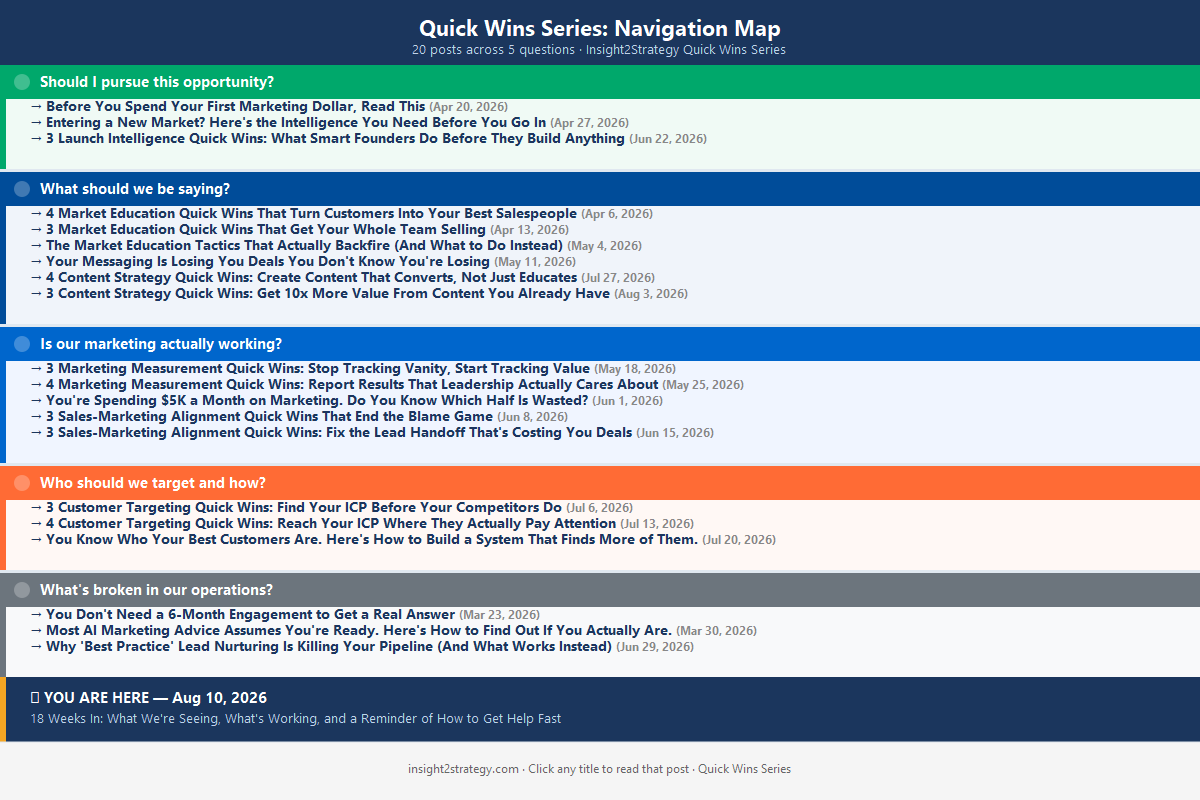
Across reader responses, service inquiries, and diagnostic work, three patterns show up again and again.
"We're doing a lot — but nothing is clearly working."
This is the most common starting point. Teams are running campaigns, publishing content, testing channels — but there's no clear line from activity to revenue. The problem usually isn't the execution. It's that the measurement infrastructure doesn't exist to make that connection visible.
The pressure is real: Gartner's CMO Spend Survey found marketing budgets sitting at roughly 7.7% of company revenue — essentially flat after years of compression. When budgets are constrained and attribution is murky, every dollar starts to feel like a guess. More activity rarely solves this. Knowing which activity is working does.
"We don't know how to explain what we actually do."
This shows up especially in B2B tech companies. The product is complex. The value is real. But translating that into clear, compelling messaging? That's where things break.
The problem is almost always inside-out messaging: teams describe what they've built — features, capabilities, process — rather than what buyers need to hear: outcomes, relief, confidence. Prospects don't disengage because they're uninterested. They disengage because they're confused.
"We're not sure who we should be targeting anymore."
Markets shift. Products evolve. What worked 18 months ago doesn't work now. And many teams are still targeting a version of their customer that no longer exists — same channels, same pitch, same ICP definition from two or three years back.
The pull toward broad targeting ("we serve any growing tech company") is understandable. But broad targeting drives up cost per acquisition and blurs everything downstream: messaging, positioning, sales qualification. Narrowing to the right profile consistently produces better results.
⚡ Quick Implementation Tip
The next time a marketing meeting begins with "we should try X," pause and redirect: What specific question are we trying to answer? Attribution problem? Messaging gap? Targeting drift? Naming the question first — before naming a tactic — consistently produces better outcomes. It takes 60 seconds and changes the entire conversation.
What the Quick Wins Series Has Covered (And What's Still Ahead)
Over the past 18 weeks, we've worked through five clusters:
- Opportunity Evaluation — validating ideas before committing capital
- Customer and Competitor Strategy — ICP validation, competitive positioning
- Messaging and Value Translation — rebuilding messaging from customer language, not internal assumptions
- Marketing Presence and Effectiveness — how buyers actually see you online
- Content Strategy — turning content into a pipeline contributor, not just a visibility metric
The through-line across every cluster: clarity before execution. Doing the right thing first consistently outperforms doing more of the wrong thing faster.
Still ahead: measurement and attribution frameworks, retention and expansion strategy, AI implementation without the hype, and a series synthesis that turns everything we've covered into a prioritization model you can apply directly.
But before we go further, it's worth asking: where are you right now? Because the right next step depends entirely on the question you're trying to answer.
Finding Your Starting Point in the Series
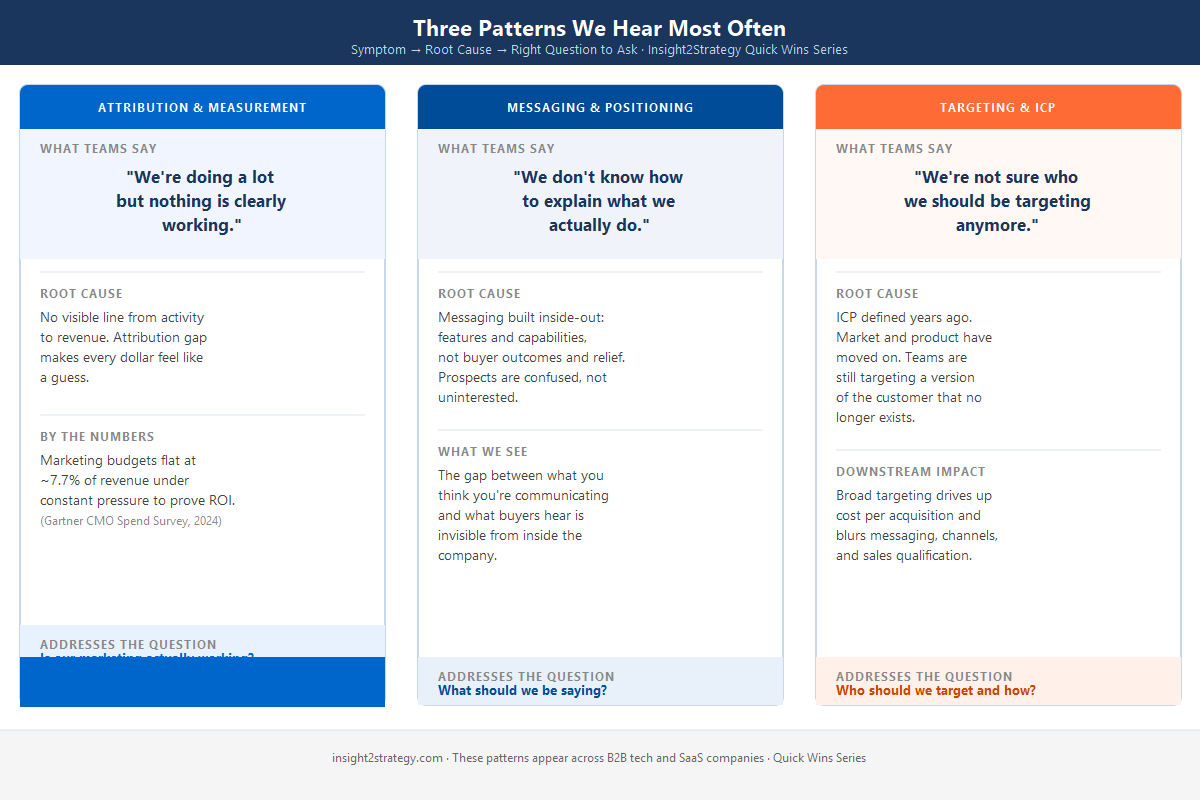
The 20 posts in this series aren't random topics — they're organized around five questions that B2B marketing teams actually ask. Each cluster below has its own set of indicators: symptoms that suggest this is the question you're actually facing.
🌱 Should I pursue this opportunity?
You're here if: You're evaluating a new product, market, or business direction and aren't sure the opportunity is real — or you've committed to something that isn't gaining traction and want honest external clarity before investing further.
- Before You Spend Your First Marketing Dollar, Read This — validating an opportunity before you commit
- Entering a New Market? Here's the Intelligence You Need Before You Go In — market entry intelligence framework
- 3 Launch Intelligence Quick Wins: What Smart Founders Do Before They Build Anything
📣 What should we be saying?
You're here if: Your team struggles to describe what you do in plain language, your messaging hasn't evolved as your product has, or sales keeps hearing "we love it but we're not sure it's for us" — and no one can explain why.
- 4 Market Education Quick Wins That Turn Customers Into Your Best Salespeople
- 3 Market Education Quick Wins That Get Your Whole Team Selling
- The Market Education Tactics That Actually Backfire (And What to Do Instead)
- Your Messaging Is Losing You Deals You Don't Know You're Losing
- 4 Content Strategy Quick Wins: Create Content That Converts, Not Just Educates
- 3 Content Strategy Quick Wins: Get 10x More Value From Content You Already Have
📊 Is our marketing actually working?
You're here if: You're spending on marketing but can't trace it to revenue, leadership keeps asking what marketing is actually producing, or you know campaigns are running but can't say which ones are worth continuing and which should be cut.
- 3 Marketing Measurement Quick Wins: Stop Tracking Vanity, Start Tracking Value
- 4 Marketing Measurement Quick Wins: Report Results That Leadership Actually Cares About
- You're Spending $5K a Month on Marketing. Do You Know Which Half Is Wasted?
- 3 Sales-Marketing Alignment Quick Wins That End the Blame Game
- 3 Sales-Marketing Alignment Quick Wins: Fix the Lead Handoff That's Costing You Deals
🎯 Who should we target and how?
You're here if: Your close rate has dropped without an obvious reason, your pipeline is filling with companies that don't convert, or outreach that used to work no longer does — and your ICP hasn't been revisited in the last 12–18 months.
- 3 Customer Targeting Quick Wins: Find Your ICP Before Your Competitors Do
- 4 Customer Targeting Quick Wins: Reach Your ICP Where They Actually Pay Attention
- You Know Who Your Best Customers Are. Here's How to Build a System That Finds More of Them.
🔬 What's broken in our operations?
You're here if: Churn is quietly increasing, your tech stack has more tools than anyone actively uses, you're being asked about AI implementation and don't know where to realistically start, or your nurture sequences are running but not producing results.
- You Don't Need a 6-Month Engagement to Get a Real Answer — how this series approaches quick diagnostics
- Most AI Marketing Advice Assumes You're Ready. Here's How to Find Out If You Actually Are.
- Why 'Best Practice' Lead Nurturing Is Killing Your Pipeline (And What Works Instead)
What We've Learned From Running These Marketing Diagnostics
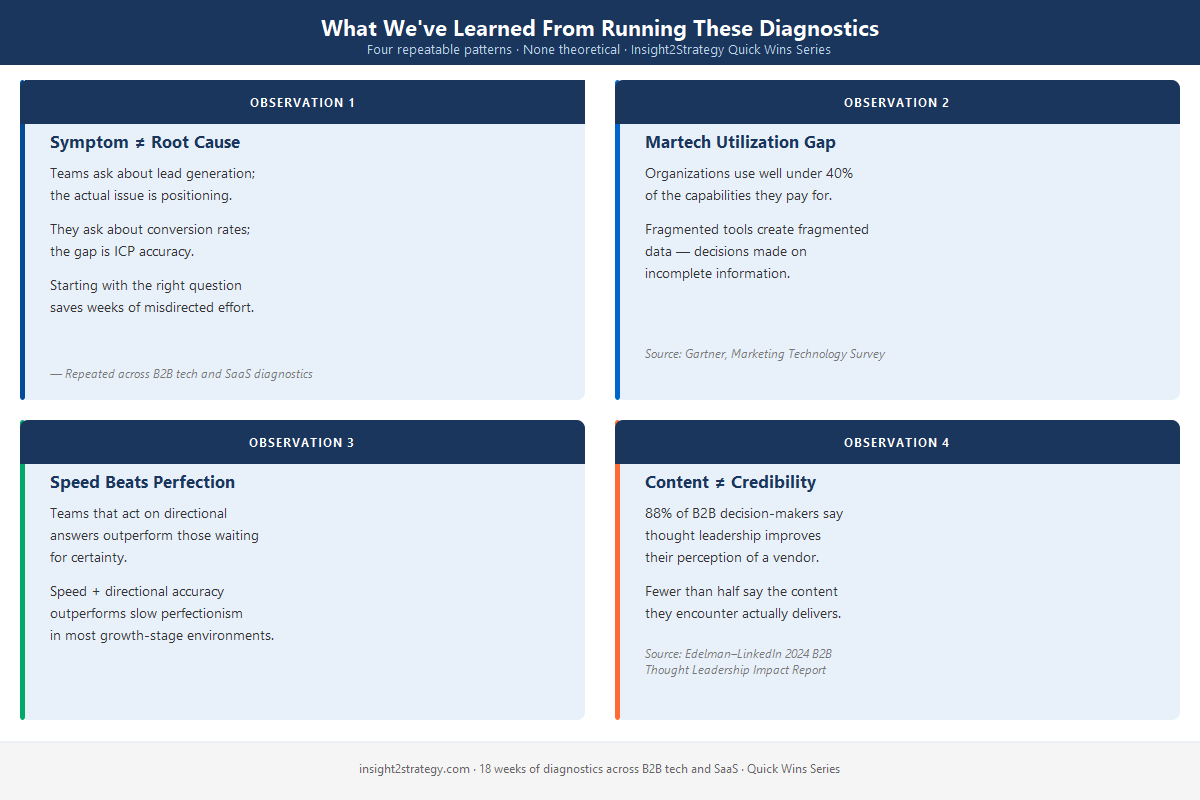
After 18 weeks and dozens of diagnostic engagements, a few patterns stand out. None of them theoretical — all repeated.
The symptom is rarely the real problem. Teams come in asking about lead generation; the actual issue is positioning. They ask about conversion rates; the gap is ICP accuracy. Starting with the right question — rather than the most visible symptom — saves weeks of misdirected effort and budget.
Martech is a significant hidden cost. Gartner's research on marketing technology utilization consistently finds organizations using well under 40% of the capabilities they pay for. Fragmented tools create fragmented data. And fragmented data means allocation decisions made on incomplete information — which compounds quietly into budget waste that's difficult to trace.
Quick decisions compound faster than perfect ones. The organizations that get the most value from diagnostic work aren't the ones that deliberate longest. They get a directional answer, make a call, and adjust from real results. Speed plus directional accuracy consistently outperforms waiting for certainty.
Creating content and building credibility are different problems. The Edelman–LinkedIn 2024 B2B Thought Leadership Impact Report found that 88% of B2B decision-makers say thought leadership improves their perception of a vendor's capabilities — but fewer than half say the content they actually encounter delivers on that expectation. Publishing more doesn't close the gap. Publishing what earns trust does.
If Something Here Sounds Familiar
That's the point.
This post isn't a pitch. It's a map.
If one of the three patterns in the opening section described your current state, the cluster links above are where to go next. Each cluster has multiple posts with actionable frameworks you can work through yourself.
If you'd rather have someone help you assess which question applies to your situation and what to do about it, we can do that:
👉 View services organized by the question you're trying to answer →

|
This post is part of The B2B Marketing Reality Check The strategic framework for growth-stage B2B tech companies — now available in paperback and Kindle. Every topic we cover in this blog goes deeper in the book, with frameworks, diagnostics, and quick wins you can put to work immediately. Get the Free PDF →Want to work through the framework hands-on? Get the companion workbook → |
Frequently Asked Questions
How do I know which marketing problem to fix first?
Start with the question that generates the most internal tension. If budget conversations end with "we don't know what's working," you have an attribution problem. If your pipeline is stalling at the awareness or consideration stage, you likely have a messaging or ICP problem. The five-question framework in this post is designed specifically to help you identify your starting point — and each question points to a different diagnostic.
What's the difference between a Quick Scan and a Deep Analysis?
Quick Scans are designed to deliver a clear directional answer within days — they're for teams that need to make a decision now, not in six weeks. Deep Analysis services go further: they produce implementation-ready outputs, not just diagnosis. The right choice depends on whether you need clarity first or whether you already know the problem and need the full solution architecture.
How quickly can a diagnostic identify the real issue?
For most Quick Scan services, you have a working answer in 5–10 business days. That's enough to redirect a budget conversation, reframe a positioning approach, or put a revised ICP in front of your sales team. The goal is directional accuracy fast enough to act on — not a six-month engagement that delays every decision waiting for certainty.
When should I work with an outside consultant versus handle this internally?
The most common reason to bring in outside perspective: you can't see the gap from inside. Messaging problems are invisible to the people who wrote the messaging. ICP drift is invisible to teams that are still selling. Attribution gaps are invisible until someone maps the full funnel from spend to revenue. If your internal team has been wrestling with the same question for more than a quarter without traction, an outside diagnostic often resolves it in days.
Insight2Strategy — B2B marketing diagnostics for tech companies and growth-stage businesses
Full Service Portfolio | Free Consultation | Contact Us
Part of the Quick Wins Series — actionable B2B marketing strategy, published weekly


Comments
Post a Comment