Entering a New Market? Here's the Intelligence You Need Before You Go In
Entering a New Market? Here's the Intelligence You Need Before You Go In
Strategic Analysis by: Insight2Strategy
Published: April 27, 2026
Executive Reading Time: 6 minutes
Executive Strategic Insights
- ~70% of market expansions fail to hit revenue targets within two years — most commonly from misidentifying the actual buyer and underestimating local competitive dynamics.
- Your existing playbook rarely transfers intact. Same industry, different buying motivations; same company size, different decision authority. The ICP assumption is the #1 expansion risk.
- Five intelligence gaps stall most expansions: buyer profile, competitive terrain, positioning resonance, realistic TAM, and operational risks hidden from home-market experience.
- Good pre-entry analysis produces a decision brief, not a research report — six structured components that drive specific go-to-market choices before budget is committed.
- The sequence is the strategy: intelligence before investment. The 3-business-day brief at $197 vs. $500K–$2M in avoidable expansion costs is a straightforward calculation.
- Framework detailed below. Each failure pattern and intelligence gap is examined with the specific actions that close it.
Expanding into a new market feels like it should be easier the second time. You already have the team, the infrastructure, the brand, and the processes. You've proven you can build something that works. What could possibly go wrong?
Quite a lot, as it turns out. Whatever you've built in your existing market, your presence in a new territory is effectively a startup. A new market has different customers, different competitive dynamics, and different buying triggers — and your existing playbook often doesn't transfer the way you expect it to.
Bain & Company and Harvard Business Review analysis consistently points to the same pattern: roughly 70% of new market expansions by established companies fail to meet their original revenue targets within the first two years — most commonly due to misidentifying the actual buyer and underestimating local competitive dynamics. The good news is that most of these failures are predictable. They follow recognizable patterns. And those patterns can be surfaced before you've committed significant resources to a market you don't yet understand.
Already navigating a market expansion? The Business Launch Intelligence Brief covers competitive landscape, ICP validation, and a 90-day entry roadmap — $197, delivered in 3 business days.
Why Your Existing Playbook Doesn't Transfer
The most confident operators are often the most vulnerable when entering a new market. Confidence is earned — they've built something that works — but that same confidence creates specific blind spots. Three failure patterns show up consistently.
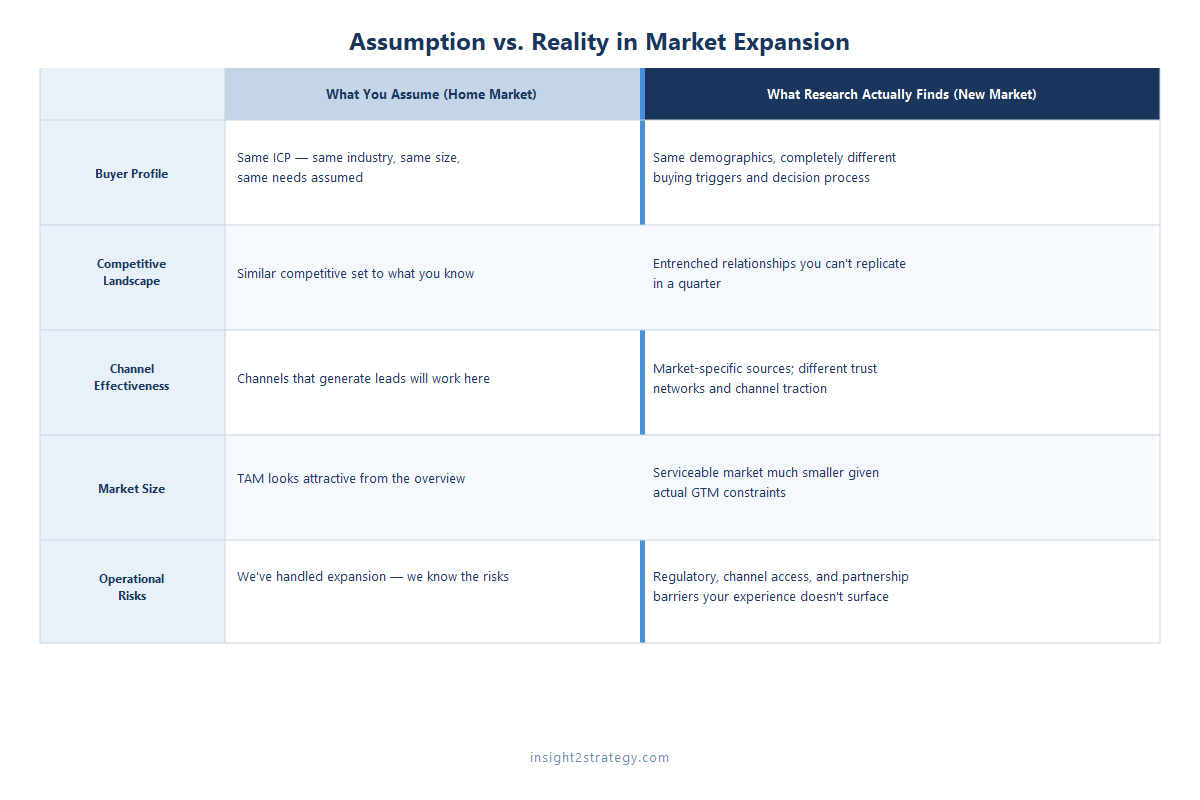
The ICP assumption trap. Your ideal customer profile was built in a market where buyers already know who you are. The demographics in your new market may look identical — same industry, same company size — but the buying motivations are often completely different. A segment that buys for operational efficiency in one market may prioritize risk reduction or regulatory compliance in another. Decision authority might sit with operations in one context and finance in another. When your message is calibrated to the wrong buyer motivation, even a technically superior offer misses.
The entrenched competitor blind spot. In your home market, your brand has history: relationships, reputation, referrals. In a new market, you're the outsider. Meanwhile, incumbents have spent years building customer trust, local partnerships, and channel relationships you can't replicate quickly. The classic example: Walmart's expansion into Germany failed after years of effort and approximately $1 billion in losses — not because of product quality, but because cultural and competitive assumptions from the U.S. market didn't transfer to German retail dynamics. Your existing market dominance doesn't insulate you from this.
The channel mismatch. The go-to-market channels that generate qualified leads in your home market may have zero traction here. Channel effectiveness is market-specific. Trade shows that drive pipeline in one industry are ignored in another. LinkedIn advertising that converts in one geography performs differently in another. Partnerships might matter far more than direct outreach — or the reverse. McKinsey market entry research suggests that companies which conduct formal competitive analysis before entering a market are significantly more likely to achieve breakeven within 18 months than those relying on informal research. The channel strategy is a major reason why.
⚡ Quick Implementation Tip
Before committing to any new market channel strategy, interview 3–5 potential buyers in that specific market. Ask how they currently solve the problem you address, where they look for vendors, and what would make them switch. These conversations take 30 minutes each and routinely invalidate months of assumed channel planning.
The Five Intelligence Gaps That Stall Market Expansions
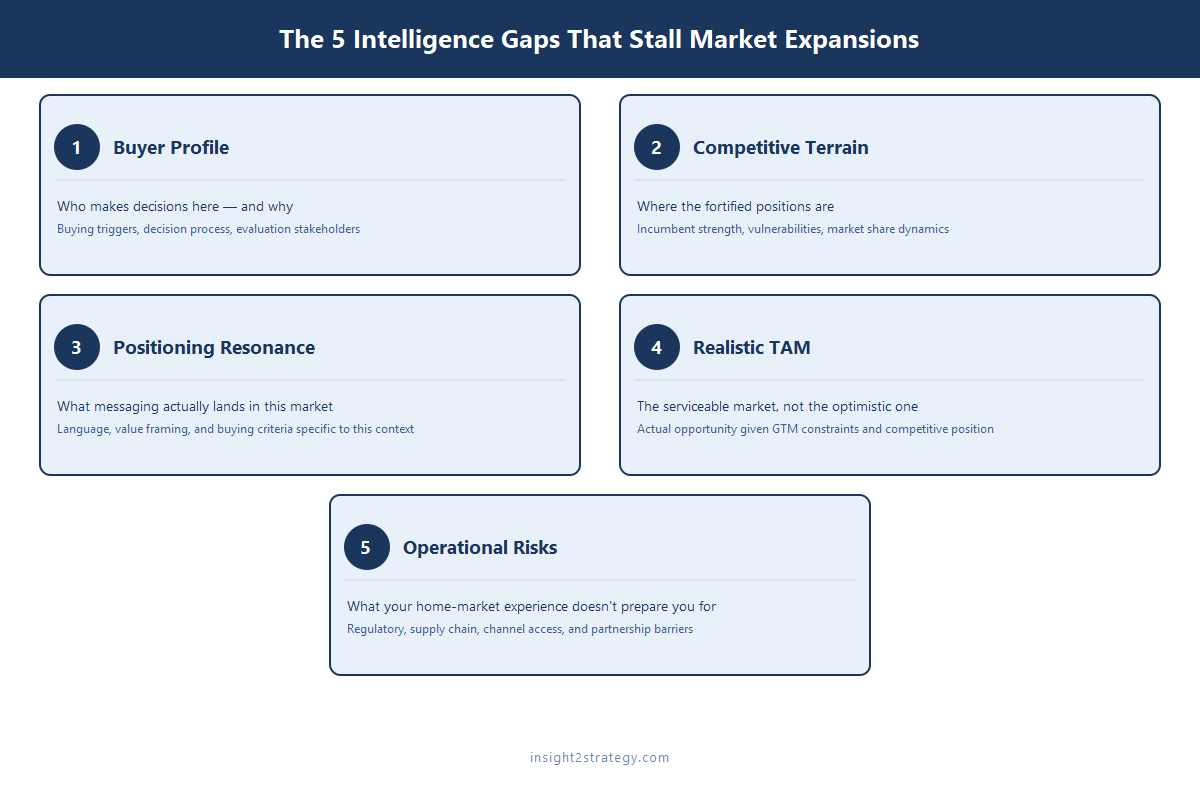
When expansions stall, it's rarely because the company lacks resources or capability. It's because the team committed those resources before the intelligence was clear. Five specific unknowns show up in almost every failed market entry.
1. Who the real buyers are — and how they make decisions. Not assumed from your existing customer base, but validated against the decision-making structure in this specific new context. The role that signs the contract may differ. The triggers that create urgency may differ. The influencers and evaluation stakeholders may be entirely different. Without validating this, marketing messages and sales outreach often miss the real buyer entirely.
2. What the competitive terrain looks like. Not just a list of players, but where they're strong, where they're vulnerable, and where you'd be walking into a fortified position. Entering against a dominant incumbent with deep customer relationships requires a fundamentally different positioning strategy than entering a fragmented market where buyers are actively searching for alternatives.
3. What positioning actually resonates here. Gartner's B2B buying journey research shows that buyers complete an average of 57% of their purchase decision process before engaging with a vendor [Gartner, 2024]. In a new market where your brand has no recognition, your content and positioning are doing all the pre-decision work — and they need to be calibrated to this market's specific language, concerns, and buying triggers. The message that converts in your home market may not even get read here.
4. What the realistic addressable market is. Not the total theoretical market that makes the expansion look attractive in a board presentation — but the serviceable market given your actual go-to-market constraints, competitive position, and realistic implementation timeline. The difference between TAM and SAM can be substantial, and confusing them drives over-investment in the wrong segments.
5. What operational risks your home-market experience doesn't surface. Regulatory differences, channel access barriers, supply chain dependencies, and partnership requirements that look manageable in a slide deck often become genuine execution blockers once you're operating in the new market. Gartner CMO Survey data suggests that only a fraction of companies entering new markets conduct structured customer research before committing significant resources — which explains why so many expansions become expensive learning experiences rather than planned entries.
📊 Implementation Framework
The six-part intelligence brief structure — market sizing with segmentation, competitive landscape analysis, ICP validation, go-to-market channel recommendations, risk assessment, and 90-day entry roadmap — closes all five gaps before you commit resources. Need help adapting this framework to your specific expansion scenario? Let's discuss your implementation approach.
What Good Market Entry Intelligence Looks Like
A rigorous pre-entry analysis doesn't produce a research report. It produces a decision brief — a structured document built from the new market's actual data, designed to drive specific go-to-market decisions.
The six-part structure: market sizing with segmentation (the realistic numbers, not the theoretical ones), competitive landscape analysis with specific positioning gaps, ICP validation against new-market data, go-to-market channel recommendations calibrated to how buyers in this market actually make decisions, risk assessment with concrete mitigation paths, and a 90-day entry roadmap with sequenced actions.
Intuition scales operations. Intelligence scales markets. The brief isn't a reason to hesitate before entering — it's precisely what allows you to move faster, with a clear view of where to focus, where to avoid, and what assumptions to pressure-test before they cost you.
The Right Sequence: Intelligence Before Investment
Most expansion attempts don't fail because companies lack execution capability. They fail because companies start investing before the intelligence is clear. The sequence matters.
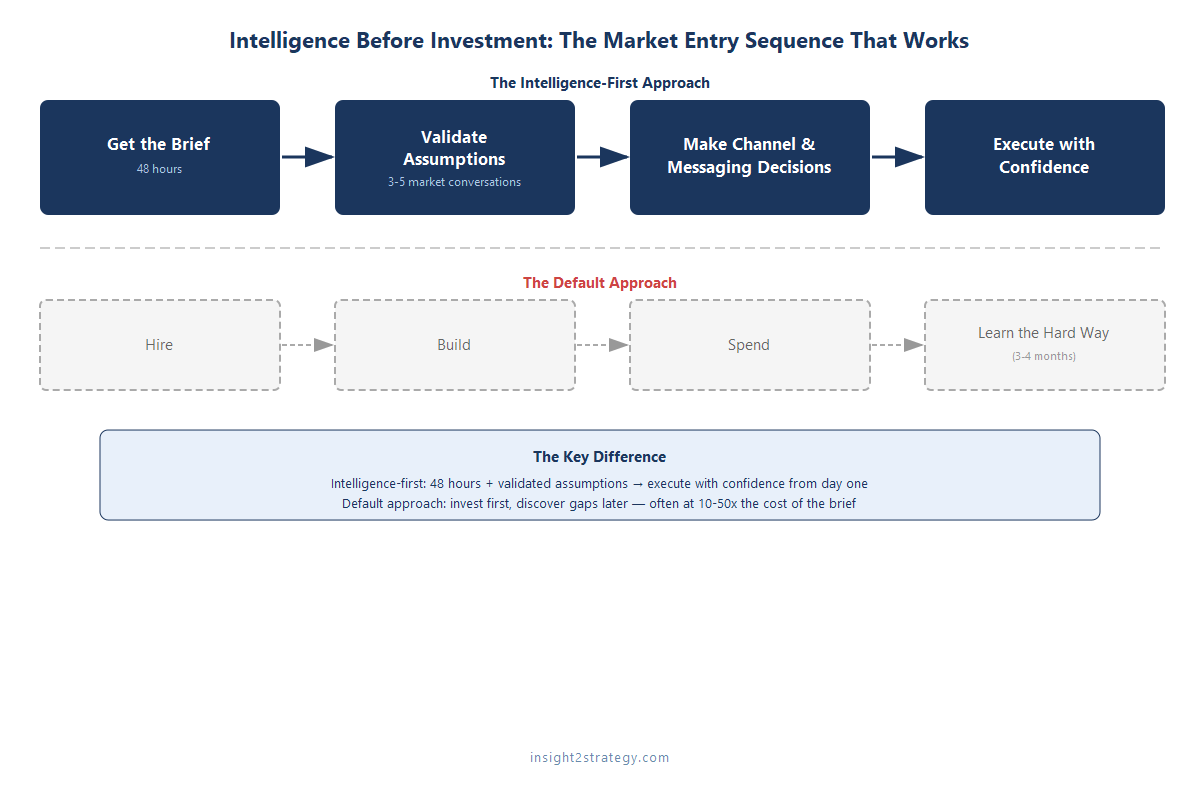
The expensive default approach:
Hire the market-specific sales rep → commit to the conference booth → build market-specific landing pages → launch paid acquisition → spend 3–4 months learning the hard way → revise strategy
The intelligence-first approach:
Get the brief (3 business days) → validate the key assumptions with 3–5 conversations with potential buyers in the new market → make channel and messaging decisions based on what you learned → execute with clear priorities and minimal wasted motion
KPMG advisory findings suggest that market expansion failures cost established businesses an average of $500,000 to $2 million in direct spend before they recognize the entry strategy needs fundamental revision. The 3-business-day brief costs $197. The math is straightforward.
⚡ Quick Implementation Tip
Run the intelligence-first sequence in the 30 days before your first market-specific investment. Specifically: get the brief in week 1, schedule 3–5 market conversations in weeks 2–3, finalize channel and messaging decisions in week 4. By the time you hire, commit to conferences, or launch paid acquisition, every decision is grounded in what this market actually needs — not what worked somewhere else.
How This Differs From the Pre-Launch Brief
If you're a first-time founder launching a new business concept, that scenario is covered in the previous post in this series. This post addresses a distinct but equally common situation: an established operator expanding into an adjacent market, a new product category, or a different geography.
The underlying intelligence framework is the same six-part structure in both cases. But the inputs and emphasis differ in important ways. Expansion scenarios come with more existing brand equity to leverage — but also more existing assumptions to actively unlearn. The operators who struggle most in new markets are rarely the ones who lack capability. They're the ones who assume their track record in the existing market means they don't need to validate assumptions in the new one.
It doesn't. Every market earns its own education.
Before You Commit Budget, Spend 48 Hours Getting Clear
As Q2 gets underway, expansion decisions that were hypothetical earlier in the year start turning into real budget commitments. Before you make that move: get the brief.
The Business Launch Intelligence Brief covers competitive landscape, ICP validation, go-to-market strategy, and a 90-day launch roadmap — calibrated to your specific expansion scenario. $197, delivered in 3 business days.
If you're already operating in the new market and need more targeted diagnostics, the ICP Validation Sprint and Competitive Intelligence Snapshot address specific intelligence gaps without the full brief structure.
Either way: the intelligence work belongs before the investment, not after.
Get your Business Launch Intelligence Brief →
Ready to Implement These Market Entry Strategies?
Every expansion scenario is unique. Let's discuss how these frameworks apply to your specific market, competitive landscape, and go-to-market constraints.
No sales pitch. Just strategic insights tailored to your specific expansion scenario.

|
This post is part of The B2B Marketing Reality Check The strategic framework for growth-stage B2B tech companies — now available in paperback and Kindle. Every topic we cover in this blog goes deeper in the book, with frameworks, diagnostics, and quick wins you can put to work immediately. Get the Free PDF →Want to work through the framework hands-on? Get the companion workbook → |
Frequently Asked Questions
Why do most market expansions fail to meet revenue targets?
The most consistent pattern is informational, not operational. Teams assume their existing ICP, messaging, and channels transfer to the new market. They often don't. Same industry, different buying motivations. Same company size, different decision authority. The 70% failure rate largely traces back to these ICP and competitive assumptions — not to execution capability. Teams that validate assumptions before committing resources consistently outperform those that discover the gaps after investment.
Why doesn't my existing ICP transfer to a new market?
Your ICP was built in a market where buyers already know your brand, your category, and your competitors. That baseline shapes everything: how they evaluate options, what triggers their urgency, who holds decision authority. In a new market, those assumptions don't hold. A buyer segment that purchases for operational efficiency in one context may prioritize risk reduction or regulatory compliance in another — same company size, fundamentally different motivation. The message built for one motivation misses the other, even when the demographic profile looks identical.
What research do I need before entering a new market?
A rigorous pre-entry brief covers six areas: realistic market sizing with segment-level breakdown (not theoretical TAM), competitive landscape with specific positioning gaps, ICP validation against new-market data, go-to-market channel recommendations based on how this market's buyers actually make decisions, risk assessment with concrete mitigation paths, and a 90-day entry roadmap with sequenced actions. Each component drives a specific category of go-to-market decision. The brief produces answers, not observations.
Is the market entry brief different for expansion vs. a new startup?
The underlying six-part framework is the same. The inputs and emphasis differ. Expansion scenarios carry existing brand equity — which is an asset — but also carry existing assumptions that need to be actively pressure-tested. First-time launches have no assumptions to unlearn, but also no existing customer data to leverage as a starting point. The expansion scenario is, in some ways, harder: operators with strong home-market track records are the most likely to underestimate how much the new market differs.
How long does a market entry analysis take?
The Business Launch Intelligence Brief is delivered in 3 business days. That covers the full six-part structure: competitive landscape, ICP validation, go-to-market strategy, and 90-day roadmap — calibrated to your specific expansion scenario. For operators already in-market who need targeted diagnostics, the ICP Validation Sprint and Competitive Intelligence Snapshot address specific gaps in a similar timeframe. Either way, the intelligence work is done before the investment is committed, not after.
How do we measure ROI on market entry intelligence?
The clearest comparison: KPMG advisory data suggests expansion failures cost established businesses $500,000 to $2 million in direct spend before the entry strategy is fundamentally revised. The brief costs $197 and takes 3 business days. But the ROI framing also works positively — operators with validated intelligence move faster (no mid-course pivots), waste less (channels and messaging are right from launch), and reach breakeven sooner. Formal competitive analysis before market entry is correlated with significantly higher breakeven achievement within 18 months, per McKinsey market entry research.
Insight2Strategy
Strategic intelligence for operators who move with conviction.
Business Launch Intelligence Brief | Free Strategy Consultation
© 2026 Insight2Strategy. All rights reserved.


Comments
Post a Comment