4 Market Education Quick Wins That Turn Customers Into Your Best Salespeople
4 Market Education Quick Wins That Turn Customers Into Your Best Salespeople
Strategic Analysis by: Insight2Strategy
Published: April 6, 2026
Executive Reading Time: 6 minutes
Executive Strategic Insights
- Increasing customer retention by just 5% can increase profits by 25–95% (Bain & Company) — this is a growth strategy, not a support task
- Post-purchase education operates on three dimensions simultaneously: retention, referral quality, and competitive differentiation
- Most businesses stop educating customers the moment the contract is signed — creating a leaky bucket that no acquisition budget can fix
- Four practical assets, 8–12 total implementation hours, with compounding ROI that begins immediately
- The four quick wins below address each failure point in the customer advocacy chain: clarity, vocabulary, recognition, and credibility
- Framework detailed below — each win can be implemented independently this week
Your best salespeople aren't on your payroll.
They're the customers who already love you — if you've given them enough education, confidence, and context to talk about you accurately.
Most growing businesses obsess over acquisition: more leads, more demos, more pipeline. But here's the structural reality most ignore: according to Bain & Company research, increasing customer retention by just 5% can increase profits by 25% to 95%. That's not a marketing tweak. That's a growth strategy hiding in plain sight.
And yet most businesses stop educating customers the moment the contract is signed. The result is predictable — a leaky bucket problem that no acquisition budget can fix. You win new customers faster than you can retain them. Referrals arrive poorly worded and don't convert. Advocates want to send business your way but aren't quite sure how to position you.
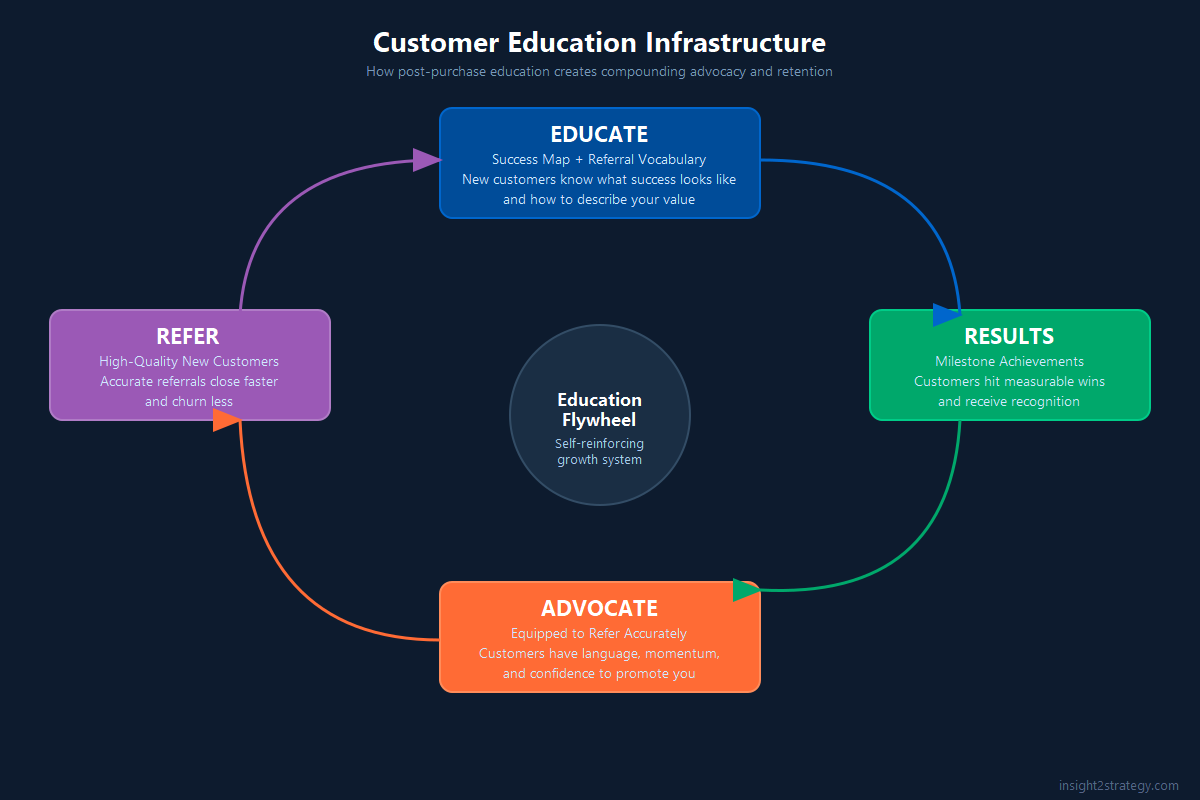
Post-purchase customer education isn't a support function. It's a strategic infrastructure decision — one that operates on three dimensions simultaneously: retention, referral quality, and competitive differentiation.
The four quick wins below can be implemented this week. Each takes hours to build. Each compounds for quarters.
Why This Is a Strategy Decision, Not a Support Task
Before we get tactical, let's ground this in data that should shift your budget perspective.
McKinsey research shows that companies that excel at post-purchase customer nurturing achieve 10–15% sales uplifts while reducing service costs by 20–30%. Forrester research confirms that organizations that prioritize customer experience generate 5.7x more revenue than competitors that lag.
Translation: your existing customers aren't just a retention metric — they're an acquisition channel waiting to be activated. When customers understand exactly what success looks like, have the language to describe your value, and receive deliberate recognition at peak satisfaction moments, they become a self-reinforcing growth engine.
The four wins below address each failure point in that chain.
Quick Win 1: Build a "First 30 Days" Success Map
The Problem
New customers don't churn because your product is bad. They churn because ambiguity is uncomfortable.
The first 30 days are the highest-stakes period in any customer relationship. Without a clear definition of success, customers create their own — and it's rarely aligned with what your product actually delivers. They default to doubt. Confusion compounds. And they churn before ever experiencing the outcome you promised.
The distinction that matters here: most onboarding focuses on features. Effective post-purchase education maps business outcomes. "Set up your account" is a feature milestone. "Confirmed your first measurable win" is an outcome milestone. Customers track outcomes; they endure features.
The Solution
Create a one-page visual or four-part email sequence that walks new customers through exactly what success looks like in their first month — not by feature checklist, but by business outcome milestones.
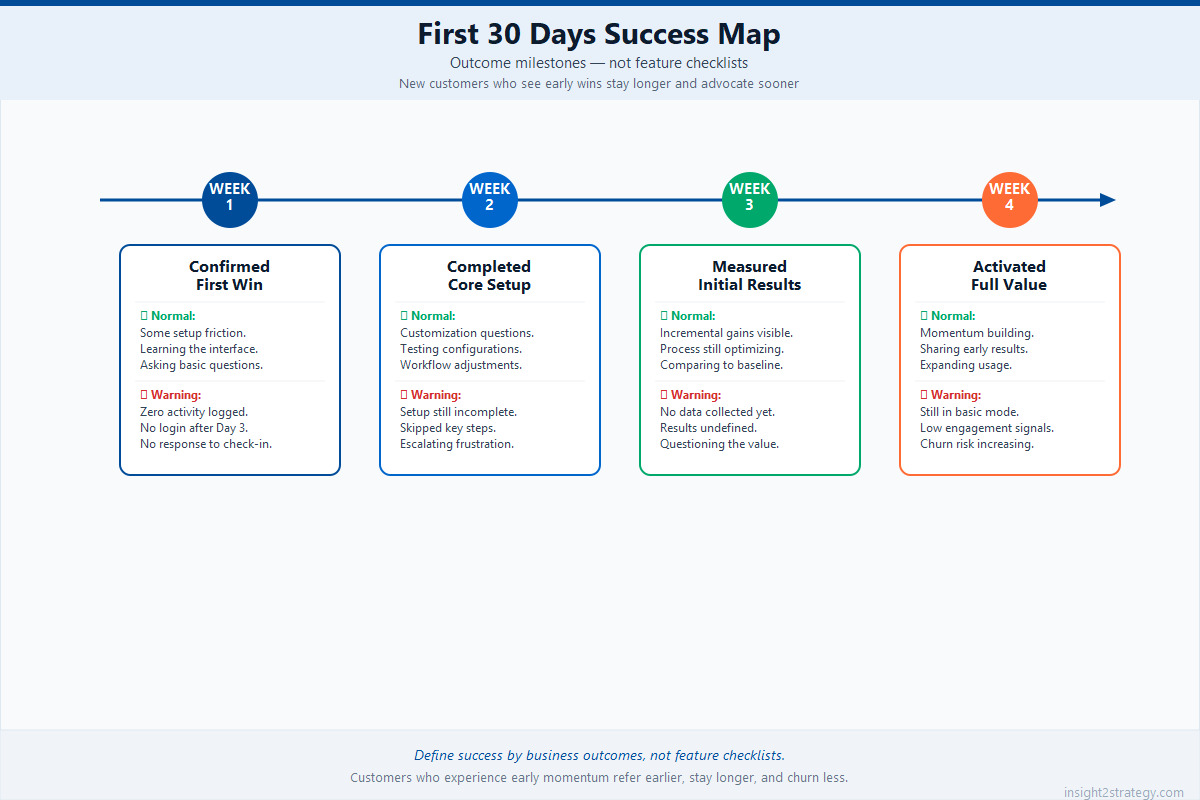
The map should answer clearly:
- What does success look like at Day 7, Day 14, Day 30?
- What is normal friction — and what are actual warning signs?
- Who do I contact if something feels off?
This is not documentation. It's a narrative roadmap.
Implementation: 1 Afternoon
- Identify 3–5 early indicators that predict long-term customer success in your business.
- Map each to a 30-day timeline with specific, observable outcome definitions.
- Write one short, direct email per milestone — acknowledging progress and previewing the next checkpoint.
- Automate delivery to every new customer immediately at purchase.
Impact
Faster time-to-value. Reduced early churn. Customers who know what good looks like relax — and when they relax, they advocate. According to McKinsey, improving the customer journey can increase satisfaction by 20%, lift revenue by up to 15%, and lower cost-to-serve by as much as 20%. The first 30 days are the highest-leverage part of that journey.
⚡ Quick Implementation Tip
Start with your most recent five churned customers. Review their support tickets and onboarding emails to identify where the uncertainty peaked. That's where your Success Map needs the most specificity — not just a general milestone, but a named outcome that would have answered the exact question they were silently asking.
Quick Win 2: Create a "What to Tell Your Colleagues" Kit
The Problem
Your customers are already referring you. Just poorly.
They describe features ("it's a project management tool") instead of outcomes ("it saves our team 12 hours a week and eliminated our invoice disputes"). They oversimplify results. They answer objections inaccurately. Or they don't bring you up at all — because they're unsure how to explain what you do.
Advocacy requires language. And most businesses never provide it.
According to Nielsen, 88% of consumers trust recommendations from people they know more than any other form of advertising. That's an enormous reservoir of latent credibility — most of which evaporates because your customers lack the precise vocabulary to deploy it effectively.
The Solution
Build a one-page referral kit that gives customers the exact language to describe your value accurately to peers. This is not a sales deck. Not marketing collateral. A translation layer between your product's reality and their colleagues' skepticism.
Include:
- A plain-English, one-paragraph description of what you do and the primary outcome customers achieve
- The top 3 measurable results (with realistic ranges, not promises)
- Answers to the 3 most common objections their colleagues will raise
Example plain-English description (adapt for your business):
"We use [Product/Service] to [primary outcome]. It's not about doing more [activity]; it's about doing the right things that actually drive [result]."
Implementation: 2 Hours
- Interview 3–5 satisfied customers: "How do you describe us to someone who hasn't heard of us?"
- Identify the gaps between their language and what you know to be compelling and accurate.
- Write a standardized version that's precise, outcome-focused, and objection-aware.
- Share proactively at renewal milestones or after documented customer wins.
Impact
Higher referral quality. Faster prospect-to-close cycles. Referrals that arrive with accurate expectations close at higher rates and churn at lower ones. When customers have the right vocabulary, word-of-mouth becomes word-of-mouth at scale.
📊 Implementation Framework
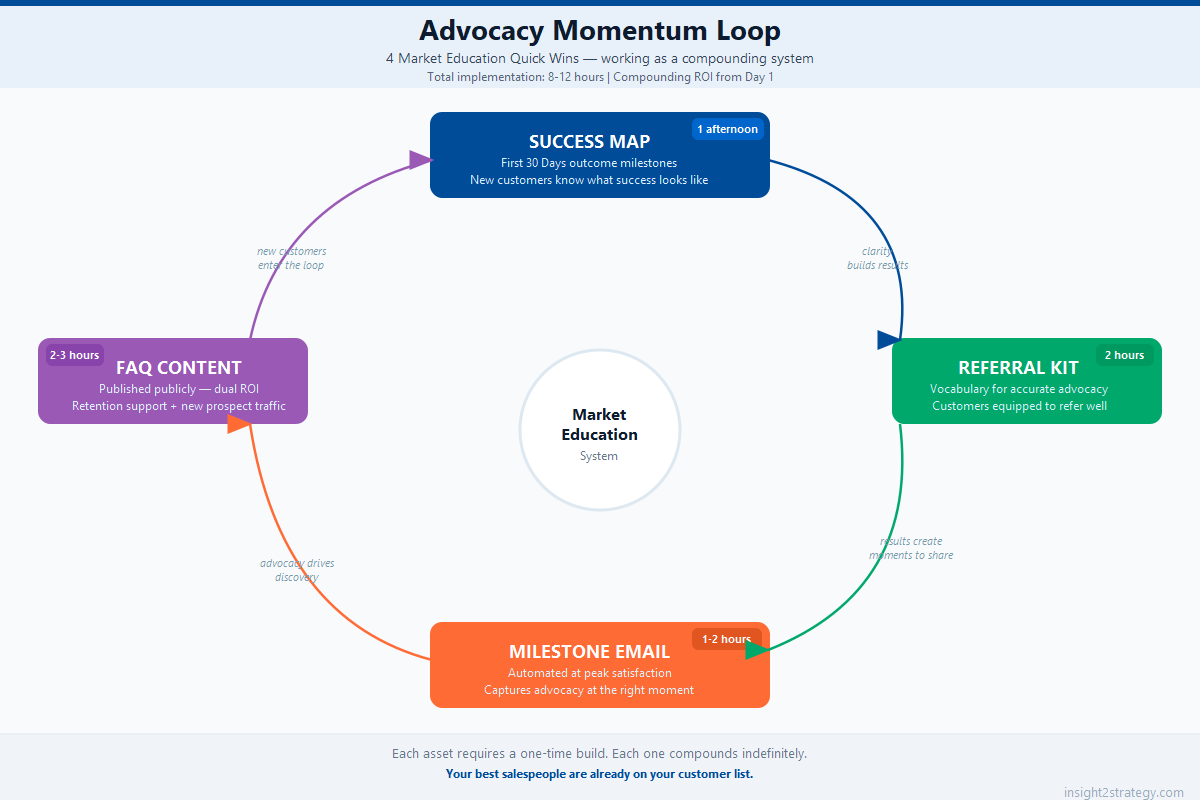
The four quick wins below form a compounding system, not an isolated checklist. The Success Map creates customers who experience clear results. The Referral Kit gives them the language to share those results. The Milestone Email captures advocacy at the moment of peak satisfaction. The FAQ content amplifies that credibility with future customers. Each win reinforces the others. Need help identifying which of these failure points is most acute in your business? Let's discuss your situation.
Quick Win 3: Build a Results Milestone Email
The Problem
You are systematically missing your highest-probability advocacy moments.
Your customers are achieving meaningful results — cost savings, time recovered, conversion gains — and no one in your organization is acknowledging the occasion. Peak satisfaction passes unrecognized. The moment when a customer would most enthusiastically recommend you dissolves into routine follow-up or silence.
Unrecognized progress fades. Recognized progress compounds.
The Solution
Automate a triggered email that fires when a customer hits a meaningful milestone. The goal is deliberate: acknowledge the achievement, quantify it if possible, and make the advocacy action frictionless enough they'll take it in the next 60 seconds.
The email should:
- Name the achievement specifically ("You just saved 200 hours since go-live")
- Connect the milestone to the business outcome that matters to them
- Reinforce the next milestone on the horizon
- Offer a single, low-commitment share action: a tweet, a testimonial link, a referral prompt
Sample email template:
"Congratulations — you just hit [Milestone]. In concrete terms, that means [quantified outcome]. You're ahead of where most [role/industry] customers are at this stage.
Next milestone to watch for: [Next milestone].
If you'd like to share this win with your team, [share button/link]."
Implementation: 1–2 Hours (with automation in place)
- Define one measurable milestone that reliably signals customer success in your business.
- Build the trigger in your CRM or email platform.
- Draft a concise, celebratory email — peer-to-peer tone, not a corporate announcement.
- Attach one frictionless share action.
Impact
Advocacy captured at the peak of emotional alignment. Gartner research confirms that emotionally connected customers are more than twice as valuable as highly satisfied — but disengaged — customers in terms of revenue contribution. The milestone email is a designed intervention at the moment of highest advocacy probability.
⚡ Quick Implementation Tip
If you don't yet have behavioral triggers in your CRM, start with a time-based proxy: send this email 30 days after purchase to every active customer. It won't be perfectly targeted, but it will be infinitely better than no milestone recognition at all. Refine the trigger once you've validated the message works.
Quick Win 4: Create a Customer FAQ That Doubles as Sales Content
The Problem
Your post-purchase support questions are hiding a lead generation asset.
The questions your customers ask in their first 90 days — "Is this normal? How do I measure ROI? How does this compare to the alternative I almost chose?" — are the exact phrases their future counterparts are entering into search engines right now.
You are answering these questions privately via support tickets when you could be answering them publicly as indexed, revenue-generating content. According to Forrester, 70% of the B2B buyer's journey is complete before a prospect reaches out to sales. That self-directed research phase is where your knowledge base either earns credibility — or doesn't show up at all.
The Solution
Treat your post-purchase knowledge base as your most valuable SEO and pre-sale content. Document the 10 questions your customers ask most frequently in their first 90 days. Answer them clearly, strategically, and in plain English. Publish them where search engines can index them.
The key distinction: don't just explain the buttons to push. Explain the reasoning behind the approach. Strategic FAQs earn credibility. Feature documentation earns bookmarks.
Implementation: 2–3 Hours
- Pull 90 days of support tickets and categorize recurring themes.
- Focus on "how do I make this work for my specific goal?" queries — strategic questions, not just operational ones.
- Write clear, direct answers with strategic context, not just operational instructions.
- Publish as publicly indexed content: blog posts, a knowledge base, or a searchable FAQ section.
- Cross-link from your sales sequence for prospect education before the first call.
Impact
Dual ROI: reduced support volume for existing customers, and organic search traffic from high-intent prospects researching the exact questions your customers ask. Your post-purchase knowledge base becomes simultaneously a retention asset and a top-of-funnel tool that compounds indefinitely at near-zero marginal cost. Post-purchase customer success content and pre-sale education become the same asset.
The Problem These Four Wins Can't Fix
If customers aren't advancing through milestones…
If they're churning before Week 4 arrives…
If they never hit measurable results to celebrate…
The issue may not be messaging. It may be something upstream: misaligned expectations set during the sales process, onboarding gaps, product-market fit issues with specific customer segments, or early behavioral signals in your customer data that no one is tracking.
Early churn indicators show up in customer data weeks before they register in your pipeline. Usage drop-offs, engagement gaps, incomplete activation sequences — these are warning signals that a well-crafted email sequence cannot address alone.
If customers aren't referring — or aren't sticking around long enough to refer — the problem often shows up in customer data before it appears in your pipeline. Our Retention Audit Express surfaces early churn signals and expansion opportunities in 2–3 business days: the stable foundation that makes market education compound rather than evaporate.
Ready to Implement These Customer Education Strategies?
Every business situation is unique. Let's discuss how these frameworks apply to your specific retention, referral, and customer success challenges — and where your highest-leverage opportunity is right now.
No sales pitch. Just strategic insights tailored to your business.
The Strategic Case for Starting Now
Customer advocacy isn't a loyalty program. It's the byproduct of clarity, momentum, and confidence — delivered deliberately at the right moments.
Four assets. Eight to twelve total hours of implementation. Here's what you get:
- Build the Success Map → A reusable retention asset that reduces early churn
- Build the Referral Kit → A scalable advocacy system that works without your involvement
- Build the Milestone Email → A designed advocacy trigger at peak satisfaction
- Build the FAQ → A content asset that generates leads and reduces support costs indefinitely
Do those four things, and your best salespeople won't need commissions. They'll already be on your customer list.
As we move through Q2 2026, the businesses that will differentiate themselves aren't spending more on acquisition — they're compounding the value of the customers they've already earned.
|
This post is part of The B2B Marketing Reality Check The strategic framework for growth-stage B2B tech companies — now available in paperback and Kindle. Every topic we cover in this blog goes deeper in the book, with frameworks, diagnostics, and quick wins you can put to work immediately. Get the Free PDF →Want to work through the framework hands-on? Get the companion workbook → |
Frequently Asked Questions
What is customer education strategy and why does it matter for growing businesses?
Customer education strategy is the deliberate design of post-purchase content, communications, and resources that help customers achieve measurable results — and understand how to articulate those results to others. For growing businesses, it matters because retention is structurally more efficient than acquisition (Bain research shows 5% retention improvement can yield 25–95% profit increases), and because educated customers become higher-quality referral sources. Most businesses treat customer education as a support function; high-growth companies treat it as a strategic infrastructure investment that compounds over time.
What should a "First 30 Days" success map include for new customers?
An effective First 30 Days success map should define outcome milestones — not feature checklists — across the first four weeks: what a successful outcome looks like at Day 7, Day 14, Day 21, and Day 30; what represents normal friction vs. an actual warning sign worth escalating; and who to contact at each stage if something feels off. The critical distinction is framing everything in terms of business results the customer cares about, not features your product offers. A well-designed success map reduces early-stage ambiguity, which is the primary driver of first-90-day churn.
How do I help customers refer me more effectively?
The most reliable way to improve referral quality is to provide customers with the exact vocabulary they need to describe your value to peers. This means: a one-paragraph plain-English description of what you do and the primary outcome customers achieve; three measurable results with realistic ranges (not overpromises); and prepared answers to the three most common objections their colleagues will raise. Most referrals fail not because customers are unwilling to refer — they fail because customers are improvising with language that doesn't land. The referral kit removes the improvisation and gives customers a prepared, accurate script.
How do I set up automated milestone emails for customers?
Start by identifying one measurable milestone that reliably signals customer success in your business — a usage threshold, a quantified result, or a product adoption indicator. Build a triggered email in your CRM or email automation platform that fires when a customer hits that milestone. The email should acknowledge the specific achievement, quantify the win if possible, reference the next milestone ahead, and offer one frictionless share action (a testimonial link, a referral prompt, or a social share). If you don't yet have behavioral triggers configured, start with a time-based proxy — 30 days post-purchase — and refine the trigger once you've validated the message. Gartner research shows emotionally connected customers generate 2x+ the revenue contribution of satisfied-but-disengaged customers, making this the highest-leverage automation in your customer success stack.
How do I create a customer FAQ that also helps with SEO and lead generation?
The key is to answer strategic questions publicly, not just operational ones. Pull 90 days of support tickets and identify the questions that start with "What's the best way to..." or "How should I approach..." or "How does this compare to..." — these are the strategic questions that your existing customers ask, and your future customers are Googling. Write clear, direct answers with strategic context (not just button-click instructions), and publish them as publicly indexed content: a blog post series, a knowledge base, or a searchable FAQ section on your website. Forrester research shows 70% of the B2B buyer journey is self-directed before sales contact — strategic FAQ content positions you as a credible resource during that research phase, simultaneously reducing support volume for current customers and generating organic traffic from high-intent prospects.
Verified Statistics & Citations
| Claim | Source | Year | Status |
|---|---|---|---|
| 5% retention increase = 25–95% profit increase | Bain & Company / Harvard Business Review | 2014 (foundational) | ✓ Verified |
| CX leaders generate 5.7x more revenue than CX laggards | Forrester Research | 2020 | ✓ Verified |
| Companies excelling at customer nurturing see 10–15% sales uplift and 20–30% service cost reduction | McKinsey & Company | Multiple studies | ✓ Verified |
| 88% of consumers trust recommendations from people they know over any other advertising | Nielsen Global Trust in Advertising | 2023 | ✓ Verified |
| Emotionally connected customers are 2x+ more valuable than highly satisfied customers | Gartner | Published research | ✓ Verified |
| 70% of B2B buyer journey is complete before prospect contacts sales | Forrester Research | Multiple publications | ✓ Verified |
Insight2Strategy
Strategic consulting for growing businesses | insight2strategy.com
Part of the Quick Wins Series — practical strategies that deliver compounding ROI


Comments
Post a Comment