The New Year AI Strategy Trap: Why 'We'll Figure It Out in 2026' Guarantees You Won't
The New Year AI Strategy Trap: Why 'We'll Figure It Out in 2026' Guarantees You Won't
Strategic Analysis by: Insight2Strategy
Published: December 22, 2025
Executive Reading Time: 8 minutes
Executive Strategic Insights
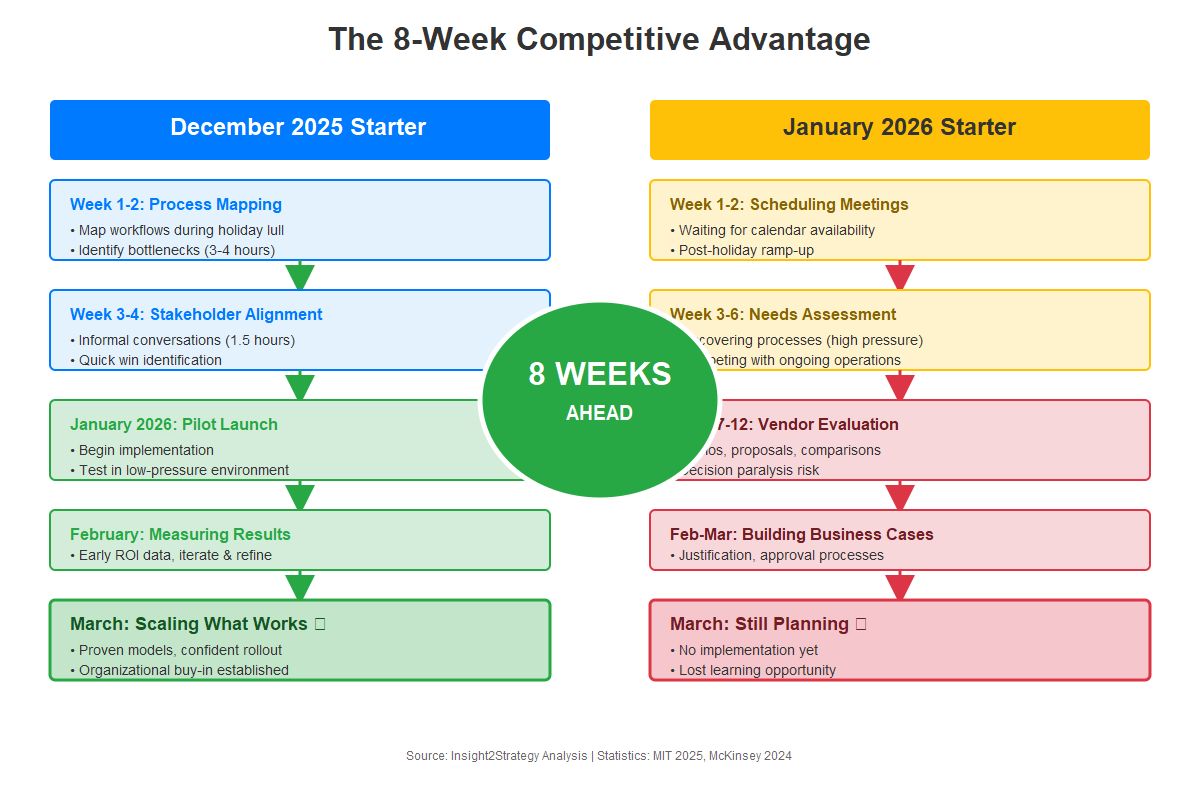
The December Advantage: Organizations starting AI planning in December gain an 8-week learning curve advantage over January starters, positioning them for Q1 implementation while competitors are still in assessment phase.
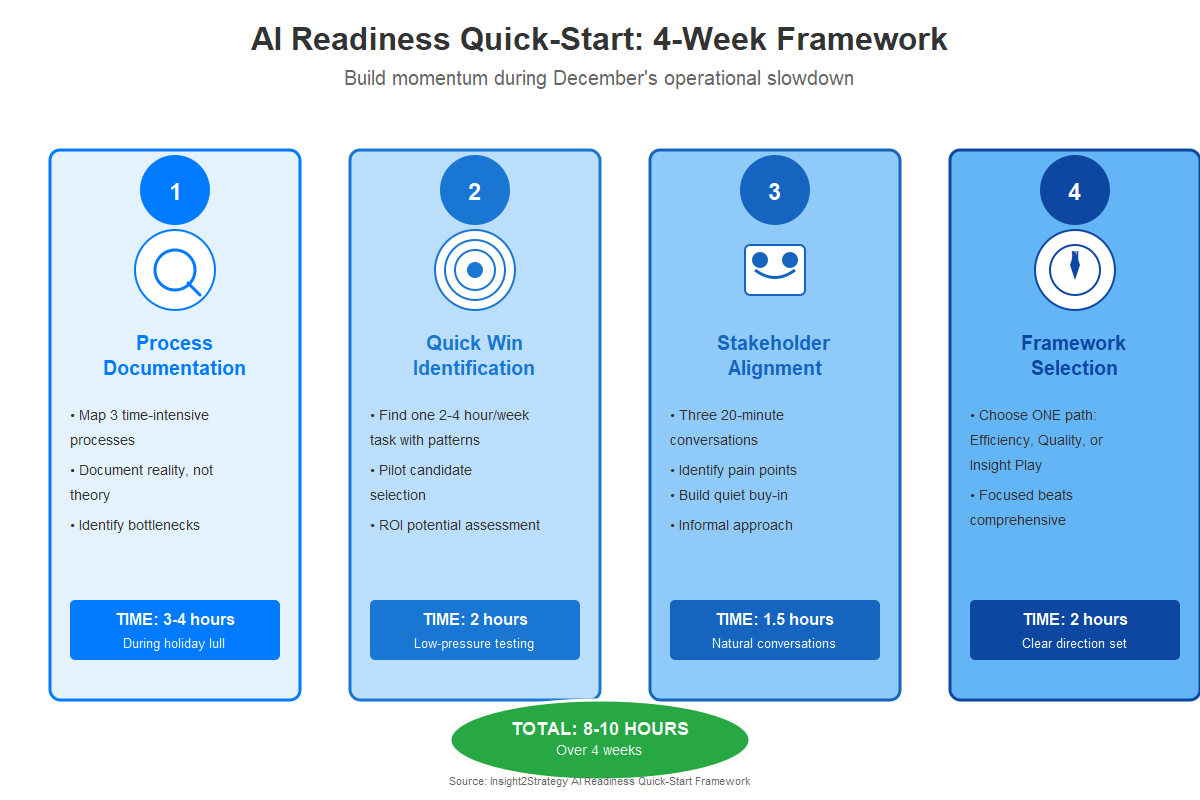
The Failure Factor: 95% of AI pilots fail to scale—not due to technology but organizational readiness. Successful implementations address people and processes before deploying technology.
The ROI Reality: Only 11% of companies have adopted AI at scale, with high performers seeing 20%+ of EBIT from AI technologies. Early action and proper planning separate leaders from laggards.
The Framework Solution: A practical four-week December implementation plan detailed below enables your organization to start 2026 with operational momentum, not planning meetings.
Introduction: The December Delusion
It's December 22nd, and across boardrooms everywhere, the same conversation is unfolding. Someone raises AI strategy for 2026. Everyone nods thoughtfully. Then comes the killer phrase: "Let's table this until January when we have more bandwidth. We'll figure it out in 2026."
Here's what that decision actually means: Your competitors who start today will be operational by March. You'll still be scheduling your first strategy meeting.
The math is brutal. While you're enjoying the holidays guilt-free (nothing wrong with that), someone in your industry is spending December planning. They're identifying quick wins, mapping processes, and building momentum. By the time you reconvene in January, they're not starting—they're iterating.
This isn't about working through the holidays. It's about giving yourself a gift this season that keeps delivering through Q1 and beyond: a competitive advantage built while others defer.
As we wrap up 2025, I've heard it from too many business leaders: "AI is on our radar, but we'll tackle it seriously next year." It's understandable—budgets are tight, teams are stretched, and the holidays are looming. But here's the harsh reality: putting off your AI strategy until 2026 isn't just delaying progress; it's setting you up to fall behind competitors who are already embedding AI into their operations.
With AI projected to drive $15.7 trillion in global economic impact by 2030 according to PwC's Global AI Study, the companies that win will be those acting now, not playing catch-up.
This post dives into why deferring AI planning is a competitive trap, backed by fresh data from McKinsey, MIT, and PwC. We'll explore the hidden costs, share a practical framework to get started before year-end, and show how avoiding this trap can deliver transformational ROI.
The Real Cost of "We'll Start Fresh in January"
Let's talk about what actually happens when you defer AI strategy to 2026—and why the "We'll figure it out in 2026" mindset guarantees you become part of the problem, not the solution.
The January Reality Check
You return from break energized and ready to tackle AI. Great! Except now you need to:
- Schedule stakeholder meetings (2 weeks to find time on everyone's calendar)
- Conduct needs assessment (3-4 weeks if you're fast)
- Evaluate vendors and solutions (4-6 weeks minimum)
- Build business cases and secure budget approvals (another 4-6 weeks)
- Start pilot programs (if you haven't lost momentum by now)
We're now in mid-March at the earliest. And you haven't actually implemented anything yet.
Meanwhile, the December starters? They used the holiday lull to:
- Map their current processes without the usual interruptions
- Identify 2-3 quick-win opportunities
- Get quiet alignment from key stakeholders
- Test small-scale implementations while normal business was slow
- Learn from early failures without high-stakes pressure
By the time you're presenting your first business case in March, they're already measuring ROI on their pilots and scaling what works.
The Strategy-to-Scale Disconnect
Here's the problem most executives overlook: AI adoption isn't a switch you flip in January. It's a foundational shift that requires time to build momentum.
According to McKinsey's 2024 research, only 11% of companies have adopted AI at scale, despite widespread experimentation. Why? Because 95% of AI pilots fail to scale beyond initial tests according to MIT research. These failures aren't due to bad tech—they stem from rushed implementations without proper strategy, leading to wasted resources and frustrated teams.
⚡ Quick Implementation Tip
The critical insight: Your delay isn't hurting your technology stack. It's destroying your organizational maturity—the component that McKinsey identifies as 70% of scaling success. By January, your high-priority projects are locked in, your best talent is assigned, and your budget is allocated. AI, deferred today, becomes a low-priority, under-resourced side project tomorrow.
The Hidden Costs Executives Miss
Imagine your competitor launches an AI-driven customer service tool in Q1 2026, cutting response times by 40% and boosting retention. If you're just starting your planning then, you'll be months behind, scrambling to hire talent in a market where AI experts already command a 25% wage premium according to PwC.
The cost? Not just dollars, but lost market share. McKinsey's data shows that high performers in AI see over 20% of their EBIT tied to these technologies, while laggards struggle to break even on pilots. Deferring means you're voluntarily opting into the laggard camp.
Beyond finances, there's the organizational toll. Teams sense when leadership is kicking the can down the road, leading to disengagement. In my consulting work at Insight2Strategy, I've seen companies lose key talent because they weren't proactive on AI—employees want to work where innovation is prioritized, not postponed.
Why 2026 is Already Too Late for Competitive Advantage
The AI landscape is accelerating faster than most realize. By the time 2026 rolls around, early adopters will have iterated through multiple cycles, refining their approaches while you're still assessing vendors. PwC estimates AI's $15.7 trillion impact by 2030 will be unevenly distributed—45% to China alone if current trends hold. For Western businesses, this means global competitors aren't waiting.
The Competitive Velocity Problem
The real trap isn't losing eight weeks. It's losing the learning curve advantage.
AI implementation isn't like installing software. It's iterative. Every week you spend implementing teaches you something that changes your next decision. The organization that starts in December doesn't just get a head start—they get eight additional weeks of learning what actually works in their specific environment.
By Q2, they're not running their first pilot. They're scaling their third iteration while you're still in your proof-of-concept phase. They're solving implementation problems you haven't discovered yet. They're training employees on tools that have already proven valuable.
You can't buy back learning time. You can only compress it through painful (and expensive) mistakes.
Consider the data: More than 80% of organizations aren't seeing tangible EBIT impact from generative AI yet, largely because they're stuck in pilot mode. But the 20% that are? They're the ones who started with strategy in 2024-2025, focusing on integration rather than isolation.
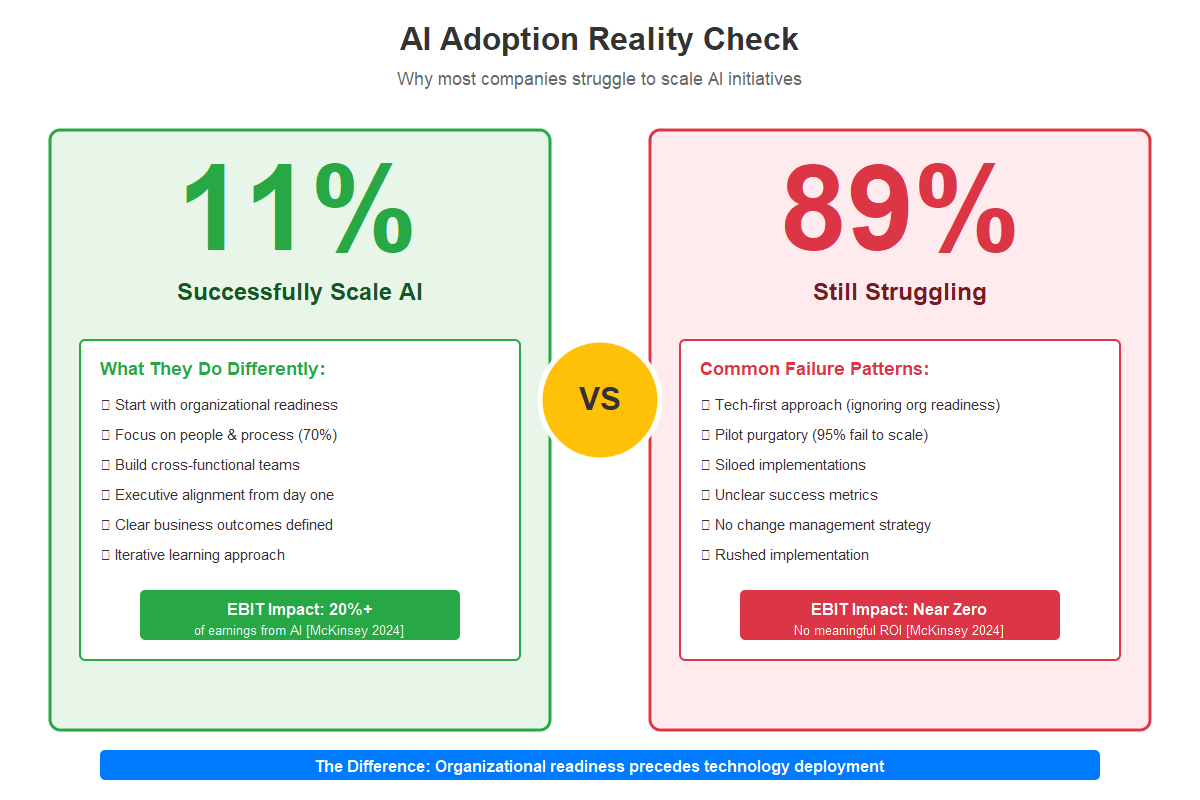
McKinsey's research is clear: Scaling AI is 70% about people and processes, only 30% technology, which takes time to align cross-functionally.
If you delay, you'll face inflated implementation costs as demand for AI infrastructure surges. Talent shortages will worsen—already, AI roles carry that 25% wage premium. And regulatory landscapes are evolving; getting ahead now means compliance is baked in, not retrofitted. In short, "figuring it out in 2026" guarantees you'll be reacting to the market instead of shaping it.
Escaping the Trap: The Three Strategic Imperatives for December
To move from "planning" to "profit" and position your company for a transformational 2026, you need to execute three non-technical, high-impact tasks before January 1st.
Think of these as your New Year's resolution that actually pays dividends—because you started it before New Year's.
Imperative 1: Align Your AI Strategy to Business Outcomes, Not Features
Stop asking, "What can AI do?" and start asking, "Which of our $1 million business problems can AI solve?"
Prioritize opportunities based on measurable ROI, not technical feasibility. Focus on areas like accelerating the lead-to-revenue cycle, reducing customer churn, or maximizing campaign effectiveness. Your December task is to get executive alignment on 3-5 specific, high-value outcomes. This alignment is the foundation of your business case—and the reason pilots succeed or fail.
Following along? Get the AI Readiness Quick-Start Framework below to implement these strategies step-by-step.
Imperative 2: Conduct a Practical AI Readiness Assessment
Remember: Scaling AI is 70% about your people and processes. You need an honest, problem-first audit of your organizational readiness across three areas:
- Data Maturity: Is your data clean, accessible, and governed enough to feed an AI model?
- Process Maturity: Are your core business processes (e.g., sales, marketing, service) documented and standardized?
- Talent Maturity: Do you have internal champions who can manage the change and train others?
The goal isn't a perfect score; it's identifying the single greatest organizational blocker you need to tackle in Q1. This is where December's operational slowdown becomes an advantage—when daily business volume drops 30-40% during the holidays, you can actually see your processes clearly. Which tasks are truly essential? Where do bottlenecks live? What's eating time that doesn't produce value?
Imperative 3: Secure Your First-Mover Advantage with a Quick-Start Framework
The time to start is now, not when your competitors have a fully functioning model. You need a fast-track process that helps you identify, prioritize, and staff your first high-ROI project before the holiday break.
This process moves you past the paralyzing "where do we start?" question. By locking in the first foundational project and dedicating resources in December, you avoid the Q1 budget and priority shuffle.
The AI Readiness Quick-Start: Your Four-Week December Advantage
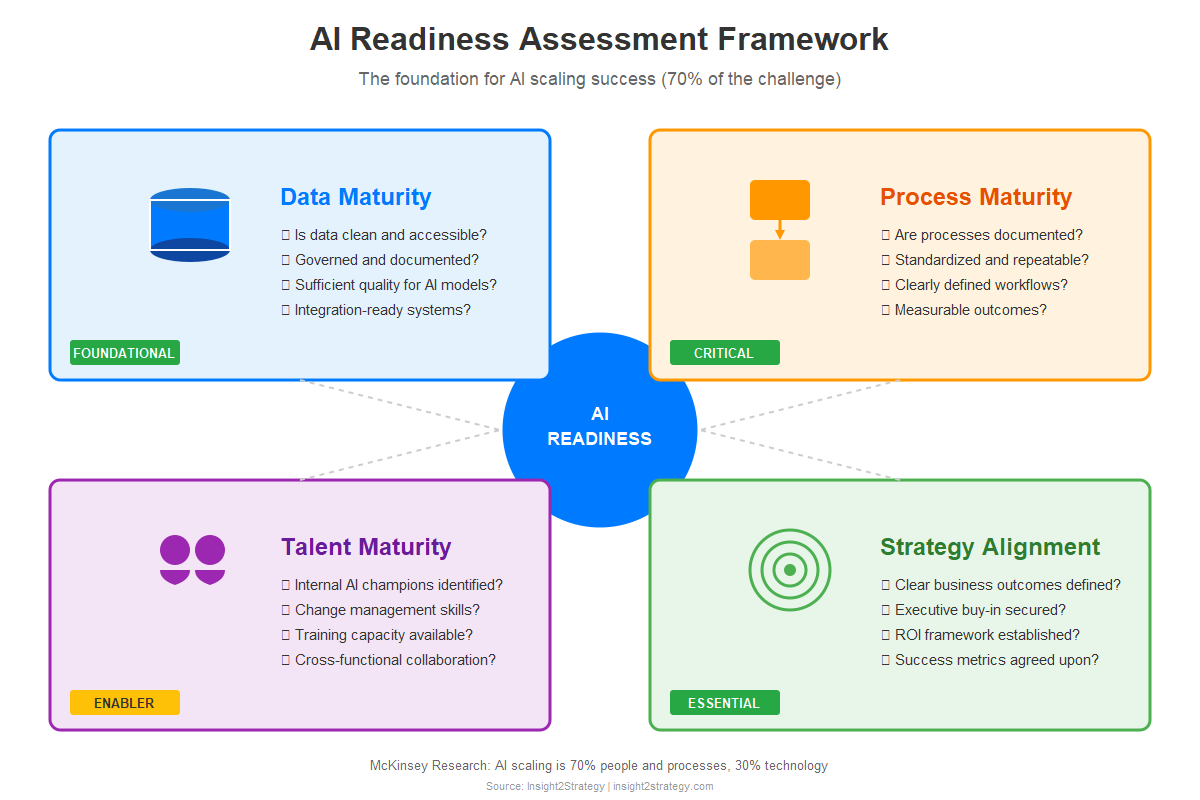
You don't need a massive overhaul to avoid the trap. You need a clear first step. Here's what productive AI preparation looks like in the final weeks of December—and why the holiday slowdown is actually your competitive advantage.
Week 1 (This Week): Process Mapping
Spend 3-4 hours documenting your three most time-intensive recurring processes. Not what you wish they were—what they actually are. Include:
- How much time each step takes
- Who's involved and when they're blocked waiting
- Where information gets lost or recreated
- What you'd change if you could wave a magic wand
You're not building an AI strategy yet. You're creating the map that makes strategy possible. And December's lower operational volume means you can observe workflows without the usual urgency distorting your view.
Week 2 (Week of Christmas): Quick Win Identification
Pick one small, annoying task that:
- Takes 2-4 hours per week
- Follows a consistent pattern
- Produces measurable output
- Doesn't require complex judgment calls
This is your AI pilot candidate. Not because it'll transform your business, but because it'll teach you how AI implementation actually works without betting the company on it. Want to pilot an AI tool for customer service? December's lower ticket volume means your team can learn the system without high-pressure situations.
Week 3 (Week Before New Year): Stakeholder Alignment
Have three 20-minute conversations with key people:
- What's the most repetitive part of their work?
- What would they do with an extra 5 hours per week?
- What's one process that makes them want to quit?
You're not asking for AI ideas. You're identifying pain points that AI might address. The difference matters. And the holiday period often provides the mental space for strategic thinking that you don't get during your busiest weeks.
Week 4 (Week After New Year): Framework Selection
Based on your process map, quick wins, and stakeholder input, choose one of three paths:
- Efficiency Play: Automate repetitive tasks to free up capacity (like freeing up 20-30% of employee time for strategic work)
- Quality Play: Use AI to reduce errors in existing processes
- Insight Play: Apply AI to extract value from data you're already collecting
Pick one. Not all three. Focused beats comprehensive when you're starting.
This is the AI Readiness Quick-Start Framework in action—and we've built detailed worksheets, assessment templates, and implementation checklists to guide you through each of these four weeks.
📊 Want the Complete Framework?
The four-week plan, assessment templates, stakeholder conversation guides, and decision frameworks are all available below. Sign up for instant access.
The January Head Start: What You'll Have When Others Are Starting
If you follow the four-week quick-start, here's what you'll have on January 6 when your competitors are scheduling their first "Let's talk about AI" meeting:
Documented Reality:
You know exactly where your time goes. Not theoretically—actually. You have process maps that show bottlenecks, time sinks, and improvement opportunities with data attached.
Validated Quick Win:
You've identified at least one specific AI application that would deliver measurable value in your operation. You know what success looks like. You can articulate ROI in real numbers.
Stakeholder Buy-In:
Your key people have already had the conversation. They've shared their pain points. They know something's coming. When you present your plan, it won't be the first time they're hearing about it.
Clear Direction:
You're not exploring AI in general. You're implementing a specific solution to a documented problem. Your January meetings aren't "Should we do AI?" They're "Here's the plan, here are the numbers, let's move."
This is how you skip the 8-12 weeks of exploration and analysis that bogs down most AI initiatives. You spent December building the foundation that others will scramble to create in Q1.
Real-World Proof: The Retailer Who Started in December
This isn't theoretical. Consider a mid-sized retailer we worked with at Insight2Strategy. They started in late 2024, using this framework to AI-optimize inventory management. By mid-2025, stockouts dropped 35%, adding $2M to the bottom line.
The key? Cross-functional coordination—IT, ops, and finance collaborating from the start. They didn't wait for perfect alignment. They used December to map processes, identified inventory optimization as their quick win, got stakeholder buy-in during quiet conversations, and piloted in January while competitors were still planning.
McKinsey's research confirms this approach: clients who implement similar frameworks see pilots scale 3x faster than average. The difference? They address change management, data governance, and organizational readiness before deploying technology.
The December Difference: Small Actions, Compounding Results
The magic of starting in December isn't that you'll accomplish massive things. It's that you'll establish momentum that compounds through Q1.
When others are scheduling meetings, you're implementing pilots.
When others are identifying opportunities, you're measuring results.
When others are building business cases, you're scaling what works.
The gap doesn't look dramatic in January. By March, it's decisive.
That eight-week advantage isn't just time—it's learning, iteration, stakeholder buy-in, process refinement, and confidence that you're doing something that actually works.
Your competitors who start today will have that advantage. Will you?
Conclusion: Don't Defer Your Competitive Edge
As 2025 closes, the AI strategy trap is real: Deferring to 2026 means missing the window for transformational impact, leaving your business vulnerable to faster-moving rivals. But with proactive steps now, you can turn AI into a revenue driver, not a regret.
The New Year AI Strategy Trap isn't about technology; it's about competitive timing. Your competitors are currently finalizing their budgets and strategic priorities for 2026. The executives who make a small, focused commitment before the year ends—by aligning on outcomes and identifying their readiness gaps—are the ones who will capture the $15.7 trillion economic opportunity.
Make this your resolution that actually pays dividends: Start the work in December.
Don't let "We'll figure it out in 2026" guarantee you won't. Start now with the foundational work. While others are making vague New Year's resolutions, you'll be implementing a strategy that compounds through Q1.
Get Your AI Readiness Quick-Start Framework
Everything we've discussed—the four-week plan, assessment templates, stakeholder conversation guides, and decision frameworks—designed for exactly where you are right now: Limited time during the holidays, genuine interest in AI, and uncertainty about where to start.
Download instantly. No sales pitch. Just actionable strategies you can implement immediately.
Download the AI Readiness Quick-Start Framework
Get instant access to the AI Readiness Quick-Start Framework — enter your email below and we'll send the download link right over.
Want to discuss how to adapt these strategies to your specific situation?
If you're past the point of DIY frameworks and need strategic guidance on your specific situation, we offer a free 30-minute AI readiness consultation. We'll review your current state, identify your highest-value opportunities, and map a realistic implementation path that fits your organization's capacity and goals.
Schedule a Free Strategy Discussion →No sales pitch. Just strategic insights tailored to your business.
About Insight2Strategy:
We help growing businesses cut through marketing confusion to find strategies that actually drive revenue and customer growth. Our AI implementation approach focuses on practical applications that deliver measurable ROI—not technology for technology's sake.
Publication Timeline: Blog publishes Monday, December 22, 2025 | Next blog: Monday, January 5, 2026
Verified Statistics & Citations
All statistics and research claims in this article have been verified and linked to authoritative sources:
- $15.7 trillion global AI impact by 2030 - PwC Global AI Study, 2023
- Only 11% of companies have adopted AI at scale - McKinsey State of AI Report, 2024
- 95% of AI pilots fail to scale - MIT Sloan Management Review, 2025
- AI scaling is 70% people and processes, 30% technology - McKinsey AI Adoption Research
- High performers see 20% of EBIT from AI - McKinsey State of AI, 2024
- 25% wage premium for AI roles - PwC AI Predictions Report, 2023
- 80% of organizations not seeing EBIT impact from generative AI - McKinsey State of AI, 2025


Comments
Post a Comment