Most AI Marketing Advice Assumes You're Ready. Here's How to Find Out If You Actually Are.
Most AI Marketing Advice Assumes You're Ready. Here's How to Find Out If You Actually Are.
Strategic Analysis by: Insight2Strategy
Published: March 30, 2026
Executive Reading Time: 7 minutes
Executive Strategic Insights
- Readiness determines ROI — not the tool. You can buy the most sophisticated AI platform on the market and still fail if your organization wasn't set up to use it.
- Only 13% of companies are truly AI-ready — yet 98% report urgency to deploy. That gap is where real budgets disappear.
- AI readiness has two measurable dimensions: Data Readiness (your infrastructure) and Team Readiness (your capability and bandwidth). Both must be evaluated before any investment decision.
- Your quadrant determines your next 90 days. The four readiness profiles each require a fundamentally different strategic response — not just a different tool.
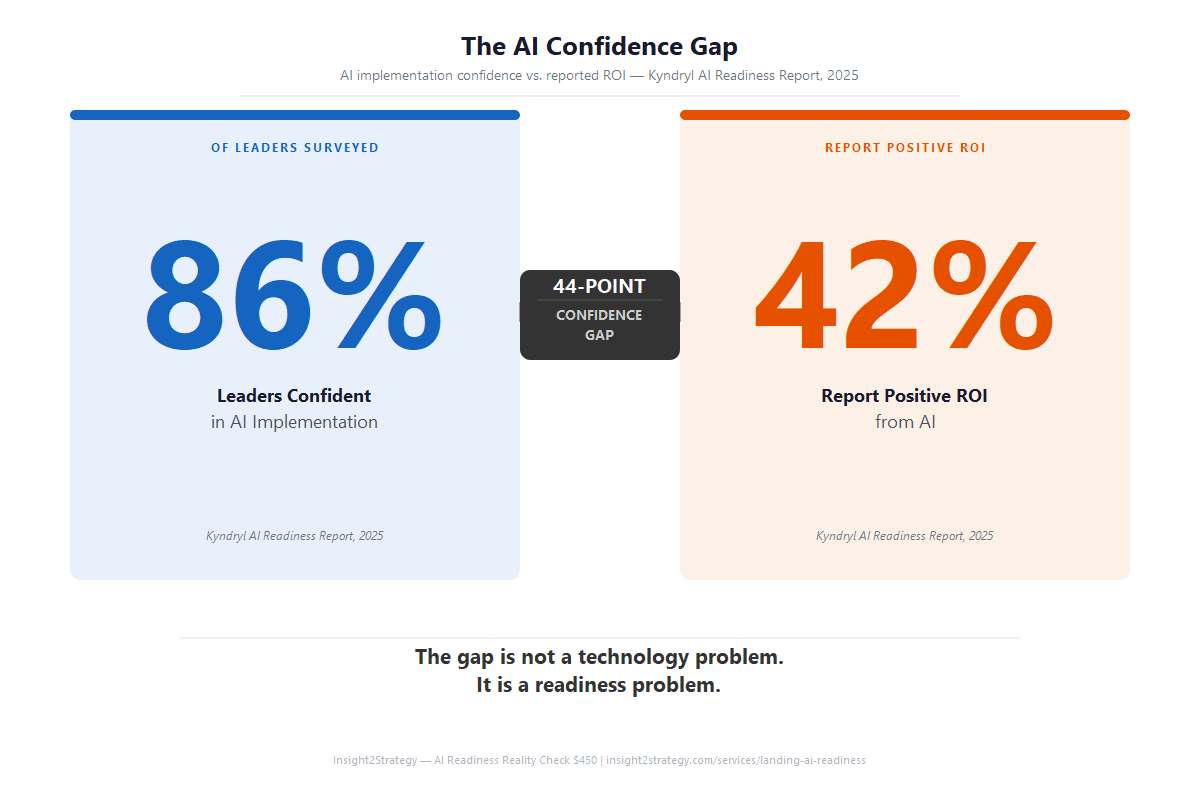
- 86% of leaders are confident; only 42% see positive ROI. That 44-point gap is almost entirely a readiness problem, not a technology problem.
- The AI Readiness Reality Check ($450, 2–3 business days) delivers an objective two-dimension score, deployment segmentation, and a 90-day roadmap calibrated to your actual constraints. Framework detailed in section 4.
The pressure is coming from everywhere. Leadership wants to know what the AI strategy is. Your competitors are announcing AI-powered everything. Your inbox is full of vendor demos promising 10x efficiency. And somewhere in the middle of all that noise, you need to answer a straightforward question before you spend another dollar: are we actually ready to use this stuff, or are we about to buy something we can't operationalize?
Here's what almost nobody is saying: readiness determines ROI, not the tool.
You can buy the most sophisticated AI marketing platform on the market and still fail — not because the technology doesn't work, but because your organization wasn't set up to use it. Every AI vendor will tell you their tool is easy to implement. Every consultant will tell you AI is transformational. Almost nobody will tell you whether your company is specifically, honestly, actually ready for it — based on your real data infrastructure and your team's real capability.
That's what this post is about.
The Two Questions That Should Come Before Any AI Tool Decision
The conversation usually starts with:
It should start with:
- Is your data infrastructure ready to feed AI reliably?
- Does your team have the capability and bandwidth to actually use what AI produces?
Most growing tech companies we work with are about 70% ready on one dimension and 30% on the other.
That gap is where AI projects stall, underperform, or quietly disappear six months later.
And you're not alone in this gap:
- Only 13% of companies globally are fully ready to capture AI's potential, despite 98% reporting increased urgency to deploy it — and that readiness number actually declined year over year. (Cisco AI Readiness Index, 2024)
- 80% of companies report inconsistencies or shortcomings in data pre-processing and cleaning for AI projects. (Cisco AI Readiness Index, 2024)
- 86% of leaders are confident in their AI implementation — but only 42% report seeing positive ROI. (Kyndryl AI Readiness Report, 2025)
Confidence ≠ readiness.
Tool access ≠ infrastructure.
Pilot project ≠ scaled capability.
If you're leading a 10–50 person marketing team, this is especially critical. You don't have the margin for expensive experiments that don't convert — or for AI tools that generate noise instead of growth.
Quick Implementation Tip
Before evaluating any AI tool, score your data infrastructure and team capability independently on a 1–10 scale. If either score falls below 5, that dimension needs attention before any AI investment — regardless of how compelling the tool demo looks. This 10-minute exercise prevents months of wasted spend.
What AI Marketing Readiness Actually Means for a Growing Tech Company
AI readiness isn't philosophical. It's operational. It lives in two concrete dimensions — and both have to be evaluated before any AI investment decision.
1. Data Readiness (The Fuel)
AI is entirely data-dependent. If your customer data is scattered, incomplete, or dirty, the AI will either fail completely or — worse — make confident, incorrect decisions at scale.
For a growing tech company, data readiness means being honest about:
- Is your customer data centralized? Or is behavioral data in your product analytics, contact data in your CRM, engagement data in your email tool, and the latest list in someone's spreadsheet?
- Is it clean and structured? Can you confidently pull a list of high-intent prospects from the last 30 days in under 10 minutes — or does that require three manual exports and a prayer?
- Do your tools actually talk to each other? Or are there people manually bridging gaps between systems every week?
Most teams dramatically overestimate their data maturity here. Although 80% of organizations believe their data is AI-ready, 95% face data challenges during AI implementation — with over 52% encountering significant issues. (AvePoint AI & Information Management Report, 2024)
The belief gap is the danger zone. AI amplifies whatever you feed it. If your inputs are fragmented, your outputs will be wrong with confidence.
2. Team Readiness (The Driver)
You can have the best data infrastructure and the most powerful AI platform available — but if your team doesn't have the capability and bandwidth to use it, that investment is wasted budget.
Even when data is strong, AI requires consistent human interpretation and oversight. Consider:
- Who owns AI internally? If the answer is "everyone," it's no one.
- Does your team have the analytical skills to interpret model output — not just accept it, but validate and act on it strategically?
- Do they understand prompts, limitations, and bias well enough to use AI tools responsibly?
- Do they have protected bandwidth to test, refine, and deploy — or are they already underwater with current workload?
Only 30% of organizations believe they have enough skilled talent to scale AI projects, and fewer than 10% have a clear AI roadmap with prioritized use cases. (Aristek Systems, 2025)
You don't lack ambition. Most growing teams lack protected bandwidth — and that difference matters when AI adoption requires consistent attention to produce results.
The Four AI Readiness Outcomes We See Most Often
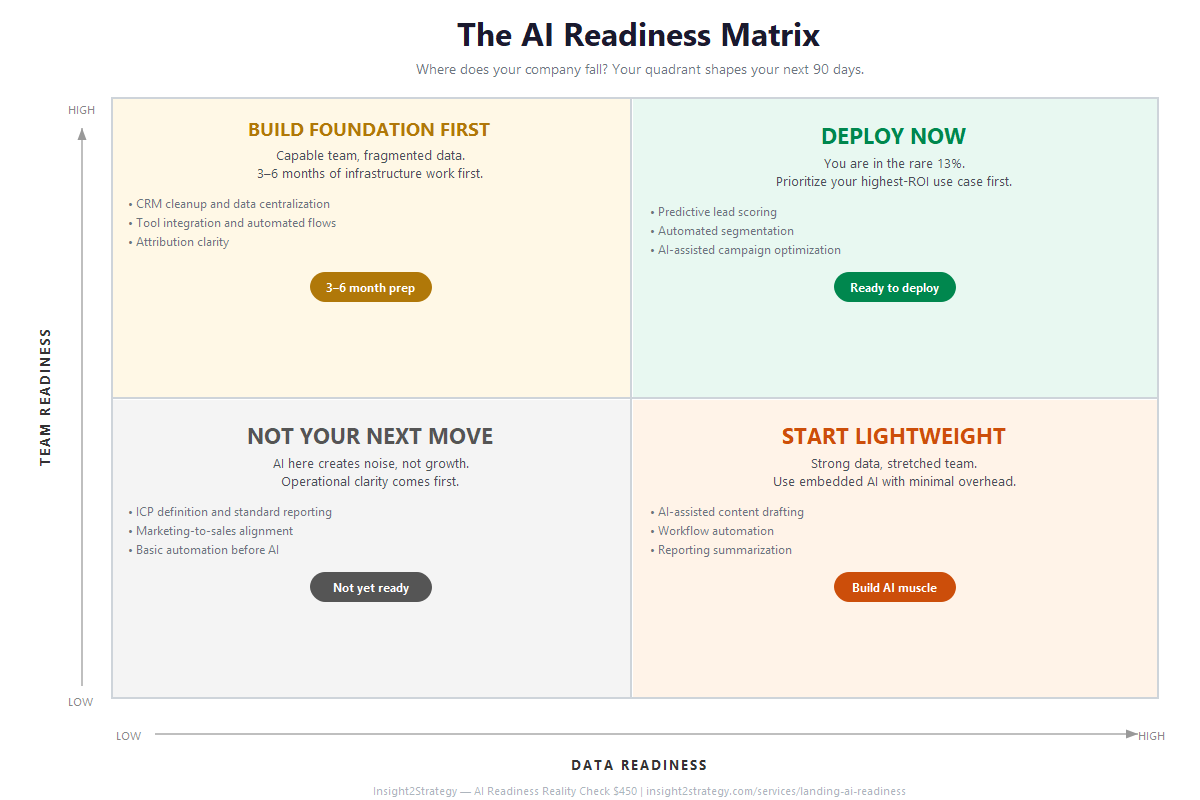
When we assess companies, they fall into one of four quadrants — and each quadrant has a specific strategic prescription, not just a label.
1. High Data + High Team → Deploy Now
You have centralized, clean data and a team that understands analytics and has the bandwidth to act. You're in the rare 13%.
Your focus isn't readiness — it's prioritization. The risk here is actually diffusion: chasing every AI application at once and executing none of them well. Pick your highest-ROI use case and deploy it completely before expanding scope.
Quick wins available: predictive lead scoring, automated segmentation, AI-assisted campaign optimization, content acceleration tied to performance metrics.
2. High Data + Low Team → Start Lightweight
Your infrastructure is sound, but your team is stretched or lacks the interpretive skills to manage complex AI systems.
The wrong move: buying an enterprise AI suite that requires a dedicated administrator.
The right move: embedded AI — features baked into tools your team already uses, with near-zero operational overhead. AI-assisted content drafting, workflow automation, reporting summarization, customer support augmentation.
You build AI muscle before you build AI infrastructure. This is the path that actually sticks.
3. Low Data + High Team → Build the Foundation First
This is the most frustrating quadrant for capable marketing leaders. Your team is analytically ready and eager to deploy — but your data is scattered, inconsistent, or siloed.
Investing in AI tools here is futile. Your next 3–6 months are a data infrastructure play:
- CRM cleanup and standardization
- Tool integration and automated data flows
- Attribution clarity
- A single source of truth for customer data
AI will not fix messy data. It will expose it — loudly and expensively.
Your team's analytical strength is exactly what makes this infrastructure investment worthwhile. Do it right.
4. Low Data + Low Team → AI Is Not Your Next Move
This is the uncomfortable truth most vendors won't tell you — because they want to close the deal.
If both dimensions are low, rushing AI creates noise, not growth. Your real investment priority isn't AI: it's operational marketing clarity, ICP definition, standard reporting cadence, and basic automation before intelligent automation.
These aren't consolation prizes. They're the prerequisites that make AI investment pay off when the time comes.
Implementation Framework
Each quadrant has a distinct 90-day execution path — from immediate deployment playbooks for the "Deploy Now" quadrant, to data infrastructure blueprints for "Build Foundation First." The framework maps to your current constraints, not a generic best practice.
Need help determining which quadrant you're in and what your specific next steps should look like? Get your AI Readiness Reality Check →
What the AI Readiness Reality Check Actually Produces
This is why we built the AI Readiness Reality Check.
Not a 60-page enterprise transformation plan. Not a generic AI workshop. Not a sales funnel disguised as "strategy."
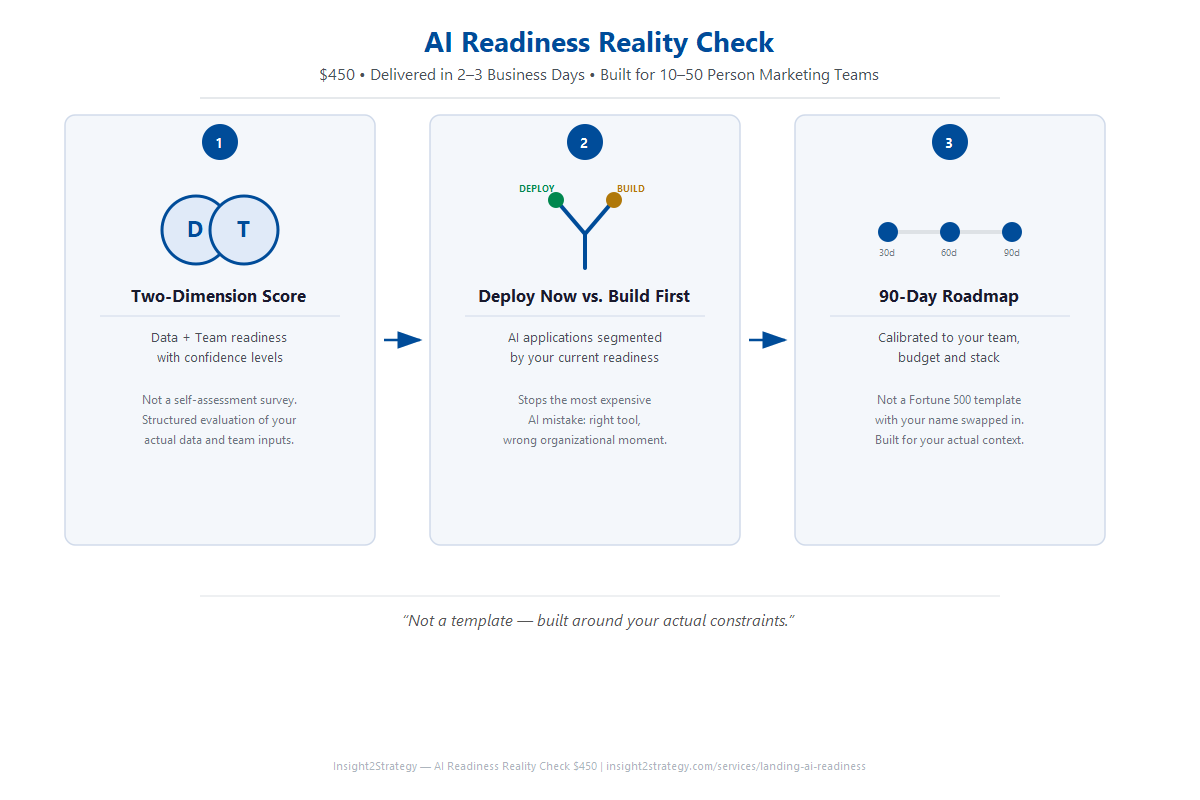
In 2–3 business days, you receive:
1. A Two-Dimension Readiness Score
An objective, structured evaluation — not a self-assessment survey — of your Data Infrastructure and Team Capability, each scored with confidence levels based on your actual inputs. You'll see exactly where you're strong and where the gaps are.
2. Clear Separation: Deploy Now vs. Build First
We take your current marketing goals and AI interests and segment them clearly: what you can implement immediately for ROI, what will fail without groundwork, and what to defer. This single output prevents the most common and most expensive AI mistake: investing in the right technology at the wrong organizational moment.
3. A 90-Day Roadmap Calibrated to Your Reality
Not a Fortune 500 playbook with your company name swapped in. Your roadmap is built around your actual team size, internal skill level, budget range, current tech stack, and growth priorities.
AI marketing for a 25-person marketing team looks fundamentally different from enterprise AI programs — and the advice has to match the context.
Quick Implementation Tip
The most common mistake after receiving an AI assessment: trying to act on everything at once. The 90-Day Roadmap works precisely because it forces prioritization — one high-confidence use case deployed completely before expanding scope. Breadth kills AI momentum. Depth builds it.
Small Business AI Strategy: Who Should Get This Assessment Right Now
This service is for you if:
- Leadership is asking "what's our AI strategy?" and you don't yet have a confident answer to give them
- You've looked at AI tools but genuinely don't know where to start — or whether your setup can actually support them
- You tried implementing something and it didn't stick, and you want to understand why before trying again
- Your marketing team is already stretched, and you need clarity before adding another layer of complexity
- You're heading into a budget conversation and want a grounded position on AI — not a number pulled from vendor projections
It's especially valuable for:
- 10–50 person tech companies and growth-stage SaaS firms
- Marketing leaders without internal data science or analytics teams
- Founders who want honest answers before writing large checks
- Anyone who keeps wondering, "How ready is my company for AI — really?"
Remember: only 13% of companies are truly AI-ready — yet nearly everyone feels pressure to act. You don't need more urgency. You need an accurate diagnosis.
Get Your Honest AI Readiness Score
AI can absolutely drive revenue. But readiness determines ROI.
Right now, most companies overestimate their data maturity, underestimate the operational lift of AI adoption, and start with tools instead of capability assessment. That's backwards.
AI Readiness Reality Check
$450 | Delivered in 2–3 business days
You provide:
- Current tech stack overview
- Basic data structure description
- Team roles and bandwidth snapshot
- Growth priorities for the next quarter
You receive:
- Two-dimension readiness score with confidence levels
- Deploy-now vs. groundwork segmentation of your AI opportunities
- 90-day execution plan calibrated to your team and budget
No hype. No vendor bias. No enterprise fluff applied to a 25-person team.
Ready to Get Your Honest AI Readiness Score?
Before you invest in another AI marketing tool, find out if your infrastructure and team are actually ready to use it. Every organization's situation is unique — this assessment is built around yours.
No sales pitch. No vendor bias. Just an honest diagnosis for your specific situation.
Transformation starts with diagnosis — not software.
Ready to go further? Once you have your AI readiness score, many clients follow up with our ICP Validation Sprint ($650) — so you know not just how ready your systems are, but exactly which customers you should be targeting with AI-powered processes from day one.
|
This post is part of The B2B Marketing Reality Check The strategic framework for growth-stage B2B tech companies — now available in paperback and Kindle. Every topic we cover in this blog goes deeper in the book, with frameworks, diagnostics, and quick wins you can put to work immediately. Get the Free PDF →Want to work through the framework hands-on? Get the companion workbook → |
Frequently Asked Questions
What is AI readiness, and why does it matter for marketing teams?
AI readiness is an objective assessment of whether your organization has the two prerequisites for successful AI implementation: a data infrastructure capable of feeding AI reliably, and a team with the capability and bandwidth to act on what AI produces. It matters because these two dimensions — not the sophistication of the tool — determine whether AI generates ROI or generates expensive noise.
How do I know which AI readiness quadrant my company falls into?
Most companies can't self-assess accurately because they tend to overestimate data quality and underestimate the operational demands of AI. A structured evaluation — like the AI Readiness Reality Check — scores both dimensions based on your actual inputs: your current tech stack, data structure, team configuration, and growth priorities. That's why an objective third-party assessment produces different (and more useful) results than an internal survey.
How long does it take to move from "Build Foundation First" to "Deploy Now"?
For most 10–50 person tech companies starting in the "Build Foundation First" quadrant, the data infrastructure work takes 3–6 months when prioritized correctly. The work typically includes CRM cleanup and standardization, tool integration, attribution clarity, and establishing a single source of truth for customer data. Teams that skip this step and deploy AI anyway consistently spend more time fixing AI-amplified data problems than they would have spent building the foundation.
How much does an AI readiness assessment cost, and what does it include?
The AI Readiness Reality Check is $450, delivered in 2–3 business days. It includes: an objective two-dimension readiness score (Data Infrastructure and Team Capability), a clear segmentation of your AI opportunities into "deploy now" vs. "needs groundwork" categories, and a 90-day execution roadmap calibrated to your actual team size, budget range, tech stack, and growth priorities. It is not a generic framework — it is built around your specific inputs.
Can we implement AI tools while building our data foundation in parallel?
In most cases, we recommend against it — divided focus typically means neither initiative gets done properly. There is one exception: embedded AI features within tools you already use (content drafting assistance, automated workflow triggers, basic reporting summarization) can run in parallel because they require minimal data integration. What to avoid running in parallel: any AI application that requires feeding clean, centralized customer data. That's where fragmented infrastructure produces confident, incorrect outputs.
Insight2Strategy | Strategic consulting for growing tech companies


Comments
Post a Comment