3 Market Education Quick Wins That Get Your Whole Team Selling (Not Just Sales)
3 Market Education Quick Wins That Get Your Whole Team Selling (Not Just Sales)
Strategic Analysis by: Insight2Strategy
Published: April 13, 2026
Executive Reading Time: 7 minutes
Executive Strategic Insights
- The core problem: Non-sales employees improvise messaging at every customer touchpoint — and every inconsistent interaction costs you deals your CRM will never capture.
- Quick Win #1: A one-page Company Story Cheat Sheet gives every team member a consistent, confident answer to "What do you do?" and "How are you different?" — built from real customer language, not internal assumptions.
- Quick Win #2: A 15-minute monthly win/loss standup exposes your whole team to unfiltered market reality — and shifts how every department communicates value within 2–3 months, with no formal training program.
- Quick Win #3: A Competitive Response Card using the Acknowledge → Bridge → Impact framework equips non-sales roles to handle "How do you compare to Competitor X?" with credibility and confidence.
- The diagnostic signal: If your team can't agree on what makes you different in a half-day workshop, that's a positioning problem — not a training problem. Distribution won't fix it.
- Full framework below: All three quick wins can be launched this week. The complete Market Education Playbook — with templates, facilitation guides, and implementation timelines — is available free at the bottom of this post.
Following along? Get the Market Education Playbook to implement all three quick wins with ready-to-use templates and facilitation guides.
When a prospect asks your customer success rep "What makes you different from Competitor X?" — do they have a confident, accurate answer?
Most companies assume yes.
Most are wrong. And the cost isn't theoretical.
Your customers don't just talk to sales. They talk to customer success, product, support, and marketing. Every one of those conversations is a selling moment — whether your team realizes it or not. And right now, most non-sales employees are improvising with inconsistent, watered-down, or outright inaccurate messaging. The result: fragmented buyer experiences, eroded trust, and revenue leaking out the side door in ways your CRM will never capture.
Here's the important distinction: this is rarely a training problem. It's a messaging architecture problem. The story lives somewhere — in the pitch deck, in the sales playbook — but it was never translated into a format non-sales people can actually use in the moment. The fix is simpler than you think, and it doesn't require a six-month enablement program.
Why Company-Wide Selling Is No Longer Optional for Internal Sales Enablement
The math has shifted against every company that treats selling as sales-only territory.
According to Gartner research, B2B buyers now spend only 17% of their total purchase journey meeting with potential suppliers. The rest is independent research and internal consensus-building — happening across forums, peer networks, and every touchpoint your team creates. Meanwhile, the average B2B buying committee now involves 6 to 10 stakeholders, according to the same Gartner research, each arriving with independent information they've gathered before a single sales conversation.
That means your customer success team, your product leads, and even your billing contacts are part of a buyer's evaluation experience. Organizations with strong cross-functional alignment see up to 20% higher sales growth than less-aligned peers [McKinsey & Company]. And Forrester research indicates that 74% of B2B buyers choose the vendor that helps them move forward with confidence — not necessarily the lowest price or the most features.
Confidence is built through consistency. Consistency requires shared understanding. And shared understanding requires intentional team education strategy built around a common value story.
Here are three quick wins to build it this month.
Quick Win #1: Build a One-Page "Company Story" Cheat Sheet
The Problem
Ask five people on your team "What problem do we solve?" and you'll likely hear five variations. Marketing emphasizes positioning. Sales emphasizes urgency. Product emphasizes capability. Customer success emphasizes outcomes.
The result is fragmented messaging — and fragmented messaging creates friction in the buying journey, especially with buying committees that compare notes across every interaction with your company. This is one of the most underestimated conversion killers in how to get non-sales teams selling effectively.
The Solution
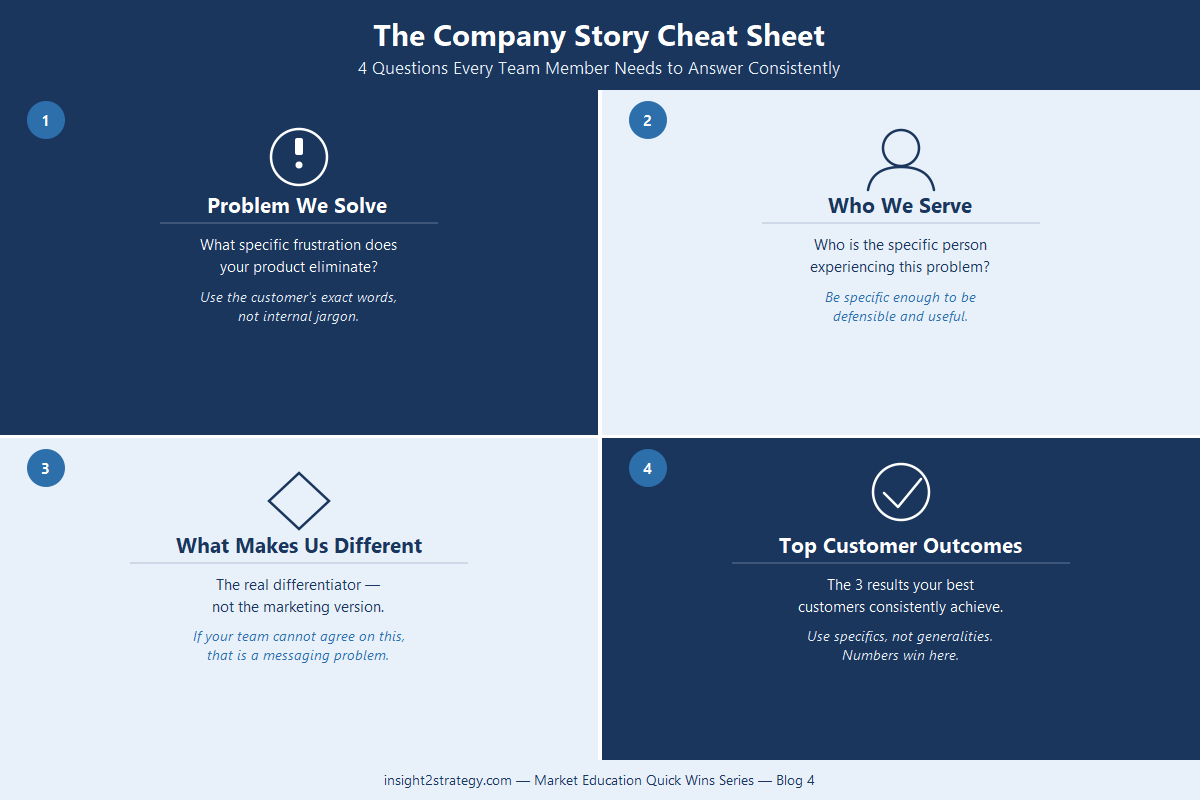
Create a single-page Company Story Cheat Sheet that answers four questions in plain, customer-tested language:
- What problem do we solve? Not your category — the specific frustration your best customers were experiencing before they found you.
- Who do we solve it for? Specific enough to be defensible: "growing B2B companies at 50–500 employees" beats "all businesses."
- What makes us different? The real answer, not the polished marketing version. This one is harder than it sounds — and if your team can't agree, see the Deeper Issue section below.
- What are the top three outcomes customers achieve? Focus on results, not features. Use the language customers actually use to describe success.
This is not a glossy brochure. It's a functional reference card built from real buyer interviews and win/loss data. Every employee keeps it on their desk or pinned in their notes app.
Implementation: Half-Day Workshop
Gather a cross-functional group — sales, customer success, marketing, product — for a focused 3–4 hour session. Start by having sales share the most common "Why you?" and "Why not Competitor X?" questions from real conversations. Then have customer success describe the top three outcomes they actually see customers achieve. Debate and refine until you can express your differentiation in one to two clear sentences.
Do not try to write polished copy in the room. Alignment is the output. Marketing can make it presentable afterward. Distribute as a simple PDF or Notion page, and include a five-minute video walkthrough in onboarding for all new hires.
Impact
Every customer-facing employee can now answer "What do you do?" "Who is this best for?" and "How are you different?" without improvising. When everyone tells the same story, buyers feel coherence. And coherence builds confidence — which, per Forrester, is the single strongest predictor of purchase commitment in complex B2B sales.
⚡ Quick Implementation Tip
Before your Company Story workshop, send this one question to your five best customers: "In your own words, what problem were you trying to solve when you found us, and what made you choose us?" Verbatim answers from actual buyers are more valuable than any internal debate about positioning — and they give you the customer-tested language your Cheat Sheet should use from day one.
Quick Win #2: Host a Monthly Win/Loss 15-Minute Standup
The Problem
Most non-sales teams have no idea why deals are actually won or lost. They see outcomes — not the buyer's decision logic. Marketing writes copy based on assumptions about what resonates. Product builds features based on internal priorities. Customer success tries to reinforce value without knowing what initially convinced the buyer.
This creates a dangerous disconnect. And it means that when non-sales employees do interact with buyers, they're working from outdated or secondhand information about what actually matters in the market right now.
The Solution
Host a 15-minute monthly win/loss standup. The format is intentionally minimal:
- 2–3 recent wins: Sales shares the buyer's exact words about why they chose you
- 1–2 recent losses: Sales shares the buyer's exact words about why they went elsewhere
- No analysis. No debate. No spin. Just the raw customer voice.
Invite customer success, marketing, product, and operations. Make attendance non-negotiable.
Implementation: 15 Minutes, Monthly
Calendar it as a standing meeting. Sales management prepares beforehand: select three to five verbatim quotes from call recordings, emails, or post-decision interviews. Keep the format rigid — three minutes per deal, no commentary, just the buyer's language. End the meeting. One person captures recurring themes in a shared doc for reference.
The goal is exposure, not strategy. Your job in the standup is to put the whole team in direct contact with market reality, unfiltered by your own assumptions.
Impact
After two to three months, you will notice something shift. Non-sales team members start using customer language organically — in product conversations, in customer success renewals, in casual prospect interactions. Product starts building the features buyers ask for in their own words. Marketing starts using the language that actually resonates, not the language that tested well in internal brainstorms.
That is market alignment happening without a formal training program.
📥 Get the Complete Market Education Framework
The Market Education Playbook includes the Company Story Cheat Sheet template, the win/loss standup facilitation guide, the Competitive Response Card worksheet, and a 30-day implementation timeline — everything you need to launch all three quick wins this week.
Quick Win #3: Create a Competitive Response Card for Non-Sales Roles
The Problem
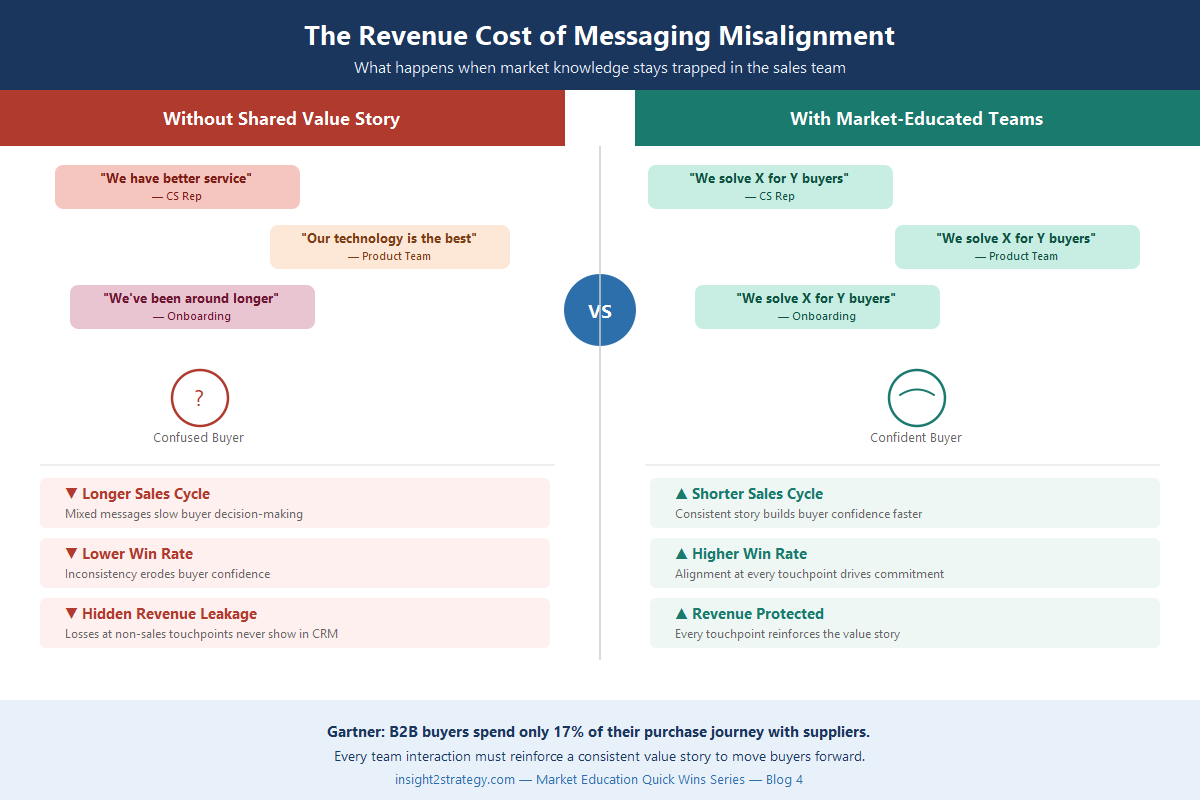
Competitive losses are routinely blamed on sales performance. Many are actually driven by inconsistent messaging at non-sales touchpoints — moments that never show up in the CRM.
A customer success rep hears "We're looking at Competitor X for our renewal." An onboarding specialist is asked at a trade show: "How do you compare to Competitor Y?" These are not edge cases. They happen every week in most companies. And right now, the most common response is a mix of improvisation, silence, or accidental damage to the company's positioning.
The Solution
Give every customer-facing employee a Competitive Response Card: a simple, honest, confident reference for the conversations they're already having.
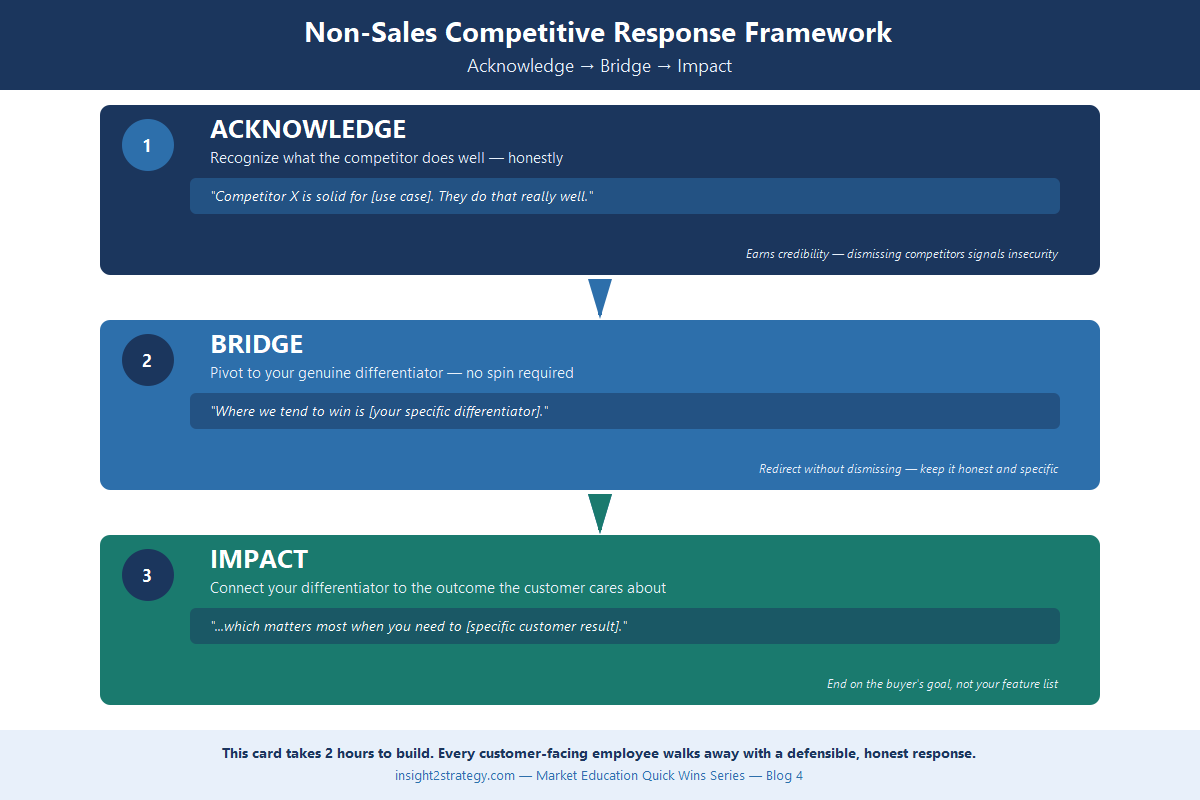
The structure, adapted from how your best sales reps actually handle these moments, follows three steps:
- Acknowledge: Recognize the competitor honestly. "Competitor X is solid for [use case]." This earns credibility — dismissing competitors signals insecurity.
- Bridge: Pivot to your genuine differentiator. "Where we tend to win is [specific differentiator]."
- Impact: Connect to the customer's outcome. "Which matters most when [specific result they want to achieve]."
Limit the card to your three to four most common competitors. Include two to three responses each. Write in plain, conversational language — not sales-speak, not technical copy. Review and approve with sales before distributing.
Implementation: 2 Hours with Sales
Pull the most common competitive objections from CRM notes and call recordings from the past six months. Ask your best sales reps: "When a customer brings up [Competitor], what's the single most effective thing you say to shift the conversation?" Distill these answers, format as a simple reference card, and distribute digitally. Include it in onboarding for all customer-facing roles.
Impact
You immediately reduce the competitive losses that are happening at touchpoints you're not tracking. A CS rep who can deliver the Acknowledge → Bridge → Impact response doesn't need to be a competitive expert. They just need to know how to confidently redirect back to your value story. That's the difference between a customer who stays and one who quietly starts evaluating alternatives.
⚡ Quick Implementation Tip
When building the Competitive Response Card, don't write generic responses from memory. Pull actual language from your best sales reps' call recordings. The question to ask: "What's the single most effective sentence you've ever said when a customer brought up [Competitor]?" That specific, field-tested language is what makes the card work in real conversations.
The Deeper Issue: When You Can't Agree on What Makes You Different
Here is the diagnostic moment no one anticipates: you run the Company Story workshop, and your cross-functional team cannot agree on what makes you different. Four stakeholders, four genuinely different answers.
That is not a training problem. That is a messaging problem.
The three quick wins above assume you have a coherent value story somewhere that simply needs to be distributed in accessible form. If your half-day workshop reveals that the underlying story doesn't exist in agreed-upon form, no amount of distribution will fix it. You'll just be distributing inconsistency at scale.
Messaging problems don't get fixed by more Slack threads or more decks. They get fixed by grounding your value proposition in actual customer language — the vocabulary your best customers use to describe the problem you solve and the results they experience.
That's exactly what our Value Translation Workshop is designed for. In two to three business days, we extract the exact vocabulary your customers already use and build a messaging hierarchy your entire team can deploy — consistently, confidently, across every touchpoint.
📊 Want the Complete Implementation Framework?
The Market Education Playbook compiles every tool from this series — the Company Story Cheat Sheet template, win/loss standup facilitation guide, Competitive Response Card worksheet, and a 30-day rollout timeline — in one ready-to-use package. Free download below.
Ready to Build Your Market Education Foundation?
The three quick wins above will create immediate, measurable alignment. But sustained company-wide revenue capability requires a complete framework.
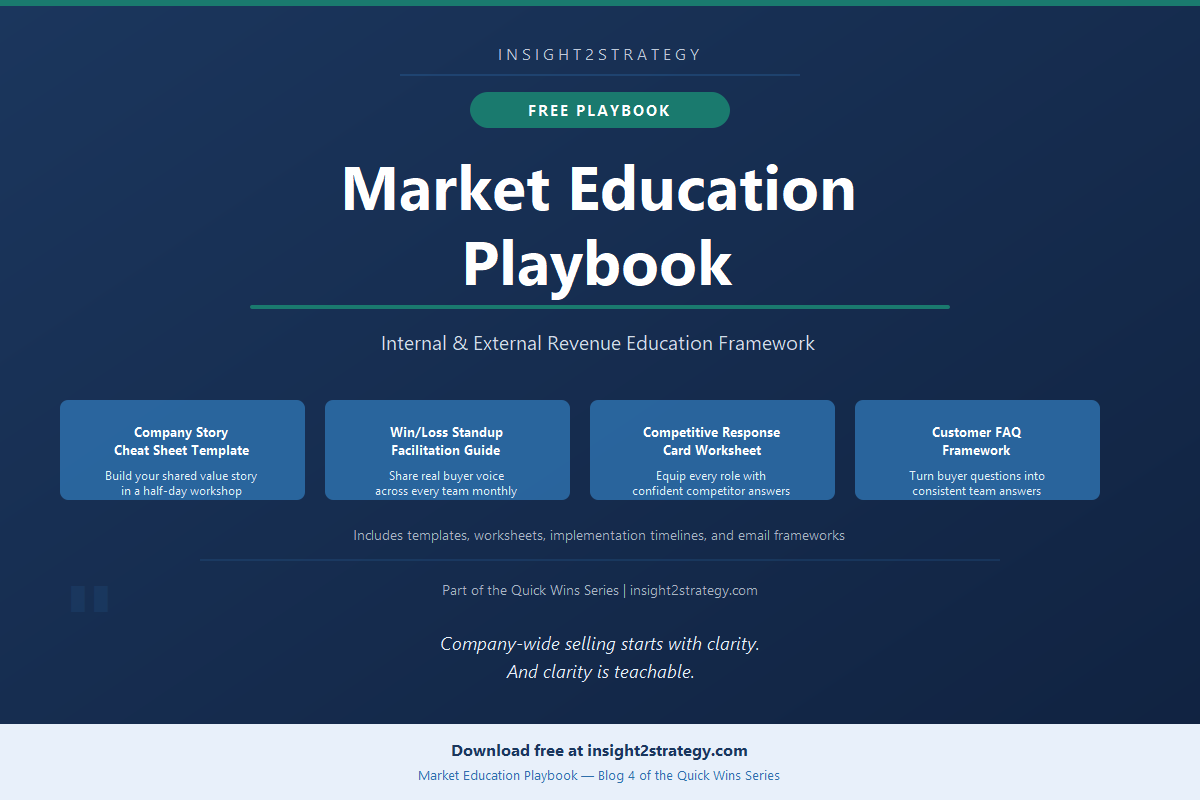
Download the complete Market Education Playbook — the full compilation of every quick win from this series, including:
- The Company Story Cheat Sheet template
- Win/Loss standup agenda and facilitation guide
- Competitive Response Card worksheet for your top competitors
- Customer FAQ development framework
- Implementation timelines and rollout checklist
- Milestone email frameworks for post-purchase customer education
Company-wide selling doesn't start with pressure. It starts with clarity. And clarity is teachable.
Enter your info below — download link delivered instantly by email.
Download the Market Education Playbook
Get instant access to the Market Education Playbook — enter your email below and we'll send the download link right over.
Want to discuss how these strategies apply to your specific situation?
Book a Free 30-Minute Strategy Session →
|
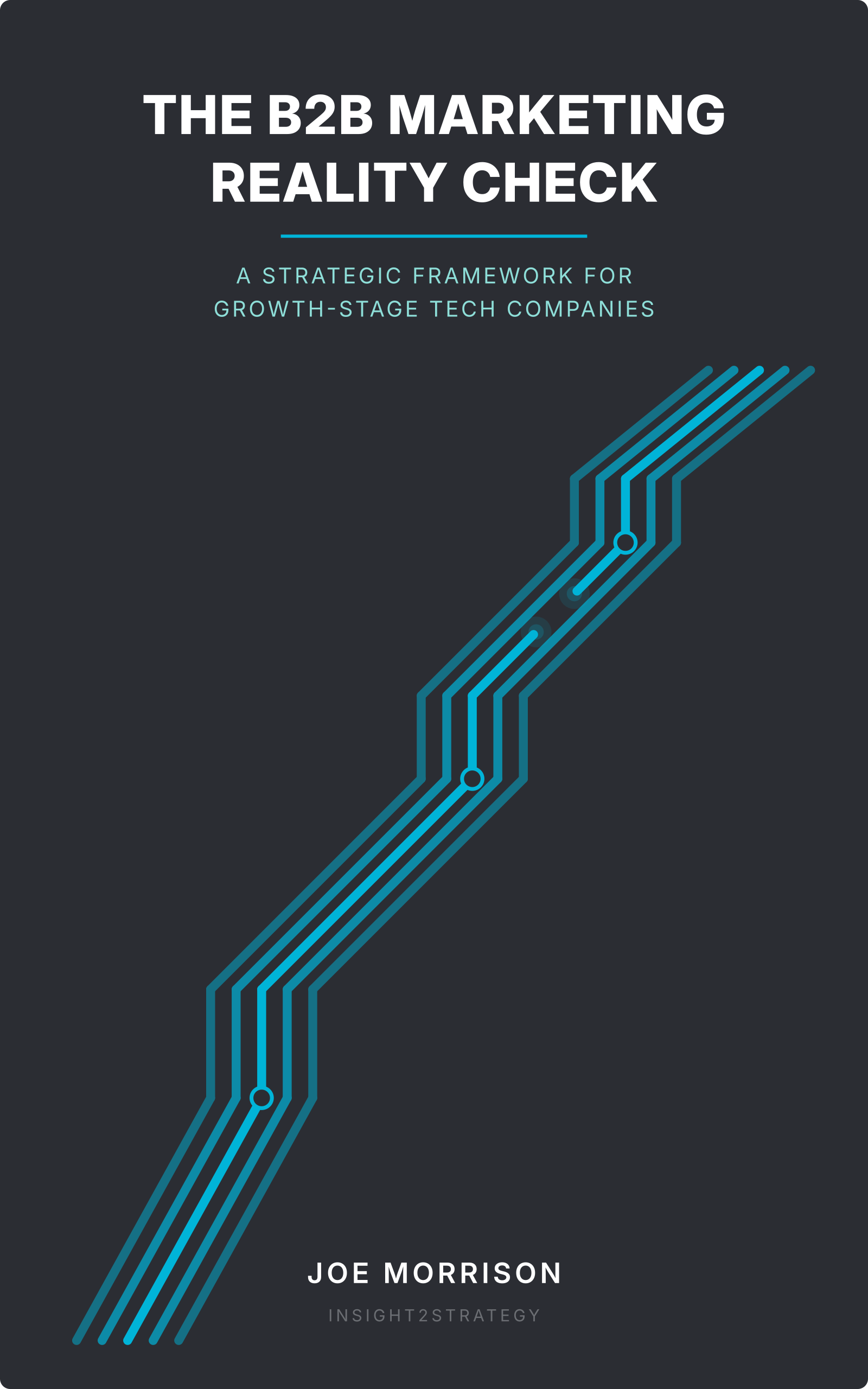
This post is part of The B2B Marketing Reality Check The strategic framework for growth-stage B2B tech companies — now available in paperback and Kindle. Every topic we cover in this blog goes deeper in the book, with frameworks, diagnostics, and quick wins you can put to work immediately. Get the Free PDF →Want to work through the framework hands-on? Get the companion workbook → |
Frequently Asked Questions
How long does internal sales enablement through market education typically take?
The Company Story Cheat Sheet can be created in a single half-day workshop. Distribution happens the same week. Observable alignment — where non-sales employees start using consistent language independently — typically emerges within 4–6 weeks of regular reinforcement through the win/loss standup cadence. Full market alignment across all touchpoints usually requires 2–3 months of consistent exposure.
What if our team can't agree on what makes us different?
That's the most important diagnostic this process surfaces. If your cross-functional team can't reach agreement in a half-day workshop, the problem isn't facilitation — it's that you don't yet have a clear, defensible differentiator grounded in customer language. The right next step is a positioning exercise (not a messaging exercise) that starts with direct customer research. Our Value Translation Workshop is specifically designed for this scenario.
How do I measure whether internal market education is actually working?
The simplest test: walk up to any five non-sales team members individually and ask "What problem do we solve — in a sentence?" and "How are we different from [top competitor]?" Consistent, confident answers indicate your foundation is working. Divergent or vague answers indicate either a distribution problem (the Cheat Sheet isn't being used) or a positioning problem (the underlying story isn't clear). Either way, you now have actionable diagnostics instead of assumptions.
How do I share competitive intelligence across departments without a formal training program?
The win/loss standup is designed exactly for this. By sharing verbatim buyer language monthly — no analysis, no spin — every department gets unfiltered market exposure. Within 2–3 months, product, marketing, and CS teams naturally start using customer-accurate language in their own work. The format's simplicity is what makes it sustainable; formal training programs require scheduling and budget that kill consistency.
When should we bring in outside expertise vs. handle this internally?
Handle it internally when your team can agree on differentiation in the workshop, you have someone who can facilitate without a stake in the outcome, and the problem is distribution rather than positioning. Bring in external expertise when internal discussions about positioning keep cycling without resolution, you're preparing for a major growth phase or pivot, or the stakes of getting this wrong are high — competitive market, price-sensitive buyers, complex buying committees.
Next in the series (4/20/2026): Expanding market education beyond your internal team and into the buyer journey itself.
Revenue isn't just the sales team's responsibility anymore. The market has moved. Your organization needs to move with it.
Ready to Accelerate?
Every business situation is unique. Let's discuss how these frameworks apply to your specific challenges and opportunities.
Book a Free 30-Minute Strategy Session →No sales pitch. Just strategic insights tailored to your business.
© 2026 Insight2Strategy · Strategic consulting for growing B2B companies · insight2strategy.com


Comments
Post a Comment