Before You Spend Your First Marketing Dollar, Read This
Before You Spend Your First Marketing Dollar, Read This
Strategic Analysis by: Insight2Strategy
Published: April 20, 2026
Executive Reading Time: 5 minutes
Executive Strategic Insights
- 42% of startups fail because there was no real market need — ahead of running out of cash and wrong team combined. This is an intelligence problem, not a marketing problem.
- Most founders commit $10,000–$15,000 in marketing spend before validating their core assumptions about who the customer is and what they'll pay.
- There are six questions every founder must answer with evidence — not intuition — before spending anything on marketing. Most can answer them. Few have the data.
- Founders who conduct structured pre-launch validation are 16% more likely to achieve viability than those who don't (Harvard Business Review, 2024).
- Early market intelligence doesn't add cost to a launch — it redirects spend that would otherwise fund avoidable lessons.
- The Business Launch Intelligence Brief delivers six structured analysis sections — $197, 3 business days — built for founders 30–90 days from launch. Framework detailed below.
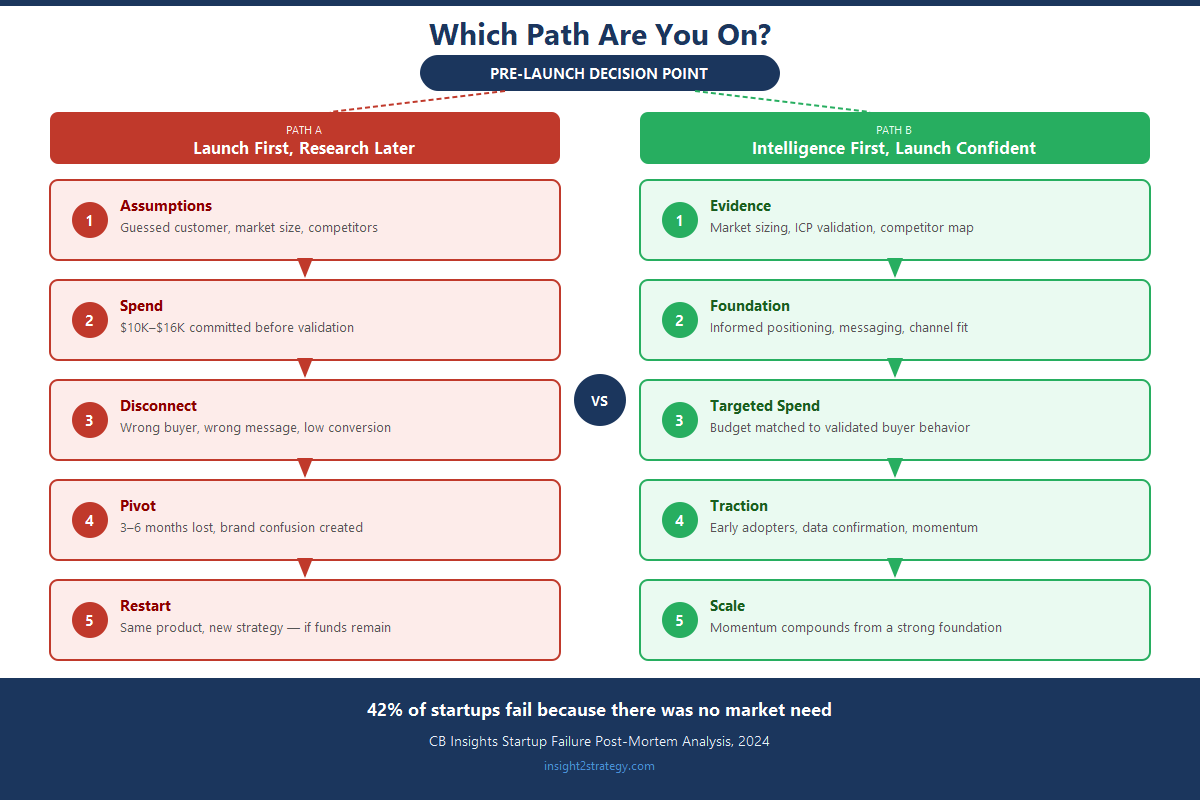
Here's what most first-time founders do: they pick a name, build a website, run some ads, and then try to figure out why nobody's buying.
The sequence is completely backwards.
Before you spend your first marketing dollar — before you even finalize your positioning — you need to know what the market actually looks like. Not what you assume it looks like. What it actually looks like. Because most business launches don't fail because of bad marketing execution. They fail because the founders were solving the wrong problem for the wrong audience in the first place — and they found out only after the budget was spent.
Why Does the Intelligence Gap Kill Most Launches?
Most pre-launch founders operate on assumptions. They assume they know who their customer is, what competitors are doing, and how large the market is. When those assumptions are wrong — and research shows they frequently are — every subsequent marketing decision compounds the error.
Research from CB Insights found that 42% of startups fail because there was no real market need for the product — the single most cited cause of startup failure, ahead of running out of cash (29%) and wrong team (23%) combined. That's not a marketing problem. That's an intelligence problem.
The cost isn't just money wasted on bad ads or wrong messaging. It's the time lost, the brand confusion created, and the momentum squandered in the first 90 days — when launch energy is highest and early adopters are paying attention. That launch window doesn't repeat itself.
The numbers frame the stakes clearly: only 40% of new businesses survive to their fifth year (U.S. Bureau of Labor Statistics, 2024). Founders who conduct structured pre-launch validation are 16% more likely to achieve viability (Harvard Business Review via Bplans Research Library, 2024). The intelligence foundation is a structural differentiator — not a nice-to-have.
⚡ Quick Implementation Tip
Before committing a single marketing dollar, write down your answers to these three questions: Who is your most-ready-to-buy customer right now (not eventually)? What indirect competitors — including the "do nothing" option — are you actually competing against? What would have to be true for your first 10 customers to find and buy from you within 90 days? If the answers feel more like hope than evidence, you have an intelligence gap.
The Six Questions Every Pre-Launch Founder Must Answer
Good launch strategy doesn't start with ads. It starts with answers. There are six intelligence questions every founder needs to answer — with evidence, not intuition — before spending anything on marketing:
1. How big is the addressable market — and which segment is accessible first?
Total addressable market is interesting. The specific segment you can actually reach and convert in the first 90 days is what pays the bills. These are very different numbers. Focus on your Serviceable Obtainable Market (SOM), not the theoretical ceiling.
2. Who are the real competitors — including the indirect ones?
Most founders check direct competitors. The harder competition is indirect: the spreadsheet a prospect already uses, the internal workaround they've built, or the "do nothing" option that beats you on price every time. If your real competitor is inertia, that changes your entire marketing strategy.
3. Who is the most ready-to-buy customer, and what triggers their decision?
There's a significant difference between someone who thinks your product is interesting and someone who is actively searching for a solution right now. Marketing becomes dramatically more efficient when you focus on the second group — and know exactly what moves them to purchase.
4. What go-to-market approach matches this market's actual buying behavior?
Some markets respond to referrals. Some research for months. Some convert on the first compelling offer. Your channel strategy should match how the market actually buys, not what marketing tactics are trending this quarter.
5. What risks exist — and which ones are manageable versus fatal?
Every market has regulatory, competitive, and operational risks. The question isn't whether they exist; it's which ones you can navigate with your actual resources and which ones would stop the business before it reaches viability.
6. What does the first 90 days look like, in sequence?
Not a vague plan — a week-by-week execution roadmap that identifies what needs to happen in what order to build real traction. Early momentum compounds in both directions.
If you cannot answer these questions with data, you're not launching a business — you're making an expensive bet. The gaps in those answers are exactly where post-launch pivots and capital-intensive corrections originate.
What Good Pre-Launch Intelligence Actually Looks Like
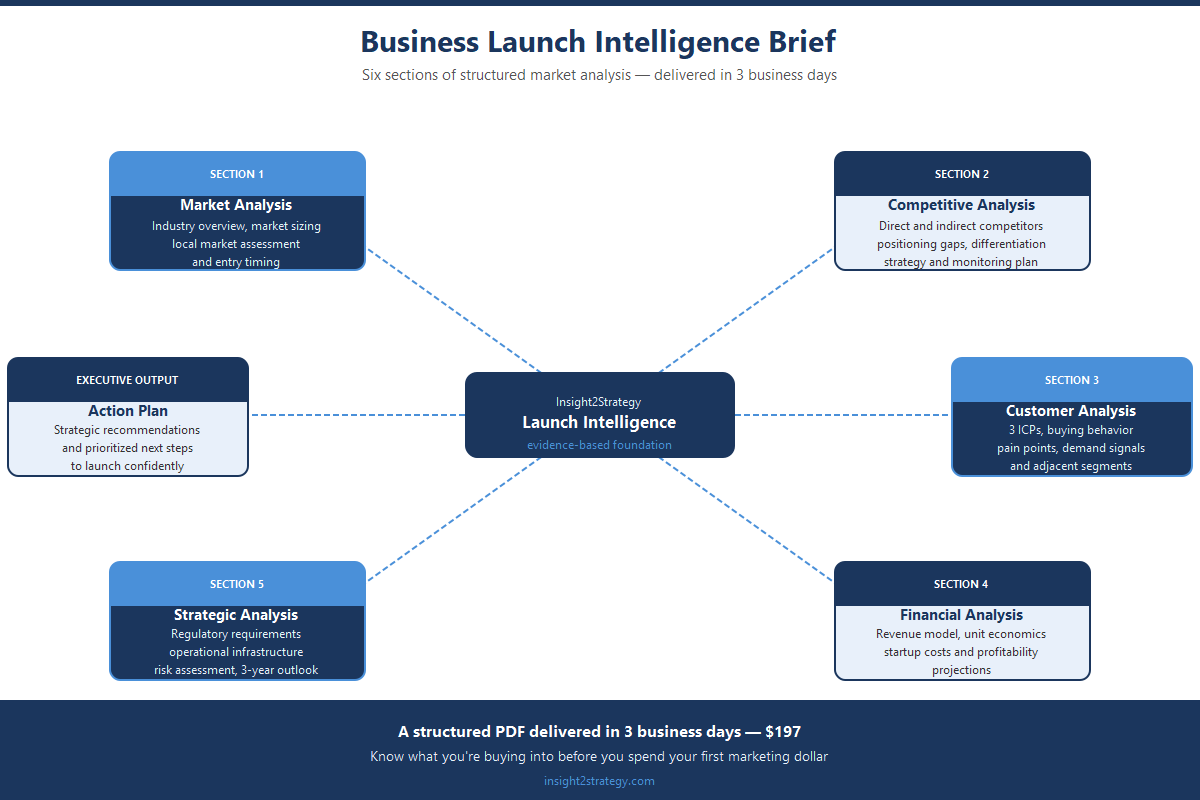
A structured intelligence brief is not a business plan. It's not a pitch deck. It's a decision-support document — built from market data, competitive research, and customer behavior analysis — designed to answer those six questions with evidence rather than intuition.
The most important element that distinguishes good intelligence from generic research is confidence tagging: every insight is labeled as validated (hard data), inferred (reasonable conclusion from available evidence), or directional (requires further verification). This transparency lets founders understand exactly where they're making informed strategic bets and where additional validation would strengthen the plan.
The practical result: cleaner positioning, more precise targeting, more efficient marketing spend, and a launch sequence built around how the market actually behaves — rather than how the founder hopes it will respond.
📊 Implementation Framework
The Business Launch Intelligence Brief applies this structured approach across six analysis sections — market analysis, competitive analysis, customer analysis, financial analysis, strategic analysis, and action plan — with confidence tagging throughout. It's designed as a decision-support document, not a research report: every section connects directly to a specific launch decision your team needs to make. Need to validate your specific assumptions before committing your budget? See what the brief delivers →
The Real Cost of Getting This Wrong
Let's talk about the math.
The average small business spends $10,000–$15,000 on marketing in its first year (SCORE Small Business Marketing Expenditure Report, 2024). Most of that budget is committed before fundamental assumptions about the customer, positioning, and channel strategy have been tested.
Consider a pattern that plays out regularly. A founder builds messaging and targeting around a clearly defined persona — the 35- to 45-year-old professional. They invest $3,000 in branding, $5,000 in a website, and $8,000 in Facebook ads, all perfectly calibrated to that demographic. After three months and $16,000, sales are minimal. They finally analyze their first ten actual customers. The real buyer isn't a corporate professional at all — it's a small business owner with completely different problems, motivations, and purchase triggers. Every piece of messaging, every ad, every channel choice needs to change. That $16,000 didn't fund marketing. It funded learning that could have been discovered before the first dollar was spent.
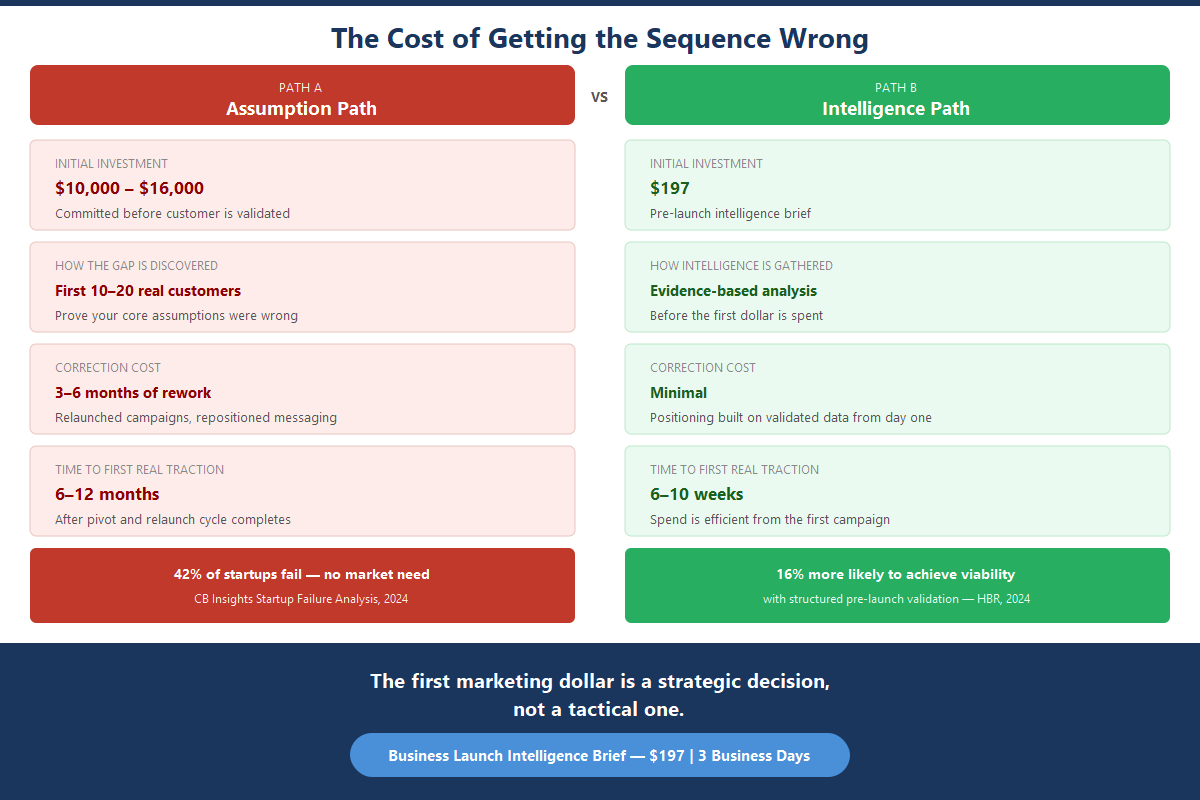
The math is straightforward: early market intelligence doesn't add cost to a launch. It redirects spend that would otherwise fund avoidable lessons.
Introducing the Business Launch Intelligence Brief
This is exactly why we created the Business Launch Intelligence Brief at Insight2Strategy.
It delivers six structured analysis sections:
- Market Analysis — industry overview, market sizing and segmentation, local market assessment, and entry timing
- Competitive Analysis — direct and indirect competitors mapped, positioning gaps identified, differentiation strategy and competitive monitoring plan
- Customer Analysis — three detailed ICPs, buying behavior, pain points, demand signal assessment, and adjacent segments
- Financial Analysis — revenue model and unit economics, startup investment requirements, profitability and operating cost projections
- Strategic Analysis — regulatory and licensing requirements, operational infrastructure, risk assessment, and 3-year outlook
- Action Plan — strategic recommendations and prioritized next steps to launch confidently
Each section includes confidence tagging so you know exactly what's based on hard data versus informed inference. The deliverable is a structured PDF report — not a consulting call — that your team can reference, revisit, and build from.
Price: $197. Delivery: 3 business days.
That pricing is intentional. At the pre-launch stage, you need intelligence fast and at a cost that makes sense before the budget has been committed elsewhere. This isn't a six-week engagement. It's the foundation that makes every subsequent marketing investment more efficient.
⚡ Quick Implementation Tip
The brief works best when ordered 30–90 days before your planned launch date — early enough that the findings can actually shape your positioning, channel strategy, and marketing budget allocation before they're locked in. If you're already 2 weeks out, the brief can still redirect spend before it's fully committed, but the earlier you get the intelligence, the more of your budget it protects.
Who This Is For — And Who It Isn't
The brief is right for:
- Founders 30–90 days from launch who want to validate or challenge their assumptions before committing their marketing budget
- Entrepreneurs entering a new market or launching a new product line from an existing business
- Teams with limited time or budget who need real intelligence without a full consulting engagement
It isn't right for:
- Businesses already 12+ months in with substantial customer data — a Competitive Intelligence Snapshot or ICP Validation Sprint produces more value at that stage
- Founders looking for a magic fix — the brief shows you what the market looks like; it doesn't manufacture demand that doesn't exist. The most valuable output might be a data-backed recommendation to reposition before launch, saving thousands of dollars and months of wasted effort
The Smartest First Marketing Investment
Most founders assume their first marketing investment should be a website, branding, or advertising. The data — and the failure patterns — point to a different answer.
When you understand the market clearly, messaging becomes obvious, targeting becomes precise, and marketing spend becomes efficient. Instead of guessing and correcting, you launch with a strategy calibrated to how the market actually behaves.
Stop guessing. Start knowing.
Get Your Business Launch Intelligence Brief
Before you spend your first marketing dollar, make sure you're solving the right problem for the right audience. Six sections of structured market analysis — delivered in 3 business days.
- ✓ Market analysis — industry overview, sizing, local assessment, entry timing
- ✓ Competitive analysis — direct and indirect competitors, positioning gaps
- ✓ Customer analysis — 3 ICPs, buying behavior, demand signals
- ✓ Financial analysis — revenue model, unit economics, startup costs
- ✓ Strategic analysis — regulatory requirements, risk assessment, 3-year outlook
- ✓ Action plan — strategic recommendations and prioritized next steps
Delivered as a structured PDF in 3 business days. No sales pitch. Just the intelligence that makes your first marketing dollar work.
|
This post is part of The B2B Marketing Reality Check The strategic framework for growth-stage B2B tech companies — now available in paperback and Kindle. Every topic we cover in this blog goes deeper in the book, with frameworks, diagnostics, and quick wins you can put to work immediately. Get the Free PDF →Want to work through the framework hands-on? Get the companion workbook → |
Frequently Asked Questions
Why do most startups fail in the first year?
The most commonly cited cause — according to CB Insights' 2024 startup failure post-mortem analysis — is no real market need, accounting for 42% of failures. This beats running out of cash (29%) and wrong team (23%) combined. Most of these failures share a common pattern: founders moved from idea to marketing spend without first validating their core assumptions about who the customer is, what the competitive landscape looks like, and what the market is actually willing to pay. The intelligence work was skipped, and the spending started too soon.
What research should I do before starting a business?
At minimum, you need evidence-based answers to six questions before committing your marketing budget: how large and accessible your target market is (specifically your Serviceable Obtainable Market, not just TAM); who your real competitors are including indirect alternatives; who your most ready-to-buy customer is and what triggers their purchase decision; which go-to-market channels match how your market actually buys; which regulatory, competitive, and operational risks are manageable versus fatal; and what your week-by-week first 90-day execution sequence looks like. Most founders can answer these from intuition. The ones who answer them from data launch more efficiently.
Is market research worth it for a small business?
The data consistently says yes. Founders with structured pre-launch validation are 16% more likely to achieve viability (Harvard Business Review via Bplans Research Library, 2024). More practically: the average small business spends $10,000–$15,000 on marketing in year one. If that budget is committed before assumptions about the customer and positioning have been validated, a significant portion funds avoidable corrections rather than actual traction. Market intelligence doesn't add cost to a launch — it redirects spend that would otherwise fund expensive lessons.
How is the Business Launch Intelligence Brief different from a business plan?
A business plan is typically a forward-looking document used for planning or fundraising — it projects what you expect to happen. The Business Launch Intelligence Brief is a decision-support document — it tells you what the market actually looks like so your strategic decisions are based on evidence rather than assumption. It includes confidence tagging throughout, explicitly labeling each insight as validated (hard data), inferred (reasonable conclusion from available evidence), or directional (requires further verification). That transparency is what makes it useful as a decision tool rather than just a research summary.
How do I validate my business idea before spending money?
Start by building evidence for each of the six questions above. For market sizing, use industry reports and local market data to quantify your realistic first-90-days opportunity. For competitor mapping, document both direct and indirect alternatives including the "do nothing" option. For customer validation, identify three to five specific personas and research where they currently get what you're offering, what they pay, and what would trigger a switch. The Business Launch Intelligence Brief does this structured analysis for you — $197 delivers a complete decision-support document in 3 business days, before your budget is committed anywhere.
Verified Statistics & Sources
| Statistic | Source | Status |
|---|---|---|
| 42% of startups fail — no market need | CB Insights Startup Failure Post-Mortem Analysis, 2024 | ✅ Validated |
| 16% more likely to achieve viability with structured planning | HBR via Bplans Research Library, 2024 | ✅ Validated |
| Only 40% of new businesses survive to year 5 | U.S. Bureau of Labor Statistics, Business Employment Dynamics, 2024 | ✅ Validated |
| Average $10K–$15K first-year marketing spend | SCORE Small Business Marketing Expenditure Report, 2024 | ⚠️ Validated range; "before validation" qualifier is directional |
Insight2Strategy
Strategic intelligence for founders and business leaders who want to make better decisions before the budget is spent.
Business Launch Intelligence Brief — $197 | 3 Business Days →


Comments
Post a Comment