The Market Education Tactics That Actually Backfire (And What to Do Instead)
The Market Education Tactics That Actually Backfire (And What to Do Instead)
Strategic Analysis by: Insight2Strategy
Published: May 4, 2026
Executive Reading Time: 7 minutes
Executive Strategic Insights
- Volume is not a strategy. Content without sequencing creates decision paralysis — 60% of B2B buying cycles end in "no decision," often due to information overload.
- Overcorrecting away from your product hurts conversion. Content so neutral that it leaves buyers directionless hands the close to competitors.
- Engagement ≠ comprehension. Readers absorb ~20% of web content on average. Your central argument may not be landing even when metrics look solid.
- Sophisticated buyers still need clarity, not complexity. "Simple" doesn't mean dumbed down — it means clear. Clarity builds authority.
- The root cause of all four myths: writing from your perspective, not your buyer's. The fix starts with diagnosing where the misalignment lives — before producing more content.
Not all educational content educates.
Some of it confuses. Some makes buyers feel talked down to. And some — perhaps most damaging — teaches buyers exactly enough to decide they don't need you.
If you've poured time and budget into "helpful" content only to watch pipeline stall, you're not alone. The problem usually isn't your team's effort or production quality. It's the assumptions underneath the content strategy — assumptions that feel responsible, even virtuous, but consistently backfire in practice.
The stakes are significant. According to Gartner, B2B buyers now spend just 17% of their total buying journey meeting with potential suppliers. [Gartner, 2022] The rest is independent research — and your content is doing most of the teaching. If that teaching is built on flawed assumptions, you're not just missing opportunities. You're actively creating confusion.
Here are four market education myths that backfire — and what strategic companies do instead.
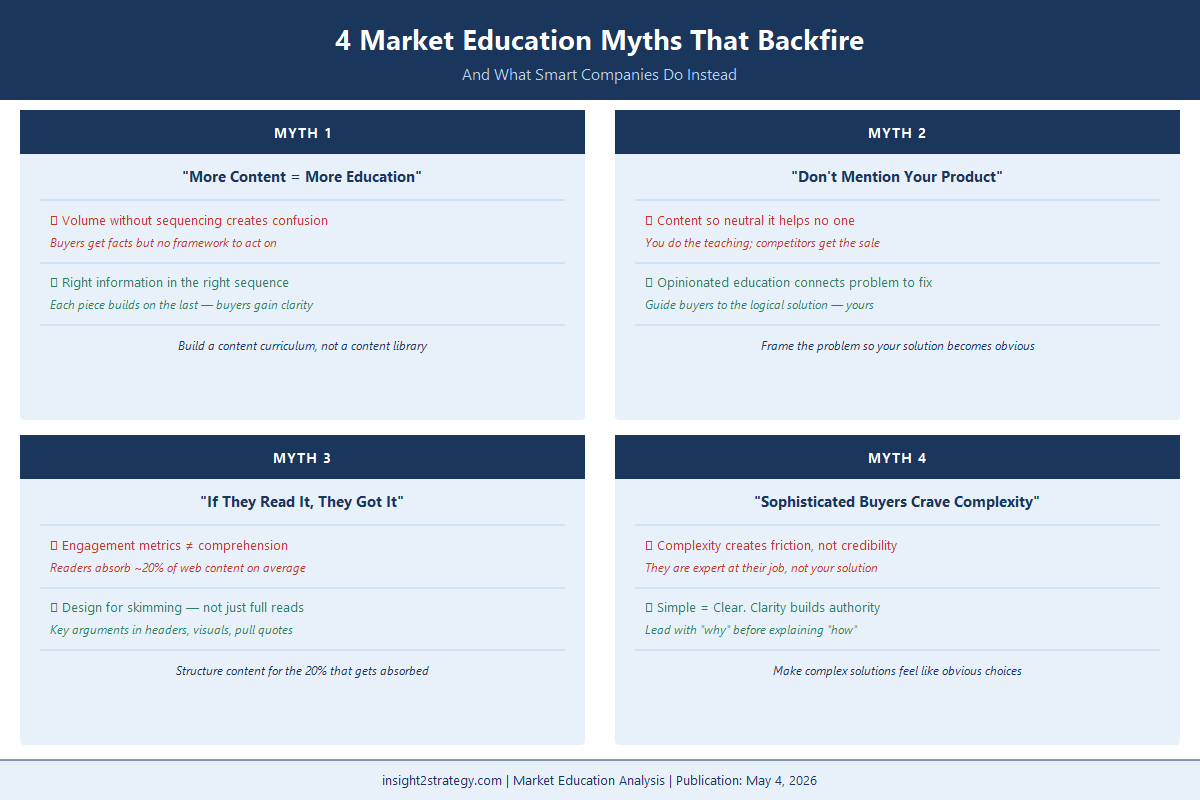
Myth 1: "More Content = More Education"
The logic is seductive: if buyers need education, produce more of it. More blog posts. More webinars. More whitepapers. More downloads. Volume signals commitment and breadth.
Why it backfires: Without strategic sequencing, content volume doesn't educate — it overwhelms. Buyers encounter dozens of disconnected pieces with no clear narrative thread. They leave with scattered information but no framework for understanding their problem. The result is decision paralysis, not clarity.
Research from Forrester shows that 60% of B2B buying cycles end in "no decision" — and information overload without clear sequencing is a leading contributor. [Forrester Research] Meanwhile, most buyers complete 57–70% of their purchase research before ever speaking with a vendor. [Corporate Executive Board / Gartner] If that independent research consists of random content with no through-line, buyers arrive at sales conversations confused rather than primed.
The reality: Effective market education works like a curriculum, not a content warehouse. Smart companies structure content around progressive understanding:
- Problem framing — What is happening in the market and why should the buyer care?
- Root cause clarity — Why does this problem exist, and why do conventional approaches fall short?
- Solution categories — What types of approaches actually resolve it?
- Solution differentiation — Why do certain approaches work better for specific contexts?
When content follows this sequence, buyers move from confusion to confidence — and your solution enters the picture naturally at the right moment.
⚡ Quick Implementation Tip
Audit your existing content library by mapping each piece to one of four phases: Problem Framing, Root Cause, Solution Categories, or Differentiation. If 80% of your pieces cluster in Phase 1 (Problem Framing), you've found your gap — and your next three content priorities.
Example: A SaaS company publishing 40+ pieces per quarter had strong open rates and flat pipeline. After cutting output by 60% and restructuring the remaining content into a sequenced buyer journey (problem → implications → solution framework → proof), demo requests increased 3.2x in 90 days with half the effort. Less content, more architecture.
Myth 2: "Educational Content Shouldn't Mention Your Product"
This myth emerges from legitimate concerns about overly promotional content. The correction seems sensible: stay neutral, build trust first, let buyers decide on their own. The result is content so carefully scrubbed of product context that it fails to connect the buyer's problem to any solution — including yours.
Why it backfires: Buyers don't separate education and evaluation. They are simultaneously learning about the problem and looking for a tool to solve it. When your content validates the problem clearly but provides no directional signal about capable solutions, you've done the category's heavy lifting while handing the conversion opportunity to whoever connects the dots next — often a competitor.
You did the teaching. Someone else gets the sale.
The reality: The best educational content is opinionated. It doesn't pitch a product — it teaches buyers how to think about the problem in a way that naturally surfaces what an effective solution must include. The goal isn't to mention your product constantly. It's to frame the problem specifically enough that your approach becomes the logical inference.
The difference is calibration, not avoidance. Mentioning a solution is not the problem. Mentioning it before earning credibility is. Connecting problem to approach after establishing stakes is not sales — it's guidance.
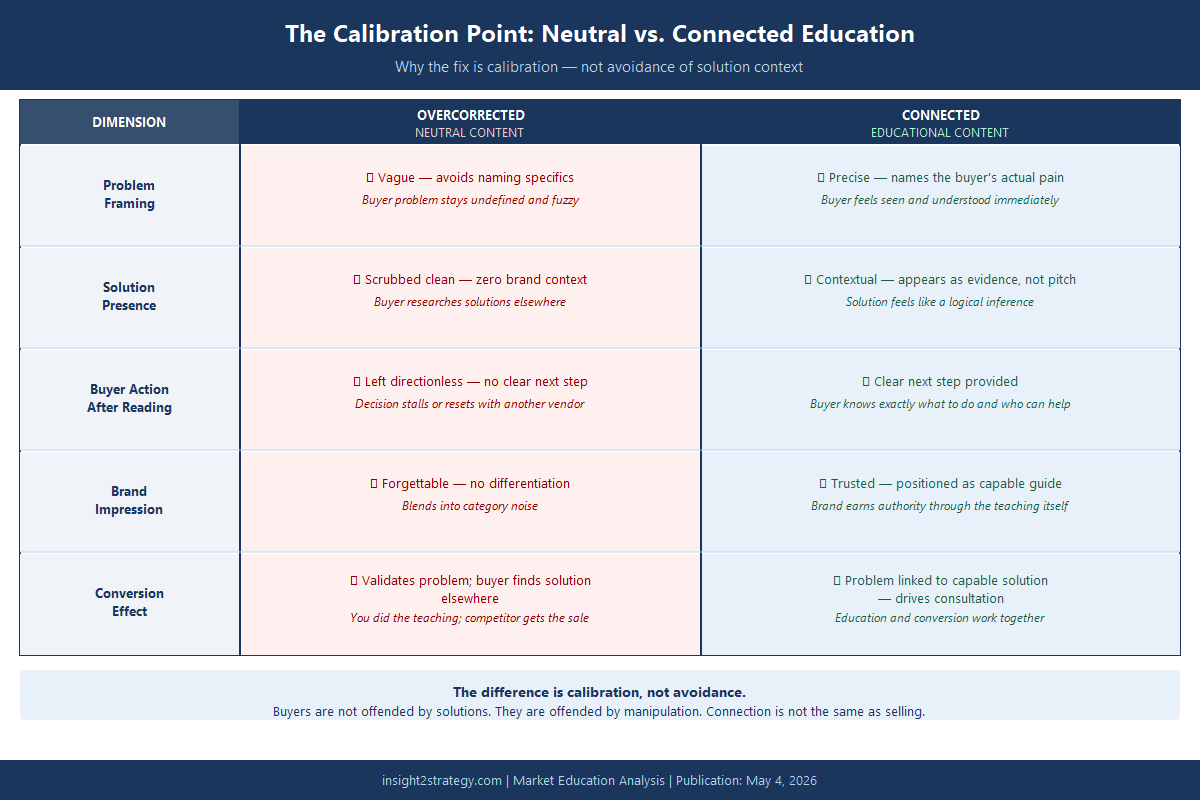
Example: A manufacturing technology firm's whitepapers read like academic papers — rigorous and completely vendor-neutral. Downloads were solid; closed deals were not. When they rewrote one piece to include an anonymized case study showing "how leading manufacturers reduced downtime by 40% using a proven implementation approach," conversion from download to sales conversation increased 47%. Same educational intent, different connective tissue.
Myth 3: "If They Read It, They Understood It"
Open rates look solid. Time-on-page is respectable. Social shares are climbing. The content is clearly working.
Except engagement isn't comprehension.
Why it backfires: The Nielsen Norman Group's decades of web reading research find that readers absorb, on average, about 20% of the text on a given web page. [Nielsen Norman Group] They scan, skim, jump to sections that match their current mental context, and leave having extracted fragments rather than frameworks. Your buyer may have read your whitepaper on implementation complexity and come away with the one data point that happened to catch their eye — while missing the strategic argument entirely.
The downstream consequence is real: a McKinsey study found that while 97% of B2B companies believe their value proposition is clearly articulated, only 65% of customers agree — a 32-point gap where deals quietly die. [McKinsey & Company] That gap is, in part, a comprehension failure. Buyers thought they understood. They didn't.
The reality: Effective educational content is designed for scanning, not just reading. Key arguments appear in headers, pull quotes, and visuals — not just body paragraphs. Frameworks are named and repeated across content pieces so they stick through repetition. Summaries arrive at the beginning, not the end.
If your central insight requires reading paragraphs six through nine to grasp, most of your audience won't grasp it.
⚡ Quick Implementation Tip
Run the "skimmer test" on your next piece before publishing: cover the body text and read only the headers, bold phrases, pull quotes, and image captions. If the core argument isn't clear from that pass alone, redesign the structure — not the writing.
Example: An IT services company ran a popular webinar series with 400+ attendees per session. Post-webinar surveys revealed that only 18% could correctly explain the core concept two weeks later. After redesigning content with built-in recaps, visual decision trees, and a one-page takeaway summary, comprehension doubled — and sales-qualified leads from the series increased 65%.
Myth 4: "Our Buyers Are Too Sophisticated for Simple Explanations"
This myth is nearly universal among companies selling to technical buyers, executives, or specialist audiences. The logic follows: sophisticated people want sophisticated content. Oversimplifying will insult them. Lead with technical depth to signal credibility.
Why it backfires: This is the intellectual ego trap. Sophisticated buyers are experts in their domain — not in your specific category, methodology, or solution. A CTO with 20 years of infrastructure experience still needs clear problem-solution framing for a category she's evaluating for the first time. Her sophistication doesn't change the way the brain processes new conceptual frameworks. No one has ever complained that something was too easy to understand.
What does frustrate sophisticated buyers: content that requires them to become experts in your product before they can evaluate whether it's relevant to their situation.
The reality: "Simple" does not mean "dumbed down." Simple means clear. The higher the complexity of your solution, the higher the requirement for clear messaging. Your job is to make a complex solution feel like an obvious choice — not to prove how smart your engineers are.
A powerful diagnostic: can a buyer grasp the core concept in 30 seconds from your hero content? If not, they won't invest the next 30 minutes to understand it. Lead with the why, not the how.
Example: A firm selling AI-powered diagnostic tools for medical imaging led its educational content with language about "convolutional neural networks" and "multi-modal predictive modeling." Radiologists — the actual buyers — found it impressive but impenetrable. When the firm rewrote its explainer to lead with an analogy ("Our AI is like a second, tireless radiologist that flags issues hidden to the human eye, reducing diagnosis time from days to minutes"), they established a clear, compelling concept before diving into technical depth. Demo requests from technical decision-makers increased 2.8x. Same technology, different entry point.
📊 Implementation Framework
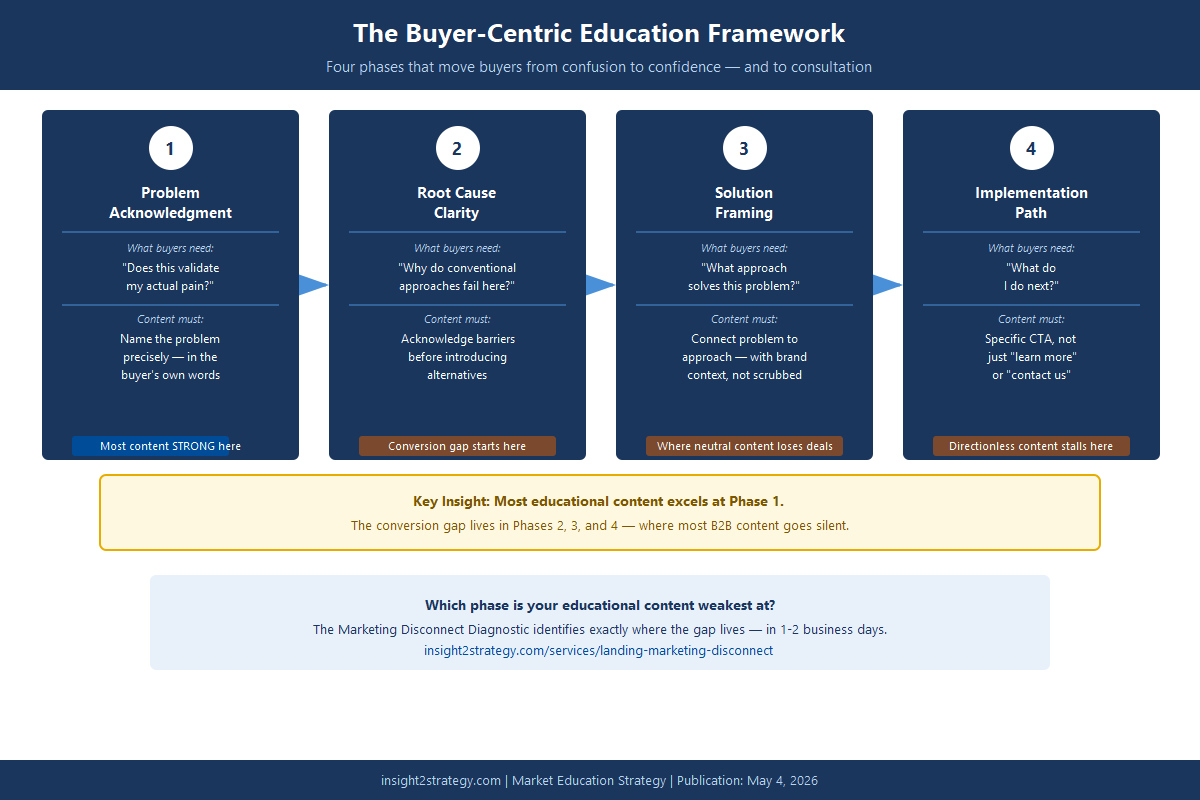
Use the four-phase buyer-centric framework to audit your existing content: Does each piece explicitly address Phase 1 (Problem Acknowledgment), Phase 2 (Root Cause Clarity), Phase 3 (Solution Framing), and Phase 4 (Implementation Path)? Most content stacks up in Phase 1 and goes silent in Phases 2–4 — which is exactly where the conversion gap lives. Need help mapping your content to this framework? Let's discuss your specific situation.
The Common Thread in All Four Myths
Read these four myths together and a single root cause emerges: you're writing from your perspective, not your buyer's.
- Volume (Myth 1) makes you feel productive and thorough — but it's not what the buyer needs to move forward.
- Product neutrality (Myth 2) makes you feel safe from the "too salesy" label — but it leaves the buyer directionless.
- Assuming comprehension (Myth 3) lets you check the box and move on — but the buyer hasn't absorbed the message.
- Embracing complexity (Myth 4) signals internal credibility — but it doesn't help the buyer make a confident decision.
The purpose of market education isn't to distribute information. It's to create buyer confidence — to move someone from "I have a problem" to "I understand my options and I know who can help." That journey requires writing from where the buyer is standing, not from where you are.
This is one reason that despite high content marketing investment, 87% of B2B marketers cite proving content ROI as a persistent challenge. [Content Marketing Institute, 2024] The issue usually isn't execution quality. It's that content is solving for what the company wants to say rather than what the buyer needs to understand.
|
This post is part of The B2B Marketing Reality Check The strategic framework for growth-stage B2B tech companies — now available in paperback and Kindle. Every topic we cover in this blog goes deeper in the book, with frameworks, diagnostics, and quick wins you can put to work immediately. Get the Free PDF →Want to work through the framework hands-on? Get the companion workbook → |
Frequently Asked Questions
How do I know if my educational content has a marketing disconnect?
The clearest signal is content that performs well by traditional metrics (opens, views, downloads) but doesn't generate qualified conversations or move pipeline. Other signals: buyers who engage with your content but arrive at sales calls with fundamental misunderstandings about your offering; high bounce rates on service pages despite strong blog traffic; or buyers who "did their research" but chose a competitor. Any of these patterns points to a gap between what you think you're communicating and what buyers actually take away.
Should we reduce our content volume or reorganize what we have?
Usually both — but start with reorganization. Map your existing content library to the four phases: Problem Acknowledgment, Root Cause Clarity, Solution Framing, Implementation Path. You'll often find that 70–80% of pieces cluster in Phase 1. Rather than immediately creating new Phase 2–4 content, look for existing pieces that can be repositioned or lightly rewritten to fill the gaps. Reduction in volume is often a byproduct of this audit — not the starting point.
Is it ever appropriate to mention our product in educational content?
Yes — with one condition: earn the right to mention it first. The pattern that works is: (1) establish the problem clearly and specifically, (2) explain why conventional approaches fall short, (3) introduce what an effective solution must include, and then (4) show how your approach delivers those capabilities. At step 4, a product or methodology reference is guidance, not a pitch. Skipping steps 1–3 and jumping straight to step 4 is what creates the "salesy" perception.
How do we measure whether buyers actually understood our content — not just engaged with it?
A few practical approaches: (1) Add a brief self-assessment or quiz at the end of key content pieces and track completion; (2) use follow-up email sequences that ask buyers to apply a concept ("Does this gap exist in your organization?") and measure response rates; (3) review sales call transcripts for evidence that buyers arrive with the right mental model — or don't. The fastest diagnostic: review the questions your sales team gets asked most often. If buyers are asking basic questions that your content is supposed to answer, you have a comprehension failure, not an awareness problem.
Ready to Identify Where Your Education Strategy Is Backfiring?
If your educational content feels like it should be working but isn't moving buyers, the gap is almost always between what you think you're communicating and what buyers actually take away.
Our Marketing Disconnect Diagnostic identifies exactly where that misalignment lives — in your messaging, your sequence, or your content format — in 1–2 business days. You'll walk away with a clear picture of what's working, what's backfiring, and where to focus next.
Or schedule a free strategy conversation to discuss your specific situation first.
About Insight2Strategy
We help growing businesses cut through marketing confusion to find strategies that actually drive revenue and customer growth. Our Marketing Disconnect Diagnostic identifies exactly where messaging gaps live — so you fix the right problems first.
insight2strategy.com | Free Consultation
Part of the Insight2Strategy Quick Wins Series — practical frameworks for marketing leaders who need results, not theory.


Comments
Post a Comment