Before You Automate Anything, Run This 3-Signal Triage
Before You Automate Anything, Run This 3-Signal Triage
Strategic Analysis by: Insight2Strategy
Published: November 9, 2026
Executive Reading Time: 6 minutes
Executive Strategic Insights
- Automation budget usually follows the loudest complaint, not the highest-cost process — a 3-signal triage fixes that before you spend a dollar.
- Score any recurring task 1-5 on Error-Prone, Manual Effort, and Frequency to see the real priority order.
- Only about 5% of generative AI efforts produce measurable business impact (MIT NANDA, 2025) — disciplined problem selection is the differentiator.
- Automation is the last intervention, not the first: eliminate, standardize, template, and reorganize come before any tool.
- A free Process Triage Calculator and 90-day measurement worksheet turn this into a repeatable quarterly practice.
Framework detailed below.
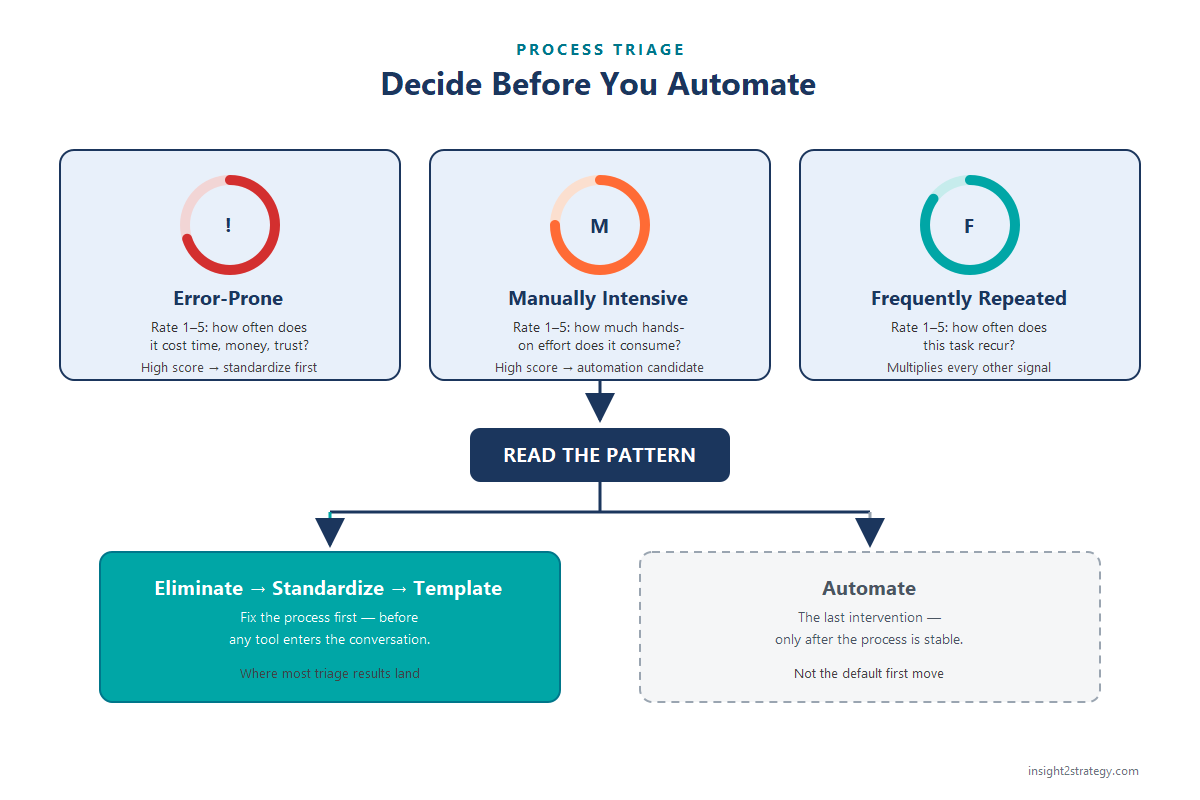
Most businesses automate the loudest problem. The smart ones automate the right one — and a three-signal triage tells you which task that is before you spend a dollar or write a line of code.
A few months ago, a business owner told us they needed AI to fix customer onboarding. Their team spent hours a week on emails, spreadsheets, follow-ups, and reminders — a textbook automation candidate on the surface. But walking through the workflow, the real problem wasn't the repetitive work. It was that every employee did the process differently. No automation platform fixes inconsistent decisions; it just makes inconsistent work happen faster.
That's the mistake underneath most failed automation spend: budget follows whichever process complains the loudest, not whichever process is actually costing the most. The organizations getting real returns from AI aren't using more sophisticated tools — they're more disciplined about what they fix first. According to research from MIT's NANDA initiative, roughly 5% of generative AI efforts produce meaningful business impact, while about 95% of pilots deliver no measurable P&L improvement (MIT NANDA, "The GenAI Divide: State of AI in Business 2025," reported by Fortune, August 2025). The common thread among the successful 5% isn't a bigger budget — it's disciplined problem selection.
That's why every automation conversation should start with a simple triage. Before you spend a dollar. Before another subscription. Before someone says, "AI can probably do that."
1. Why Triage Before Tools
Every business runs dozens of recurring processes — invoice approvals, lead qualification, proposal creation, onboarding, reporting, scheduling. The temptation is always to start with whichever one generates the most complaints. But the loudest problem isn't always the highest-value one; sometimes it's just the most visible.
Triage forces you to evaluate work objectively before deciding how to fix it — because automation isn't actually the first option. It's usually the last. The progression looks like this: eliminate unnecessary work, standardize decisions, create templates or checklists, improve ownership, then automate what's left. Too many organizations skip straight to the final step.
2. Signal 1: Is It Error-Prone?
Rate the task 1-5 on how often it produces mistakes that cost time, money, or trust. A "1" almost never causes problems; a "5" creates customer issues, lost revenue, compliance concerns, or damaged trust on a regular basis.
This question isn't really about automation — it's about consistency. If five employees perform a task five different ways, automation isn't the priority; standardization is. Documented steps, templates, and decision rules make the process predictable. Only once it's predictable should automation enter the conversation, because automation multiplies whatever you feed it — consistency or inconsistency alike. Many teams find that a simple checklist or template resolves a meaningful share of these errors before any tooling is involved.
3. Signal 2: Is It Manually Intensive?
Rate 1-5 on how much hands-on effort the task consumes — hours per week, clicks, copy-paste, manual data entry, administrative overhead. This is the classic automation sweet spot, especially when the work requires little judgment: moving data between systems, generating recurring reports, sending reminders, updating CRM records, routing requests. If employees spend hours doing something a computer can reliably do in seconds, automation deserves serious consideration.
⚡ Quick Implementation Tip
Can't decide where to triage first? Multiply hours saved per instance by how often the task happens — Time Saved × Frequency = Opportunity. The biggest number wins your first round.
4. Signal 3: Is It Frequently Repeated?
Rate 1-5 on how often the task recurs. A process performed once a quarter probably isn't worth automating, no matter how annoying. But a five-minute task performed fifty times a day quietly consumes enormous capacity. Frequency compounds — the simplest way to see it is Time Saved × Frequency = Opportunity, and most teams underestimate that multiplier significantly.
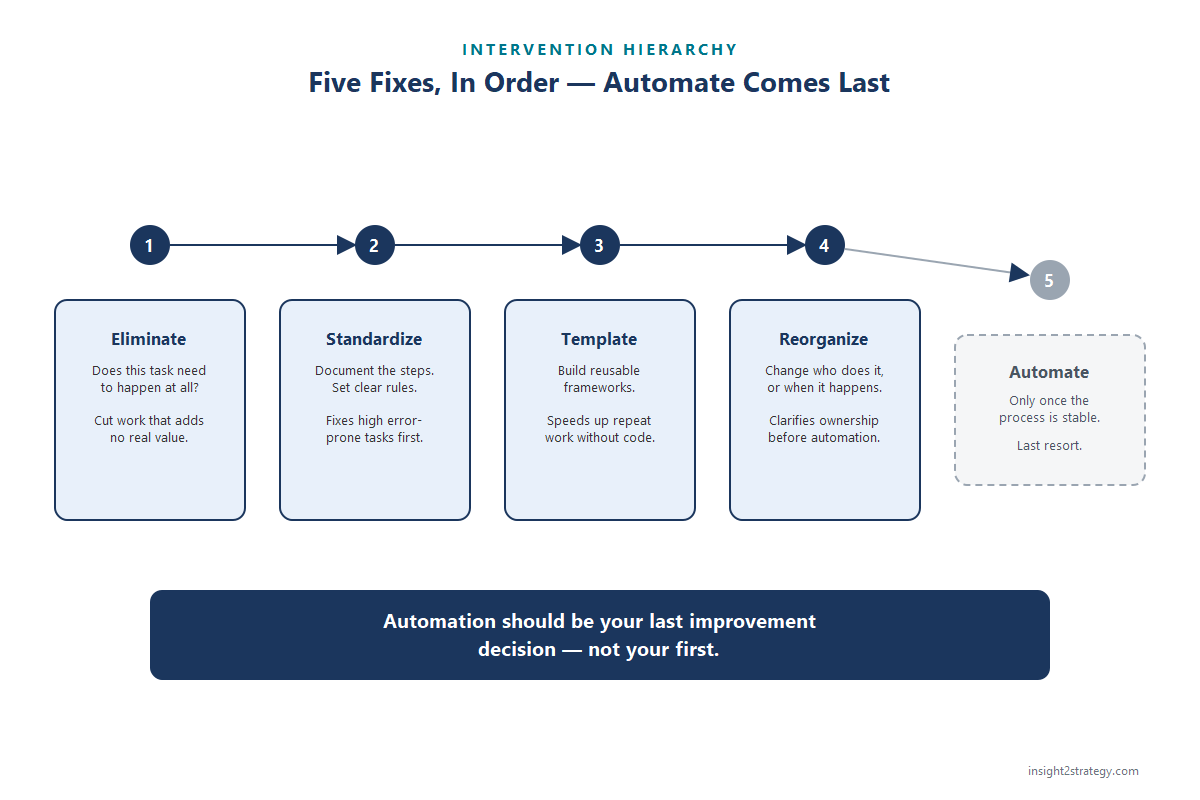
5. Read the Pattern, Pick the Intervention
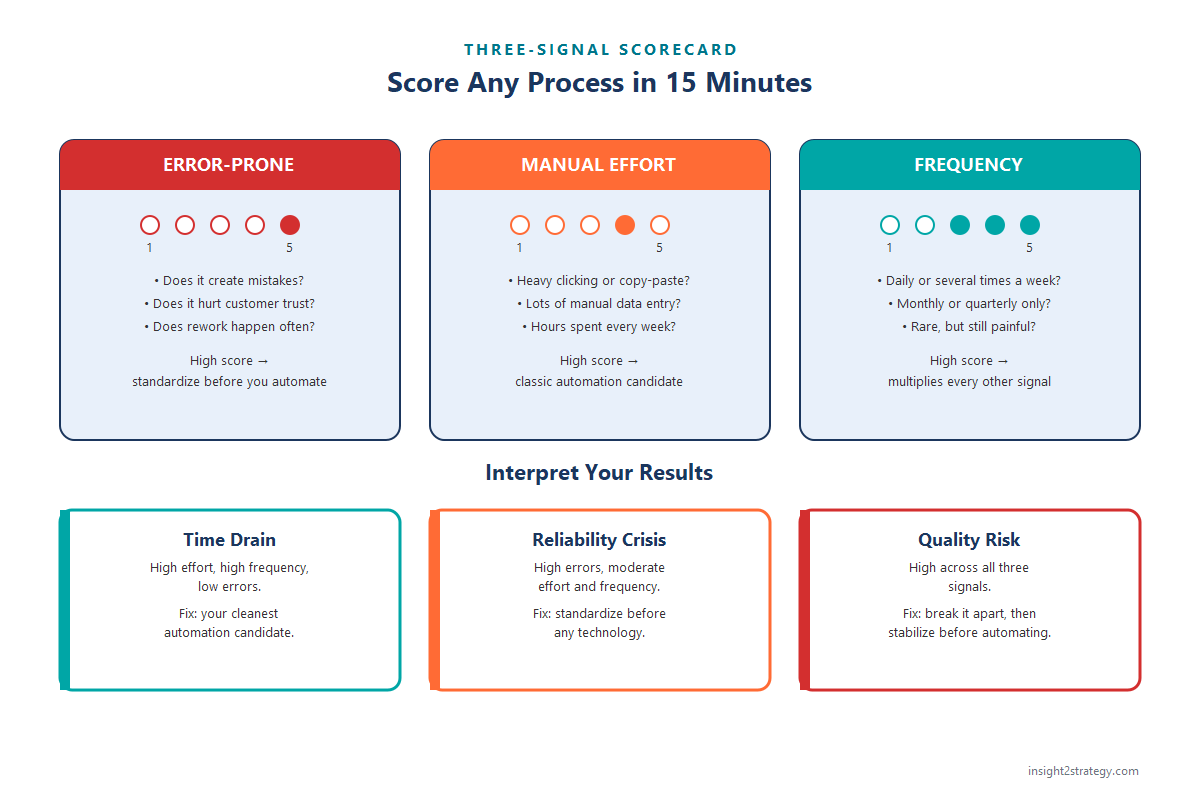
The total score matters less than the pattern the three scores form:
Time Drain — high manual effort, high frequency, low error rate. The work is already reliable; people are just spending too much time on it. This is the cleanest automation candidate, and it typically delivers quick ROI because it removes repetitive effort without adding business risk. Weekly reports, appointment reminders, CRM updates, and file organization are common examples.
Reliability Crisis — high error rate, moderate manual work and frequency. Don't automate — standardize. Build SOPs, decision trees, templates, and approval rules. Quality usually improves before any technology enters the picture.
Quality Risk — high scores across all three signals. This is the pattern that triggers the most internal panic and the most premature automation spend. Resist it. Break the workflow into smaller pieces, identify where mistakes originate, eliminate unnecessary decisions, clarify ownership — then automate only the stable portions.
The readiness gap is bigger than the technology gap. Many organizations believe they have an AI problem; in reality, they have a process problem. Gartner's 2026 CMO Spend Survey found that 70% of CMOs want to lead AI initiatives, but only 30% believe their organization is ready to scale it. Similarly, WRITER's 2026 AI Adoption in the Enterprise research found that 75% of executives say their company's AI strategy is "more for show" than real operational guidance. Buying software is easy; building repeatable processes takes discipline — and triage is what closes that gap.
Quick Wins Using the Triage
Client Onboarding: Often scores high on all three signals. Fix: build a standardized checklist and template pack first, then automate data population. Result: meaningfully shorter onboarding time and fewer dropped steps.
Reporting: Typically error-prone and time-draining. Fix: standardize data sources and dashboard formats before automating generation.
Content Distribution: High manual effort, high frequency, low error rate — a genuine Time Drain. Fix: template the format, then automate scheduling and distribution.
📊 Want the Complete Framework?
The three signals above work as a mental model — but the Process Triage Calculator scores your own task list automatically and maps each result straight to the right intervention. Sign up below for instant access.
6. Measure for 90 Days
Whichever intervention you choose, name one metric it should move — cycle time, error rate, hours reclaimed, customer satisfaction, revenue — and track it for a full quarter. Resist declaring victory after two weeks; most process changes need time for adoption before a real trend shows up. Measurement is what turns process improvement from opinion into evidence.
|
This 3-signal triage comes from The Lazy Engineer's Advantage Our free book on eliminating operational friction includes this Process Triage Calculator plus a full process audit worksheet — free to download. Get the Free Book → |
7. Your Next Step: The Process Triage Calculator
You don't have to run this scoring exercise from scratch. The Process Triage Calculator scores any recurring task on all three signals, identifies the pattern automatically, and recommends the right fix — eliminate, standardize, template, reorganize, or automate — before you invest time or money. It also includes a process audit worksheet from our free book, The Lazy Engineer's Advantage.
Frequently Asked Questions
Why shouldn't I just automate my biggest time-waster right away?
Because "biggest time-waster" only measures one signal — manual effort. A task can eat hours every week and still be the wrong place to start if it's also riddled with errors (a Reliability Crisis) or genuinely rare (low frequency, low ROI on automation). Score all three signals first.
How do I decide whether to standardize or automate a process?
Check the error rate. High errors with moderate effort and frequency is a Reliability Crisis — standardize with SOPs and templates first. Automating an inconsistent process just executes the inconsistency faster.
What if a task scores high on all three signals?
That's a Quality Risk. Resist the instinct to treat it as an automation emergency. Break the workflow into smaller pieces, stabilize the parts that are breaking, and automate only what's proven stable.
How often should I revisit this triage?
Quarterly is a good default. New recurring tasks accumulate faster than most teams notice, and a task that scored low six months ago may score very differently once frequency or error rate has crept up.
Got a Tangled Set of Processes to Prioritize?
All three signals above are yours to score today — the exercise takes about fifteen minutes and requires nothing but a task list and a pen. If you'd rather work through a dozen "should I automate this?" questions with a second set of eyes, a free consultation can help you build a prioritized 90-day plan.
No sales pitch. Just a prioritized plan for what to fix first.
Sources: MIT Initiative on the Digital Economy (NANDA), "The GenAI Divide: State of AI in Business 2025," reported by Fortune (August 2025). Gartner, 2026 CMO Spend Survey (May 2026). WRITER, "2026 AI Adoption in the Enterprise."


Comments
Post a Comment