Your Buyers Are Asking ChatGPT Who to Hire. You're Not in the Answer.
Your Buyers Are Asking ChatGPT Who to Hire. You're Not in the Answer.
Strategic Analysis by: Insight2Strategy
Published: October 5, 2026
Executive Reading Time: 8 minutes
Executive Strategic Insights
- The entry point has moved. 89% of B2B buyers now use generative AI throughout the purchase process — building vendor shortlists inside AI answers before visiting any website.
- SEO ranking does not equal AI citation. You can hold a page-one Google position and still be absent from 97% of the AI-generated answers buyers receive about your category.
- The exclusion is invisible. No impression, no bounce, no analytics signal when an AI answer omits your brand. Companies are losing pipeline they cannot see losing.
- The stakes are concrete. 69% of B2B buyers chose a different vendor than planned based on AI guidance; one-third purchased from a company they had never previously heard of (G2, Apr 2026).
- The diagnostic is available today. A 15-minute AI search test reveals your current citation presence — the baseline any GEO strategy must start from.
By the time a B2B buyer reaches your website, they have often already asked an AI assistant who the credible vendors are — and built a shortlist from the answer. If your company is not in that answer, you were eliminated before you knew the race had started.
This is no longer a future trend. It's happening today in buying committees across industries. Your prospects aren't starting with Google. They're starting with ChatGPT, Claude, Perplexity, and Google's AI Overviews. And most brands are completely missing from those synthesized answers.
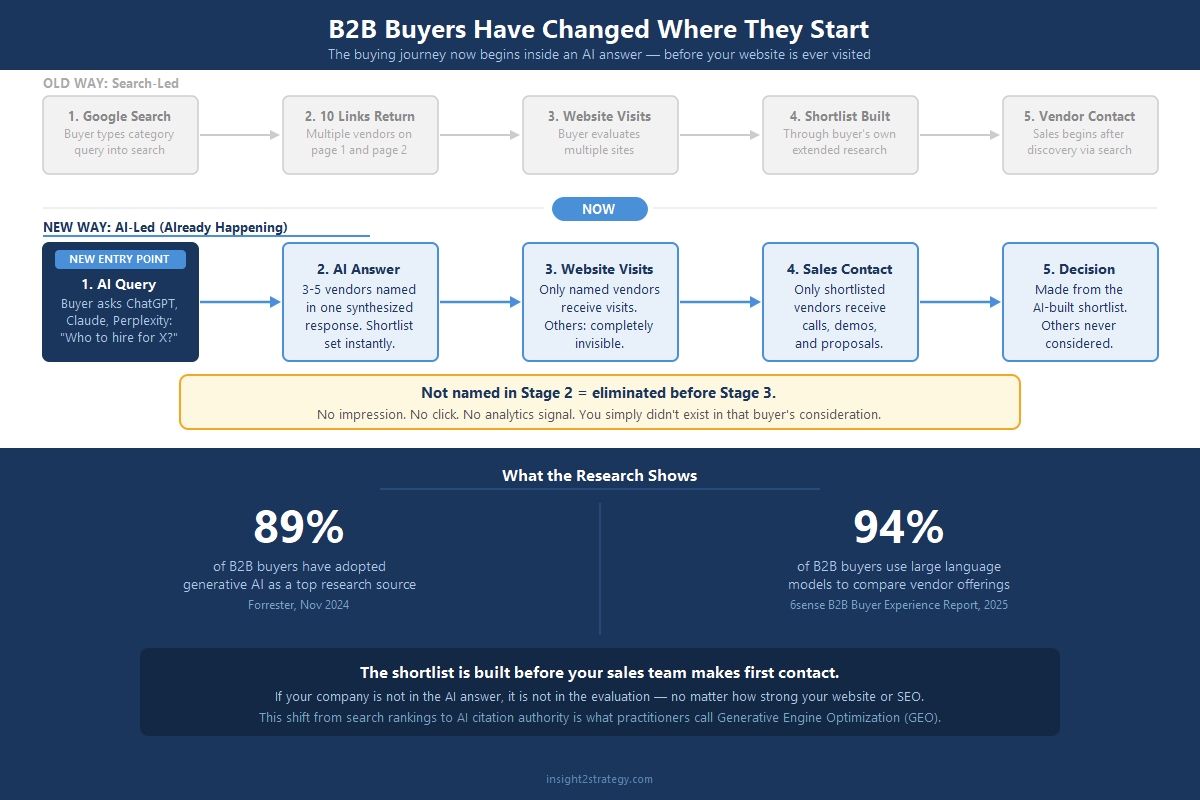
The Buying Journey Now Starts Inside an AI Answer
B2B buyers have always valued efficiency. When faced with complex procurement decisions, they seek reliable information that cuts through marketing noise. Today, that means opening an AI assistant instead of a search engine and asking questions like:
- "Best project management tools for manufacturing teams"
- "Who are the top vendors for cybersecurity compliance in healthcare?"
- "Compare ERP systems for mid-market distribution companies"
- "Find me a marketing strategy consultancy for B2B tech companies"
The AI doesn't return ten blue links. It returns a curated shortlist with descriptions, pros, and recommendations — synthesized from millions of data points. Your brand either appears in that answer or it doesn't.
This shift is mainstream, not experimental. According to Forrester's B2B Buyer Adoption of Generative AI report (Nov 2024), 89% of B2B buyers have adopted generative AI, naming it a top source of self-guided information in every phase of the buying process. The 2025 6sense B2B Buyer Experience Report reinforces this: 94% of B2B buyers use large language models during the buying process, frequently to compare vendor offerings before visiting a single vendor website.
Think about what that means in practice. Your carefully crafted website, case studies, and thought leadership content are being evaluated after an AI has already created an initial consideration set. If you're not on it, you're invisible before the race begins.
Why This Is Different From Traditional SEO
The natural response from many marketing leaders is: "Okay, we just need to rank higher."
This is incorrect — and the difference matters enormously.
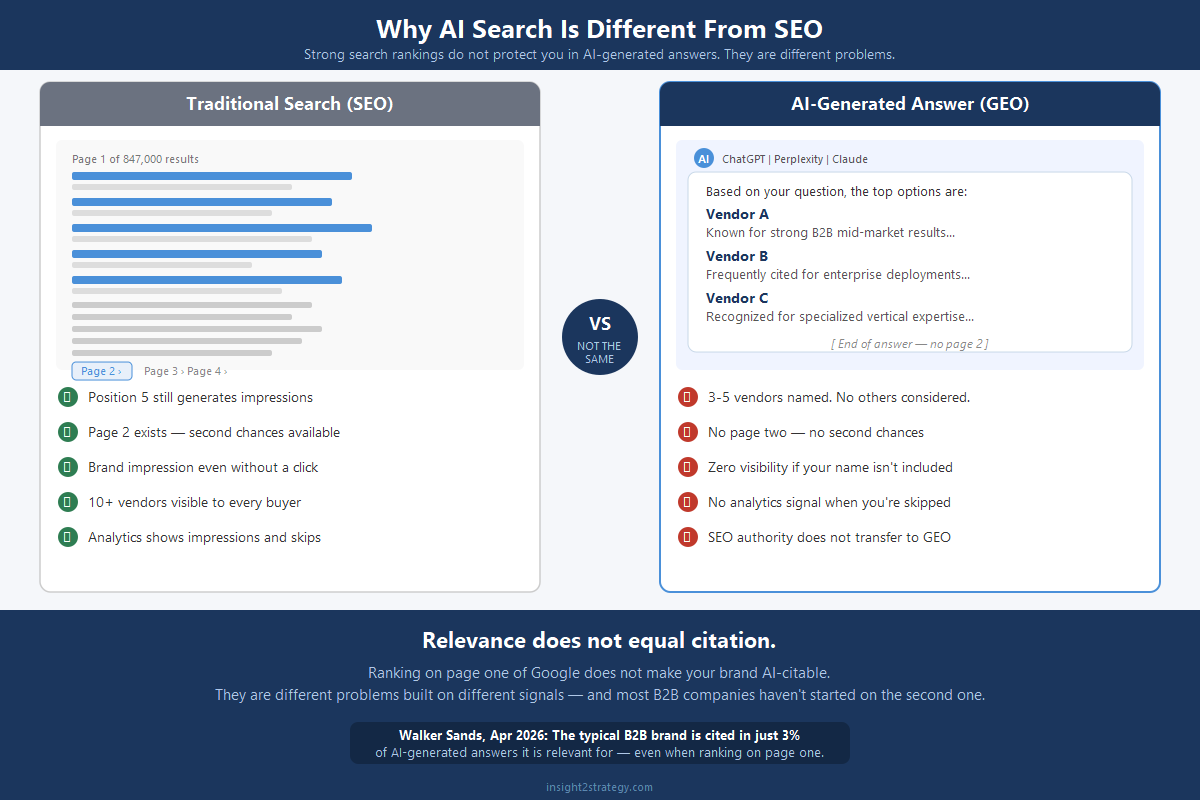
AI-powered search differs from traditional search in three fundamental ways:
1. No Page Two. In traditional search, a result ranked fifth or eighth still generates impressions and occasionally earns a click. In an AI-generated answer, you are either named in the synthesized response or you are completely invisible. There is no alternative page to browse, no "see more results" option. The AI provides one authoritative answer naming a handful of solutions.
2. Synthesis, Not Traffic. Traditional SEO prioritizes generating clicks to your website, where you control the narrative. AI search prioritizes satisfying the user within the engine itself. The goal is to answer the question — not to direct the buyer to a list of websites for further research. The AI is doing the evaluation for the buyer.
3. The Invisible Elimination. If your brand is not mentioned in the AI answer, you have no way of knowing you were excluded. Traditional analytics show impressions, click-through rates, and bounce data. In an AI search, absence generates no signal. You weren't skipped — you simply didn't exist in that buyer's consideration context.
This creates a zero-sum visibility game. Being relevant to the query is no longer sufficient. You must be cited — judged credible enough by the AI to name in the answer. Strong SEO does not automatically produce strong AI citation. They are different problems requiring different approaches. The shift from optimizing for search rankings to optimizing for AI citation authority is what practitioners are calling Generative Engine Optimization (GEO).
⚡ Quick Implementation Tip
Run a parallel test this week: search your top category keyword in Google and note your position, then ask the same question in ChatGPT and note whether your brand appears. The gap between your Google ranking and your AI citation presence is your GEO gap — and it's the number worth tracking.
The Brutal Gap: Relevant but Not Cited
Here is where many companies get a rude awakening — particularly those with strong content programs and healthy organic traffic.
Walker Sands published its B2B AI Search Visibility Benchmark in April 2026. The finding: AI Overviews appear on nearly 50% of search results pages where enterprise B2B brands rank, yet the typical brand is cited in just 3% of the AI-generated answers it is relevant for. [Walker Sands, Apr 2026]
Read that again. Your company can rank on the first page of Google for a category keyword — the result of years of content investment and domain authority building — and still be excluded from 97% of the AI-generated answers buyers receive about your category. Your SEO authority does not automatically transfer to AI citation authority.
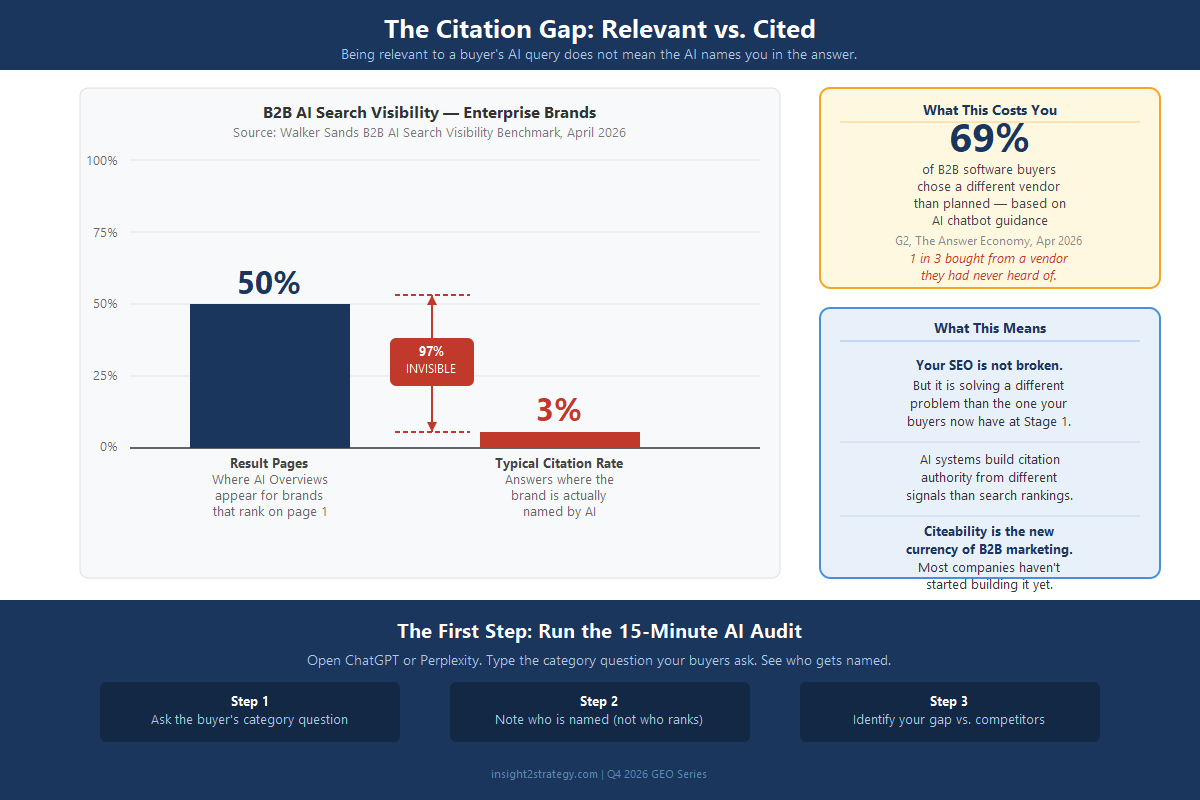
This gap exists because generative AI engines optimize for synthesis, not for surfacing links. They look for signals of authority, specificity, consistency, and established category leadership across sources — signals that are meaningfully different from the on-page SEO signals that drive Google rankings. Many companies with strong traditional marketing have simply not built the right signals for AI engines yet.
The key insight: relevance does not equal citation. Citeability is the new currency — and most B2B companies haven't begun building it.
📊 Implementation Framework
Building AI citation authority requires a different approach than traditional SEO: consistent presence in third-party content, clear category positioning across sources, and technical credibility signals that AI engines recognize. The posts that follow in this series break down each component. Need help mapping your current citation gaps before the next post? Let's discuss your specific situation.
What It Costs You
The pipeline consequences of this gap are not abstract.
G2's April 2026 report, The Answer Economy: How AI Search Is Rewiring B2B Software Buying, surveyed B2B software buyers on the direct influence of AI chatbots on their vendor decisions. The results: 69% of B2B software buyers chose a different vendor than they had originally planned based on AI chatbot guidance. And one-third purchased from a vendor they had never previously heard of. [G2, Apr 2026]
When a buyer shifts their intended vendor because an AI suggested an unknown alternative, they are trusting the AI's synthesis over their own prior research. The vendor did not earn that introduction through a cold outreach or a PPC campaign. The AI decided it was the right answer to the buyer's question.
For companies not appearing in AI answers, this creates a cascading loss:
- Early consideration set access — You're not in the conversation when the shortlist forms
- Pipeline velocity — Buyers advance with shortlists that don't include you
- Top-of-funnel discovery — New market segments and buyer types never find you
- Competitive positioning — Competitors who appear get introduced to buyers as credible options while you are absent
- Analytics blindspot — Declining lead flow arrives with no visible cause in your dashboards
Many companies will see slowing pipeline months before they recognize AI visibility as a contributing factor. The absence generates no signal — which makes it both harder to diagnose and easier to underestimate.
The First Question to Ask Today
Before any strategy conversation about GEO, there is a diagnostic every business leader can complete in fifteen minutes.
Open ChatGPT or Perplexity. Type the exact questions your best buyers ask when they are researching solutions to the problem your company addresses. Not your brand name — the category question your buyers use:
- "Best [your category] for [your ideal customer's industry or size]"
- "Who should I hire for [specific challenge you solve]"
- "Top vendors in [your space] 2026"
- "Compare [your category] options for [buyer situation]"
Read the answer carefully. Note who is named. Note the language used to describe the category and the criteria the AI implies matter for vendor selection. Then search your own company name in the same tool and assess how you are described — or whether you appear at all.
The gap between how buyers ask, how the AI responds, and how your brand is characterized is your AI visibility gap. Understanding it is the prerequisite to closing it.
Most leadership teams are surprised by what they find. Some discover their brand is absent entirely. Others find outdated descriptions. Some see competitors positioned as the default recommendation in a space where they believe they are equally credible.
The goal isn't to panic — it's to establish your baseline. You cannot improve AI citation authority until you know where you stand today.
⚡ Quick Implementation Tip
When you run the 15-minute test, document three things: (1) which competitors are named in category queries where you should appear, (2) the exact language the AI uses to describe your category's selection criteria, and (3) how your own brand is described when searched directly. These three data points define your starting position for any GEO strategy.
The posts that follow in this series will address why AI systems cite certain brands consistently while excluding others, how to audit your full AI search presence systematically, and what specific changes actually improve citation rates. The exercise above gives you the immediate answer about whether this problem is theoretical or present in your specific market.
Conclusion: The Early-Mover Advantage
Your buyers have already changed how they build vendor shortlists. The question is not whether generative AI search is affecting your pipeline — the adoption data makes that answer plain. The question is whether your brand is in the answer when they ask.
The companies that close this gap early will compound the advantage. AI systems tend to reinforce the brands they already cite, because citation generates credibility signals that support further citation. The vendors establishing AI visibility today are building positions that will be significantly harder to displace as this behavior becomes more entrenched through 2027 and beyond.
Citeability is the new currency of B2B marketing. The companies that treat it as a core strategic priority now — rather than a future initiative — are the ones that will be named when your buyers ask for recommendations.
Want to Know Exactly Where You Stand in AI Search?
The AI Visibility Reality Check tests your company across five platforms — ChatGPT, Claude, Gemini, Copilot, and Perplexity — with 21 structured queries built from your actual buyer language. You get a composite AI Visibility Score, your primary gap pattern with scored evidence, and a prioritized fix sequence matched to your website platform.
$497 · Delivered in 3 business days · Includes ready-to-publish FAQ starter set
Or start with the free 15-minute self-test from Blog 3 of this series — publishing October 19.
Not sure whether your buyers can find you inside AI answers? That's exactly what the Insight2Strategy free consultation is designed to address. Let's take a look together.
Want the bigger picture on how modern B2B buyers find, evaluate, and choose vendors? Our free book, The B2B Marketing Reality Check, covers the full shift. Download it here.
|
This post is part of The B2B Marketing Reality Check The strategic framework for growth-stage B2B tech companies — now available in paperback and Kindle. Every topic we cover in this blog goes deeper in the book, with frameworks, diagnostics, and quick wins you can put to work immediately. Get the Free PDF →Want to work through the framework hands-on? Get the companion workbook → |
Is Your Company in the Answer When Buyers Ask AI Who to Hire?
Most B2B leadership teams don't know their AI citation presence until they look. A focused conversation helps you understand your current gap and the highest-priority moves to close it.
No sales pitch. Just a focused look at where you stand and what moves the needle for your specific business.
Frequently Asked Questions
How do B2B buyers use AI to find vendors today?
B2B buyers open tools like ChatGPT, Perplexity, Claude, or Google's AI Overviews and ask category-level questions — not brand-specific queries. They ask things like "best [category] for [their situation]" or "compare [category] options for [their industry]." The AI returns a synthesized answer naming 3-5 vendors with descriptions and selection criteria. Buyers use this answer to form their initial shortlist before visiting any vendor website. Forrester (Nov 2024) found 89% of B2B buyers have adopted generative AI as a primary self-guided research tool; 6sense (2025) found 94% use LLMs specifically to compare vendor offerings.
What is Generative Engine Optimization (GEO)?
Generative Engine Optimization (GEO) is the practice of optimizing your brand's presence in AI-generated answers — as distinct from traditional Search Engine Optimization (SEO), which focuses on ranking in search engine results pages. GEO addresses the signals that AI systems use to decide which vendors to cite: established category authority, consistent third-party credibility indicators, clear positioning language, and specificity of expertise. Strong SEO does not automatically produce strong GEO results — they are different problems requiring different approaches.
Why isn't my brand in AI search results even though I rank well on Google?
Google rankings and AI citation are determined by different signals. Google ranks pages based on relevance, backlinks, and technical SEO factors. AI systems synthesize answers based on signals of established authority, category leadership, and cross-source credibility — signals that look different from SEO factors. Walker Sands (Apr 2026) found that the typical B2B brand is cited in just 3% of the AI-generated answers it is relevant for, even when holding strong Google positions. Many companies with excellent traditional SEO have not yet built the signals AI engines look for when deciding which brands to name.
How do I check if my company appears in AI search results?
Open ChatGPT or Perplexity. Search the category question your buyers ask — not your brand name, but the question: "best [your category] for [your buyer's situation]" or "top vendors in [your space] 2026." Note who gets named and what language is used. Then search your brand name directly to see how the AI describes you. Document which competitors appear in category queries where you should be present. This 15-minute test gives you your baseline AI citation presence — the starting point for any GEO strategy.
What is the business risk of not appearing in AI-generated answers?
The pipeline impact is direct and compounding. G2 (Apr 2026) found 69% of B2B buyers chose a different vendor than they originally planned based on AI guidance, and one-third purchased from a vendor they had never previously heard of. If your brand is absent from AI answers in your category, you are missing the initial consideration set entirely — before outreach, before PPC, before website visits. And unlike low search rankings, AI exclusion generates no analytics signal. Companies see the downstream effect (slower pipeline) months before identifying the cause.
This post is Blog 1 of a 4-part series on AI search visibility for B2B companies. Next: why AI systems cite certain brands consistently and what signals actually drive citation decisions.


Comments
Post a Comment