Why AI Engines Recommend Your Competitors and Not You (The 5 Signals That Decide)
Why AI Engines Recommend Your Competitors and Not You (The 5 Signals That Decide)
Strategic Analysis by: Insight2Strategy
Published: October 12, 2026
AI Search Visibility Series, Post 2 of 4
Executive Reading Time: 6–7 minutes
Executive Strategic Insights
- The typical enterprise B2B brand appears in 3% of relevant AI-generated answers — meaning 97 out of 100 buyer research conversations happen without them in the room.
- AI citation is not random — it is determined by five specific, measurable signals entirely within your control.
- Entity Authority and Factual Density are the highest-impact signals: consistent brand identity across the web + statistics with inline citations can lift AI visibility by up to 40%.
- The Great Decoupling: ranking #1 in Google no longer guarantees you appear in AI-generated buyer answers — citation inclusion is the new metric that matters.
- The five signals are infrastructure, not one-time fixes — early movers who build them now establish a compounding structural advantage into 2027.
- The competitive gap is a legibility gap: your competitors are named not because they are better, but because AI can understand them more completely.
Here is a number worth sitting with: the typical enterprise B2B brand appears in 3% of the AI-generated answers for which it is relevant [Walker Sands B2B AI Search Visibility Benchmark, April 2026].
Read that again. In 97 out of every 100 conversations where a buyer is actively researching solutions in your category, your company is not part of the answer they receive. The vendor who never gets introduced. The brand that never makes the shortlist. The company that loses before the conversation starts.
This is not a traffic problem. This is not an SEO ranking problem. It is a brand legibility problem—and it has a direct line to your revenue pipeline.
Why the "AI Is Random" Assumption Is Costing You
Many companies notice inconsistent results when they test AI tools. One prompt names them. The next one does not. A competitor appears repeatedly despite lower search rankings. That inconsistency creates the impression that AI recommendations are arbitrary.
They are not.
Generative AI systems synthesize answers from sources they can find, parse, understand, verify, and trust enough to reuse. Research published in the ACM SIGKDD proceedings (Aggarwal et al., 2024) demonstrated that optimizing content for generative engines can increase source visibility in AI-generated responses by up to 40%, with the largest gains coming from adding statistics, quotations, and source citations.
A 40% swing in visibility is not the output of a random process. It is the output of a content infrastructure decision. And the most costly response to AI invisibility is to assume nothing can be done about it.
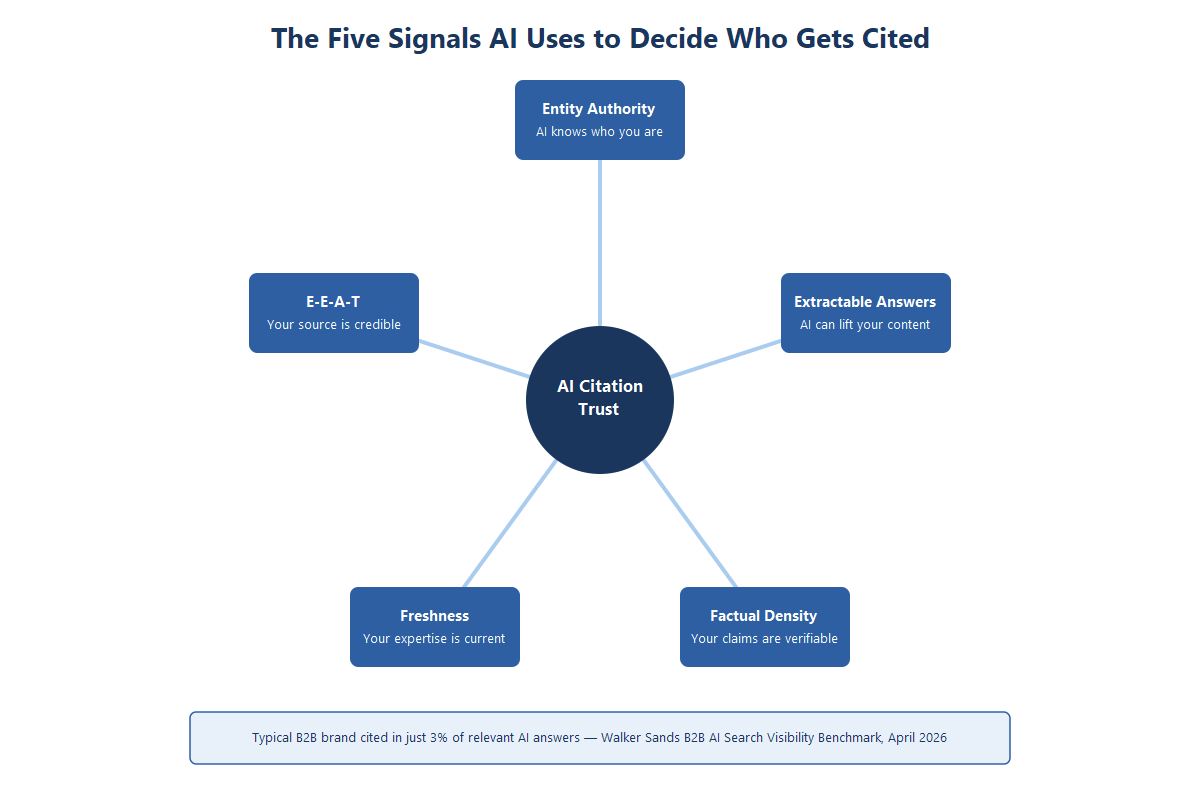
The Five Signals That Determine Who Gets Named
Signal 1: Entity Authority
Before any AI system can recommend your company, it must first construct a confident, coherent understanding of what your company is.
This is not automatic. Consider two cybersecurity vendors.
Vendor A appears consistently across industry directories, analyst reports, podcast mentions, LinkedIn, and third-party review platforms. Its name, description, and category associations are identical across every touchpoint.
Vendor B only talks about itself on its own website. On one directory it is called a “consulting firm.” On another, a “technology partner.” On its own site, a “cybersecurity solutions provider.”
Which one does an AI system feel confident naming in an answer? The one it can identify completely and consistently—every time.
Entity authority is built through consistent naming, clear industry categorization, Schema.org structured data markup, and third-party corroboration across directories, press coverage, and industry publications. Engines cite entities they can confidently identify. If they cannot identify you without ambiguity, they default to the competitor they can.
⚡ Quick Implementation Tip
Audit your brand’s name, description, and category across your website, LinkedIn, Crunchbase, Google Business Profile, and the top three industry directories in your space. Inconsistencies become citation liabilities—and they’re often easier to fix than you expect.
Signal 2: Extractable, Self-Contained Answers
AI engines are not readers in the way humans are. They are extractors.
A generative system answering “What are the leading B2B marketing intelligence tools?” is scanning for a passage it can lift with confidence and reuse without distorting the meaning. Long-form narrative that buries the answer is not penalized—it is simply passed over in favor of content that states the answer cleanly.
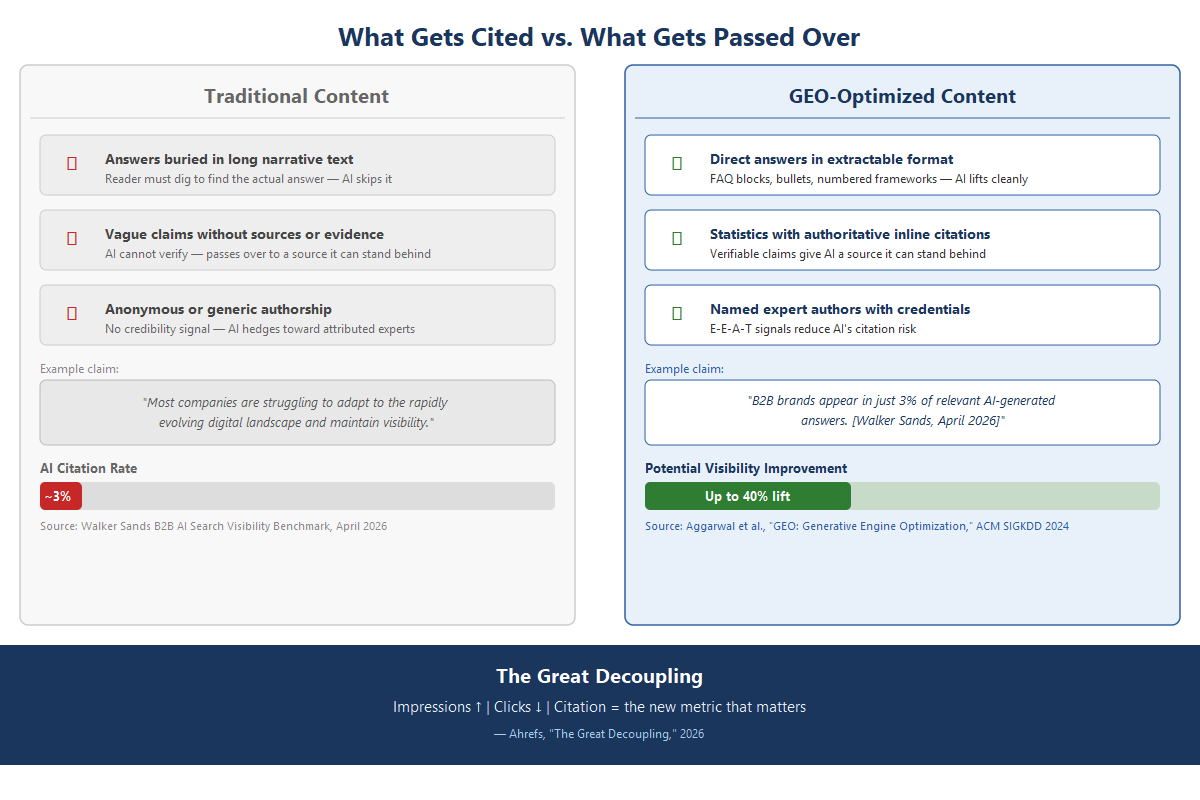
Compare these two versions of the same claim:
Hard to extract: “AI visibility is becoming increasingly important as businesses continue to adapt to changing customer behaviors and evolving search technologies.”
Easy to extract: “Companies improve AI visibility by strengthening entity authority, publishing source-backed content, updating information regularly, and demonstrating expertise.”
One sentence. Direct answer. Easy to extract. Easy to cite.
FAQ sections, numbered frameworks, bolded key claims, and short direct paragraphs are not stylistic choices—they are extraction architecture. They tell AI exactly where the answer lives, so it does not have to guess.
Signal 3: Factual Density and Citations
The GEO study (Aggarwal et al., 2024) identified factual density and source citations as producing the single largest gain in AI visibility—ahead of technical optimization, content length, and keyword density.
The logic is straightforward. An AI system generating an answer is making a trust decision at scale. A specific, sourced claim is safer to reuse than a general assertion. Consider the difference:
Weak: “Most companies struggle with AI visibility.”
Strong: “The typical enterprise B2B brand appears in only 3% of relevant AI-generated answers [Walker Sands, April 2026].”
The second statement carries a verifiable chain of authority. The first asks the AI to vouch for an opinion. Vague positioning is citation repellent. Specific, evidence-backed claims are citation magnets.
Every major content asset you publish should be able to answer three questions: What evidence supports this claim? Where did the data originate? Can a reader independently verify it? If the answer is no, your competitors with better sourcing may become the citation instead.
📊 Implementation Framework
For every significant claim in your content, apply a three-question test: (1) What evidence supports this? (2) Where did the data originate? (3) Can a reader verify it independently? Content that passes all three earns AI citation; content that fails is passed over for a source that can. Need help auditing how your content performs on these signals? Let’s discuss your approach.
Signal 4: Freshness
Not every query requires recent information—but most business queries do.
A buyer asking “what are current best practices for B2B AI search visibility” is implicitly asking for 2026 guidance, not 2023 guidance. Content that has not been updated signals that the brand may not be current on the topic. AI systems weigh this when selecting sources.
An updated publication date, current statistics, and references to recent market developments are not cosmetic changes. They signal that your expertise is active rather than archived. The practical discipline: treat your highest-value content assets as living documents that require scheduled review, not one-time publications.
Signal 5: Experience, Expertise, Authoritativeness, and Trust
AI systems are risk managers operating at scale.
When a generative engine surfaces a company or a specific claim, it is implicitly endorsing that source to every user who receives the answer. The systems are designed to minimize the risk of surfacing unreliable information. Sources with named authors, verifiable credentials, original research, and third-party corroboration reduce that risk. Anonymous content, generic bylines, and claims without backing increase it.
Named authors with traceable credentials, original data from real client engagements, and consistent expert positioning across publications create what might be called citation capital—accumulated trust that makes your content the lower-risk choice when an AI system is deciding between two sources.
Practical trust signals: author profiles with professional credentials, original research or primary data, earned mentions in reputable industry publications, and verified client testimonials. Each strengthens the case for an AI system to stand behind your content.
When #1 Rankings No Longer Mean #1 Reach
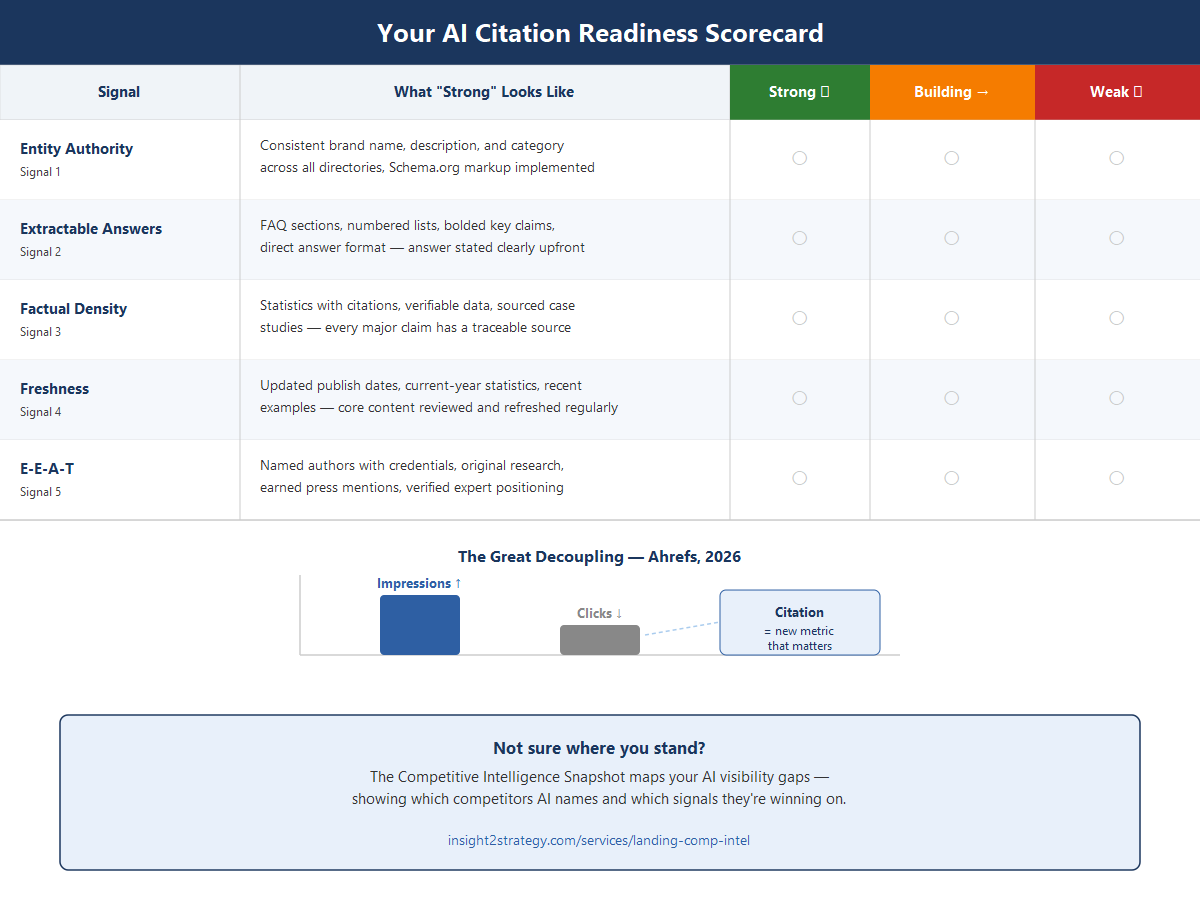
Traditional SEO operated on a predictable equation: higher rankings produced more clicks, which produced more traffic, which produced more pipeline.
That equation is changing.
Ahrefs has documented what they call the “great decoupling”—AI Overviews driving impressions upward while clicks decline, particularly for informational and commercial research queries [Ahrefs, The Great Decoupling, 2026]. A buyer researching your category receives a synthesized AI answer. If your brand is not in that answer, your first-page ranking sits untouched while competitors get named.
You can rank first in organic search and still lose the citation.
You can lose the citation and never know a buyer was evaluating your category.
The measurement question has changed. “Where do we rank?” is no longer sufficient. The relevant question is: “Are we included in the answer the AI provides when a buyer asks about our space?”
That shift changes not just how marketers measure success, but how leadership teams should think about content as a strategic investment.
The Compounding Advantage of Getting This Right Early
The five signals are not one-time fixes. They are infrastructure—and infrastructure compounds.
Entity authority, once built, reinforces itself as additional third-party sources reference a clearly defined brand. A content library with high factual density accumulates citation trust over time. Author credibility compounds as expertise is demonstrated repeatedly across publications and platforms.
The companies that establish strong AI citation signals in Q4 2026 will be structurally harder to displace through 2027 and beyond. AI systems develop citation patterns based on accumulated evidence. Early movers in category authority build a lead that is structural, not merely temporal.
If your competitors are being named in AI answers and you are not, the gap is not a mystery. It is a legibility gap. And legibility, unlike brand awareness or domain authority built over years, can be built with precision—because the signals are specific, knowable, and entirely within your control.
Frequently Asked Questions
What is entity authority in AI search, and how do I build it?
Entity authority is the degree to which AI systems can confidently identify your brand as a distinct, well-defined entity. It is built through consistent brand naming and descriptions across all digital touchpoints (website, LinkedIn, Crunchbase, industry directories), implementation of Schema.org structured data markup on your website, and earning corroborating mentions on third-party authoritative sources like industry publications and analyst reports. Inconsistent or conflicting information across these sources is the most common reason brands fail this signal.
How do I make my content more extractable for AI citation?
Structure your most important answers so they can be lifted cleanly without context. This means leading with the direct answer before the explanation, using numbered or bulleted lists for multi-part answers, adding FAQ sections that mirror the questions your buyers ask, bolding key claims so they stand out as extractable units, and keeping answer-oriented paragraphs short and self-contained. The test: can you read a single paragraph and have a complete answer to a specific question? If not, restructure it.
How does adding statistics improve AI citation rates?
The Princeton GEO study (Aggarwal et al., 2024) found that adding statistics, quotations, and source citations produced the largest single improvement in AI visibility—up to 40% increase in how often content was included in AI-generated responses. The reason: AI systems making trust decisions prefer verifiable, sourced claims over general assertions. A claim with a traceable source is lower-risk to reuse than an opinion without backing. Every major claim in your content should carry a verifiable source citation.
Does content freshness actually affect AI citations?
Yes, particularly for queries about evolving topics—which covers most business-to-business research. AI systems are trained to provide current, relevant information, and they weight recency when multiple sources are available on the same topic. An article last updated in 2023 will often lose to a comparable article updated in 2026 when the query implies a need for current guidance. The practical fix: schedule regular reviews of your cornerstone content and update statistics, examples, and references to reflect current conditions.
What is E-E-A-T and why does it matter for AI citation?
E-E-A-T stands for Experience, Expertise, Authoritativeness, and Trust—a framework originally from Google’s quality evaluator guidelines, but equally relevant to how generative AI systems assess source credibility. AI systems surface content to users as authoritative answers, so they favor sources that demonstrate real-world expertise through named authors with verifiable credentials, original research and primary data, earned recognition in reputable publications, and consistent expert positioning. Anonymous content or generic “marketing team” bylines carry less weight than a named practitioner with demonstrable domain knowledge.
|
This post is part of The B2B Marketing Reality Check The strategic framework for growth-stage B2B tech companies — now available in paperback and Kindle. Every topic we cover in this blog goes deeper in the book, with frameworks, diagnostics, and quick wins you can put to work immediately. Get the Free PDF →Want to work through the framework hands-on? Get the companion workbook → |
Find Out Which of These Five Signals You're Failing
The AI Visibility Reality Check tests your company across five platforms with 21 structured queries built from your actual buyer language. You get a scored breakdown by platform and query block, your primary gap pattern with evidence, and a prioritized fix sequence mapped to the specific signals where you're losing to competitors.
$497 · Delivered in 3 business days · No tools required on your end
Prefer to discuss your situation first? Schedule a free strategy discussion →
Sources
- Aggarwal et al., “GEO: Generative Engine Optimization,” ACM SIGKDD 2024 (arXiv:2311.09735)
- Walker Sands, B2B AI Search Visibility Benchmark, April 2026 — walkersands.com/b2b-ai-search-visibility-hub
- Ahrefs, “The Great Decoupling,” 2026 — ahrefs.com/blog/the-great-decoupling


Comments
Post a Comment