How to Audit What ChatGPT, Claude, and Perplexity Say About Your Company (in an Afternoon)
How to Audit What ChatGPT, Claude, and Perplexity Say About Your Company (in an Afternoon)
Strategic Analysis by: Insight2Strategy
Published: October 19, 2026
Reading Time: 8 minutes
Executive Strategic Insights
- 71% of B2B buyers now use AI chatbots somewhere in their vendor research — most companies have never tested what those tools say about them
- The typical enterprise B2B brand appears in just 3% of relevant AI answers, creating a significant competitive opportunity for companies that act first [Walker Sands, April 2026]
- A simple 5-step afternoon audit reveals your AI visibility gap — no tools, subscriptions, or agency required
- Three distinct gap patterns (Authority, Messaging, Discovery) each require a different fix — diagnosing the right one first saves months of misdirected effort
- Adding statistics, quotable statements, and citations to the right pages improves AI visibility by up to approximately 40% [GEO Study, ACM SIGKDD 2024]
Full audit process detailed below. Download the free worksheet to implement it in an afternoon.
You do not need a tool subscription or an agency to find out how AI describes your company. You need an afternoon, a list of the questions your buyers actually ask, and a simple way to score what comes back.
Here is why that afternoon is worth spending: 51% of B2B software buyers now begin their vendor research with an AI chatbot rather than Google — up from just 29% a year earlier. Another 20% use AI somewhere else in the process [G2, April 2026]. That means 71% of your buyers are forming their initial impressions from systems you have probably never tested.
You have checked your Google rankings. You have reviewed your Clutch profile. But when did you last ask ChatGPT what it recommends in your category — not your company name, but the actual buying question a prospect would ask? When did you verify whether Perplexity's sources include your strongest case study or your competitor's?
The companies building a compounding advantage in AI search right now are not doing anything exotic. They ran this audit. They found the gap. They fixed the highest-leverage thing first.
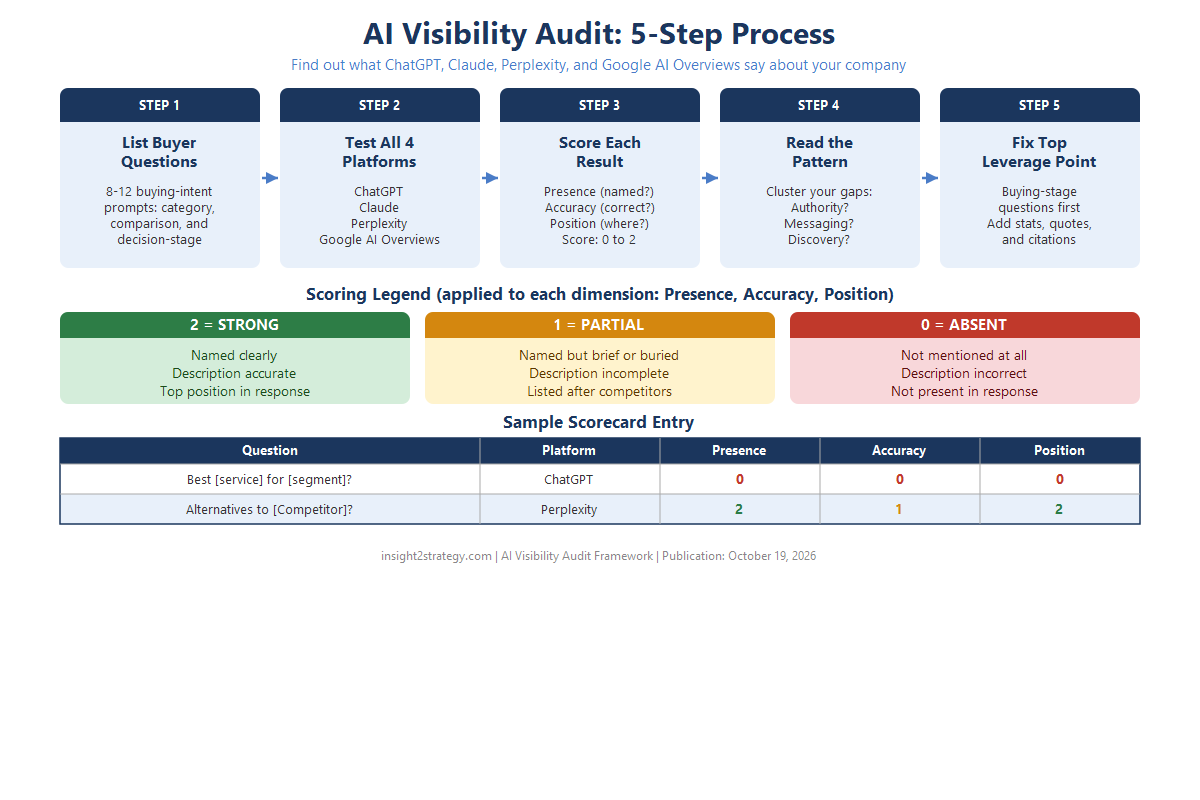
This is a five-step AI visibility audit you can complete in a single afternoon.
Following along? Get the free AI Visibility Self-Audit worksheet to run this process step-by-step with a pre-built testing grid and scorecard.
Step 1: List the Questions Your Buyers Actually Ask
The problem: Most executives test AI visibility by searching their company name and deciding things look fine. Branded searches produce favorable results — AI knows who you are. What you need to know is whether AI knows what problem you solve and who you solve it for.
The solution: Write 8–12 questions a buyer would ask before they know your company exists. Focus on buying-intent prompts across three categories:
Discovery questions:
- "Best [category] for [specific industry or segment]"
- "Top [service providers] for [company size]"
Comparison questions:
- "Alternatives to [your main competitor]"
- "How does [approach A] compare to [approach B]?"
Decision-stage questions:
- "How much does [your service type] cost?"
- "Who specializes in [specific customer problem]?"
Implementation: Start with your sales team. Ask what prospects say in the first five minutes of a discovery call, which competitors come up, and what concerns surface before a buyer has even spoken to sales. Those answers become your audit prompts.
Pro tip: If you record sales calls, run a quick search in Gong or Chorus for terms like "alternatives" or "how do you compare." The questions buyers ask before they knew you were an option are the most valuable prompts to test.
Impact: Specificity matters. Ten precise questions that mirror real buying behavior reveal more than fifty generic ones.
Step 2: Run Every Question Across the Four Major AI Platforms
The problem: Testing only one AI platform gives you an incomplete — and often misleading — picture. Each platform uses different source data, retrieval methods, and ranking signals. A company that appears prominently in ChatGPT may be absent in Perplexity. Google AI Overviews often draws from entirely different web content than Claude.
The solution: Run each of your 8–12 buyer questions in all four:
- ChatGPT (GPT-4o or the latest model)
- Claude (claude.ai)
- Perplexity (perplexity.ai — note which sources it cites; those URLs are the evidence trail for what's feeding the AI's answer)
- Google AI Overviews (standard Google search, check for the AI summary block)
Implementation: Use a simple spreadsheet. For every question in every platform, record:
| Question | Brands Named | Your Position | How Described | Sources Cited |
|---|---|---|---|---|
| Best [service] for [segment] | Competitor A, B, You | 3rd | Accurate but brief | None |
| Alternatives to [Competitor] | You, Competitor A | 1st | Accurate, positive | Your case study |
Pay particular attention to Perplexity's citations — they tell you exactly which pages informed the recommendation. If a competitor's whitepaper keeps appearing as a source, that's a meaningful signal about what's driving their visibility.
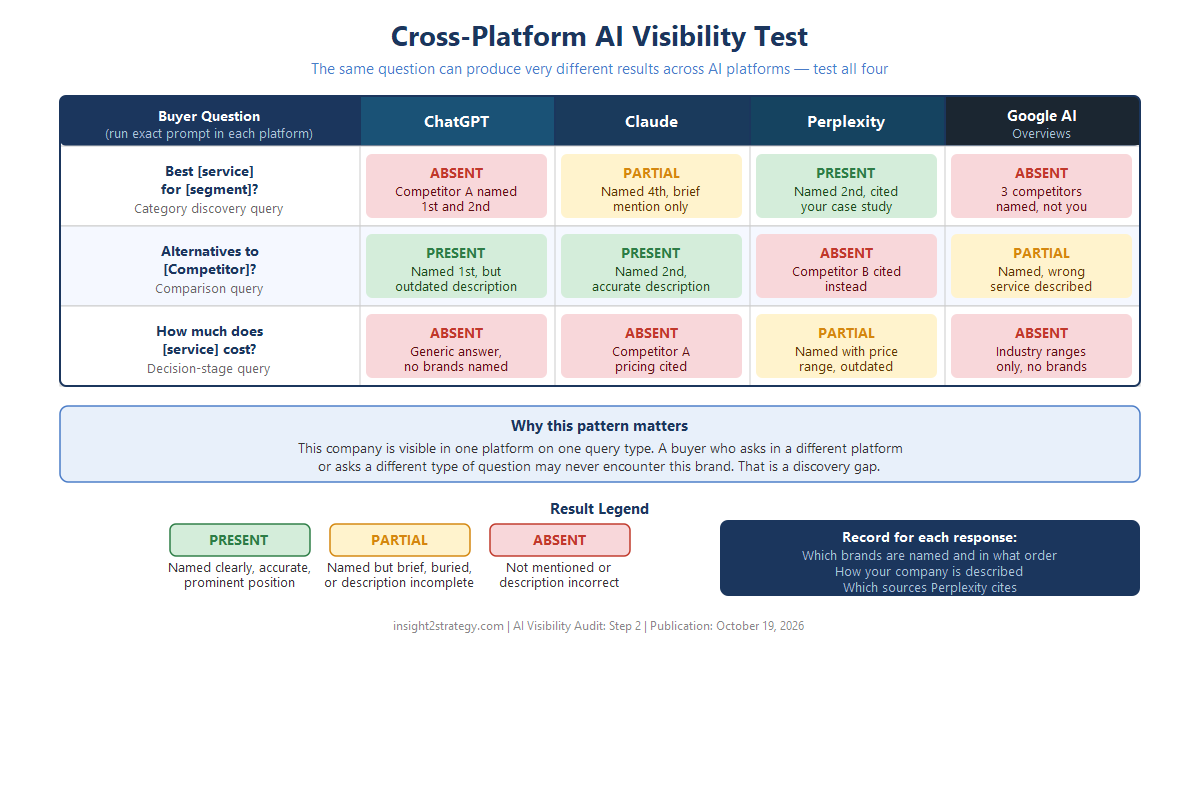
Impact: Sixty to ninety minutes of cross-platform testing will reveal your pattern. That pattern is what guides the fix.
Step 3: Score Presence, Accuracy, and Position
The problem: Raw observations are hard to act on. Without a scoring structure, it's easy to focus on memorable examples rather than the actual pattern across all your questions.
The solution: Apply a simple 0–2 scale to three dimensions for each question in each platform:
Presence — Were you named?
- 0 = Not mentioned
- 1 = Mentioned briefly or in passing
- 2 = Clearly named or recommended
Accuracy — Was the description correct?
- 0 = Inaccurate or outdated
- 1 = Partially right, missing key differentiators
- 2 = Accurate and consistent with current positioning
Position — Where did you land in the response?
- 0 = Absent
- 1 = Named later, after multiple competitors
- 2 = Named early or in a primary recommendation
Example scorecard rows:
| Question | Platform | Presence | Accuracy | Position |
|---|---|---|---|---|
| Best [service] for [segment]? | ChatGPT | 1 | 2 | 1 |
| Alternatives to [Competitor]? | Perplexity | 2 | 1 | 2 |
Total the scores by dimension across all questions. Patterns emerge quickly.
Impact: Numerical scores transform vague impressions into actionable priorities. Instead of "I don't think we're visible," you know exactly where and why visibility is breaking down.
📊 Want the Complete Scorecard Template?
The AI Visibility Self-Audit worksheet includes a pre-built testing grid, Presence/Accuracy/Position scorecard with color-coding, and a pattern diagnosis guide — so you're not building the system while you use it.
Step 4: Read the Pattern — The Numbers Point to the Root Cause
The problem: Most companies react to individual AI responses — they see one wrong answer and immediately try to fix that specific answer. That's usually the wrong move.
The solution: Look for clusters across your scores. The pattern across all questions and all platforms points to the underlying problem. Each problem has a different fix.
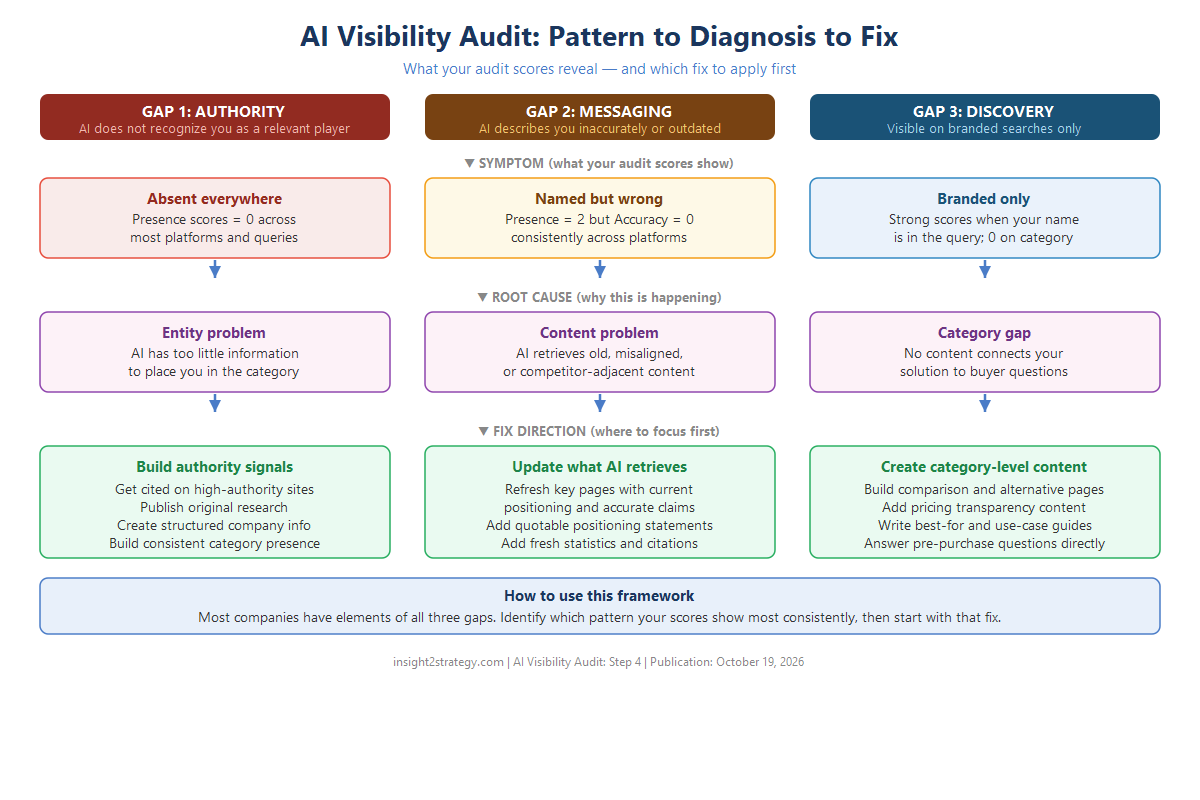
Pattern 1 — Absent everywhere (consistent low Presence scores across all platforms and most questions):
This is an authority and entity recognition problem. AI systems don't have enough information to recognize your company as a relevant player in the category. Fixes: consistent mentions on high-authority sites, original research, structured company information, and category-defining content.
Pattern 2 — Named but described wrong (decent Presence scores, low Accuracy scores):
This is a messaging problem. The AI knows you exist but retrieves outdated or inaccurate information — wrong positioning, old product descriptions, or a description indistinguishable from a competitor's. Fixes: updating key pages with current, accurate positioning and adding clear quotable statements that describe what you do and who you serve.
Pattern 3 — Present only for branded queries (strong when your name is in the query, invisible on category questions):
This is a discovery problem. Buyers who already know your name can find you. Buyers who don't know you yet never will. Fixes: comparison pages, "best for" content, pricing transparency, and direct answers to the buying-intent questions buyers ask before they've heard your name.
Most companies have elements of all three. Usually one dominates. The dominant pattern is where you start.
Step 5: Fix the Highest-Leverage Gap First
The problem: After an audit, the temptation is to fix everything at once. The result is diluted effort that doesn't move the needle on anything.
The solution: Start with the questions closest to a buying decision. "Who are the best providers for this segment?" "What alternatives exist to this competitor?" "What does this service type cost?" These are the queries where your presence or absence directly affects which vendors make the shortlist.
Implementation: For your highest-priority questions, improve the specific pages on your site that should be answering them. Research from Aggarwal et al. (the Generative Engine Optimization study, ACM SIGKDD 2024) found that three content changes most effectively increased a source's appearance in AI-generated answers — and improved AI visibility by up to approximately 40%:
- Add a specific, citable statistic that supports your positioning on the relevant page
- Include a quotable one-to-two sentence summary of what you do and who you serve
- Cite credible external sources that validate your approach
The asymmetry is worth noting: one well-optimized page answering a high-intent buying question can shift how you appear across multiple platforms, in multiple AI responses, for multiple buyer queries. This is targeted work — not a site overhaul.
The typical enterprise B2B brand currently appears in just 3% of the AI answers for which it is relevant [Walker Sands, April 2026]. That gap is the opportunity — and it's fixable faster than most companies expect.
⚡ Quick Implementation Tip
Start with just three questions: your top comparison query ("alternatives to [competitor]"), your top category query ("best [service] for [segment]"), and your top cost query ("how much does [service] cost"). Run them in ChatGPT and Perplexity. Those six results reveal your dominant gap pattern in under 30 minutes — and tell you exactly which page to update first.
|
This post is part of The B2B Marketing Reality Check The strategic framework for growth-stage B2B tech companies — now available in paperback and Kindle. Every topic we cover in this blog goes deeper in the book, with frameworks, diagnostics, and quick wins you can put to work immediately. Get the Free PDF →Want to work through the framework hands-on? Get the companion workbook → |
Get the AI Visibility Self-Audit (Free)
The complete step-by-step worksheet to test how ChatGPT, Claude, Perplexity, and Google AI Overviews describe your company — and a prioritized action plan to fix what's wrong.
What's inside: Buyer question inventory · Multi-engine testing grid · Presence/Accuracy/Position scorecard · Gap pattern diagnosis · Priority action plan
Instant access. You'll receive the download link by email immediately after signing up.
Download the AI Visibility Self-Audit
Get instant access to the AI Visibility Self-Audit — enter your email below and we'll send the download link right over.
Ran the audit and found significant gaps?
Some visibility issues are a quick content fix. Others — a blocked AI crawler, a systematic entity problem, a missing category content layer — point to a deeper gap that takes more than an afternoon to close.
The AI Visibility Reality Check runs the full 21-query audit across all five platforms, scores every result, identifies your gap pattern with evidence, and delivers a prioritized fix sequence matched to your website platform — in 3 business days.
Get the Full AI Visibility Reality Check →$497 · 3 business days · Or start with a free 30-minute call
Visibility Problems Are Easier to Fix When You Can See Them
The biggest mistake companies make with AI visibility isn't having poor visibility. It's not knowing they have a visibility problem at all.
Most business owners who run this audit discover three things they weren't expecting: their AI visibility is worse than they assumed; the fix is more targeted than they feared; and their competitors have the same blind spot — for now. The companies that audit and act in Q4 2026 will have the most to show for it as AI-assisted buying continues to grow.
An afternoon of testing today prevents months of invisible pipeline later.
Want the bigger picture on how modern B2B buyers find, evaluate, and choose vendors in an AI-assisted world? Our free book, The B2B Marketing Reality Check, covers it: insight2strategy.com/book
Frequently Asked Questions
Do I need special tools to audit my AI visibility?
No. The entire audit runs in standard browser tabs — ChatGPT, Claude, Perplexity, and Google are all free to use for basic queries. A spreadsheet to record results is the only other requirement. No subscriptions, no agency, no specialized software.
Which AI platforms should I test?
Test all four: ChatGPT (GPT-4o), Claude (claude.ai), Perplexity (perplexity.ai), and Google AI Overviews (standard Google search). Each uses different data sources and retrieval logic — a company visible in one may be absent in another. Testing only one platform gives a misleading picture.
How long does a GEO audit take?
The testing phase takes 60–90 minutes once your question list is ready (which itself takes about 20 minutes with your sales team). Scoring and pattern diagnosis add another 30 minutes. The full AI visibility audit comfortably fits in an afternoon.
How do I score my AI search visibility audit results?
Use a 0–2 scale on three dimensions for each question in each platform: Presence (were you named?), Accuracy (was the description correct?), and Position (where did you appear in the response?). Total the scores by dimension across all your questions. The pattern in the low scores tells you which gap type dominates — Authority, Messaging, or Discovery — and therefore which fix to apply first.
Insight2Strategy helps growing B2B companies cut through marketing confusion to find strategies that drive revenue. insight2strategy.com


Comments
Post a Comment