GEO Compounds SEO — How to Fund Both in 2027
GEO Compounds SEO — How to Fund Both in 2027
Strategic Analysis by: Insight2Strategy
Published: October 26, 2026
Executive Reading Time: 7 minutes
Executive Strategic Insights
- Most B2B companies cluster in the 30–60 AI Visibility range — partial presence, not total absence. The gap type predicts the fix, not the score.
- GEO and SEO draw from the same content investment. Cutting one weakens both simultaneously — they compound in both directions.
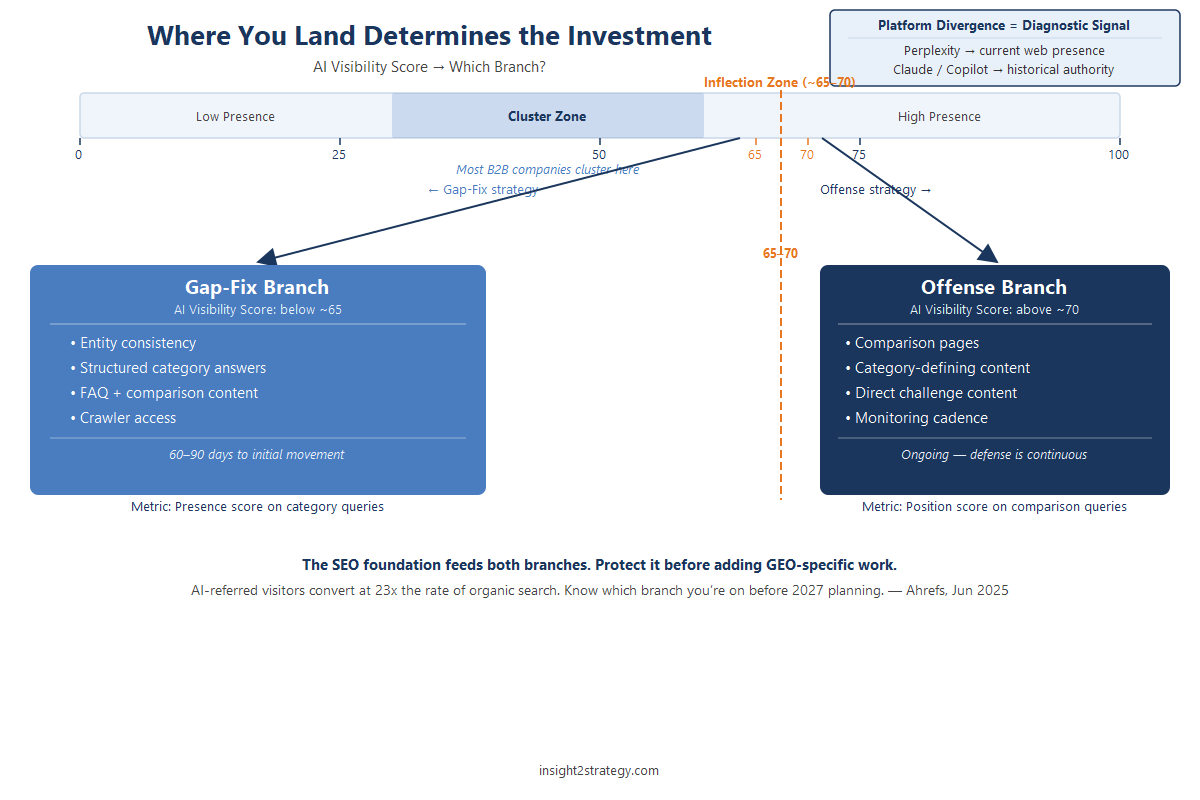
- Your AI Visibility score determines your branch: gap-fix strategy (below ~65) or offense strategy (above ~70). These require completely different content investments.
- Platform divergence is a diagnostic signal. Perplexity reflects current web presence; Claude and Copilot reflect historical authority. Both require different investments to move.
- AI-referred visitors convert at 23x the rate of organic search (Ahrefs, Jun 2025). The companies entering 2027 with both channels working won’t face a false choice.
The assumption that GEO replaces SEO produces exactly the wrong budget decision.
When AI Overviews started pushing organic clicks down, the instinctive response was to treat it as a zero-sum problem: if AI search is winning, SEO is losing, and budget should follow. That instinct is understandable. It’s also incorrect — and the companies acting on it are making a strategic error that will compound in the wrong direction through 2027.
The companies that have been running AI visibility programs the longest aren’t choosing between GEO and SEO. They’re finding that fixing one makes the other more effective — and that the work compounds in both directions. What follows is what the audit data actually shows.
What the Audit Data Shows
After running the AI Visibility scoring framework across B2B companies — professional and technical services firms, 15 to 500 employees, across multiple AI platforms — several patterns emerge consistently that challenge the conventional GEO narrative. These observations come from a real but focused sample; treat them as directional, not as industry-wide statistics.
Most companies cluster in the 30–60 range. The distribution isn’t bimodal. Companies aren’t simply “present” or “absent” in AI search. Most have partial presence — they appear in certain AI responses and disappear in others, answer branded questions reasonably well but fail category and comparison searches. For example, an AI may correctly describe a company when prompted with its name but fail to mention it entirely when asked who the leading providers in a category are, what alternatives exist to a competitor, or which companies buyers should evaluate. The gap is usually partial rather than absolute.
The dominant gap type predicts the fix — not the score. A company scoring 38 and a company scoring 62 may need completely different interventions. Low Presence scores point toward authority work: citation-building, entity consistency, structured crawlable content. Low Accuracy scores point toward messaging: outdated positioning, absence of quotable statements AI models can retrieve cleanly. Companies that appear on branded queries but vanish on category queries need discovery content — comparison pages, FAQ structures, pricing transparency signals. The score matters less than identifying which lever is stuck.
Platform divergence is more common than platform consensus. The intuitive assumption is that if you appear in ChatGPT you appear everywhere — and vice versa. The data shows consistent divergence. Companies frequently score strongly on Perplexity (web-search-first) and poorly on Claude or Copilot (training-data-dominant). That divergence is itself a diagnostic signal. Perplexity performance reflects current web presence; training-data-dominant platform performance reflects historical authority. Both matter, and they require different investments to move.
High-presence companies face a fundamentally different problem. Companies scoring above 70 don’t have a gap-fix problem — they have a defense and differentiation problem. The strategic question shifts: How do we win the comparison query, not just appear in it? How do we claim the category position rather than share it? How do we monitor and defend presence as competitors invest to close the gap? This is the offense branch of GEO strategy, and it requires entirely different content investments than the gap-fix branch. Most generic GEO advice conflates the two.
⚡ Quick Implementation Tip
Run a platform divergence check before committing to any GEO investment: test your company on Perplexity vs. Claude vs. Copilot for the same category query. If results diverge significantly, that gap is a diagnostic signal — not a failure — and it tells you which investments will move which platform. Build your initial GEO audit from this single observation.
Why GEO and SEO Compound
The “GEO vs. SEO” framing is wrong at the root. The right question is: what feeds what?
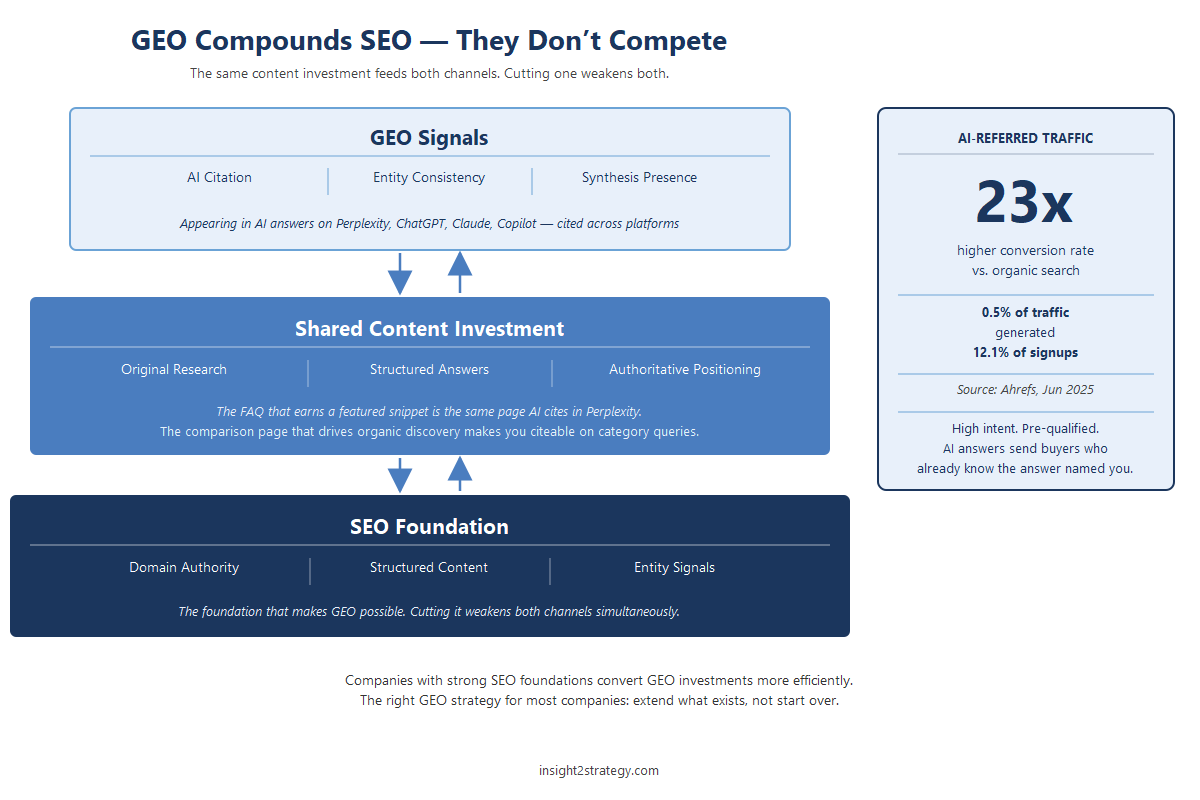
The shared foundation. Both channels draw from the same underlying content investment — original research, authoritative positioning, consistent entity signals, structured answers to buyer questions. A page that answers a buyer question clearly, with a citable statistic and a quotable summary, performs better in both traditional search and AI citation. The investments aren’t parallel tracks; they’re overlapping circles. You can’t fund one at the expense of the other without weakening both.
Where they diverge. Traditional SEO optimizes for click-through — driving visitors from a search result to your site. AI citation optimizes for synthesis — appearing in answers delivered without a click. A page that ranks first in Google and generates zero clicks because the AI answered the question instead is still working. It fed the AI the right answer. SEO infrastructure is what makes GEO possible.
The decoupling reality. Ahrefs data shows what many B2B marketers are already observing: AI Overviews are pushing impressions up while clicks fall — the “great decoupling” (Ahrefs, 2026). The correct interpretation isn’t that SEO is dying. It’s that the content is working at a different layer. Cutting the SEO investment that’s feeding AI citation to fund “GEO tactics” is self-defeating. You’d be cutting the signal to fund the signal.
The compounding direction. Companies with strong SEO foundations — high domain authority, well-structured content, consistent entity signals — convert GEO investments more efficiently. The same FAQ page that earns a featured snippet also gets cited in Perplexity. The same comparison page that drives organic discovery also makes you citeable when a buyer asks an AI who the alternatives to your top competitor are. The leverage is asymmetric in favor of companies that have done the SEO work, which means the right GEO strategy for most companies is to extend what exists, not to start over.
89% of B2B buyers have adopted generative AI as a top source of self-guided research (Forrester, Nov 2024). They’re not abandoning traditional search; they’re using AI as a synthesis layer on top of it. The content that feeds that synthesis layer is the same content that ranks in traditional search — structured, authoritative, specific. The same investment, doing double duty.
📊 Implementation Framework
Before making any budget decision between GEO and SEO: identify whether the content you are considering reducing is currently feeding AI citations. Check your top-ranked pages against the responses your target platforms give on category queries. If your SEO content is appearing in AI synthesis, reducing that investment reduces both channels simultaneously. Map the overlap before moving any dollars.
The Offense/Gap-Fix Branch: What Your Score Tells You
There are two fundamentally different GEO strategies, and most organizations are following advice written for the wrong one.
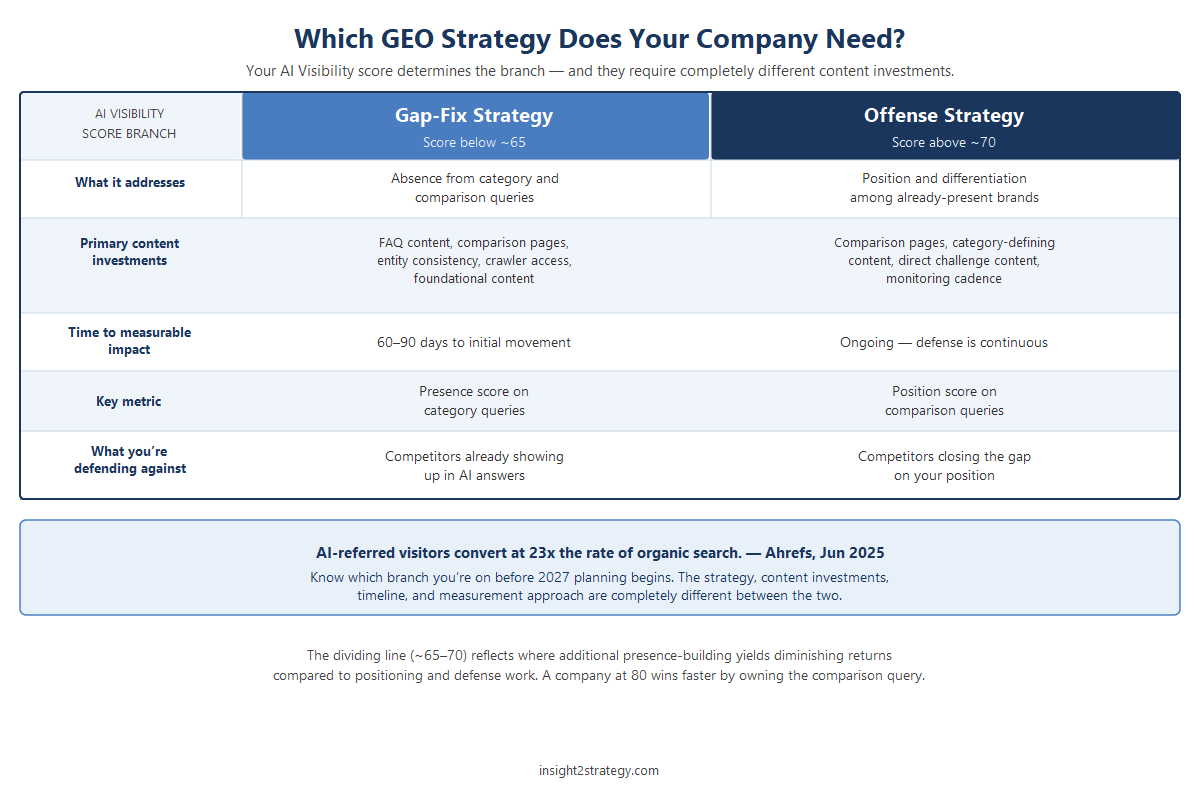
Gap-fix strategy (scores below ~65). The primary objective is getting into the conversation. Priority work: remove technical barriers to AI crawlers, build entity consistency across all web presence, publish structured answers to category and symptom queries, add FAQ content to pages that should be winning. Every action is about reducing absence. Measurement: presence scores on category and comparison queries in monthly re-tests. Time to initial movement: 60–90 days.
Offense strategy (scores above ~70). The primary objective is winning the comparison and claiming the category. Priority work: comparison pages (“X vs. competitors”), category-defining content (“what to look for when buying your type of service”), direct challenge content, monitoring and defending position as competitors invest. Measurement: position scores on comparison queries — not just whether you appear, but where. This is ongoing, not a sprint.
The dividing line isn’t arbitrary. It reflects the inflection point where additional presence-building activity has diminishing returns compared to positioning and defense work. A company at 80 that spends six months trying to push branded query scores higher is wasting effort that would compound faster on owning the comparison query. The frame shifts from “getting in” to “winning.”
Gartner projects that traditional search engine volume will drop 25% by 2026 (Gartner, Feb 2024). That projection has already begun to manifest. The companies positioned to capture AI-referred traffic — which converts at 23x the rate of organic search (Ahrefs, Jun 2025) — are the ones who know which branch they’re on and are investing accordingly.
| Gap-Fix Strategy (Score below ~65) |
Offense Strategy (Score above ~70) |
|
|---|---|---|
| What it addresses | Absence from category and comparison queries | Position and differentiation among already-present brands |
| Primary content investments | FAQ content, comparison pages, entity consistency, crawler access, foundational content | Comparison pages, category-defining content, direct challenge content, monitoring cadence |
| Time to measurable impact | 60–90 days to initial presence movement | Ongoing — defense is continuous |
| Key metric | Presence score on category queries | Position score on comparison queries |
| What you’re defending against | Competitors already showing up in AI answers | Competitors closing the gap on your position |
⚡ Quick Implementation Tip
Locate your branch before December planning: test 5–10 category queries on Perplexity, ChatGPT, and Claude. Count how often your company appears vs. competitors. If you’re absent from most category queries, you’re in gap-fix territory. If you appear but lose the comparison query, you’re in offense territory. This single test determines the entire investment structure for 2027.
The 2027 Budget Logic
The practical test before making any SEO/GEO budget decision: check whether the content you’re considering reducing is the same content AI is currently citing. If yes, that cut reduces GEO performance simultaneously. You cannot separate the channels at the content layer.
The framework:
Protect. SEO and content infrastructure — the foundation both channels share. Authority signals, structured content, entity consistency. These aren’t “old SEO.” They’re the feedstock for AI synthesis. Do not reduce investment here to fund GEO-specific work.
Add. GEO-specific work sized to fit your branch. Gap-fix companies need structured answers, entity work, and discovery content. Offense companies need comparison content, category-defining pages, and a monitoring cadence. The investment scales with your starting position.
Measure differently. Add “inclusion rate in category answers” as a KPI alongside rankings. Test quarterly on a fixed question set. The frequency matters less than the consistency — you need a baseline before December planning begins, not a perfect methodology.
The companies entering 2027 with both a working SEO foundation and a GEO audit-and-iterate process in place won’t need to choose. They’ve already answered the question. The companies still debating whether GEO “replaces” SEO will arrive at 2027 planning without the data to make the budget case for either channel.
Into December Planning
This post makes the strategic argument for compounding. The December planning arc goes into the mechanics: how to size the GEO investment relative to current SEO performance, how to structure a monitoring cadence without overcommitting resources, how to present the compound investment case to stakeholders who still see it as either/or.
The question to resolve before that conversation: which branch do you need? Gap-fix or offense? The answer changes the budget discussion entirely — the content investments, the measurement approach, the time horizon, and the story you bring to the table. That’s the diagnostic question this series has been building toward.
|
This post is part of The B2B Marketing Reality Check The strategic framework for growth-stage B2B tech companies — now available in paperback and Kindle. Every topic we cover in this blog goes deeper in the book, with frameworks, diagnostics, and quick wins you can put to work immediately. Get the Free PDF →Want to work through the framework hands-on? Get the companion workbook → |
Frequently Asked Questions
What does AI visibility audit data show about B2B companies?
Most B2B companies cluster in the 30–60 AI Visibility range — not absent, but partially present. They appear in certain AI responses and disappear in others, typically performing better on branded queries than on category and comparison queries. Platform divergence is also common: a company may perform well on Perplexity (which is web-search-first) while performing poorly on Claude or Copilot (which weight historical training data). These patterns are directional, based on the I2S AI Visibility framework applied to B2B companies in the 15–500 employee range.
Why don’t GEO and SEO compete for budget?
Because they draw from the same underlying content investment. The FAQ page that earns a featured snippet in Google is the same page that gets cited in Perplexity. The comparison page that drives organic discovery is also what makes you citeable when a buyer asks an AI who your alternatives are. Cutting SEO infrastructure to fund GEO-specific work reduces both channels simultaneously — you’d be cutting the signal you’re trying to amplify. The correct frame is: protect the shared foundation, then add GEO-specific work on top of it.
What is the difference between gap-fix GEO and offense GEO?
Gap-fix GEO applies to companies with AI Visibility scores below ~65. The objective is getting into the conversation: entity consistency, FAQ content, comparison pages, crawler access. Time to initial movement is 60–90 days. Offense GEO applies to companies scoring above ~70. The objective is winning the comparison query and claiming the category: comparison pages, category-defining content, direct challenge content, and a monitoring cadence to defend position. These strategies require entirely different content investments and measurement approaches — and most generic GEO advice conflates them.
Should I cut SEO budget to fund GEO in 2027?
No — unless the SEO content you’re cutting has no current AI citation value and no organic search value (in which case it should have been cut already). Before reducing any SEO investment, run the practical test: is the content you’re considering reducing currently appearing in AI answers on category queries? If yes, that cut reduces GEO performance simultaneously. The correct budget move is to protect the shared SEO/content foundation and add GEO-specific investments (sized to your branch — gap-fix or offense) as a net addition, not a reallocation.
Know Which Branch You’re On Before 2027 Planning Begins
Planning your 2027 channel mix? Let’s pressure-test where your GEO and SEO dollars should go — and identify which branch you’re on before the budget conversation begins.
No sales pitch. A focused conversation about where GEO and SEO investments compound for your specific situation.
The scoring framework and gap patterns described in this post come from the AI Visibility Reality Check, which we built to answer this question systematically for B2B companies. If you want to know your score and which branch applies to your situation: insight2strategy.com/services/landing-ai-visibility
Want the bigger picture on how modern B2B buyers find, evaluate, and choose vendors? Free book: The B2B Marketing Reality Check


Comments
Post a Comment