Your Competitors' Customers Are Telling You Exactly How to Beat Them. Are You Listening?
Your Competitors' Customers Are Telling You Exactly How to Beat Them. Are You Listening?
Strategic Analysis by: Insight2Strategy | Published: September 21, 2026 | Reading Time: 6 minutes
Key Insights
- G2 hosts over 3 million verified reviews and Capterra over 2 million — together, an unprecedented publicly available database of competitor customer feedback.
- The most valuable output isn't a list of competitor weaknesses. It's the verbatim language customers use — which belongs directly in your sales conversations and positioning.
- Effective competitive intelligence produces two distinct tools: an Attack Playbook (where competitors are vulnerable) and a Defense Playbook (how to respond when prospects raise their strengths).
- Formal win/loss programs using this approach have been linked to up to 50% improvement in win rates. (Gartner, cited by Evalueserve)
- The 5-step DIY process below is doable in a few hours for one competitor — no tools or budget required.
Every company competing with you has customers who are publicly writing—in detail—about what those competitors do well and where they fail. They're doing it right now, on G2, Capterra, Trustpilot, Google Reviews, and a dozen other platforms. They're describing specific frustrations, naming exact features they wish existed, and explaining why they almost switched to someone else.
Most companies ignore this data completely. The ones who don't win more deals.
As we head into Q4 planning season, the companies that will outperform their competitors aren't necessarily building better products — they're building sharper positioning. And sharpening your positioning starts with understanding exactly where your competitors are winning and losing, in their customers' own words.
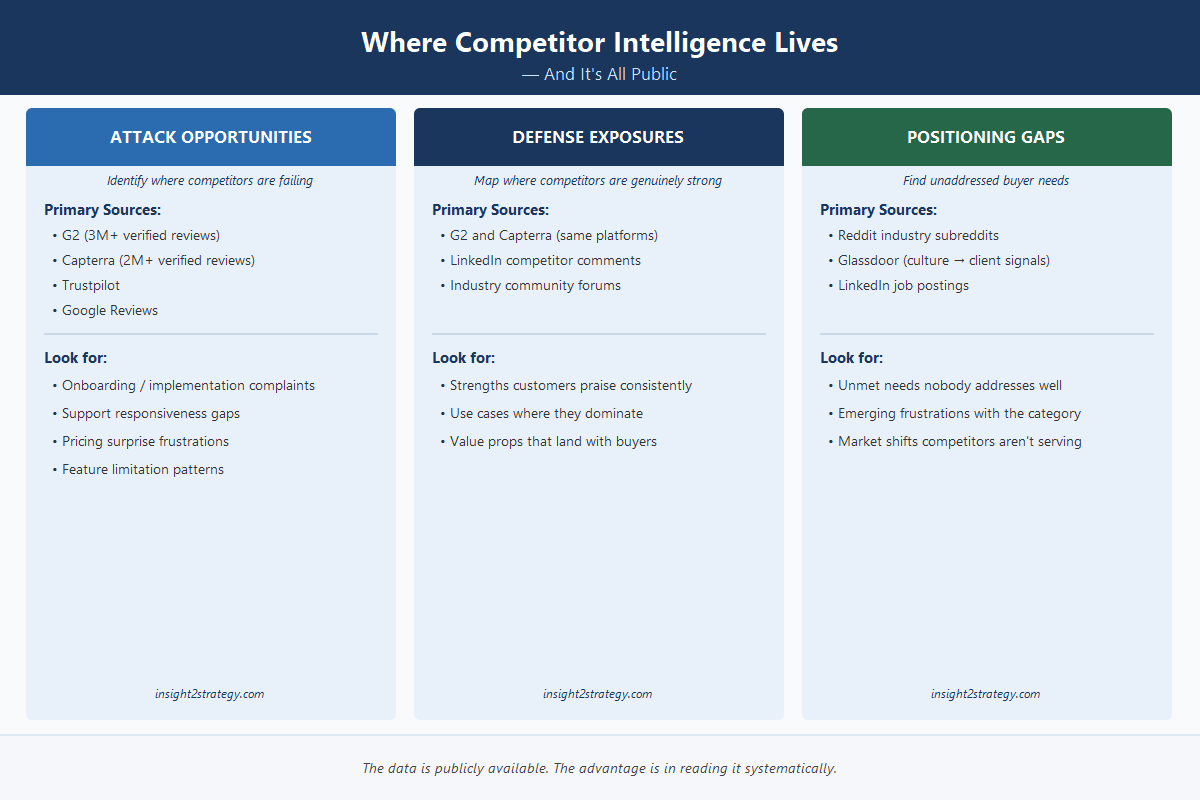
What Your Competitors' Customers Are Actually Telling You
G2 hosts over 3 million verified reviews. Capterra hosts over 2 million. (G2.com; Capterra.com) Behind those numbers is an extraordinary amount of competitive intelligence that most businesses walk right past.
This is not anecdotal feedback — it's pattern-rich data. When you mine competitor reviews systematically, you stop seeing individual opinions and start seeing recurring themes that reveal true market vulnerabilities:
- Recurring pain points: “Implementation took months” appearing across 20+ reviews isn't a one-off complaint — it's a structural weakness
- Feature gaps customers name specifically: Missing integrations, limited reporting, poor customization — all documented in the customers' own words
- Why they almost switched: Post-purchase reviews often contain the exact triggers that make someone consider a competitor — which means they're also the triggers your prospects are watching for
- Pricing and value frustrations: Hidden fees, surprise renewals, unclear ROI — these complaints are a direct map to what your buyers worry about before signing
The real value isn't the volume of reviews. It's that the buyers who left them just went through a decision process similar to the one your prospects are making right now.
Why Most Companies Leave This Intelligence Untouched
If this data is so valuable and readily accessible, why aren't more businesses using it? The honest answer is fourfold:
1. Volume without structure. Thousands of reviews across multiple platforms, with no clear process for turning them into something actionable. Reading a bad review is easy. Aggregating that data into themes your sales team can use is hard.
2. No bridge to revenue. Even when someone reads the reviews, they rarely convert the insight into positioning language, talk tracks, or battle cards. Insight without translation doesn't move deals.
3. Internal bias. Sales reps hear what they expect to hear. Marketing focuses on its own narrative. Without an outside lens, the real competitive signal stays buried under confirmation bias.
4. The “someday” trap. Competitive intelligence is perpetually a good idea that gets deferred for immediate priorities. Which means your competitors — who are also deferring it — leave a window open for whoever acts first.
Formal win/loss analysis programs — which use similar competitive insight gathering — have been linked to up to 50% improvement in win rates. (Gartner, cited by Evalueserve) The mechanism is straightforward: your team stops guessing why deals are won or lost and starts having informed conversations built on documented evidence.
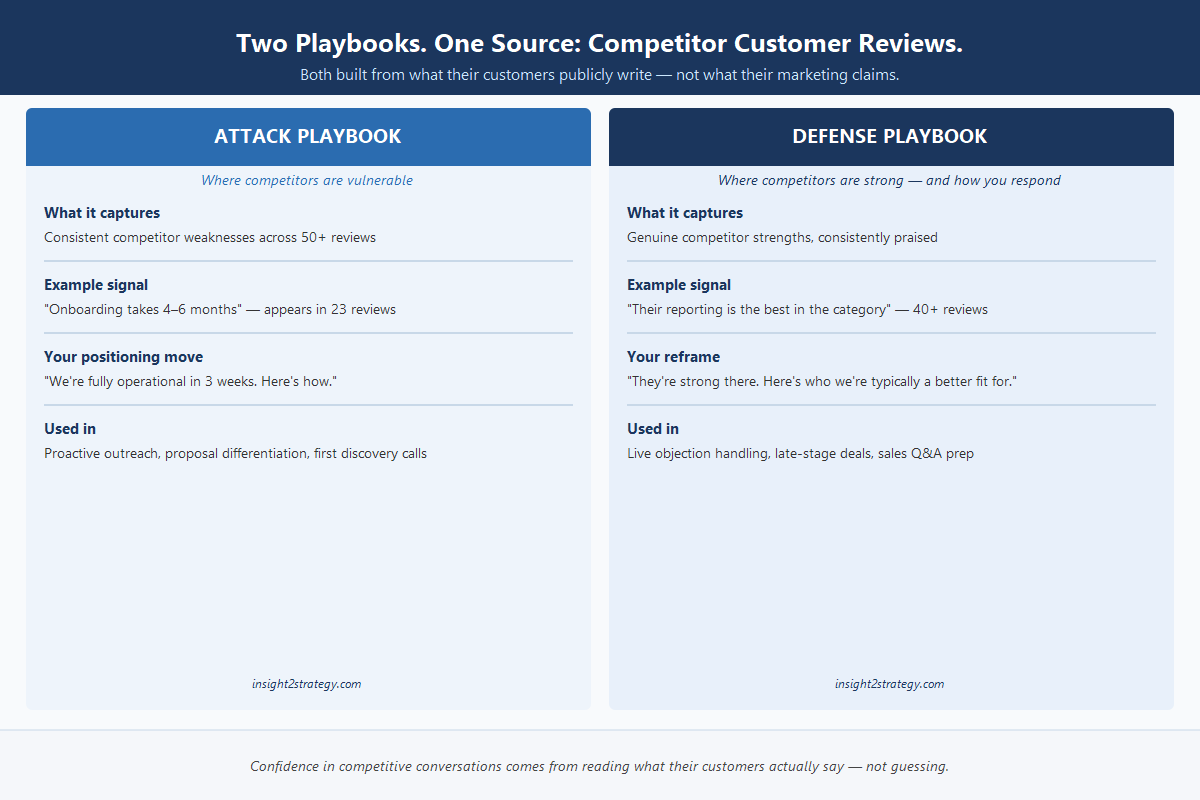
How to Build Your Attack Playbook
The attack playbook answers one question: where are your competitors genuinely vulnerable, in ways your prospects care about?
When you mine competitor reviews systematically, the most common attack opportunities fall into four categories:
Onboarding and implementation gaps. “Took six months to get value” appears constantly in reviews for service businesses and software platforms alike. If your implementation is faster, that's a specific, defensible claim — not a vague differentiator.
Support responsiveness. Slow ticket resolution and difficult-to-reach humans are among the most consistently cited frustrations across industries. If you're genuinely more responsive, say so with specificity: response SLAs, dedicated contacts, named account managers.
Flexibility and customization limits. “Couldn't adapt it to how we actually work” is a phrase that shows up in review after review. If you accommodate workflow variation, frame that as a concrete capability — not a generic “we're flexible” claim.
Pricing transparency. Unexpected fees at renewal or project scope expansion are perennial frustrations. If your pricing model avoids this, address it directly in your sales process and materials.
The most overlooked asset in this work is the verbatim language itself. Instead of guessing how to describe your advantage, you use the exact phrases your competitors' own customers have used to describe their frustrations. That language belongs in your sales conversations, your website, and your positioning — because it's the language your prospects are already using internally to evaluate options.
How to Build Your Defense Playbook
The defense playbook answers the harder question: where are your competitors genuinely strong, and what does your team say when a prospect brings it up?
The worst possible response when a prospect says “I've heard Competitor X is really strong on [capability]” is to fumble or pivot vaguely. Companies that have invested in understanding the competitive landscape have a prepared, confident reframe:
“They're strong there. Here's how we're different, and here's who we tend to be a better fit for.”
That kind of response does three things: it builds immediate trust (you know your market), it signals confidence (you're not trying to be everything), and it advances the deal (clarity beats hedging in late-stage conversations).
The reframe isn't about dismissing competitor strengths. It's about acknowledging them honestly and then shifting the conversation to the dimensions where your differentiation is most relevant to this specific buyer. Sometimes a competitor strength is genuinely better for a different kind of buyer — and saying so is more credible than trying to neutralize it.
⚡ Quick Implementation Tip
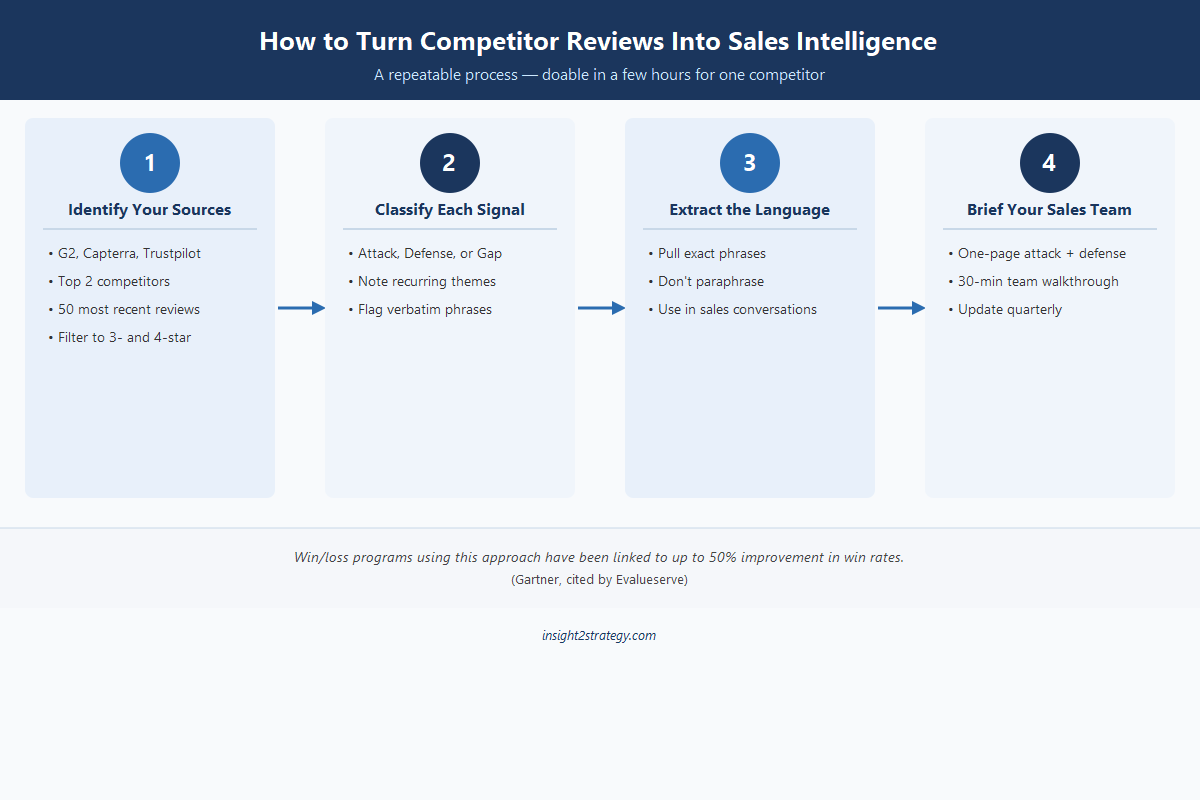
Start with your top two competitors and their 50 most recent reviews on G2 or Capterra — specifically the 3-star and 4-star reviews. These contain the most honest, signal-rich feedback. Focus your reading there and you can build a usable one-page attack and defense reference in a single working session.
📊 Implementation Framework
The 5-step process below is the same framework we use in competitive intelligence engagements. Need help adapting it to your specific competitive landscape and sales process? Let's discuss your approach.
How to Do This Yourself
If you have a few hours and a competitor with meaningful review volume, here's a process you can run immediately:
- Pick your top two competitors — the ones your prospects mention most often, or who appear in your recent lost deals
- Read their 50 most recent reviews — focus especially on 3-star and 4-star reviews, which tend to carry the most nuanced, signal-rich feedback
- Tag each review with a category: onboarding, support, pricing, flexibility, feature gaps, expectations vs. reality
- Extract verbatim phrases — don't paraphrase. The exact language is what you want in your sales conversations
- Build a one-page reference — attack column (their consistent weaknesses), defense column (their genuine strengths and your prepared responses) — then brief your sales team in thirty minutes
This works. It's not complicated, and it gives your team a concrete competitive edge within a week. The limitation is scale and consistency: doing this for one competitor once is valuable, but the real advantage compounds when you do it for three competitors and update it as new reviews come in.
The Competitive Advantage Is in the Listening
The data is publicly available. The patterns are there for anyone willing to read them systematically. The companies that will enter Q4 with sharper positioning than their competitors aren't working from better instincts — they're working from more structured information.
Your competitors' customers are telling you exactly how to beat them. The only question is whether you're reading it before your competitors do.
If you'd rather have a structured version of this analysis done for your top competitors — the attack playbook, defense playbook, and verbatim language your team can use — the Competitive Intelligence Snapshot is how we've packaged it. Or start with a free conversation if you want to think through your competitive landscape first.
|
This post is part of The B2B Marketing Reality Check The strategic framework for growth-stage B2B tech companies — now available in paperback and Kindle. Every topic we cover in this blog goes deeper in the book, with frameworks, diagnostics, and quick wins you can put to work immediately. Get the Free PDF →Want to work through the framework hands-on? Get the companion workbook → |
Frequently Asked Questions
Which review platforms give the most useful competitive intelligence?
For B2B software and services, G2 and Capterra are the highest-signal sources — they have structured review formats that make it easier to spot patterns across many reviews. For service businesses outside tech, Google Reviews and Trustpilot are useful. LinkedIn competitor content comments and industry-specific forums (Reddit subreddits, Slack communities) surface emerging frustrations earlier than formal review platforms. Start with G2 and Capterra if your competitors are listed there, then add forums for qualitative depth.
How do I respond confidently when a prospect says a competitor is better?
The framework: acknowledge the strength honestly, then shift to fit. “They're strong there. What we find is that we're typically a better fit for [buyer profile] because [specific reason].” Avoid dismissing or deflecting — those responses signal that you're not confident in your own position. The companies that handle competitor objections best have done the work to genuinely understand what competitors are good at and who they serve best — which is exactly what the defense playbook provides.
How often should I update my competitive intelligence?
Quarterly is sufficient for most growing businesses. Review platforms update continuously, but the structural weaknesses that drive buyer decisions tend to persist over months. The most important time to update is when a competitor launches something new, when you start losing deals you expected to win, or when your sales team starts hearing objections they haven't encountered before. Any of those signals warrants a fresh look at what their customers are saying.
Ready to Map Your Competitive Landscape?
Every competitive landscape is different. Let's discuss how to build your specific attack and defense playbooks from what your competitors' customers are saying right now.
No sales pitch. A focused conversation about what your competitors' customers are already telling you.
Insight2Strategy helps growing businesses cut through marketing confusion to find strategies that actually drive revenue and customer growth. www.insight2strategy.com


Comments
Post a Comment