4 Lead Nurturing Quick Wins: Turn “Maybe Later” Into “Let’s Talk Now”
Strategic Analysis by: Insight2Strategy
Published: September 7, 2026
Reading Time: 8 minutes
Executive Strategic Insights
- Your nurture database is an underutilized asset — the fastest path to more pipeline rarely involves generating more leads at the top of the funnel.
- Companies excelling at lead nurturing generate 50% more sales-ready leads at 33% lower cost per lead (Forrester Research).
- 73% of B2B leads are not sales-ready when they first enter your funnel (MarketingSherpa, 2012) — silence is often timing, not disinterest.
- 4 structural quick wins activate dormant leads without a platform overhaul: Wake Up sequences, behavioral triggers, stalled opportunity follow-up, and activation events.
- AI-powered nurture compounds a strong foundation — but scales problems if messaging, segmentation, or trigger logic aren’t in place first.
- Implementation framework detailed below — each quick win includes specific tactics you can deploy this quarter.
Your nurture database is one of the most underutilized strategic assets in your business — and the fastest path to more pipeline rarely involves generating more leads at the top of the funnel.
Here’s the pattern we see repeatedly in growing businesses: leads come in, they engage, they go quiet — and then the company treats the silence as disinterest and spends more money chasing net-new prospects. Meanwhile, hundreds (or thousands) of warm leads sit dormant in a CRM, waiting for the right message or the right moment to re-engage.
The fix isn’t a six-month platform overhaul. It’s a set of intentional, structural improvements to a nurture program that likely already exists.
Companies that excel at lead nurturing generate 50% more sales-ready leads at 33% lower cost per lead (Forrester Research). That’s a structural advantage built from an asset you already own. Here are four lead nurturing quick wins to start capturing it this quarter.
Following along? Get the Lead Nurturing Mini-Guide below to implement these strategies step-by-step — includes email templates, trigger logic maps, and a planning worksheet.
Quick Win 1: Build a “Wake Up” Sequence for Leads Inactive 60+ Days
The problem
When leads go quiet, most nurture programs go quiet with them. After a few unanswered emails, the sequence ends — and nothing replaces it.
But silence isn’t disinterest. It’s often timing. Only 27% of leads are sales-ready when they first enter your funnel (MarketingSherpa, 2012). The other 73% need time, context, or the right catalyst. A lead who downloaded your guide six months ago isn’t a dead lead — they’re an unactivated asset.
The solution
A 3-email re-engagement sequence triggered automatically after 60+ days of inactivity. This isn’t a promotional blast — it’s a structured conversation designed to either restart engagement or create a clean exit.
Implementation
- Email 1 — Pattern Interrupt: Short subject line (“Still relevant?” / “Checking in”). Acknowledge the gap without apologizing. Offer one clear next step — a resource, a diagnostic, or a simple “reply to let us know where you’re at.”
- Email 2 — Value Reset: If Email 1 wasn’t opened, send this 3–4 days later. Share a high-impact insight relevant to their original area of interest. No pitch — just value that reconnects them to why they engaged in the first place.
- Email 3 — The Friendly Decision Point: If neither email landed, send this 7 days later. Give them an easy yes/no: “Ready to revisit this now, or should we pause outreach?” — with a clear one-click option to stay on the list and a frictionless unsubscribe. Clean exits are better than indefinite stalls and protect your deliverability.
⚡ Quick Implementation Tip
Both outcomes from a Wake Up sequence are wins: a re-engaged lead restarts pipeline; an unsubscribe improves list quality and deliverability. The sequence forces a defined outcome either way — which is exactly what most passive nurture programs lack.
The business impact
Re-engagement campaigns consistently outperform standard nurture emails in response rate — the structured decision-point format forces an outcome either way. You either re-qualify warm interest or clean the list of truly inactive contacts. Both improve pipeline quality.
Quick Win 2: Add Behavioral Triggers to Your Main Nurture Sequence
The problem
Most nurture sequences treat every lead the same regardless of what they actually do. Someone who visits your pricing page three times in one week has meaningfully different intent than someone who opened an email but never clicked. Sending both the same next message isn’t personalization — it’s broadcasting with extra steps.
Companies that excel at personalization generate 10–20% revenue uplift compared to peers who don’t (McKinsey, Next in Personalization, 2021). The gap between a sequence that responds to behavior and one that ignores it compounds over time.
The solution
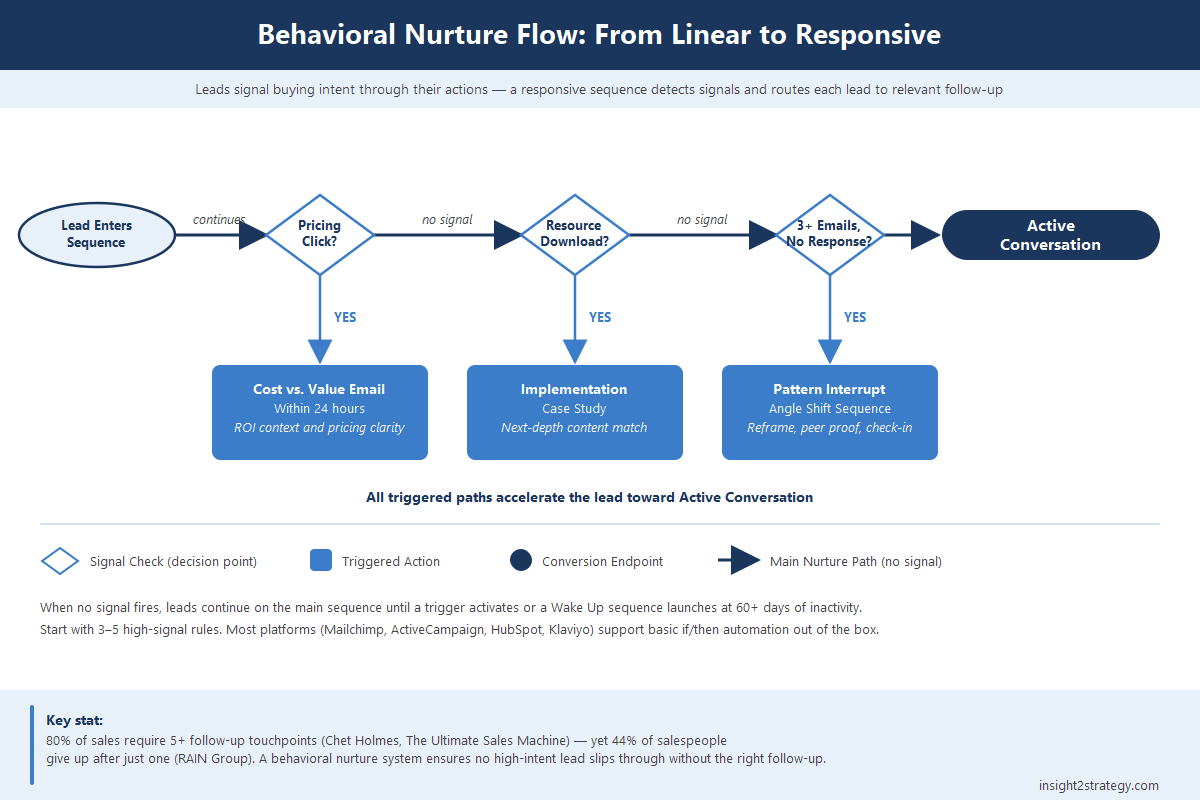
Layer 3–5 behavioral trigger rules into your existing sequence. You don’t need a complex system — most email platforms (Mailchimp, ActiveCampaign, HubSpot, Klaviyo) support basic if/then automation. Start with the highest-signal actions:
- If a lead clicks pricing or ROI content → Send a “cost vs. value” follow-up within 24 hours
- If a lead downloads a technical resource → Follow with an implementation-focused case study
- If a lead ignores 3+ emails → Shift to a different angle: problem reframe, peer proof, or a low-friction check-in
- If a lead clicks a specific industry case study → Trigger a second related case study or a focused consultation offer
The goal is to build decision branches into a conversation that was previously a monologue.
📥 Get the Complete Trigger Logic Map
The Lead Nurturing Mini-Guide includes a full if/then trigger table with 6 high-signal rules and platform setup notes for Mailchimp, ActiveCampaign, HubSpot, and Klaviyo.
The business impact
Triggered emails consistently outperform batch campaigns in open rates and engagement. As more leads hit behavioral triggers, fewer fall through the cracks — and the sequence gradually compounds its own conversion rate.
Quick Win 3: Create a “Stalled Opportunity” Sequence
The problem
Some of your most valuable opportunities aren’t cold leads — they’re warm deals that reached discovery, demo, or proposal stage and then went dark. These aren’t people who lost interest. They’re people whose internal priorities shifted, whose budget cycle moved, or who needed more time than the initial conversation allowed.
Most companies don’t have a structured response to this. So stalled deals sit in the pipeline until someone marks them lost — without a single structured follow-up beyond a “just checking in” email.
The data is clear: 80% of sales require at least five follow-up touchpoints (Chet Holmes, The Ultimate Sales Machine), yet 44% of salespeople give up after just one (RAIN Group, 2024). That’s not a prospect problem — it’s a system problem.
The solution
A dedicated 4-email sequence for mid-funnel opportunities that have gone silent for 14+ days after a sales touchpoint. This sequence is distinct from early-stage nurture — it’s more direct, more specific to their prior conversation, and more outcome-focused.
Implementation
- Email 1 — Reconnect with context: “When we last spoke, you were focused on [X] — is that still a priority?” Specific reference to the previous conversation. Short.
- Email 2 — New insight: Share a relevant trend, risk, or development that’s emerged since you last connected. Reframe urgency without pressure.
- Email 3 — Social proof: A case study or example from a similar company that moved forward — and what changed for them as a result. Let the outcome speak.
- Email 4 — Close the loop: “Should we reconnect now, or take this off your plate for the moment?” Clear, low-pressure decision. A clean exit is better than indefinite stall.
⚡ Quick Implementation Tip
The most important word in a Stalled Opportunity email is specific. “When we last spoke, you were focused on scaling your outbound team before Q4” outperforms “I wanted to follow up on our conversation” every time. Pull from your CRM notes before sending Email 1.
The business impact
Because these prospects are already warm, conversion to meeting is dramatically higher than cold re-engagement. You’re not starting a new conversation — you’re reopening one that was never really closed.
Quick Win 4: Build an Activation Event Into Your Nurture Calendar
The problem
Educational content keeps you top of mind. But it rarely creates urgency.
Without a specific moment to act — a date, an event, a time-bounded offer — leads stay in “maybe later” mode indefinitely. The nurture sequence runs, emails get opened, and nothing moves. Passive nurturing is better than nothing, but it’s not a lead activation strategy.
The solution
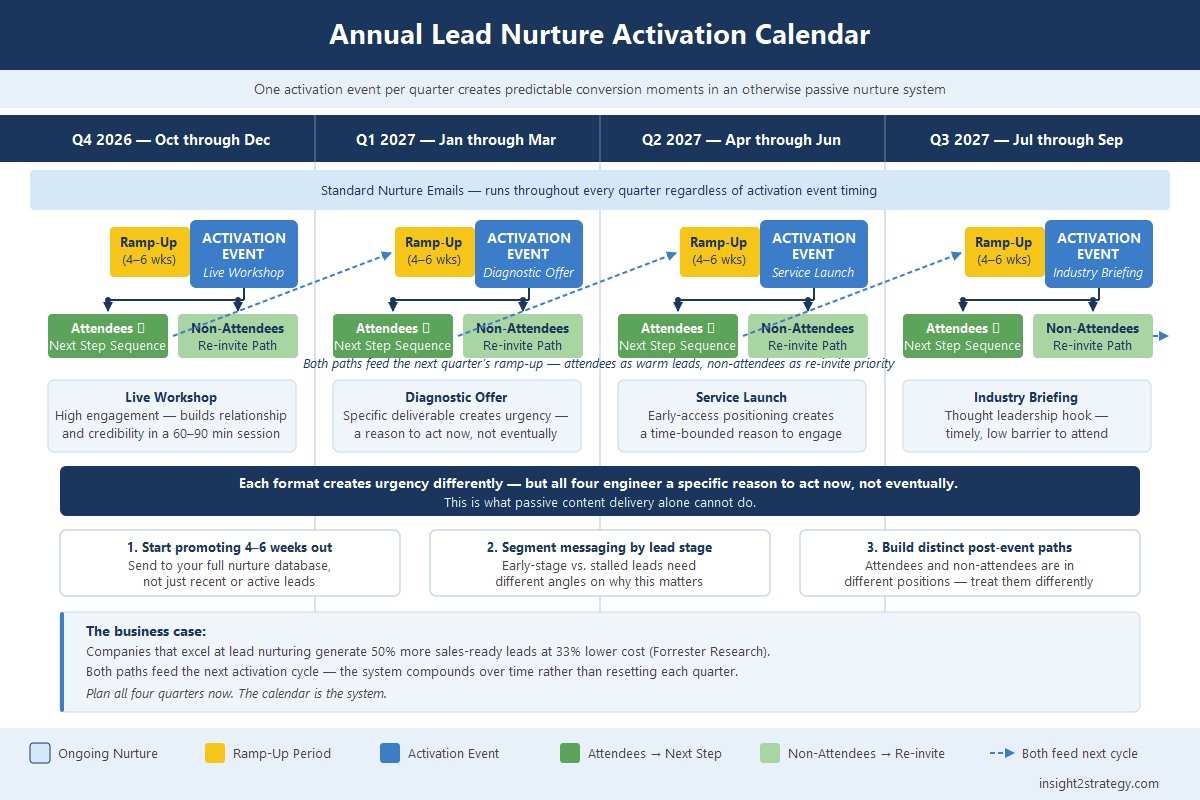
Introduce one activation event per quarter and integrate it into every nurture track. The format is flexible:
- A focused live workshop or group diagnostic session
- A limited-time assessment or audit offer (e.g., “5 spots available this quarter”)
- A new service launch with early-access positioning
- A quarterly industry briefing framed around a specific business problem
What matters is that it creates a specific reason to engage now — not eventually.
Implementation
Plan your activation events for the next four quarters now (Q4 2026 through Q3 2027). For each event:
- Start promoting to your full nurture database 4–6 weeks out
- Segment messaging by lead stage — early-stage leads and stalled opportunities get different angles on why this event matters to them specifically
- Build distinct post-event follow-up tracks for attendees and non-attendees — they’re in different positions and need different next steps
The business impact
The mechanism is simple: urgency. A specific date, a limited-access format, or a bounded offer gives prospects a reason to act now rather than later — engineering a conversion moment into a system that otherwise has none. Passive nurture keeps you top of mind; activation events create the moment that tips “maybe later” into a conversation.
What AI Can (and Can’t) Do for Your Nurture Program Right Now
AI-powered nurture personalization is real — and getting more capable every quarter.
Done right, AI can optimize send times, generate personalized content variants at scale, surface behavioral patterns that humans would otherwise miss, and predict which leads are approaching a buying window. McKinsey research shows organizations using AI for customer-journey automation are seeing revenue uplifts of 3–15% and sales ROI improvements of 10–20% (McKinsey, May 2023).
But AI doesn’t fix a broken foundation.
If your messaging is unclear, your segmentation is shallow, or your behavioral trigger logic doesn’t exist yet — AI scales the problem, not the solution. The companies that struggle most with AI implementation in nurture aren’t facing an AI problem. They’re facing a strategy and structure problem that they’re hoping AI will solve.
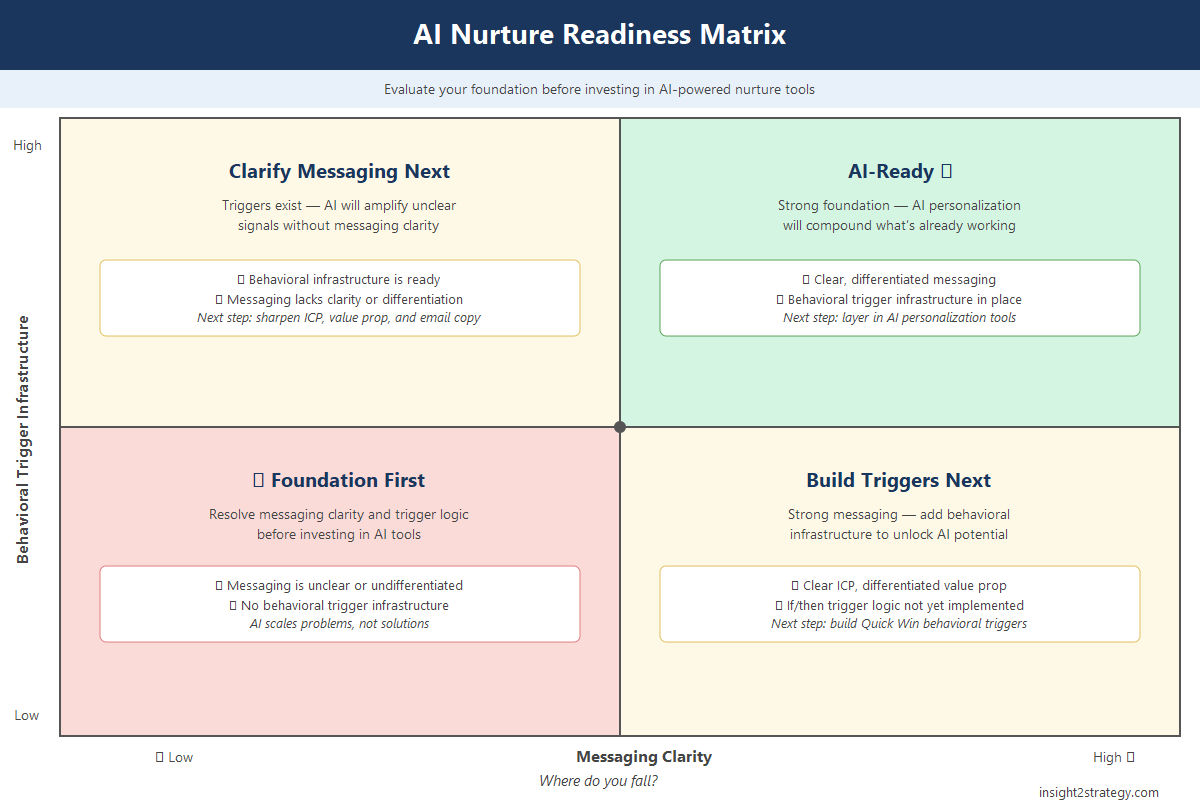
Before investing in AI-powered nurture tools, it’s worth getting an honest read on where your foundation actually stands.
If you want a structured version of that assessment: our AI Readiness Reality Check gives you a two-dimension score — what you can deploy now versus what requires foundational groundwork first. AI Readiness Reality Check →
|
This post is part of The B2B Marketing Reality Check The strategic framework for growth-stage B2B tech companies — now available in paperback and Kindle. Every topic we cover in this blog goes deeper in the book, with frameworks, diagnostics, and quick wins you can put to work immediately. Get the Free PDF →Want to work through the framework hands-on? Get the companion workbook → |
Frequently Asked Questions
How many emails should a re-engagement sequence include?
Three emails is the sweet spot for a Wake Up sequence. Email 1 is a pattern interrupt, Email 2 delivers fresh value, and Email 3 offers a clean yes/no decision. Beyond three, you risk damaging deliverability with contacts who have genuinely lost interest. The structured endpoint is what makes the sequence work — it forces an outcome either way.
What actions should trigger a personalized nurture email?
Start with the three highest-signal behaviors: a pricing or ROI page click (buying intent), a resource download (implementation intent), and three consecutive ignored emails (disengagement signal). These are available in most email platforms without custom integrations. Add more triggers after your first three are live and measurable — don’t try to build the full system at once.
How long should you wait before running a Stalled Opportunity sequence?
14 days of silence after a sales touchpoint is the right trigger point. Earlier than that and you risk being pushy; later and the prospect has mentally moved on. The 4-email sequence then runs over roughly 40 days — enough time to be persistent without being aggressive. The specific reference to their prior conversation in Email 1 is what makes the sequence feel personal rather than automated.
What activation event format works best for lead conversion?
It depends on your lead stage mix. For early-stage nurture databases, a live workshop or industry briefing tends to convert best — it’s low-commitment and educational. For mid-funnel databases with stalled deals, a limited-access diagnostic or assessment offer creates urgency more effectively. The key is that the format matches where your leads are in their decision process, not just what’s easiest to produce.
How do we measure ROI on lead nurturing improvements?
Track three metrics: re-engagement rate (% of inactive leads who open or click within a sequence), lead-to-opportunity rate (% of nurtured leads who convert to sales conversations), and time-to-conversion (how many days from entry to first sales touchpoint). Most teams see measurable improvement in re-engagement rate within 60 days of implementing a Wake Up sequence — that’s the fastest leading indicator of whether the program is working.
Your Next Step
These four lead nurturing tactics are high-leverage improvements you can make to a nurture program that already exists. No new platform required. What’s needed is intention, structure, and a clear activation strategy.
If you want the complete framework — including proven email templates, engagement scoring, activation campaign formulas, and timing guidelines — the Lead Nurturing Mini-Guide has everything in one place.
It combines the myth-busting insights from our earlier post on lead nurturing strategy with the tactical implementation tools you need to act this week:
- Wake Up and Stalled Opportunity sequence templates
- Behavioral trigger logic mapped to common platforms
- Engagement scoring framework
- Activation event planning calendar and promotion checklist
Get the Lead Nurturing Mini-Guide (Free)
4 quick wins + email templates + activation planning tools. Enter your email below and we’ll send your download link immediately.
Instant delivery. No sales pitch. Just actionable lead nurturing tactics you can implement this week.
Download the Lead Nurturing Mini-Guide
Get instant access to the Lead Nurturing Mini-Guide — enter your email below and we'll send the download link right over.
Want to discuss how to adapt these strategies to your specific situation?
Schedule a Free Consultation →Your “maybe later” list isn’t a liability. It’s the next conversation waiting for the right reason to happen.
Insight2Strategy | Strategy. Marketing. Growth.
www.insight2strategy.com | Free Consultation | Marketing Reality Check
Helping growing businesses build marketing systems that drive sustainable pipeline growth.


Comments
Post a Comment