3 Content Strategy Quick Wins: Get 10x More Value From Content You Already Have
3 Content Strategy Quick Wins: Get 10x More Value From Content You Already Have
Strategic Analysis by: Insight2Strategy
Published: August 3, 2026
Executive Reading Time: 7 minutes
Executive Strategic Insights
- The core problem: Most B2B marketing teams have a content efficiency problem, not a content volume problem. SiriusDecisions estimates 60–70% of B2B marketing content goes unused by sales teams.
- Quick Win 1 — Repurposing workflow: Every long-form piece contains at least four derivative assets. A structured 60-minute workflow extracts LinkedIn posts, data points, email snippets, and a video script without writing anything new.
- Quick Win 2 — Content audit: Your top-performing content is likely absent from nurture sequences, sales enablement, and social channels. Redistributing proven pieces consistently outperforms creating new ones.
- Quick Win 3 — Content upgrades: A downloadable asset tied to a specific post converts at 3–5x the rate of a generic lead magnet — because context eliminates friction.
- The intelligence layer: Competitive language from customer reviews is the most underused content source in B2B marketing. It's the bridge from efficiency to precision.
Following along? The complete Content Strategy Toolkit — repurposing checklist, audit matrix, and upgrade planner — is available as a free PDF below.
Most companies are sitting on 6–24 months of content they wrote once, published once, and then never touched again.
That blog post from last spring? Still sending trickles of traffic from your CMS, never integrated into a nurture sequence. That whitepaper your team spent three weeks producing? Buried on a resources page that gets 40 visits a month. That webinar recording from Q4? Shared in one email, unlisted on YouTube, quietly forgotten.
This isn't a content creation problem — it's a content efficiency problem. According to SiriusDecisions, 60–70% of B2B marketing content goes unused by sales teams. You're producing assets with real strategic value and treating each one as disposable the moment the next project starts.
The fix isn't writing more. It's extracting more from what you already have. These three quick wins can be implemented this week, and they compound over time.
Quick Win 1: Build a Content Repurposing Workflow
Most teams treat every piece of content as a one-time event. You publish it, promote it for a week, then immediately shift focus to creating something new. The result: a growing content library that generates modest, declining traffic instead of compounding returns.
The shift that changes this is treating content as a system, not an event.
For every long-form piece you publish — a blog post, case study, webinar, podcast episode — there are at least four derivative assets hiding inside it, already written:
- 3 LinkedIn posts: Each covering one key insight from the piece — not summaries, but standalone observations written for the platform. One data point angle, one framework angle, one contrarian take.
- 5 pull quotes or data points: Formatted for Twitter/X as standalone insight posts, deployable over the following 2–3 weeks.
- 1-paragraph email: The "here's what you need to know and why it matters" distillation — useful for newsletter segments and sales follow-up.
- 1 short video script: The core argument in 3 minutes of conversational format — recordable on a phone, usable as LinkedIn native video or YouTube Short.
⚡ Quick Implementation Tip
Take your most recent long-form piece. Before you open a new document, run it through this framework. Time yourself. For most teams, this takes 45–60 minutes — not because you're writing new content, but because the content is already written. You're extracting what's already there. Tools that help: Descript for video clips, Canva for quote graphics, a simple Google Doc as your repurposing checklist.
The structural advantage: A blog published once might generate 400 visits in its first month. That same blog, systematically repurposed across channels, can generate 3–5x that reach without writing a single new word. The thinking is done. Stop leaving it on the table.
Quick Win 2: Audit Your 5 Best-Performing Pieces and Redistribute Them
Before creating anything new, answer this question: where are your top performers actually showing up right now?
The gap between your best content and its actual distribution is almost always larger than you think. The top-performing blog posts — the ones that rank, convert, and close — often aren't in nurture sequences, aren't being shared by sales, and haven't been promoted on social since their launch week.
📥 Get the Complete Audit Framework
The Content Strategy Toolkit includes a printable version of this audit matrix with a worksheet for your top 5 pieces. Free download below.
The audit:
- Pull your top 5 pieces by organic traffic, conversion rate, or time-on-page — whichever metric is most meaningful for your business
- For each piece, check three things:
- Is it in your automated email nurture sequences?
- Does your sales team know it exists and know when to use it?
- Has it been promoted on social in the last 90 days?
- Every "no" answer is a distribution gap — content that's already proven and just needs a second (or third) deployment
Where to redistribute:
- Email nurture: High-performing evergreen content belongs in your automated sequences, not just your blog archive. A post that converts 3% of cold traffic will often convert at higher rates inside a nurture sequence where context is already established.
- Sales enablement: If a piece answers the objections your sales team hears most, it should be in their hands in a format they'll actually use — a one-page summary, a "send this when they ask about X" note. Make it frictionless.
- Social recycling: A post that performed well 6 months ago will perform again with a fresh angle or updated framing for a new audience segment. Platforms reward consistency, not novelty.
⚡ Quick Implementation Tip
This week: Block 2 hours, pull the data, and map each top performer against your distribution channels. You'll likely find 3–4 pieces that deserve immediate redistribution before you write anything new.
Quick Win 3: Create a Content Upgrade for Your Top 3 Blog Posts
A content upgrade is a downloadable asset that directly extends the value of a specific blog post — a checklist, a template, a worksheet. It lives inside the post itself, gated behind a simple email opt-in.
Most blogs end with a dead end. The reader gets value, closes the tab, and leaves no trace. A content upgrade closes that gap by giving readers an obvious, immediate next step that's contextually matched to what they just read.
The conversion math is compelling. While a generic lead magnet (an ebook on your site's homepage) might convert at 1–2% of visitors, a content upgrade tied to a specific post converts at 3–5x that rate — because it's matched to what the reader is already interested in. [Backlinko; industry benchmark]
How to choose which posts to upgrade:
Prioritize posts with: (1) high organic traffic, (2) content that naturally leads to a "what do I do with this?" question, and (3) topics where your audience would value a reusable tool over more reading.
- A post on "How to Audit Your Marketing Funnel" → companion audit template
- A post on "5 Questions Before Hiring a Marketing Agency" → scoring worksheet
- A post on pricing strategy → competitive pricing audit template
What makes an effective content upgrade:
- Specific, not generic — it should only make sense in the context of that post
- Immediately usable — a template the reader can fill out today, not a guide they'll read someday
- Brief — a 1-page checklist often outperforms a 20-page guide
- Clearly named — the title should tell the reader exactly what they get
⚡ Quick Implementation Tip
This week: Pick your highest-traffic post. Identify the most obvious "next step" asset. Build it in Google Docs or as a simple PDF. Add a CTA inside the post. This can be done in a half-day — and it keeps generating leads from traffic you're already getting.
The Content You're Not Creating: Competitive Language
There's a fourth category of content that most teams overlook entirely: the language your competitors' customers use to describe their problems.
Review sites, sales call transcripts, and customer feedback on competitors are goldmines of positioning language — the exact words your prospects use when they're frustrated, searching for solutions, and ready to buy. That language belongs in your content. It's the difference between content that ranks and content that converts.
This is the bridge from content efficiency to content intelligence. Getting more from what you have is the quick win. Understanding what your audience is actually saying about alternatives in your market — that's the strategic layer that makes every piece you create more precise.
Start With What You Have
You don't need a bigger content budget. You need more leverage from the content you already own.
Start with Quick Win 1 this week: take your most recent long-form piece, run it through the repurposing framework, and build the habit before you build the system.
And if you're ready to add the competitive intelligence layer — our Competitive Intelligence Snapshot turns your competitors' customer reviews into content briefs, positioning language, and objection handlers your team can deploy immediately. If you'd rather have that work done for you, that's what we built it for.
Get Your Free Content Strategy Toolkit
The three frameworks from this post — repurposing workflow checklist, content audit matrix, and content upgrade planner — in a structured PDF your team can use immediately.
- ✓ One Piece → Many Outputs repurposing checklist (60 minutes per piece)
- ✓ Content Distribution Audit Matrix with 5-piece worksheet
- ✓ Content Upgrade Planner with 30-day tracking
- ✓ 3-week implementation roadmap
Free download. Delivered immediately to your inbox.
Download the Content Strategy Toolkit
Get instant access to the Content Strategy Toolkit — enter your email below and we'll send the download link right over.
Want to discuss how these strategies apply to your specific content library?
Schedule a Free Consultation →
|
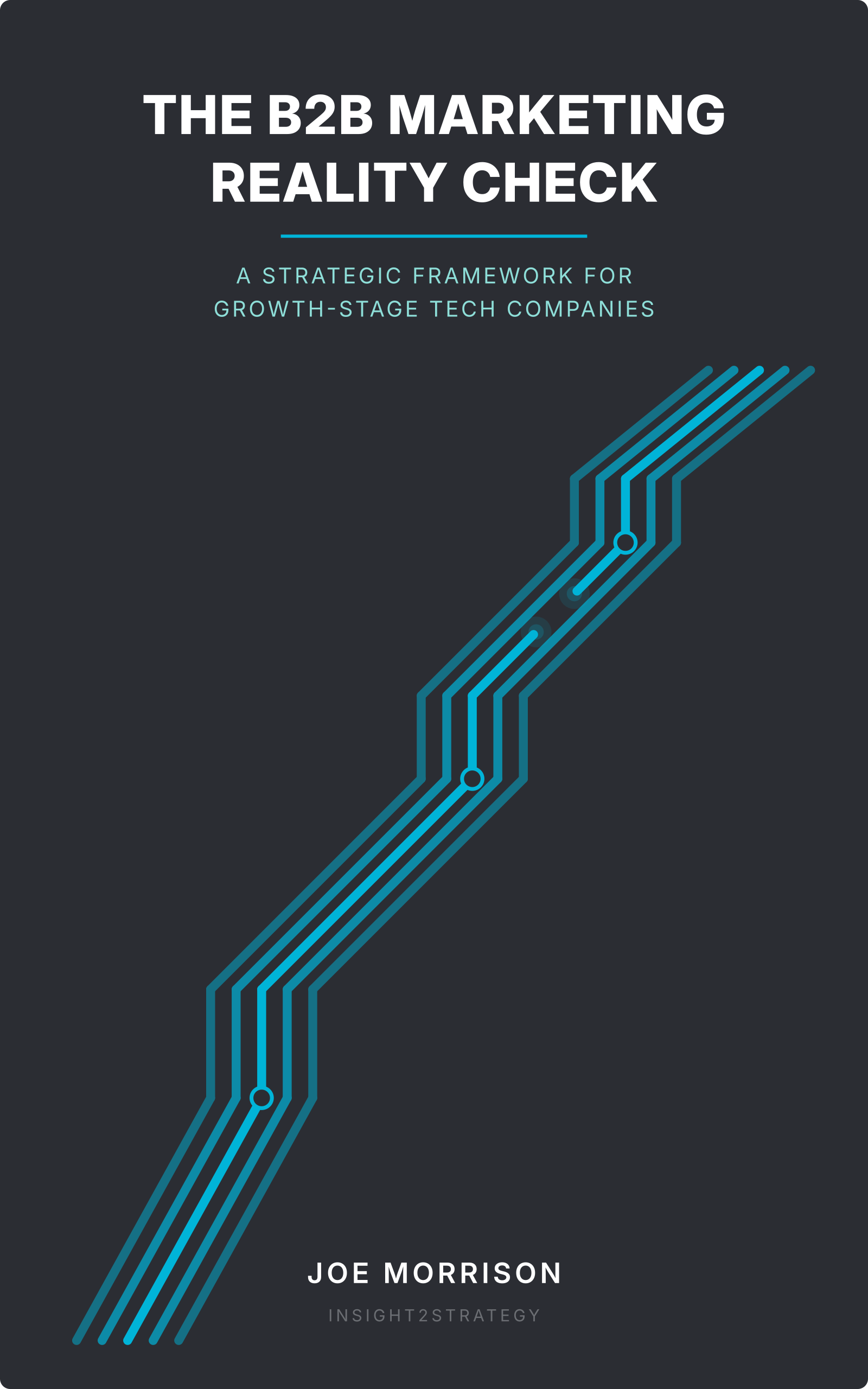
This post is part of The B2B Marketing Reality Check The strategic framework for growth-stage B2B tech companies — now available in paperback and Kindle. Every topic we cover in this blog goes deeper in the book, with frameworks, diagnostics, and quick wins you can put to work immediately. Get the Free PDF →Want to work through the framework hands-on? Get the companion workbook → |
Frequently Asked Questions
How long does a content repurposing workflow take to run per piece?
For most teams, the full repurposing checklist takes 45–60 minutes per piece when done within 48 hours of publication. The content is already written — you're extracting, not creating. If you're doing it weeks later and need to re-read the piece first, add 20–30 minutes.
What counts as a "top performer" for the content audit?
Use whatever metric is most meaningful for your business: organic traffic, conversion rate, time-on-page, or leads generated. The goal is identifying content that has already demonstrated value with an audience — these are the pieces most likely to perform again when redistributed to new channels or used in nurture sequences.
How often should I redistribute older content on social media?
For evergreen top performers, a 90-day social cycle is reasonable — post it with a fresh angle or updated framing rather than the same caption. Platforms reward consistency. Content that converted cold traffic 6 months ago will reach a largely new audience segment today.
What is a content upgrade, and how is it different from a lead magnet?
A lead magnet is a standalone resource offered site-wide (e.g., an ebook on your homepage). A content upgrade is specific to a single blog post — it extends the value of that post with an immediately usable tool (checklist, template, worksheet). Because the reader is already engaged with the topic, content upgrades convert at 3–5x the rate of generic lead magnets.
When should we hire outside expertise vs. handle this internally?
The three quick wins in this post are designed for internal implementation — each is a half-day to 2-hour project. The point at which outside expertise adds disproportionate value is when you want to add the competitive intelligence layer: systematically capturing what your competitors' customers are saying and building that language into your content strategy. That requires a structured research process and isn't easily DIY'd at the same quality level.
Insight2Strategy
Strategic marketing advisory for B2B companies. We help leadership teams build the strategies, systems, and content that drive consistent pipeline growth.


Comments
Post a Comment