4 Content Strategy Quick Wins: Create Content That Converts, Not Just Educates
4 Content Strategy Quick Wins: Create Content That Converts, Not Just Educates
Strategic Analysis by: Insight2Strategy
Published: July 27, 2026
Executive Reading Time: 6 minutes
Executive Strategic Insights
- The core problem is structural, not stylistic: Most content fails to convert because it educates without bridging insight to decision — a gap that four targeted adjustments close.
- Quick Win 1 — Add "So What" sections: A 2–4 sentence paragraph after each key section that translates insight into business implication. Takes minutes per section; meaningfully shifts whether readers leave with an action or just an idea.
- Quick Win 2 — Map to buyer stage, not topic: Most companies have 60–70% of content at the "Aware" stage and almost nothing at "Evaluating" — the stage buyers need most before reaching out.
- Quick Win 3 — Replace generic CTAs: Specific, stage-matched CTAs eliminate the friction of self-assessment. Personalized CTAs significantly outperform generic ones — the mechanism is simple relevance.
- Quick Win 4 — Create one tool per content cluster: Calculators, worksheets, and scoring templates produce a personalized output that converts at higher rates than static educational content.
- Implementation framework detailed below — all four adjustments can be applied to content you've already published.
The Bridge Problem: Why Educational Content Doesn't Convert
Educational content that doesn't convert isn't an awareness problem. It's a bridge problem.
Most companies we work with aren't struggling to create content. They're publishing blogs, posting on LinkedIn, sharing frameworks, and explaining their process — consistently. And yet the pipeline sits quiet. Leads aren't increasing. Sales conversations aren't improving. Content feels like effort, not leverage.
Here's why: you're educating your audience, but you're not helping them connect that education to a decision. According to Gartner's B2B Buying Journey research, 77% of B2B buyers say their last purchase was very complex or difficult. When your content adds complexity rather than reducing it, buyers disengage. The goal isn't to teach — it's to help them decide.
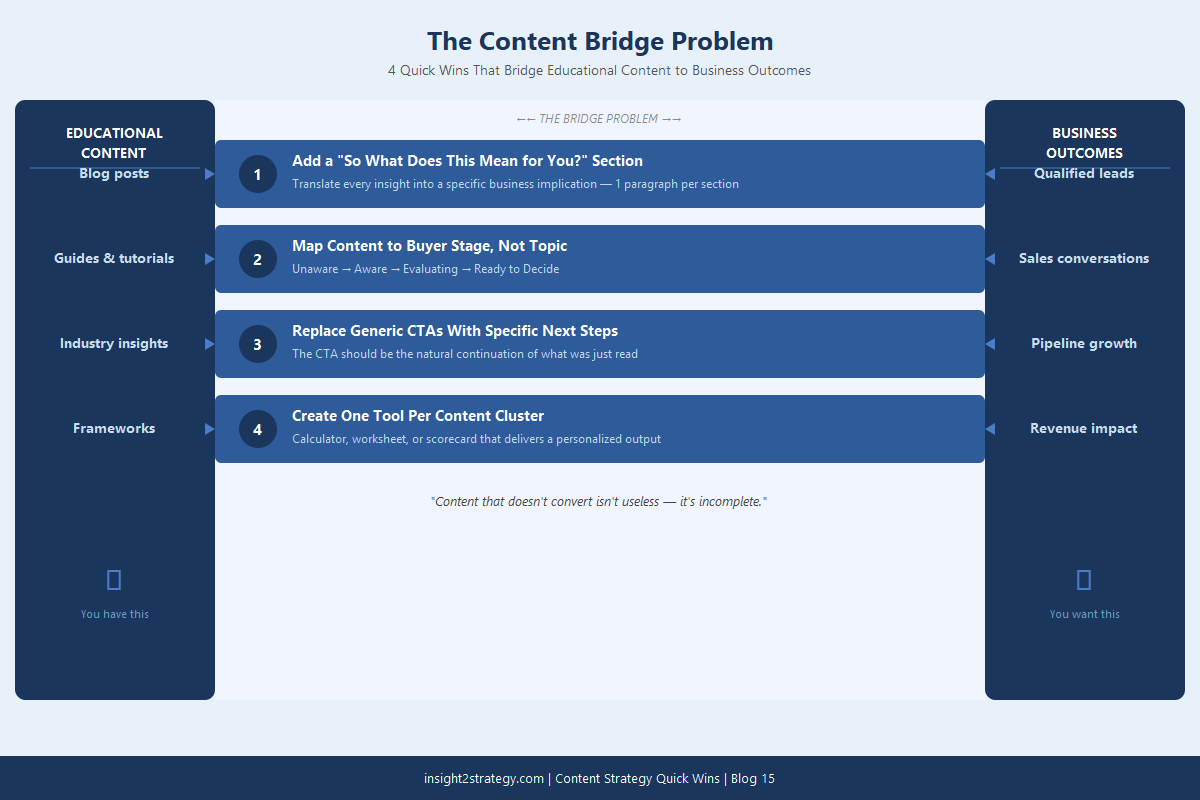
Four quick, practical adjustments close that gap — and you can start implementing them this week.
Quick Win 1: Add a "So What Does This Mean for You?" Section
The Problem
Most content stops at insight. You explain a trend, break down a strategy, share data, maybe even walk through a few examples. But you leave your reader to do the hardest part themselves: translating that insight into a business decision.
They won't do it. When content adds more complexity to an already complicated decision, buyers disengage. The burden of translation should sit with you, not your reader.
The Solution
After every major section, add a short "So what does this mean for you?" block. Two to four sentences that explicitly connect the idea you just explained to the business outcome the reader cares about. No jargon. No new ideas. Just translation.
Implementation
At the end of each key section, add something like this:
So what does this mean for you? If your content isn't tied to a clear decision or outcome, your audience won't prioritize acting on it. High-performing content teams focus less on volume and more on decision clarity — every piece should move a buyer one concrete step closer to action.
Tie the translation to their specific situation: their role, their size, their problem. The more specific the translation, the more useful the content becomes.
⚡ Quick Implementation Tip
Open your highest-traffic blog post right now. Identify each major section heading. After each one, add 2–4 sentences that answer: "What should a reader in my target market actually do with this information?" That's the entire adjustment. It takes 15–20 minutes per post and fundamentally changes whether readers leave with an action or just an idea.
Impact
You remove friction. You position yourself not just as someone who understands the problem — but as someone who helps solve it. Content shifts from "interesting to read" to "worth acting on."
Quick Win 2: Map Content to Buyer Stage, Not Topic
The Problem
Most content strategies are organized around what the company wants to talk about — not where the buyer actually is in their decision process. A prospect who just realized they have a problem needs completely different content than someone actively comparing vendors. If you're publishing the same type of content regardless of where your reader is, you're invisible when it matters most.
According to SiriusDecisions research (now part of Forrester), B2B buyers complete 60–70% of their research before ever engaging with sales. If that research phase meets generic content, you lose the buyer before the conversation starts.
The Solution
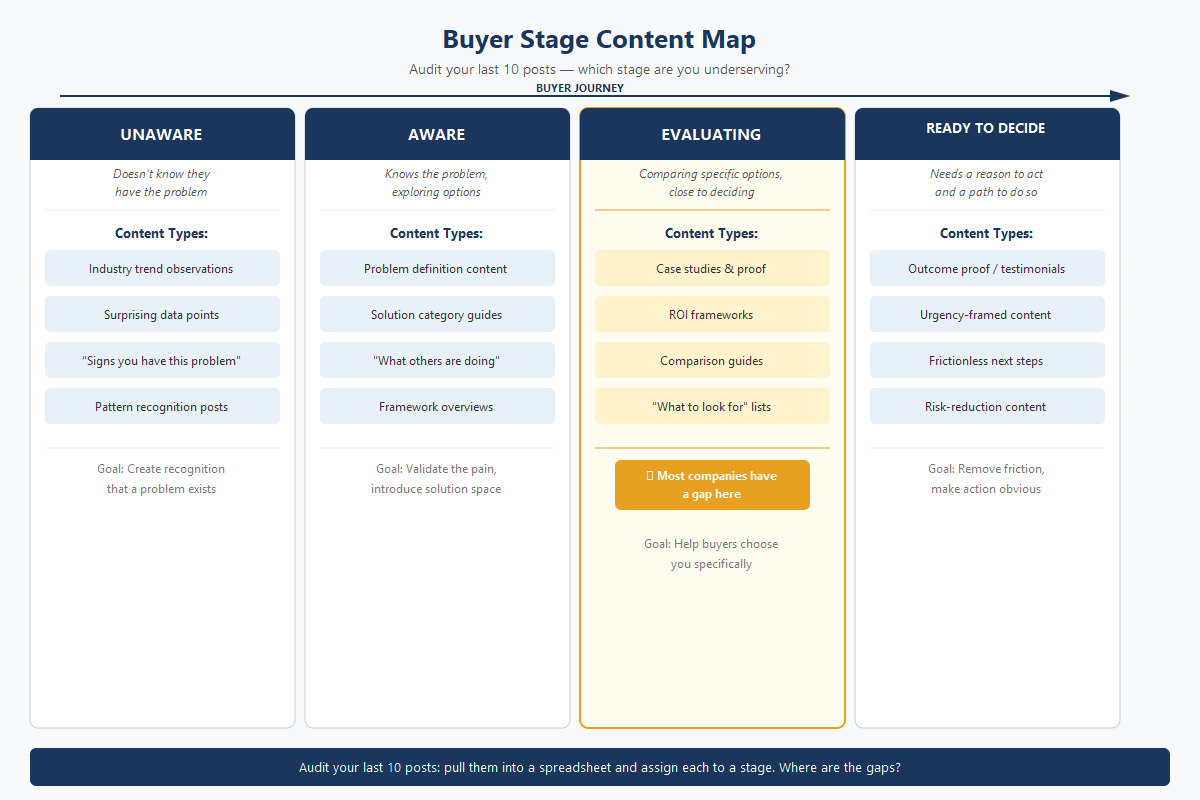
Reorganize your content around four buyer stages rather than topic categories:
- Unaware — Doesn't know they have the problem. Content focus: observation-driven trends, surprising data, patterns that create recognition.
- Aware — Knows the problem, exploring options. Content focus: validate the pain, introduce solution categories without pitching yours yet.
- Evaluating — Comparing specific options. Content focus: case studies, ROI frameworks, comparison guides.
- Ready to Decide — Choosing between vendors. Content focus: urgency-framed content, outcome proof, frictionless next steps.
Implementation
Pull your last 10 pieces of content. For each one, assign it to a buyer stage. Create a simple spreadsheet: Title | Current Stage | Target Stage | Missing Element. You'll likely find 60–70% sits in "Aware" and almost nothing in "Evaluating" — the stage buyers need most before they reach out.
Then rebalance: add one comparison guide, one ROI framework, one "what to look for" checklist. These are the pieces that move qualified buyers to action.
Impact
You stop creating content that sounds good and start creating content that moves deals forward. Your content meets buyers exactly where they are — no more shouting into a void.
Quick Win 3: Replace Generic CTAs With Specific Next Steps
The Problem
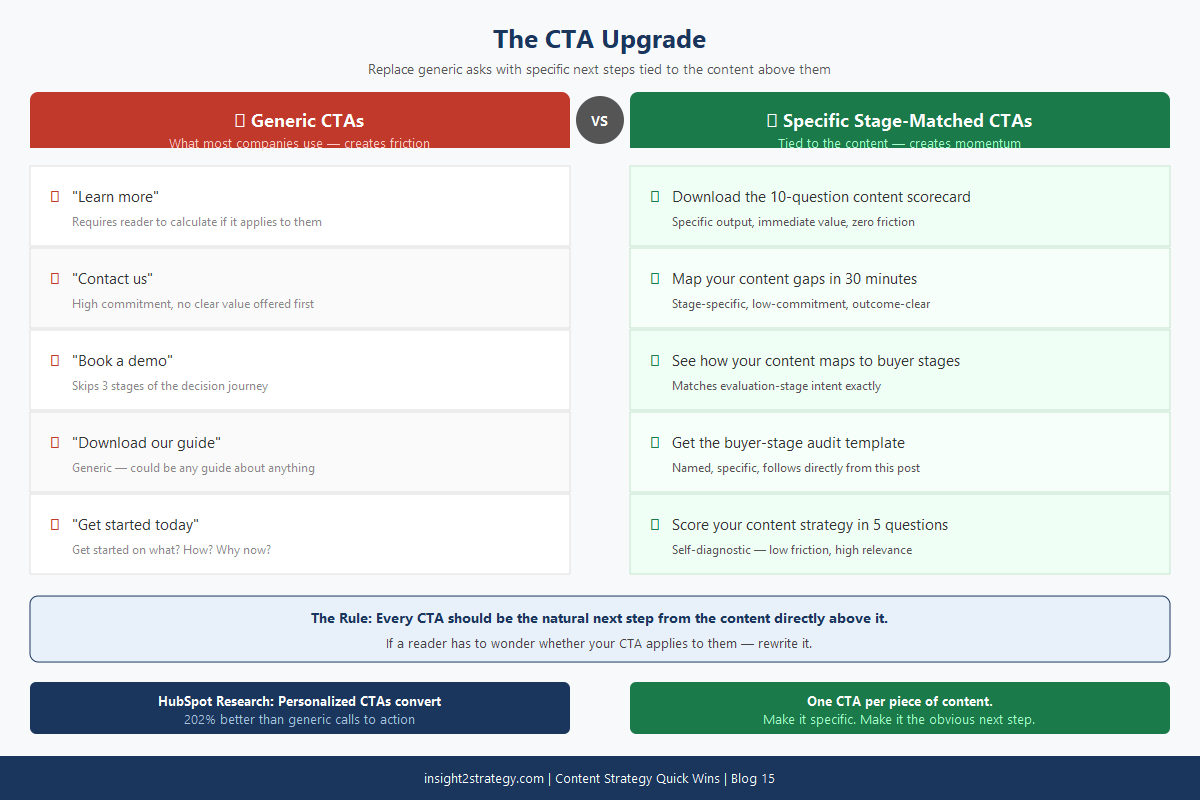
Most CTAs are vague: "Learn more," "Contact us," "Get started." These don't convert because they don't reduce uncertainty — and uncertainty kills action. A prospect who just read a 1,200-word post on content strategy gaps is rarely ready to book a discovery call. Asking them to jump there skips every step in between.
The Solution
Replace every CTA with a specific next step that ties directly to the content they just consumed. The best CTA is simply the next logical piece of information the reader needs to make progress.
Implementation
Instead of generic asks, make the action feel like a natural continuation:
| Generic CTA | Specific Replacement |
|---|---|
| "Download our guide" | "Download the 10-question checklist to score your current content strategy" |
| "Book a demo" | "See how your content performs using our conversion scoring framework" |
| "Contact us" | "Schedule a 30-minute session to map your content gaps to your pipeline stages" |
| "Learn more" | "Get the buyer-stage template to audit your last 10 pieces today" |
| "Get started" | "Run a quick 5-question content audit and see where you're leaving leads behind" |
Impact
According to HubSpot research, personalized CTAs convert significantly better than generic ones. The mechanism is simple: relevance eliminates the friction of self-assessment. The reader doesn't need to figure out whether your next step applies to them — it obviously does, because it flows directly from what they just read.
Quick Win 4: Create One "Tool" Per Content Cluster
The Problem
Even strong educational content often lacks utility. Readers understand the idea but don't have a way to apply it. Content informs; tools enable. And the gap between understanding and action is exactly where conversions are lost.
The Solution
For every major content cluster — your core themes — create one simple, practical tool: a calculator, worksheet, scoring template, or checklist. Not a comprehensive resource. Something a reader can complete in 10–15 minutes and walk away with a concrete, personalized output.
Implementation
Map the tool to the problem your content cluster addresses:
| The Problem | The Tool |
|---|---|
| "I don't know if my content is effective" | Content Performance Scorecard — score 8 inputs, get a gap analysis |
| "I can't tell where buyers are dropping off" | Buyer-Stage Content Audit — map your last 10 posts in under 20 minutes |
| "I need to justify content investment to leadership" | Content ROI Calculator — project pipeline impact from current metrics |
| "I don't know which solution approach fits best" | Decision Matrix Template — pre-weighted criteria for content strategy choices |
Keep it simple: 5–10 inputs, a clear output, and immediate value without requiring a sales conversation.
⚡ Quick Implementation Tip
Identify your most-trafficked content cluster. Then ask: what's the one question readers still have after finishing every post in that cluster? Build a tool that answers it with their own numbers. A scoring worksheet or a simple 8-question assessment with a gap analysis output is enough. Tools are also inherently shareable — when a reader forwards your scorecard to a colleague, your brand and framing travel with it.
Impact
According to Demand Metric research, interactive content generates significantly more conversions than passive content. The reason: tools produce a personalized output the reader can act on — their numbers, their situation, their next step. That's a fundamentally different experience than reading someone else's example.
When Content Isn't Converting Because the Language Is Wrong
These four quick wins address structure, staging, and mechanics. But sometimes content doesn't convert because it's written in the wrong language — specifically, in your company's product language instead of your customer's outcome language.
You're describing features and capabilities. Your customers think in problems, tradeoffs, and outcomes. When that gap exists, content can be perfectly structured and still land flat. The reader follows the logic but doesn't feel seen.
If you've applied these four quick wins and conversion rates still aren't moving, that's the signal to address the language before publishing another piece. The fix isn't more content — it's extracting what your customers actually say about the value you deliver and rebuilding your content vocabulary from there.
If you'd rather have that work done for you: our Value Translation Workshop extracts exactly what your customers say about the value you deliver and turns it into a messaging hierarchy ready for your content, website, and sales deck.
Start This Week
More content won't fix a conversion problem. Better-connected content will.
Start small:
- Pick your highest-traffic blog post. Add a "So what does this mean for you?" paragraph to each main section.
- Audit your last 10 published pieces against the four buyer stages. Identify where the gap is — it's almost always "Evaluating."
- Replace every CTA on your top five pieces with a specific, stage-matched next step.
- Identify your most-trafficked content cluster. Define what tool would be most useful to a reader who just finished reading it.
The goal isn't to educate your audience. It's to help them decide.
These four adjustments move your content from the first job to the second.
📊 Implementation Framework
The four quick wins above work in sequence: first make existing content actionable (QW1), then ensure you're covering the right buyer stages (QW2), then tighten your conversion mechanics (QW3), then build one enabling tool (QW4). Need help applying this to your specific situation? Let's map your content gaps to your pipeline stages.
|
This post is part of The B2B Marketing Reality Check The strategic framework for growth-stage B2B tech companies — now available in paperback and Kindle. Every topic we cover in this blog goes deeper in the book, with frameworks, diagnostics, and quick wins you can put to work immediately. Get the Free PDF →Want to work through the framework hands-on? Get the companion workbook → |
Frequently Asked Questions
Why isn't my content generating leads even though traffic is growing?
Traffic and conversion are two separate problems. High traffic with low leads almost always indicates a staging or mechanics issue — not a visibility issue. The most common diagnosis: the majority of your content sits at the "Aware" stage and almost none at the "Evaluating" stage, which is where buyers are actively comparing options and closest to reaching out. The buyer-stage audit in Quick Win 2 will surface this in about 10 minutes.
What is buyer stage content mapping and how is it different from a content calendar?
A content calendar organizes what you publish and when. Buyer stage mapping organizes why a given piece of content exists in your buyer's journey. The distinction matters because a well-organized calendar of the wrong content types still won't move the pipeline. Buyer stage mapping asks: at each point in a buyer's decision process, what does someone need to read to take one step forward? Most companies discover their content answers this question well for buyers who are early in research — and poorly for buyers who are close to deciding.
How do I write CTAs that actually convert?
The most effective CTA is the natural next step from the content above it. Ask yourself: someone just finished reading this piece — what's the single most useful thing they could do next? That's your CTA. It should feel like a continuation, not an interruption. If your CTA requires the reader to mentally jump from "I just learned something interesting" to "I'm ready to buy," you've skipped too many steps. Stage-match every CTA to where the reader is in their decision, not where you want them to be.
How long does a content audit against buyer stages typically take?
About 10 minutes for 10 pieces of content. Pull your last 10 blog posts or content assets. Assign each to one of four stages: Unaware, Aware, Evaluating, Ready to Decide. Most companies find the distribution in under 15 minutes — and the pattern is usually clear immediately. The audit isn't the hard part; acting on what you find is. That's where the rebalancing work begins.
Do we need to create all new content to fix a conversion gap?
No. Three of the four quick wins in this post apply to content you've already published: adding "So What" sections (QW1), auditing existing content against buyer stages (QW2), and rewriting CTAs (QW3). Only creating tools (QW4) requires new production. Starting with your highest-traffic existing content gives you the fastest path to improved conversion without creating anything new.
Ready to Put These Strategies to Work?
Every business situation is unique. Let's discuss how these four quick wins apply to your specific content mix, buyer stages, and pipeline goals.
No sales pitch. Just strategic insights tailored to your content and pipeline situation.
Insight2Strategy helps growing B2B companies build content strategies that move pipelines, not just traffic metrics. Learn more →


Comments
Post a Comment