24 Weeks of Quick Wins — and One Question That Ties Them All Together
24 Weeks of Quick Wins — and One Question That Ties Them All Together
Strategic Analysis by: Insight2Strategy
Published: September 28, 2026
Executive Reading Time: 8 minutes
Executive Strategic Insights
- 24 weeks of quick wins across measurement, targeting, messaging, integration, nurturing, and retention — all organized around one thread
- The measurement and attribution cluster generated more engagement than every other topic combined — a signal about where most companies are stuck
- Most marketing problems are one level upstream from where they appear: lead gen problems are often messaging problems, messaging problems are often ICP problems
- The five-question framework organizes all 24 topics and all 11 diagnostic services into a single decision map
- Three paths forward: implement quick wins independently, use the services decision tool, or book a free fit-check consultation
We've been at this for 24 weeks. Quick wins for measurement, alignment, targeting, content, integration, nurturing, retention — plus launch intelligence for those just getting started. If you've been following along, you've accumulated a serious toolkit of implementable tactics.
But before we close, there's one thing worth naming explicitly.
There's a thread running through every post in this series. And if you miss it, you miss the point.
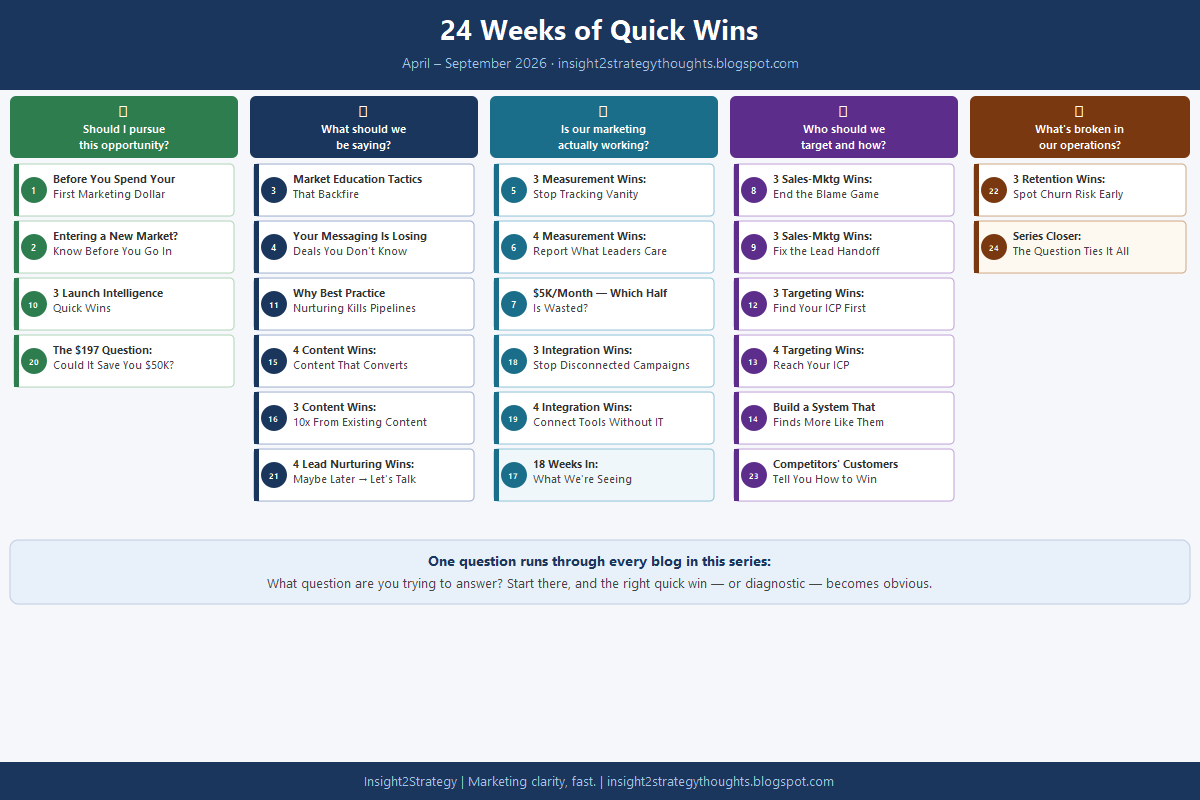
The One Question Behind Every Quick Win
Every topic in this series comes back to the same root:
You're making decisions with incomplete information.
Not because you're careless. Because complete information is expensive, time-consuming, and often unavailable until you've already made the decision. So you work with what you have. You optimize what's easiest to measure. You make educated guesses.
The quick wins in this series were designed to close those gaps faster. A better attribution setup gives you clarity on which channels actually drive revenue. A tighter ICP definition stops you from chasing the wrong prospects. A simple retention audit surfaces why good customers quietly leave. These work because they give you better data for the decisions you're already making.
But sometimes the gap isn't closable with a quick win.
Sometimes you're not working with incomplete information. You're working with the wrong question entirely. The marketing isn't underperforming because you need better tactics. It's underperforming because you're solving the wrong problem.
That's not a failure. That's a signal — and it's the most useful signal you can get.
⚡ Quick Implementation Tip
Before adding any new tactic to your list, ask: Which of the five questions below is this trying to answer? If you can't map it to a specific question, it's not ready to execute — it's a symptom of unclear diagnosis.
What We Learned Running This Series
Publishing 24 weekly posts isn't just about producing content. You learn things from watching how people respond — what they click, what they ignore, what they ask after reading. Here's what we actually saw.
The measurement blogs generated more engagement than anything else we published — by a significant margin. Attribution, analytics health, performance visibility. Reader questions, replies, and service inquiries all spiked around these topics. The pattern tells us something: most companies know something is wrong with their marketing. The problem is they can't tell what. They're not short on data. They don't trust the data they have, and they can't connect it to the decisions that actually matter.
The real problem is almost always one level upstream from where it appears. This pattern repeated across nearly every service inquiry during the series. The company that thinks it has a lead generation problem actually has a messaging problem. The company that thinks it has a messaging problem actually has an ICP problem. The company convinced its campaigns aren't working actually has a channel-strategy mismatch. Quick wins help you implement better. But if you're working from the wrong diagnosis, better execution of the wrong tactic isn't progress.
Knowing what to do and having time to do it are two completely different constraints. The simplest quick wins — the ones implementable in under an hour — were often the least executed. Not because they weren't useful. Because implementation requires focused time, internal alignment, and someone to own it. More complex ideas got bookmarked for later that never came. This gap between knowing and doing is real, and pretending it isn't doesn't serve anyone. The diagnostic services exist precisely because some problems aren't solved with a blog post and a to-do list.
The most common question we didn't have a dedicated post for: "How do I know which problem to fix first when everything feels broken?" We touched on prioritization across multiple posts, but the frequency of this question tells us something. It's not a tactics question. It's a decision-making question — and it signals that the natural next step after a quick-wins series is a framework for choosing which quick win actually matters most right now. That's on our list for what comes next.
The Five Questions That Organize Everything
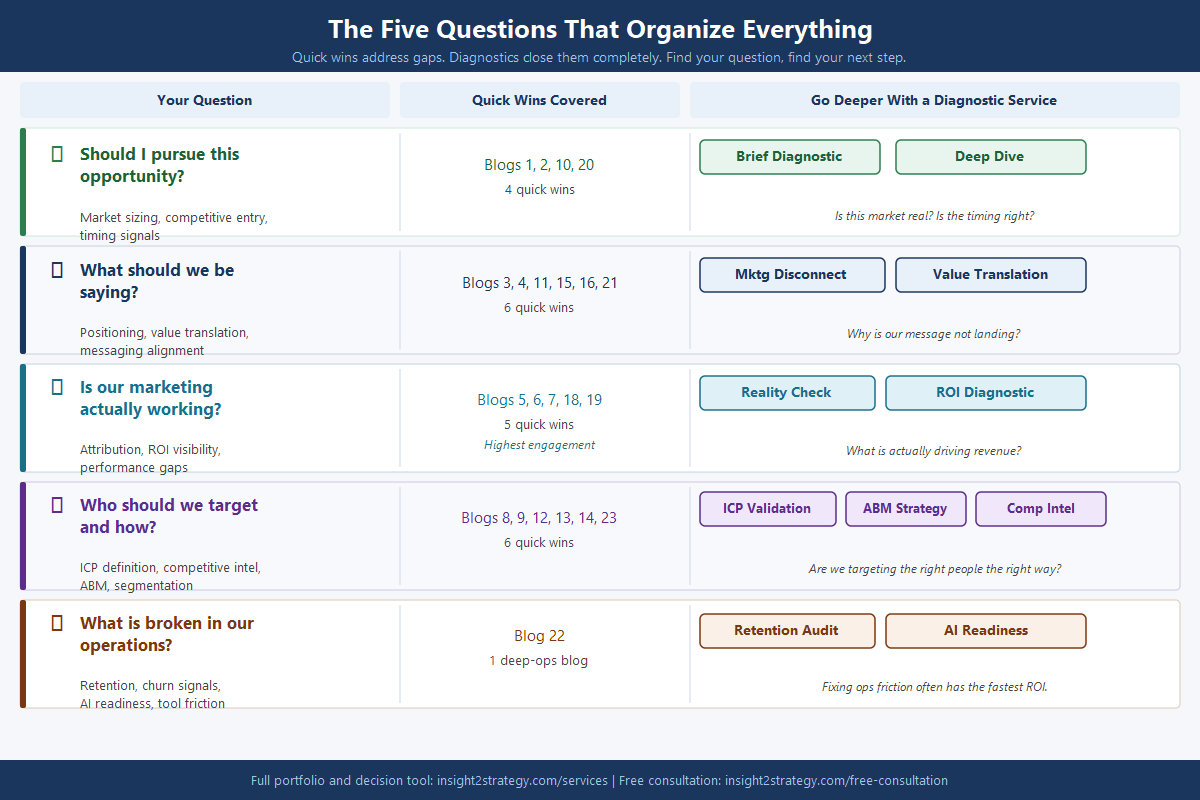
Every quick win in this series fits under one of five questions. If you can answer these clearly, your marketing becomes dramatically simpler.
🌱 Should I pursue this opportunity?
Quick wins covered: Blogs 1, 2, 10, 20
Before you invest in campaigns, channels, or messaging, you need to know whether the market is real, the timing is right, and demand actually exists. Skipping this step leads to expensive validation through execution.
Go deeper: Launch Intelligence Brief or Business Opportunity Deep Dive
📣 What should we be saying?
Quick wins covered: Blogs 3, 4, 11, 15, 16, 21
Most messaging problems aren't creative problems. They're translation problems. You know what you do. Your customers know what they need. But those two things don't align, and the gap shows up in conversion rates.
Go deeper: Marketing Disconnect Diagnostic or Value Translation Workshop
📊 Is our marketing actually working?
Quick wins covered: Blogs 5, 6, 7, 18, 19
This was the highest-engagement category for a reason. Without a clear answer here, everything else is speculation. Which channels are driving revenue? Where are leads dropping off? What's actually generating ROI?
Go deeper: Marketing Reality Check or ROI Diagnostic
🎯 Who should we target — and how?
Quick wins covered: Blogs 8, 9, 12, 13, 14, 23
Targeting mistakes are expensive and common. Too broad wastes spend. Too narrow misses opportunities. Wrong segment produces poor conversion and frustrating sales cycles.
Go deeper: Competitive Intelligence Snapshot, Market Readiness Score, ICP Validation Sprint, or ABM Quick-Start
🔬 What's broken in our operations?
Quick wins covered: Blog 22
Sometimes the problem isn't strategy. It's execution — disconnected tools, poor handoffs, broken retention processes. Fixing operational friction often produces faster ROI than any new campaign.
Go deeper: Retention Audit Express or AI Readiness Reality Check
📊 Implementation Framework
Pick your question first. Then find the blog cluster. Then decide whether a quick win closes the gap or whether the problem is deeper. That sequence matters — trying to implement a tactic before you've diagnosed the root question is how you execute correctly on the wrong problem.
Where to Go From Here
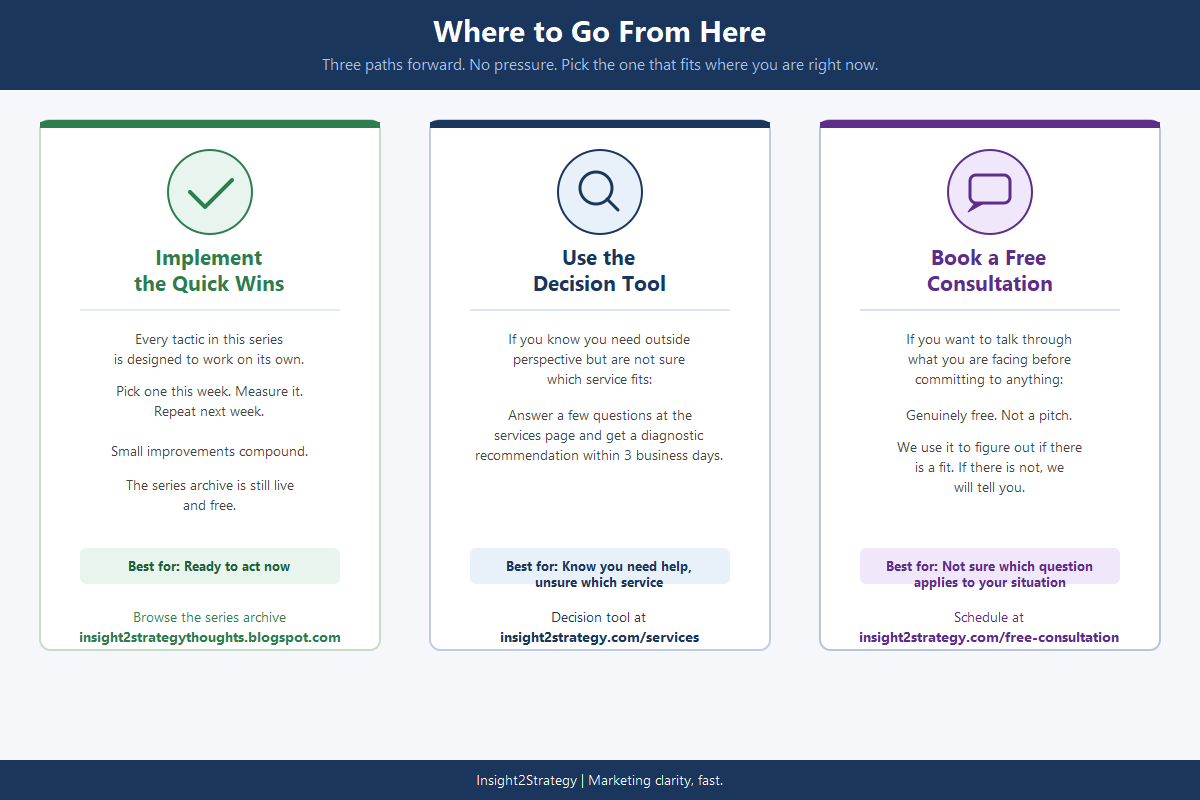
Three genuine paths forward — none require a big commitment:
Option 1: Implement the quick wins. Every tactic in this series is designed to work on its own, without buying anything. If you've bookmarked posts and haven't acted on them, pick one this week. A single measurement quick win from Blog 5 or 6 will tell you more about your marketing in two hours than most reporting setups reveal in a month.
Option 2: Use the services page decision tool. If you know you need outside perspective but aren't sure which service fits, the decision tool at the services page returns a personalized service recommendation based on your primary question and where you are. It was designed for exactly this situation.
Option 3: Book a free consultation. If you want to talk through what you're facing before committing to anything, the consultation is genuinely free and genuinely useful. We don't use it as a sales pitch. We use it to figure out whether there's actually a fit — and if there isn't, we'll tell you.
The goal isn't to move you from blog reader to client. The goal is to make sure you have what you need to make progress. Sometimes that's a quick win. Sometimes it's a diagnostic. Sometimes it's a 30-minute conversation. You know which one applies.
Thank You — And What's Coming Next
Twenty-four weeks is a real commitment. If you followed any portion of this series — read one post, shared one framework, replied to one email — thank you. Genuinely. The measurement data is one thing. The reader questions we got after each post are what made writing this worthwhile.
A few things we're continuing:
The practical content format stays. The Quick Wins series may evolve, but the philosophy doesn't change: actionable insights you can use this week, not six months from now.
Deeper dives on the topics that generated the most questions. Measurement, ICP clarity, and the prioritization question — "which problem do I fix first?" — are at the top of the list. If there's a specific challenge you'd like us to tackle, reply to this email or drop a comment. Reader questions have shaped this series from day one.
The diagnostic services will keep improving. Every client engagement teaches us something. Every report gets sharper. That feedback loop is how these services get better, and we take it seriously.
The brand promise stays the same: you shouldn't need a six-month consulting engagement to get a clear answer to a specific question. That's what we built these services for. That's what this blog series has been about — giving you the clearest, most actionable answers we can, as fast as we can.
Thanks for 24 weeks.
Now it's your move. What's the one question your marketing is trying to answer right now?
Going Deeper: The Full Framework Is Coming
If this series resonated, we're taking the framework deeper. The B2B Marketing Reality Check: A Strategic Framework for Growth-Stage Tech Companies — a complete strategic guide built from the insights behind this series — is coming later this year.
It turns these quick wins into a full diagnostic and action system: chapter-length treatments of every topic we've covered, integrated frameworks that show how the pieces connect, and practical Monday-morning actions you won't find in the blog posts. From ICP and value proposition through market education, measurement, AI strategy, and sales-marketing alignment — the complete reality check, in one place.
Watch this space for details on how to get your copy — the PDF will be free.
Ready to Name the Question You're Actually Trying to Answer?
Every business in this series was working on one of five problems. Most didn't know which one — not precisely. That's where we start. Let's spend 30 minutes figuring out which question applies to your situation and what the clearest next step looks like.
No sales pitch. 30 minutes of genuine clarity on where to focus. If there's no fit, we'll tell you.
The full portfolio — all 11 diagnostics organized by the question you're trying to answer — is at insight2strategy.com/services. Or use the decision tool to find the right fit. Not sure which fits? Book a free consultation — no pitch, just clarity.

|
This post is part of The B2B Marketing Reality Check The strategic framework for growth-stage B2B tech companies — now available in paperback and Kindle. Every topic we cover in this blog goes deeper in the book, with frameworks, diagnostics, and quick wins you can put to work immediately. Get the Free PDF →Want to work through the framework hands-on? Get the companion workbook → |
Frequently Asked Questions
How do I know when a quick win is enough vs. when I need a diagnostic?
A quick win is enough when the problem is clear and the fix is tactical — you know what's broken, you just need to implement a better process. You need a diagnostic when the same problem keeps coming back despite tactical fixes, when you can't agree internally on what's actually wrong, or when the gap between "what we're doing" and "what we expected" is large but the cause isn't obvious. The pattern that came up most during this series: if you've tried three different fixes and the metric hasn't moved, the issue is upstream from where you're looking.
Which of the five questions is most important to answer first?
Start with the question that's blocking everything else. Typically that's the opportunity question (Should I pursue this?) for early-stage businesses, and the measurement question (Is our marketing actually working?) for established businesses hitting a growth plateau. If you can't answer the measurement question, every other question is just speculation. If you're spending on targeting before confirming your messaging, you're paying to reach the right people with the wrong message.
What is the five questions marketing framework?
It's a diagnostic organizing framework, not a methodology. The five questions — opportunity, messaging, measurement, targeting, and operations — represent the five root areas where marketing breaks down. Every symptom (poor conversion, low engagement, wasted spend, bad retention) traces back to one of these five. The framework helps you stop treating symptoms and start identifying the correct root question, which then points to the right fix — whether that's a quick win or a structured diagnostic.
When should I hire outside expertise vs. handle internally?
Handle it internally when: the team has done this type of work before, the problem is execution (not diagnosis), and you have the bandwidth to implement and measure. Bring in outside expertise when: the same issue has persisted through multiple internal attempts, you need a neutral outside view on a politically charged internal question, or the cost of a wrong diagnosis (missed market, wrong ICP, invisible attribution gap) exceeds the cost of getting it verified. Most diagnostic services in this portfolio are designed to answer a specific question quickly — not to replace your team.


Comments
Post a Comment