The $197 Question That Might Save You $50,000 — And the $747 Answer That Builds the Plan
The $197 Question That Might Save You $50,000 — And the $747 Answer That Builds the Plan
Strategic Analysis by: Insight2Strategy
Published: August 31, 2026
Executive Reading Time: 6 minutes
Executive Strategic Insights
- 42% of startups fail because there was no market need — a research failure, not a technology failure (CB Insights).
- Two distinct questions drive pre-launch analysis: "Is the market real?" (validation) and "Is this investable?" (planning) — they require different depth.
- A solid market scan covers six components: market sizing, competitive landscape, ICP validation, go-to-market strategy, risk assessment, and a 90-day roadmap.
- A full strategic assessment adds competitive positioning strategy, technology stack analysis, unit economics for 2–3 business models, pricing architecture, and a phased roadmap with decision gates.
- The right sequence: validate first. If the market is real, then build the investment plan.
- The optimal window: 30–90 days before launch — early enough that findings shape decisions, late enough that you have a specific opportunity to evaluate.
Most expensive launch mistakes don't feel expensive in the moment. They feel like reasonable bets.
You choose the wrong target customer because your research was thin — and that's not a $197 mistake. That's a $30,000–$75,000 mistake when you add up the wasted ad spend, the wrong website, the wrong positioning, and the six months it took to figure out what three business days of real data would have told you upfront.
The research problem is well documented. CB Insights analyzed hundreds of failed startups and found 42% collapsed because there was no market need for the product (CB Insights, 2024). That's not bad luck — that's bad validation. And it's not rare: only 17% of small businesses conduct formal competitive research before launching (U.S. Chamber of Commerce).
The market wasn't wrong. The research was.
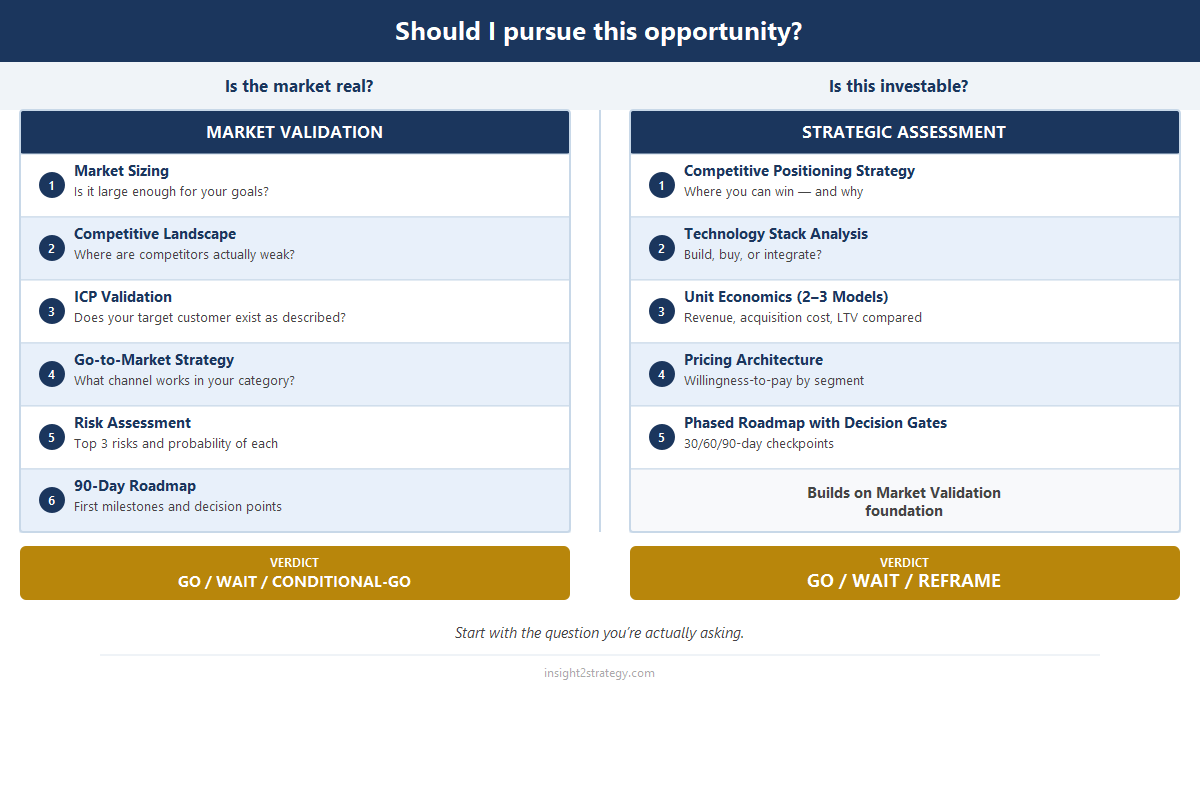
This post walks through what rigorous pre-launch analysis actually covers — and when different depths of research are appropriate.
The Question Both Analyses Answer — At Different Depths
There's one question at the center of every pre-launch decision: Should I pursue this opportunity?
That question has two sub-questions underneath it.
The first: "Is the market real?" This is a validation question. You need to know whether customers exist, whether competitors are serving them and how well, and whether your timing makes sense — before you commit real money. Think of it as the green-light check on the runway.
The second: "Is this investable, and how exactly should I pursue it?" This is a planning question. You need unit economics, pricing architecture, and a phased roadmap with decision gates — the full flight plan with fuel calculations, weather contingencies, and alternate landing spots.
Knowing which question you're actually asking saves you from over-engineering your research or under-preparing your plan.
What a Pre-Launch Market Scan Should Cover
A solid pre-launch market scan answers six questions:
Market sizing — Not just "is there a market," but is it large enough to support the business you're trying to build at the margins you need? Total addressable market, serviceable market, realistic first-year capture.
Competitive landscape — Who's already winning, what gaps exist, and how crowded (or open) the field actually is. Where competitors are weak matters more than that they exist.
ICP validation — Whether your target customer actually exists as described. This is where the most expensive false assumptions live. Who the best-fit customer is — and who they aren't.
Go-to-market strategy — High-level channels, messaging hooks, and acquisition cost estimates based on what actually works in your category.
Risk assessment — The three biggest things that could kill this opportunity, how likely each is, and what mitigation looks like for each.
90-day roadmap — Concrete next steps with milestones and budget checkpoints. Immediate actions, sequenced decisions, and the first signals that tell you whether you're on track.
⚡ Quick Implementation Tip
Each component of your market scan should carry a confidence rating — High / Medium / Low. This tells you exactly where the data is solid and where you might want deeper digging before committing. The final output should be a single confidence-tagged verdict: GO, WAIT, or CONDITIONAL-GO. Not a pile of data. A decision.
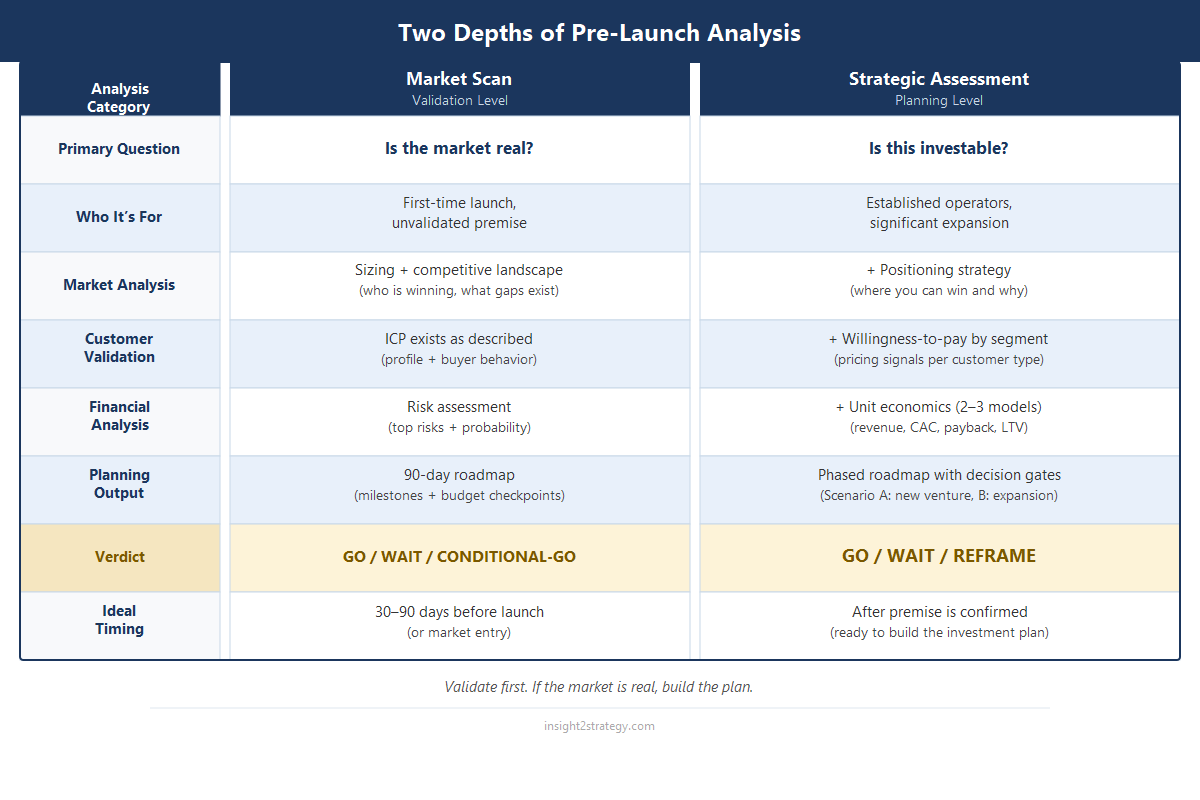
What a Full Strategic Assessment Adds
When the question shifts from "Is this real?" to "Is this investable, and how exactly should I build it?" — the analysis has to go deeper.
A full strategic assessment starts with everything in the market scan and adds:
Competitive positioning strategy — Not just who the competitors are, but where you can win and why — and what that implies for your product, pricing, and messaging against current and emerging players.
Technology stack analysis — What to build, what to buy, what to integrate. So your technical architecture decisions align with your business model from the start rather than requiring an expensive rebuild after launch.
Unit economics for 2–3 business model options — Revenue per customer, acquisition cost, payback period, lifetime value — compared across models so you can choose with data, not intuition.
Pricing architecture with willingness-to-pay by segment — What different customer segments will actually pay, and why, so your pricing strategy is grounded in buyer behavior.
Scenario-specific phased roadmap with decision gates — Not just "here's the plan." Here's what you should see at 30, 60, and 90 days — and what you should do if you don't. Covers both new-venture scenarios (Scenario A) and expansion scenarios (Scenario B), because the decision gates are different.
The output is a single-verdict GO / WAIT / REFRAME with the exact rationale and investment thresholds required — including, when relevant, a "pursue but reframe the offer" recommendation that preserves the opportunity while changing the approach.
📊 Implementation Framework
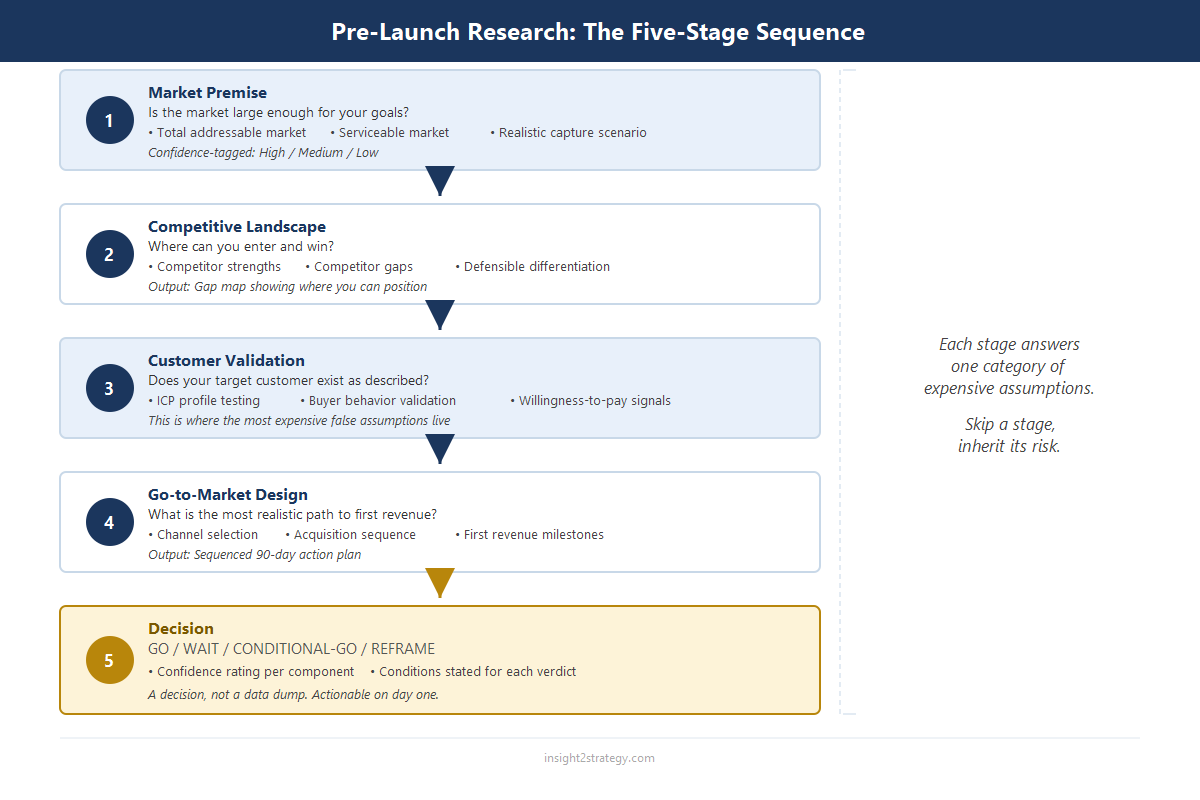
The five-stage research sequence below shows how each component builds on the one before it. Market sizing informs where to focus the competitive analysis. Competitive analysis shapes the ICP validation questions. ICP findings determine what go-to-market channels are realistic. And the go-to-market design feeds the risk assessment and 90-day roadmap. Skip a stage and you inherit its risk. Need help applying this sequence to your specific situation? Let's discuss your analysis approach.
The Natural Sequence: Validate First, Then Plan
For most founders and operators entering a new market, the right sequence is validation before planning. Confirm the market is real before you build the investment thesis.
Most expensive launch failures don't happen because founders failed to plan. They happen because they planned before they validated. They built detailed financial models for a customer who didn't exist, a market that was smaller than assumed, or a competitive position that wasn't defensible. The model was rigorous. The premise was wrong.
Start with validation. If the market is real, build the plan.
The only wrong path is guessing.
The exception: established operators evaluating a significant expansion who have already done substantial informal validation. If you've been watching a market for two years, have relationships with potential customers, and understand the competitive landscape directionally — you may be ready to move straight to the strategic assessment. You're building the investment thesis, not confirming the premise.
Worth noting: your future customers are already doing their research without you. Gartner's B2B buying journey research found that buyers complete an average of 57% of their purchase decision process before engaging with a vendor (Gartner, 2024). The competitive intelligence you gather pre-launch is what positions you to meet buyers where they already are — instead of discovering after launch what you should have known before.
How This Connects to the Series
This blog is part of a series organized around one question: what question are you actually trying to answer about your business?
Each phase has addressed a different stage. The ICP exercises in Blogs 12–13 assume you have customer data. The measurement quick wins in Blogs 5–6 assume you have a baseline. The positioning frameworks in Blogs 16–19 assume you've already launched.
Pre-launch research is the foundation that makes every subsequent tool more precise. When you know your ideal customer is real — not assumed — the ICP validation exercises produce sharper results. When you know your go-to-market channel is validated, the measurement setup is more targeted from day one.
Who This Analysis Is For — And What Comes After
The right window for pre-launch market research is 30–90 days before launch or market entry. Early enough that findings can still shape decisions. Late enough that you have a specific opportunity to evaluate.
This isn't the right fit for businesses already 12+ months in with substantial customer data. If you've launched and you're trying to sharpen customer targeting, the ICP Validation Sprint is the more appropriate tool. If you're trying to understand your competitive position post-launch, the Competitive Intelligence Snapshot is the right starting point.
After launch, the natural sequence continues: Marketing Disconnect Diagnostic to align messaging with what's actually landing, ICP Validation Sprint to validate your best-fit customer segment, Competitive Intelligence Snapshot for deep competitive positioning.
Ready to Evaluate Your Opportunity with Rigorous Analysis?
Every market is different. Let's discuss what pre-launch research actually needs to cover for your specific opportunity — and which depth of analysis is appropriate for your situation.
No sales pitch. Just strategic insights tailored to your specific opportunity.
Two Services That Cover This Ground
If you'd rather have this analysis done for you, two services address this directly.
The Business Launch Intelligence Brief ($197 · Quick Scan) answers the validation question: Is the market real? Six components, confidence-tagged throughout, GO/WAIT/CONDITIONAL-GO verdict in 3 business days.
The Business Opportunity Deep Dive ($747 · Deep Analysis) answers the planning question: Is this investable and how exactly should I pursue it? Full strategic assessment covering competitive positioning, unit economics for 2–3 business model options, pricing architecture, and a scenario-specific phased roadmap with decision gates. GO/WAIT/REFRAME verdict in 3 business days.
Both start with a simple intake form. Both deliver in 3 business days.
The most expensive mistake isn't spending $197 or $747. It's spending $50,000 to learn what the data would have told you in three days.
Start with the question you're actually asking.
|
This post is part of The B2B Marketing Reality Check The strategic framework for growth-stage B2B tech companies — now available in paperback and Kindle. Every topic we cover in this blog goes deeper in the book, with frameworks, diagnostics, and quick wins you can put to work immediately. Get the Free PDF →Want to work through the framework hands-on? Get the companion workbook → |
Frequently Asked Questions
When is the right time to do pre-launch market research?
The optimal window is 30–90 days before launch or market entry. Early enough that your findings can still shape product decisions, positioning, and go-to-market sequencing. Late enough that you have a specific opportunity to evaluate rather than a vague category to explore. Doing this too early (6+ months out) means the competitive landscape may shift materially before you act on the findings.
What does a business opportunity assessment actually cover?
At minimum: market sizing (is it large enough for your goals?), competitive landscape (where are competitors weak?), ICP validation (does your target customer exist as described?), go-to-market strategy (what channel actually works in your category?), risk assessment (top 3 risks and their probability), and a 90-day roadmap (first milestones and decision points). A full strategic assessment adds competitive positioning strategy, technology stack analysis, unit economics for multiple business models, pricing architecture, and a phased roadmap with decision gates.
Should I do the Market Scan or the Strategic Assessment first?
Start with the market scan if you're evaluating an unvalidated premise — a new venture, a new product line, or a market you haven't operated in before. Move to the strategic assessment once the premise is confirmed and you're ready to build the investment plan. The exception: established operators with two or more years of informal market observation and existing customer relationships in the category may be ready to go straight to the strategic assessment.
How do I measure ROI on pre-launch market research?
The ROI calculation is straightforward: compare the cost of the research against the cost of the mistakes it prevents. CB Insights' analysis of failed startups found 42% failed because there was no market need — a finding that rigorous pre-launch validation reliably catches. The cost of validating before launch is fixed and finite. The cost of discovering after launch that your core premise was wrong is open-ended — and typically measured in the $30,000–$75,000 range when you account for wasted ad spend, wrong positioning, and the time cost of pivoting.
When should I handle this internally versus bring in outside expertise?
Internal teams handle it well when they have no personal stake in the outcome of the analysis (i.e., when they're not the ones who proposed the opportunity), when they have access to primary research tools and databases, and when they have bandwidth to complete the analysis in the 30–90 day pre-launch window. Outside expertise adds value when internal teams have confirmation bias toward the opportunity, when the competitive landscape requires specialized research access, or when time constraints make a structured rapid-delivery approach more practical than building the analysis in-house.
Insight2Strategy | Strategic consulting for business owners who want data-driven decisions, not guesswork.
Free Consultation | Marketing Reality Check | Contact Us
© 2026 Insight2Strategy. All rights reserved.


Comments
Post a Comment