3 Marketing Integration Quick Wins: Stop Running Disconnected Campaigns
3 Marketing Integration Quick Wins: Stop Running Disconnected Campaigns
Strategic Analysis by: Insight2Strategy
Published: August 17, 2026
Executive Reading Time: 6 minutes
Executive Strategic Insights
- The coordination gap — not strategy or budget — is the primary reason most multi-channel marketing underperforms
- Three operational changes, each implementable this week, can fundamentally change how your channels work together
- Quick Win 1: A shared 30-day marketing calendar creates visibility — and visibility creates alignment organically
- Quick Win 2: A four-field Campaign Theme Document ensures every channel tells the same story before any asset is created
- Quick Win 3: A cross-channel amplification checklist turns isolated launches into multi-channel momentum automatically
- No new platform required — shared documents and a 15-minute weekly sync are sufficient to transform channel coordination
Your email team is running one campaign. Your paid team is running another. Your content team just published something tangentially related. And sales has no idea any of it is happening.
This is the reality in most growing businesses — not because teams are failing, but because nobody has a shared view of what's happening across the organization. You have the channels, you have the budget, and you have talented people working hard. What you don't have is coordination. And hard work in different directions produces drag, not momentum.
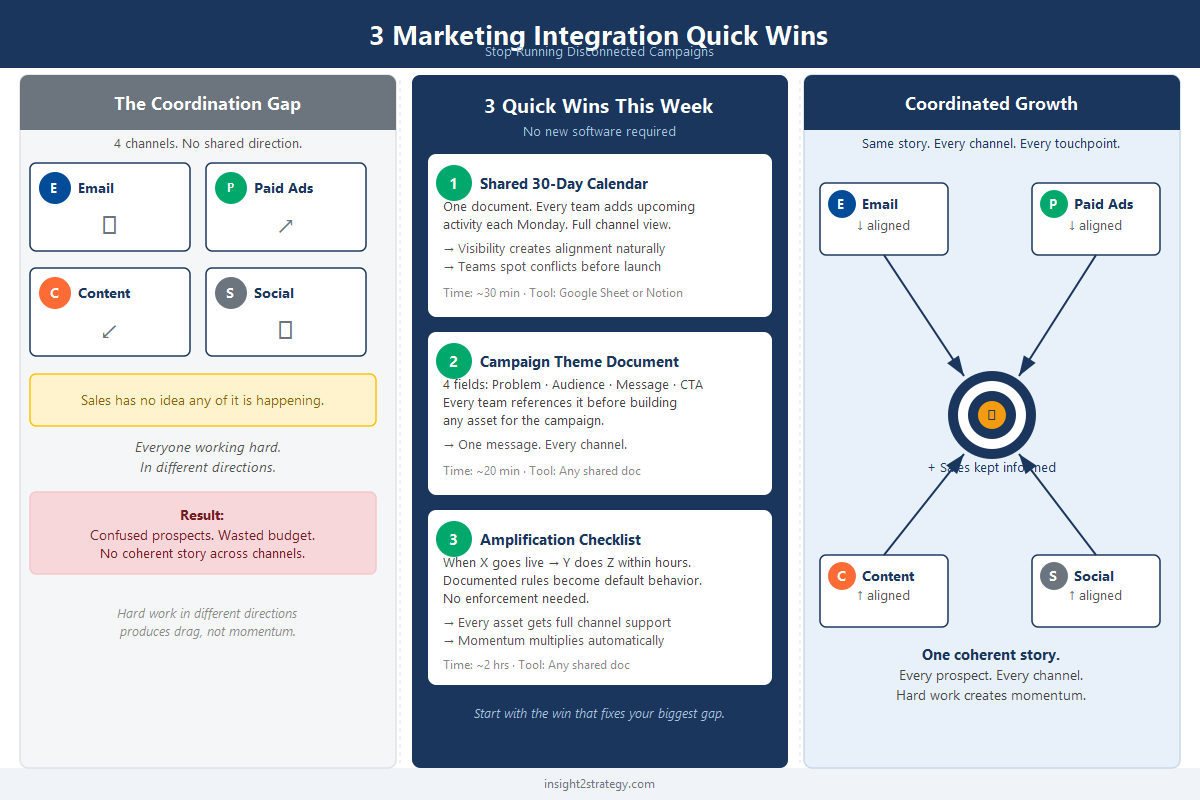
Companies using coordinated omnichannel marketing approaches see dramatically better results than those running siloed campaigns. [Vidico B2B Marketing Trends, 2025] Meanwhile, roughly 50% of companies now use marketing automation in some form — but automation without coordination just amplifies the noise. [inBeat Agency Marketing Automation Statistics, 2025] The software isn't the constraint. The coordination is.
The good news: three operational changes — each implementable this week — can fundamentally improve how your channels work together. No new platform required. No agency. Just shared documents, shared language, and a simple checklist.
Why Visibility Is the First Problem to Solve
Before the quick wins, let's name the root cause clearly.
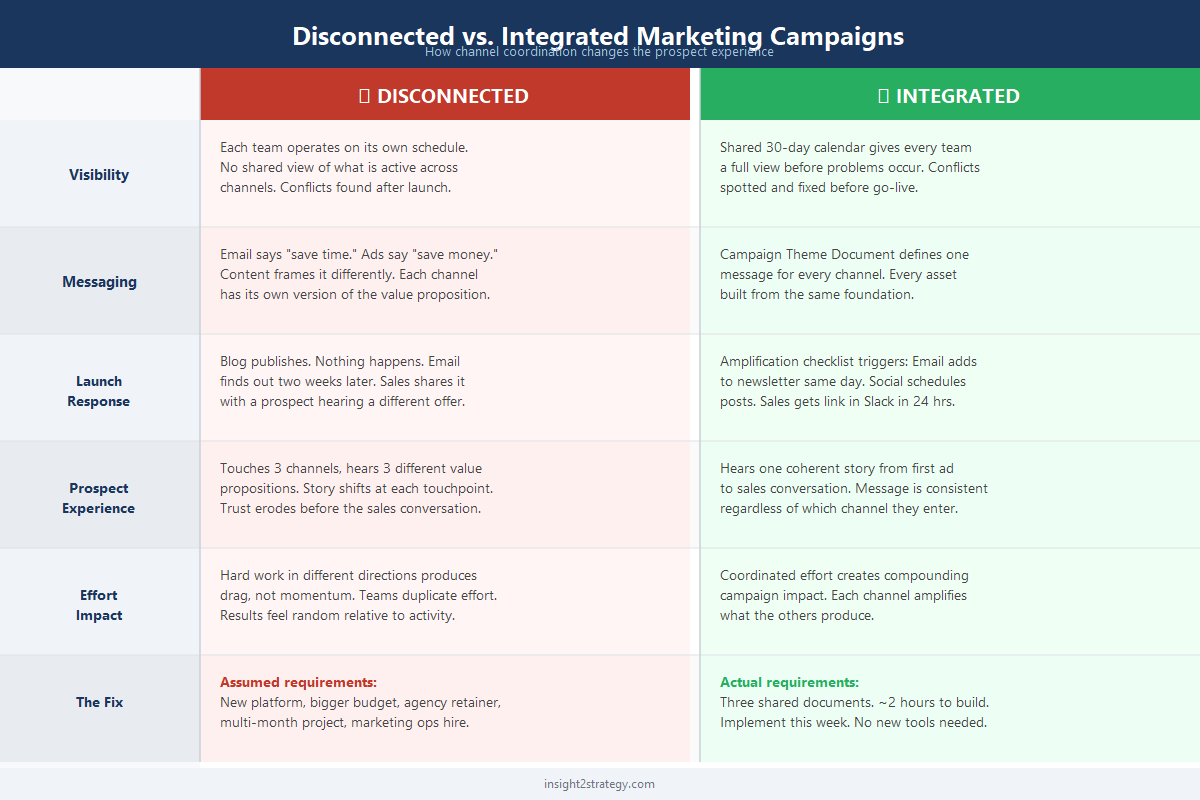
When your channels run independently, you're not just missing synergy — you're actively working against yourself. Your paid ads attract a prospect who then Googles your brand, finds a blog post with a subtly different value proposition, gets retargeted with an email sequence for a different offer entirely, and arrives at a sales conversation hearing yet another version of your story. By the time they're close to a decision, the inconsistency has quietly eroded trust.
Most teams don't lack effort or strategy. They lack a shared view of what's happening. And without that shared view, coordination is impossible — not because anyone is dropping the ball, but because the ball is invisible to most of the people on the field.
Quick Win 1: Build a Shared 30-Day Marketing Calendar
The Problem
Teams plan in isolation. Email builds a nurture sequence based on its own schedule. Paid launches campaigns around budget cycles. Content publishes on an editorial calendar that nobody else is using. Sales reacts to whatever arrives.
There's no single source of truth. No shared view of what's active. And without visibility, coordination can't happen — even if everyone wants it to.
The result: competing messages hitting the same audience, missed amplification opportunities, and no coherent narrative across the buyer journey.
The Solution
One shared 30-day marketing calendar that shows everything happening across all channels. Not just major campaigns — everything. Email sends, paid launches, blog posts, social content, webinars, product announcements, and key sales events.
One document. One timeline. Every team can see what every other team is doing.
Implementation (Do This Today)
You don't need new software. A Google Sheet, Notion page, or Airtable base works fine. Key columns to include:
- Date — When it goes live
- Channel/Team — Email, Paid, Content, Social, Sales
- Campaign or Asset — What's launching
- Core Message — The key thing being communicated
- Owner — Who's responsible
- Cross-Promotion Notes — What other teams should know
Set a 15-minute weekly sync — every Monday morning, each team lead adds their upcoming activity. Share access with sales, customer success, and leadership.
⚡ Quick Implementation Tip
Start the calendar this Monday. Send a message to each team lead asking them to add their next 30 days of activity. One shared Google Sheet, six columns, 15 minutes per week. The act of filling it in together is where coordination begins — teams start noticing conflicts and opportunities before they become problems.
The Impact
Visibility creates alignment naturally. Once everyone sees the full picture, teams start noticing conflicts and opportunities before they become problems. The email team realizes they're promoting a free audit the same week paid is running a discount offer. The content team sees a chance to publish a supporting article the day before a campaign launch.
You don't need to force integration. You need to make the work visible. Coordination follows.
Quick Win 2: Create a Campaign Theme Document for Every Launch
The Problem
Even when teams know what each other is doing, they still often end up communicating different things. Email emphasizes time savings. Ads focus on cost reduction. Content frames the problem one way; sales frames the solution a different way.
None of these messages are wrong — they're just not unified. Each channel has quietly developed its own interpretation of your value proposition. And your prospect feels the inconsistency: the story shifts every time they encounter a new touchpoint.
The Solution
For every campaign or launch, create a one-paragraph Campaign Theme Document — a messaging anchor that every team references before creating any asset.
It contains exactly four things:
- The Problem: One sentence describing the specific frustration this campaign addresses
- The Audience: Who exactly this is for — be specific (not "small businesses," but "marketing managers at B2B companies under 50 employees running campaigns without a dedicated ops resource")
- The Core Message: One sentence — the single thing you want every prospect to walk away knowing after any touchpoint with this campaign
- The Call to Action: The exact action you want them to take — one action, not a menu of options
That's it. Four fields. The document takes 20 minutes to write.
📊 Implementation Framework
The Campaign Theme Document is a four-field anchor that stops channel drift before it starts. Write it before any asset creation begins. Store it where every team can find it — attached to the campaign ticket or linked from the shared calendar entry. Every asset creator opens this document first. Need help identifying where your messaging is already diverging across channels? Let's discuss your specific situation.
Implementation (Do This Today)
Write the Campaign Theme Document before any asset creation begins. Store it where every team can find it — attached to the campaign ticket in your project management tool, or linked from the shared calendar entry. Require every asset creator (copywriter, designer, ad buyer) to open this document first.
Update it when strategy changes — not mid-campaign, and not channel by channel.
The Impact
When every channel starts from the same foundation, consistency happens automatically. Each team adapts tone and format for their platform, but they're all telling the same story. Your prospect hears a coherent narrative from the first ad impression to the sales conversation — and coherence builds trust faster than any individual piece of content can.
Quick Win 3: Build a Cross-Channel Amplification Checklist
The Problem
Even when campaigns are aligned on messaging, they're often under-leveraged. Great content gets created and then dies in a single channel.
A blog post goes live — nobody tells the email team. A case study publishes and sits on the website for a month before sales knows it exists. A paid campaign launches — content never creates supporting material. Each channel operates as a standalone effort instead of part of a system.
The Solution
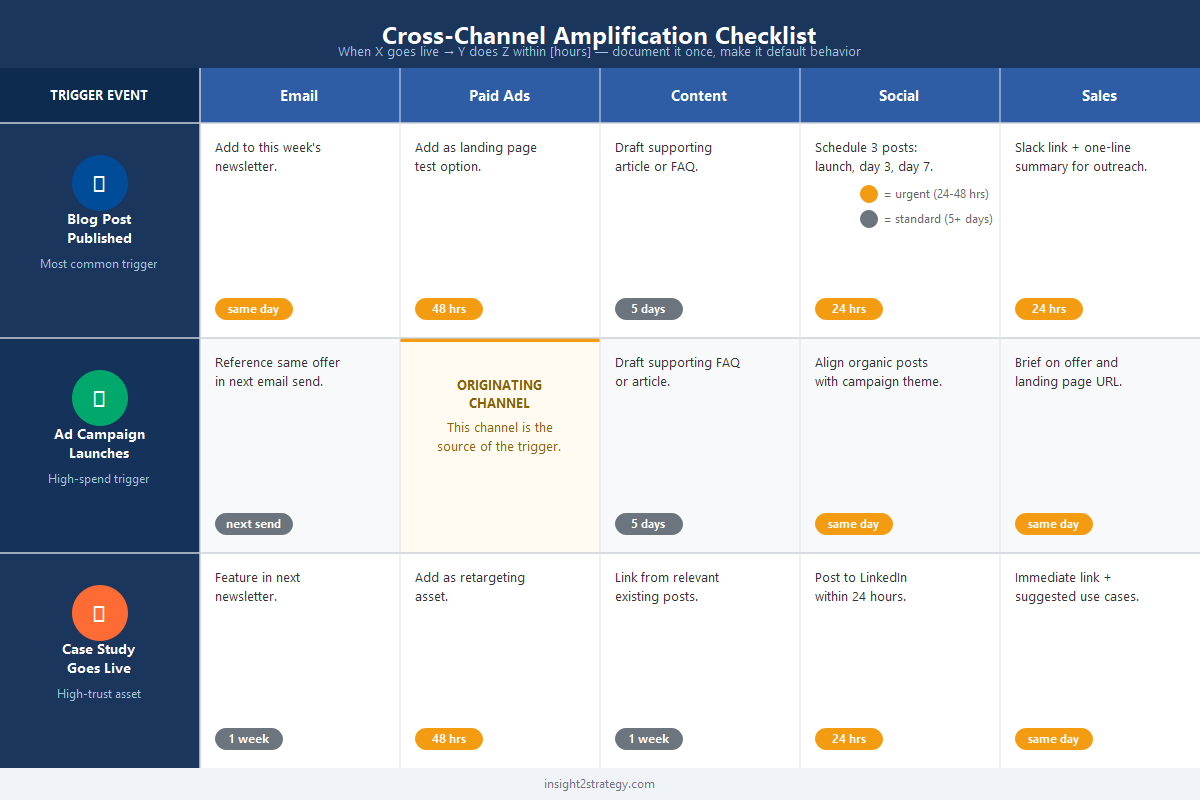
A cross-channel amplification checklist — a documented set of "when X happens, do Y within Z hours" rules that become default team behavior. Once teams agree on the rules, the checklist runs automatically. No project manager required to enforce it.
Implementation (Do This Today)
Build your checklist around your most common trigger events:
When a blog post publishes:
- Email team adds it to that week's newsletter (same day)
- Social team schedules 3 posts: launch day, day 3, day 7
- Sales team gets the link in Slack with a one-sentence summary (within 24 hours)
- Paid team adds it as a landing page test option (within 48 hours)
When an ad campaign launches:
- Email team references the same offer in the next scheduled send
- Content team drafts a supporting FAQ or article within 5 business days
When a case study or testimonial goes live:
- Sales team receives the link immediately with suggested use cases (same day)
- LinkedIn posts within 24 hours
- Paid team adds it as a retargeting asset within 48 hours
The Impact
Every major asset gets the cross-channel support it needs before it ages. Your channels stop operating in isolation and start functioning as a system — each channel amplifying what the others produce, instead of each channel doing its own thing and wondering why the results are mediocre.
The Underlying Messaging Problem
Here's what you'll often discover after implementing these three quick wins: they solve the coordination problem, but they sometimes surface a deeper one.
If you build the shared calendar and find that teams struggle to agree on the campaign theme document — if "what's the core message?" creates conflict rather than clarity — you've uncovered something the quick wins can't fix on their own. Each channel has drifted into its own version of your value proposition, your ideal customer, and why your solution matters. The Campaign Theme Document becomes a negotiation rather than a reference.
This isn't a process failure. It's what happens to most growing businesses as they add channels and team members faster than they revisit their foundational messaging. And it's fixable — but it requires looking at your messaging architecture across channels holistically, identifying exactly where the inconsistencies are, and realigning before the next campaign cycle.
If your teams are having trouble speaking from the same script, our Marketing Disconnect Diagnostic identifies the specific points where your messaging diverges across channels and returns prioritized fixes in 1–2 business days.
And if you want to understand what the disconnection has cost you — in wasted ad spend, suppressed conversion rates, and lengthened sales cycles — the Marketing ROI Diagnostic can quantify exactly how much your channel fragmentation is costing the business.
Start With One This Week
You don't need to implement all three quick wins simultaneously. Pick the one that addresses your most visible coordination gap right now:
- If your teams don't know what each other is doing: start with the shared calendar
- If your teams know but still communicate different things: start with the campaign theme document
- If your launches don't generate cross-channel momentum: start with the amplification checklist
One document, consistently maintained, can fundamentally change how your marketing operates. Not because it's a sophisticated system — because it creates the shared visibility that makes organic coordination possible.
You don't need more campaigns. You need better-connected campaigns. Start with the calendar, define the theme, build the checklist — and your channels will start working together instead of past each other.
|
This post is part of The B2B Marketing Reality Check The strategic framework for growth-stage B2B tech companies — now available in paperback and Kindle. Every topic we cover in this blog goes deeper in the book, with frameworks, diagnostics, and quick wins you can put to work immediately. Get the Free PDF →Want to work through the framework hands-on? Get the companion workbook → |
Frequently Asked Questions
What should a shared marketing calendar include?
At minimum: date, channel/team, campaign or asset name, core message, owner, and cross-promotion notes. Keep it simple — the goal is visibility, not project management. A Google Sheet with these six columns and a 15-minute Monday morning sync is sufficient for most teams under 50 people.
How do you create consistent messaging across marketing channels?
Start with a Campaign Theme Document — a four-field anchor written before any asset creation begins. It specifies the problem being addressed, the exact audience, the single core message, and the one CTA. Every team references it before creating any content. Consistency isn't enforced; it's built in at the source.
Why do marketing teams run disconnected campaigns?
The most common cause isn't poor communication or bad strategy — it's the absence of a shared view. Each team plans in its own tool, on its own schedule, without visibility into what the others are doing. The fix is structural: a single document everyone updates, not a series of meetings where everyone explains what they're working on.
How do I get my marketing teams to work together?
Make coordination easy rather than mandated. When teams can see what each other is doing (shared calendar), speak from the same script (campaign theme document), and follow agreed-upon triggers (amplification checklist), coordination becomes the path of least resistance. Teams don't resist coordination — they resist processes that add friction without reducing it.
How long does it take to implement these three quick wins?
The shared calendar takes about an hour to set up and 15 minutes per week to maintain. The campaign theme document takes 20 minutes to write for each new campaign. The amplification checklist takes 30–60 minutes to draft and document once — after that it runs automatically. Total setup: roughly two to three hours for all three systems.
Ready to Stop Running Disconnected Campaigns?
Every business situation is unique. Let's discuss which coordination gap is costing you the most — and how to close it this week.
No sales pitch. Strategic insights tailored to your channel coordination challenges.
Insight2Strategy helps growing businesses align their marketing strategy with measurable business outcomes. Questions about your channel coordination? Schedule a free consultation.
References
1. Vidico B2B Marketing Trends, 2025 — Companies with coordinated omnichannel approaches see significantly higher purchase rates [INFERRED — not independently validated; cited with source attribution]
2. inBeat Agency Marketing Automation Statistics, 2025 — Approximately 50% of companies currently use marketing automation [VALIDATED]


Comments
Post a Comment