You Know Who Your Best Customers Are. Here's How to Build a System That Finds More of Them.
You Know Who Your Best Customers Are. Here's How to Build a System That Finds More of Them.
Strategic Analysis by: Insight2Strategy
Published: July 20, 2026
Executive Reading Time: 7 minutes
Executive Strategic Insights
- The gap that matters: Most B2B teams know their best customers. Almost none have codified that knowledge into a system any rep can apply in 30 seconds.
- ICP validation is a 5-step process — not a workshop. It starts with your existing customer data and ends with a weighted scoring rubric built from evidence, not assumptions.
- ABM requires the ICP first. Running account-based marketing without a validated ICP means your account list is built on firmographic guesswork, not win data.
- The sequence matters: ICP answers who to pursue. ABM answers how to pursue them at scale. Skipping the first step makes the second expensive and inconsistent.
- Forrester data point: 99% of B2B marketers report ABM delivers higher ROI than other marketing approaches — the common prerequisite is a validated ICP.
- Actionable framework below: Five ICP validation steps and four ABM build items — the complete playbook to get from tribal knowledge to a functioning targeting system.
Introduction
You can probably name your three best customers right now. You know who they are. They love what you do, they don't push back on price, they stay — and they expand. Your sales team lights up when a new lead looks just like them.
The problem isn't that you don't know who your best customers are. The problem is that this knowledge lives in a few people's heads. It hasn't been turned into something a rep can apply to a cold lead in 30 seconds, or that marketing can use to build a campaign without a debate about who to target first.
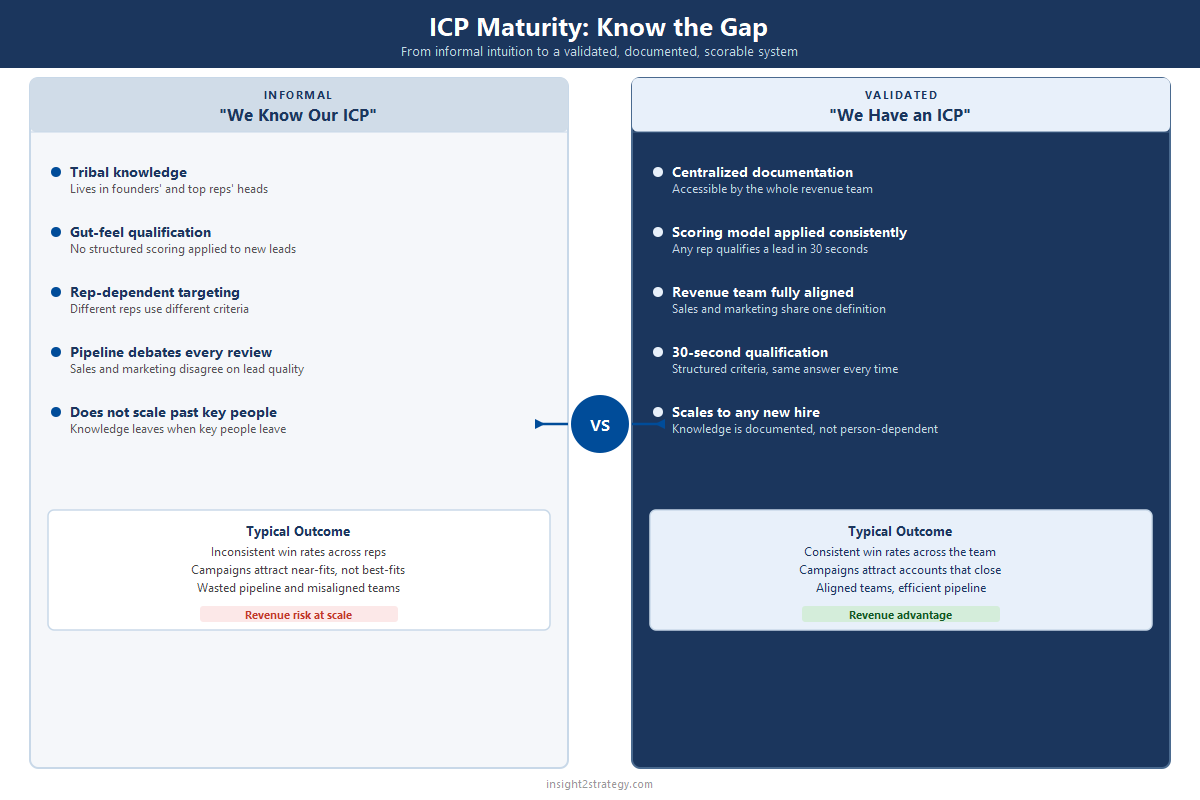
Because it's not codified, it's not scalable. The fix isn't a workshop or a bigger budget. It's a process: turning informal intuition into a validated, documented, scorable system — and then building an outreach program that actually uses it. This post walks through both, step by step.
How to Validate Your ICP
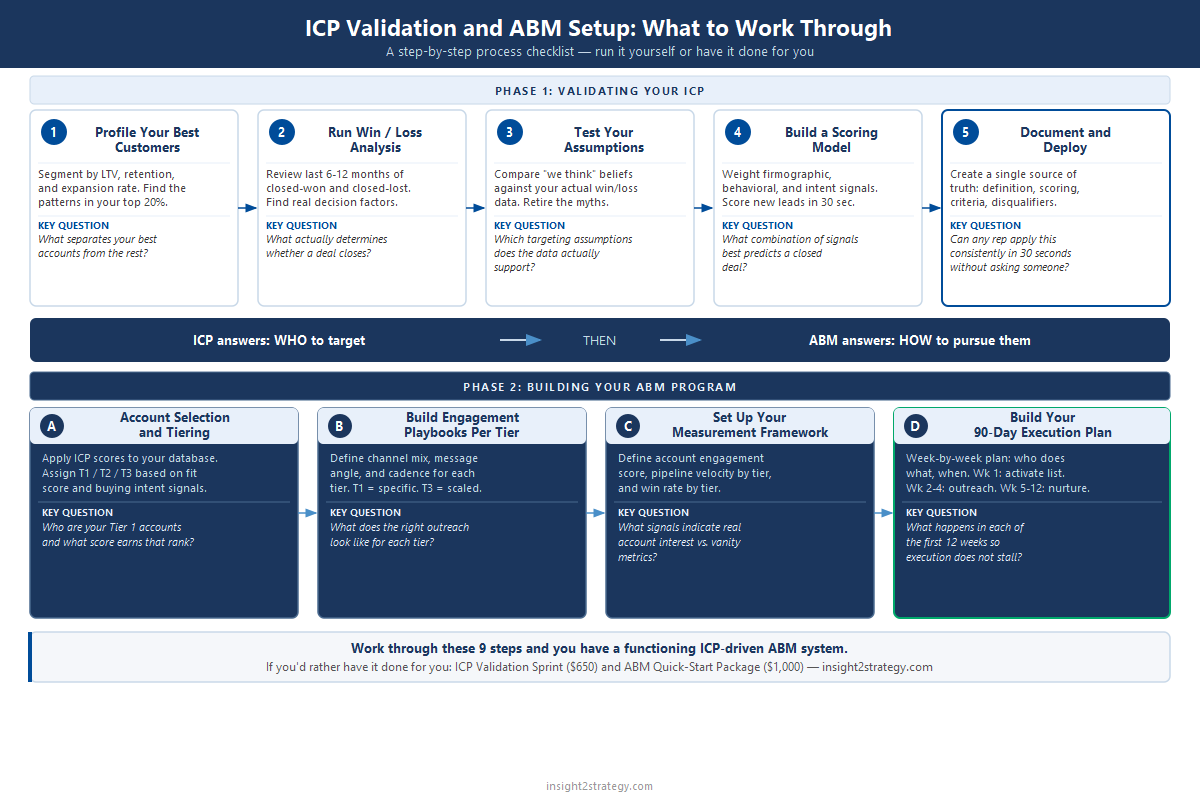
Most teams treat ICP definition as a one-time exercise — a workshop, a persona template, a slide deck. The problem with that approach is that it produces a profile built on assumptions, not evidence. The five steps below replace assumptions with data.
Step 1: Profile your existing customer base.
Pull your CRM data and segment current customers by lifetime value, time-to-value, retention rate, and expansion revenue. You're not looking for who bought — you're looking for who bought and thrived. The patterns in that segment are your actual ICP signal.
Step 2: Run a structured win/loss review.
Go back through the last 6–12 months of closed-won and closed-lost deals. For each, identify the real decision factors: what triggered the buying process, what objections appeared, what the competitive dynamics were. Most teams skip this and build their ICP from the wins alone — but the losses are where the disqualification signals live. Forrester research shows structured win/loss programs generate 50% more sales-ready leads at 33% lower cost, because the team stops investing cycles in accounts that look right but don't close.
Step 3: Test your assumptions against the data.
Every team carries targeting beliefs: "Mid-market is our sweet spot," "Tech companies convert best," "Series B is the right timing." Map each assumption against your win/loss data. Some will be confirmed. Others will turn out to be memorable anecdotes that don't hold at scale. Eliminating bad assumptions is often more valuable than confirming good ones.
Step 4: Build a scoring model.
Take what you've learned and convert it into a weighted rubric: firmographic criteria (industry, size, revenue), behavioral signals (engagement patterns, buying triggers), and intent signals (timing, triggering events). Assign point values so any rep can score a new prospect in 30 seconds and get a consistent answer — Tier 1, Tier 2, or pass.
⚡ Quick Implementation Tip
When building your scoring model, start with no more than 8–10 criteria. A model with 25 variables sounds comprehensive but produces analysis paralysis. Three strong firmographic signals plus two behavioral triggers often outperform a complex multi-variable rubric. You can always add criteria after you've validated the model against real deals.
Step 5: Document it.
Create a single source of truth: the ICP definition, scoring criteria, use cases by segment, and disqualification signals. One document the whole team uses, not a slide deck that lives in someone's Drive folder and gets referenced once.
How to Build Your ABM Program
Once your ICP is validated, the question becomes operational: how do you pursue those accounts systematically rather than reactively?
Account-based marketing flips the traditional demand gen model. Instead of casting wide and filtering down, you start with a defined set of target accounts and build the outreach program around them. Forrester research finds that 99% of B2B marketers report ABM delivers higher ROI than other marketing approaches. The performance difference comes down to concentration of effort — but concentration requires precision, which is why the ICP work comes first.
Here are the four things to build:
1. Score your accounts and build a tiered list.
Apply your ICP scoring model to your existing database and prospect universe. Every account gets a score; scores determine tier placement. Tier 1: highest fit, highest priority, personalized high-touch. Tier 2: strong fit, scalable outreach. Tier 3: signal monitoring, minimal resource investment. The tiering decision answers a critical question: where should your team's time go?
2. Build engagement playbooks per tier.
Each tier needs a distinct outreach approach — not just a different email template, but a different combination of channels, messaging angle, and cadence. A Tier 1 playbook might combine a personalized direct outreach from the AE, a specific piece of content addressing a known pain point, and an invitation to a small executive conversation. A Tier 3 playbook might be a relevant automated sequence that watches for intent signals. The rule: the higher the tier, the more specific and human the outreach.
⚡ Quick Implementation Tip
Don't build playbooks for all three tiers simultaneously. Start with your Tier 1 playbook only — the 15–25 highest-scoring accounts. Get the outreach pattern right, measure what moves, then template down to Tier 2. Trying to design all three tiers in parallel before you have real engagement data produces playbooks that look good in a deck but don't survive contact with prospects.
3. Define your measurement framework before you launch.
ABM success metrics differ from traditional demand gen. Account engagement score (are your Tier 1 accounts interacting with your content?), pipeline velocity by tier (how fast are accounts moving through stages?), and win rate by tier (are Tier 1 accounts actually closing at a higher rate?) matter more than top-of-funnel volume. Set these up before the first outreach goes out — it's very hard to retrofit measurement onto a running program.
4. Build a 90-day execution calendar.
Translate the playbooks into a week-by-week plan. Week 1: list activation and CRM setup. Weeks 2–4: first outreach sequences by tier. Weeks 5–12: nurture cadence, sales handoff triggers, and campaign milestones. The calendar doesn't need to be perfect — it needs to be specific enough that execution doesn't stall after week two.
How the Two Connect
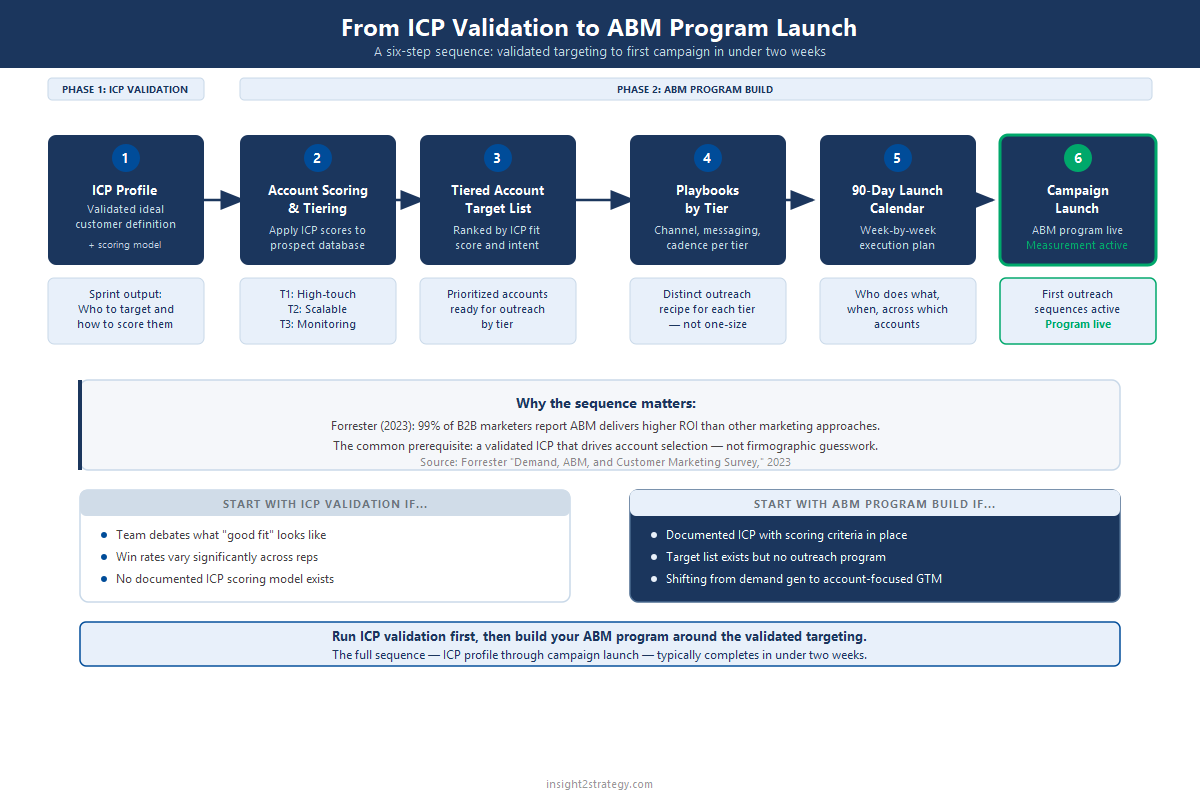
ICP validation and ABM program setup aren't parallel tracks — they're a sequence.
ICP validation answers the strategic question: Who exactly are we pursuing, and what signals tell us an account is worth our time? ABM setup answers the operational question: How do we pursue them at scale and with discipline?
Trying to run ABM without a validated ICP means your account list is built on assumptions. You'll move quickly in the wrong direction — expensive outreach aimed at accounts that look right but don't close. Conversely, having a validated ICP with no ABM program means you know exactly who to pursue but have no system to do it consistently.
Research from SiriusDecisions/Forrester shows that B2B companies with tightly aligned sales and marketing — built around a shared, validated customer definition — grow revenue 24% faster over a three-year period. The ICP is what creates that shared definition. ABM is what operationalizes it.
📊 Implementation Framework
The five ICP validation steps and four ABM build items above are the complete playbook. Work through them in sequence and you'll have a functioning targeting system by end of quarter. Need help adapting this framework to your specific situation? Let's discuss your implementation approach.
Where to Start
Start with ICP validation if:
- Your team debates what a "good fit" looks like in pipeline reviews
- Win rates vary significantly across reps with no clear explanation
- Marketing campaigns generate volume but not pipeline quality
- You've grown past founder-led sales and need targeting knowledge to be scalable
Start with ABM program build if:
- You have a documented ICP with scoring criteria already in place
- You have a target account list but no structured outreach program behind it
- You're shifting from broad demand gen to an account-focused go-to-market approach
Run both in sequence if:
- You want to compress ICP validation and ABM program build into a single two-week engagement
- You're building or rebuilding your revenue team and need the foundation before you scale
Conclusion
The companies that consistently win in their target markets don't necessarily have better products or more budget. They have better targeting — and they've built systems that make targeting repeatable.
As you move through Q3 2026 and build your pipeline strategy for Q4, the question worth asking isn't "Are we doing enough marketing?" It's "Are we pursuing the right accounts, with the right message, at the right time — and does everyone on the team know what 'right' means?"
The five ICP steps and four ABM build items above are the complete playbook. Work through them and you'll have a functioning targeting system by end of quarter.
If you'd rather have this done for you: the ICP Validation Sprint ($650) and ABM Quick-Start Package ($1,000) deliver both in 2–3 business days each. Or schedule a free consultation to talk through where to start.
|
This post is part of The B2B Marketing Reality Check The strategic framework for growth-stage B2B tech companies — now available in paperback and Kindle. Every topic we cover in this blog goes deeper in the book, with frameworks, diagnostics, and quick wins you can put to work immediately. Get the Free PDF →Want to work through the framework hands-on? Get the companion workbook → |
Frequently Asked Questions
What is an ICP in B2B marketing?
An Ideal Customer Profile (ICP) is a detailed description of the type of company most likely to buy from you, stay, and grow. In B2B marketing, a strong ICP defines the firmographic criteria (industry, company size, revenue), behavioral signals (engagement patterns, buying triggers), and intent indicators that distinguish your best accounts from everyone else. The key distinction: an informal ICP lives in a few people's heads; a validated ICP is documented, data-tested, and scorable by any member of your revenue team.
How do you validate an ICP?
ICP validation is a five-step data process: (1) profile your existing customers by lifetime value, retention, and expansion rate; (2) run a structured win/loss review of the last 6–12 months of deals; (3) test your targeting assumptions against what the data actually shows; (4) build a weighted scoring model from confirmed signals; and (5) document the model as a single source of truth the whole revenue team uses. The process typically takes 2–3 business days when done efficiently with access to CRM and deal history data.
What data do you need to build an ICP scoring model?
The minimum dataset for a meaningful ICP scoring model: CRM records segmented by deal outcome (won/lost), customer lifetime value or annual contract value, retention and churn data, deal-level notes on objections and decision factors, and basic firmographic data (industry, company size, geography). You don't need a large sample — 50–100 closed deals is sufficient to identify reliable patterns, especially when combined with structured win/loss interviews.
How do you build an ABM program for a small business?
For a small business, an ABM program has four components: a tiered account list (start with 15–25 Tier 1 accounts), engagement playbooks per tier (Tier 1 = high-touch personalized; Tier 2 = scalable sequences), a measurement framework defined before launch (account engagement, pipeline velocity, win rate by tier), and a 90-day execution calendar. The key is to start with Tier 1 only, validate the playbook with real engagement data, then build out lower tiers. You do not need a large team or complex technology stack to run effective ABM at the growth-stage level.
What does an ABM playbook include?
An ABM playbook for a specific tier includes: the channel mix (which outreach channels to use and in what order), the messaging angle (what pain point or trigger event the messaging addresses), the cadence (how many touches, over what time period, with what spacing), the content to deploy at each touch, the sales handoff trigger (what signal moves the account from marketing to direct sales engagement), and the measurement criteria (what engagement scores indicate the account is moving forward). Each tier should have a distinct playbook — the higher the tier, the more personalized and human the execution.
Should I start with ICP validation or ABM program setup?
Start with ICP validation if your team doesn't have a documented, data-tested ICP with a scoring model. Start with ABM program setup if you already have a validated ICP with scoring criteria and just need the execution program built around it. If neither is in place, run both in sequence — ICP validation first (output: a validated scoring model), then ABM program build (input: that scoring model to drive account selection and tiering). Running ABM without a validated ICP is the most common reason ABM programs underperform.
Ready to Build Your Targeting System?
Every revenue team's situation is different — the right starting point depends on what you already have documented and where execution is stalling. Let's spend 30 minutes figuring out exactly where to start for your business.
No sales pitch. Just an honest conversation about where you are and what the right next step looks like.
About Insight2Strategy
Insight2Strategy delivers B2B go-to-market strategy services for growth-stage companies. Our ICP validation and ABM program services are designed to get your revenue team aligned and executing within 2–3 business days.


Comments
Post a Comment