Why “Best Practice” Lead Nurturing Is Killing Your Pipeline (And What Works Instead)
Why “Best Practice” Lead Nurturing Is Killing Your Pipeline (And What Works Instead)
Strategic Analysis by: Insight2Strategy
Published: June 29, 2026
Executive Reading Time: 8 minutes
Executive Strategic Insights
- The core problem isn't execution — most failing lead nurturing programs are built on assumptions that haven't been tested against how B2B buyers actually make decisions.
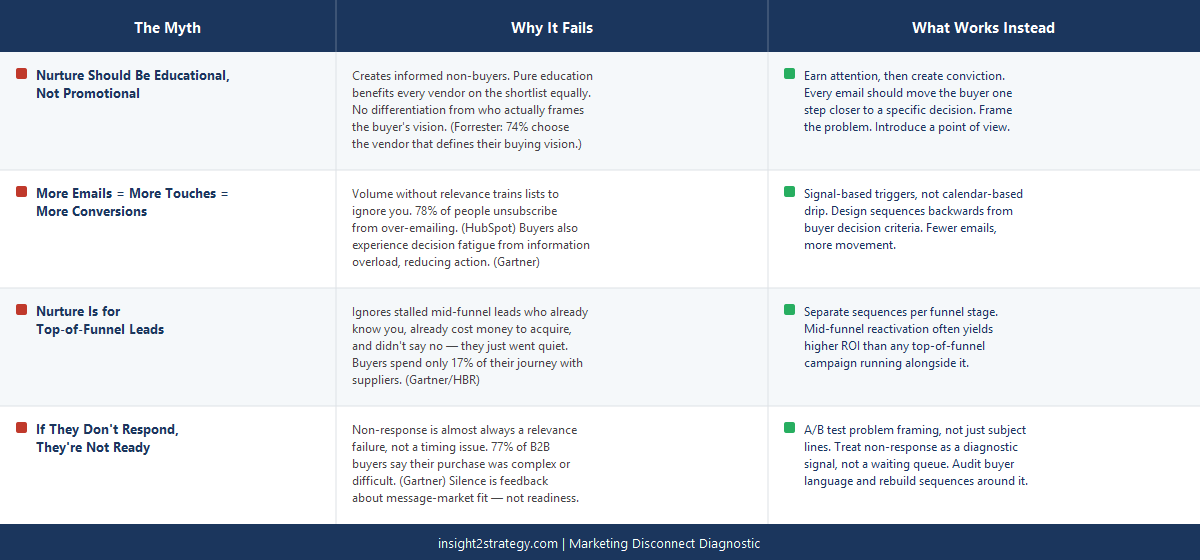
- Educational-only nurture creates informed non-buyers — 74% of B2B buyers choose the vendor that helps define their buying vision, not just the most informative one (Forrester).
- Volume without relevance accelerates disengagement — 78% of consumers have unsubscribed because a brand sent too many messages (HubSpot).
- Mid-funnel is the highest-ROI opportunity most companies ignore — stalled leads who already know you, already expressed interest, and already cost money to acquire.
- Non-response is a relevance signal, not a timing signal — waiting for “better timing” doesn’t fix a message-market fit problem.
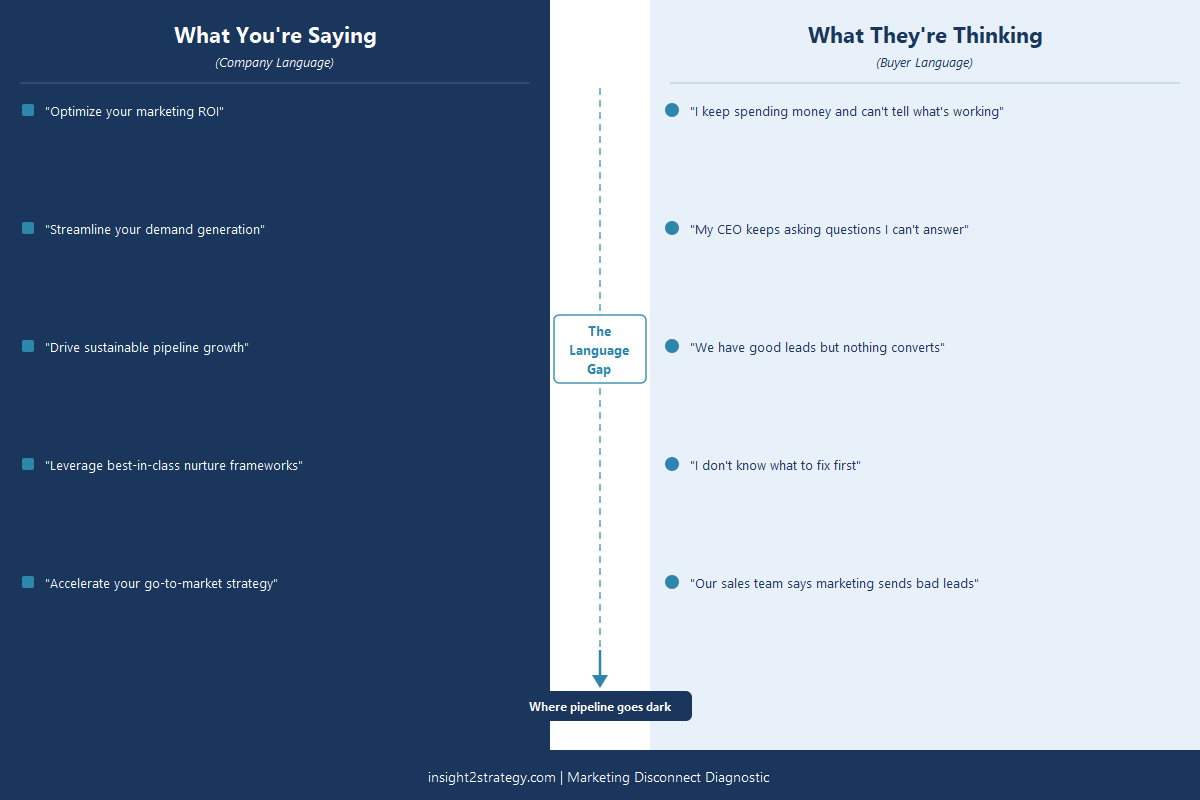
- The root cause behind all four myths: your nurture speaks your language; your buyers think in theirs. That gap is where deals go dark. Framework detailed below.
You built the nurture sequence.
Six emails over three weeks. Helpful content, clear CTAs, solid open rates.
And then… nothing converts.
If that sounds familiar, you’re not alone. Most email nurture campaigns look right on paper. They follow “best practices,” check all the boxes, and still quietly fail to move deals forward.
The problem isn’t your execution. It’s the assumptions baked into what “good” nurturing is supposed to look like — assumptions that haven’t been stress-tested against how B2B buyers actually make decisions.
If your lead nurturing strategy is still rooted in the standard playbook, you’re not nurturing leads. You’re babysitting them.
Let’s break down the four myths doing the most damage — and what works instead.
Myth 1: “Nurture Should Be Educational, Not Promotional”
This one sounds smart. It feels respectful. It aligns with the idea of “adding value.”
And it’s quietly killing your pipeline.
Why It’s Wrong
Pure education doesn’t create customers — it creates informed non-buyers.
When your nurture sequence is 100% educational, you’re doing two things: teaching prospects what to think about, and avoiding telling them what to do next. That second part is where deals get lost.
Research from Forrester shows that 74% of B2B buyers choose the vendor that helps them define their buying vision — not the one that simply provides the most information. If you’re only educating, you’re helping someone win. Not necessarily you.
There’s an additional problem: pure education is brand-agnostic. When you spend five emails teaching prospects how to evaluate vendors in your category, you’re funding their research process for every competitor on their shortlist.
The Reality
Effective nurture earns attention first, then creates conviction. Every touchpoint should be doing one job: moving the buyer one step closer to a specific decision. That’s not “salesy.” That’s leadership.
The best nurture sequences frame the problem in a specific way, introduce a clear point of view, and guide the buyer toward a logical next step.
Example
Instead of: “Here are 5 ways to improve your lead generation strategy.”
Try: “Most companies waste 40–60% of their marketing spend because they’re optimizing the wrong stage of the funnel. Here’s how to identify where your leak actually is — and what to fix first.”
Same educational value. Completely different positioning. One teaches. The other moves.
⚡ Quick Implementation Tip
Audit your last nurture sequence. For each email, ask: “What specific decision does this move the buyer toward?” If the answer is “it educates them,” rewrite the email around a concrete next belief they need to form — not just information they should have.
Myth 2: “More Emails = More Touches = More Conversions”
If some nurturing is good, more must be better. This logic is how nurture programs inflate from six emails to eighteen, with declining results at every stage.
Why It’s Wrong
Volume without relevance doesn’t build trust — it erodes it.
HubSpot research found that 78% of consumers have unsubscribed from emails because a brand was sending too many messages. Meanwhile, Gartner reports that buyers experience decision fatigue when overwhelmed with information, making them less likely to act — not more.
More emails don’t equal more engagement. They often accelerate disengagement. The math is straightforward: twelve emails that miss the mark will always convert worse than four that match where the buyer actually is.
The Reality
Compression beats volume. Relevance beats frequency — always.
Design your nurture backwards from the buyer’s decision criteria, not forwards from your content calendar. Signal-based triggers — emails sent when a prospect visits your pricing page, downloads a specific resource, or re-engages with content — dramatically outperform calendar-based drip sequences, because the trigger reflects actual intent.
One company cut a twelve-email drip to four behavior-triggered messages tied to website actions. Pipeline velocity increased while email volume dropped significantly. Fewer emails. More movement.
Example
A traditional sequence asks: “How many emails should we send this month?”
A strategic sequence asks: “What does this specific buyer need to hear right now to move forward?”
That shift changes everything about what you write, when you send it, and who receives it.
Myth 3: “Nurture Is for Top-of-Funnel Leads”
This is one of the most expensive misconceptions in B2B marketing — and it creates a systematic blind spot.
Why It’s Wrong
Most companies treat nurture as something you do before a lead becomes an opportunity. They invest heavily in top-of-funnel education while ignoring the mid-funnel leads who already know them — prospects who expressed interest, went through discovery, and then went quiet.
These aren’t cold leads. They’re warm leads who already cost money to acquire, already understand what you do, and for some reason stalled. They didn’t say no. They just stopped responding.
Harvard Business Review has noted that B2B buyers spend only 17% of their total purchase journey meeting with potential suppliers — meaning the vast majority of their decision-making happens independently, outside of sales conversations. If you’re not visible during that 83%, you’re not in the conversation.
Meanwhile, research consistently shows that companies that excel at lead nurturing generate 50% more sales-ready leads at 33% lower cost (Forrester Research). The implication for mid-funnel: the most overlooked revenue opportunity in most B2B pipelines isn’t new leads — it’s reactivating stalled ones.
The Reality
Nurture isn’t just for generating opportunities — it’s for recovering and accelerating them. You need distinct approaches for each funnel stage:
- Top of funnel: Problem identification and differentiation. Why this problem matters, why you solve it differently.
- Mid-funnel (stalled): Objection handling, ROI reinforcement, case study proof, re-engagement. Why the problem still needs solving, why now, why you.
- Late-stage (proposal/trial): Onboarding support, social proof, closing triggers. How to succeed, why they won’t regret it.
Dropping stalled mid-funnel leads back into a generic top-of-funnel sequence — which they’ve already been through — is the nurture equivalent of starting a conversation over from the beginning. It ignores everything you already know about them.
⚡ Quick Implementation Tip
Pull every lead in your CRM that went dark 60–90 days ago. These are your best immediate reactivation targets. They already know you, already expressed interest, and already cost money to acquire. Build a 3-email sequence specifically for this segment using the language they used when they first engaged — not your general content calendar messaging.
Myth 4: “If They Don’t Respond, They’re Not Ready”
This is the easiest assumption to make — and the most dangerous.
Why It’s Wrong
Silence doesn’t mean lack of interest. It almost always means lack of relevance.
According to Gartner, 77% of B2B buyers describe their most recent purchase as complex or difficult. They’re navigating internal conversations, stakeholder alignment, and competing priorities you can’t see. If your message doesn’t reflect what they’re actually dealing with, they won’t respond — not because they’re not ready, but because it doesn’t resonate.
Forrester research shows that 65% of buyers say vendors don’t adequately communicate how their solution solves a specific business problem — which is often why deals stall and messages go unanswered.
The Reality
Non-response is feedback. It’s telling you one of three things:
- The wrong problem is being framed for this person
- The right problem is framed in the wrong language
- The message is reaching someone without the authority or need you assumed
Waiting for “better timing” doesn’t fix a relevance problem — it just delays the same result.
One team was running a nurture sequence using their internal terminology: “optimize operational efficiency,” “streamline workflows.” Zero replies. They rewrote the sequence using language pulled directly from their buyers’ own LinkedIn posts and sales call transcripts: “stop losing deals because your team can’t quote accurately in real time.” Three previously silent leads replied within 48 hours and booked demos.
Same ICP. Same problem being solved. Different language. Completely different result.
Example
If your email says: “Improve your marketing efficiency with better attribution…”
But your buyer is thinking: “We’re wasting budget and can’t prove what’s working…”
You’ve already lost them. Same problem, different vocabulary, completely different impact.
A/B testing subject lines doesn’t fix this. You need to A/B test the problem framing — and when one version gets 4x more replies, you’ve learned something that should change your sales conversations, your website copy, and your entire nurture architecture.
The Root Cause Behind All Four Lead Nurturing Myths
Every one of these myths fails for the same reason: they’re built around what you want to communicate, not around how your buyer thinks about their problem.
Your emails sound like a marketer wrote them — because they did. Meanwhile, your buyers’ inboxes are full of their own problems, described in their own words: frustrations, uncertainties, and desired outcomes that your sequence isn’t speaking to.
- You educate because it feels safe
- You send volume because it feels productive
- You focus on top-of-funnel because it’s measurable
- You interpret silence as disinterest because it’s convenient
None of those reflect how buyers actually make decisions.
The gap isn’t effort. It’s alignment. And until that gap is closed, no amount of “best practice” will fix your nurture performance.
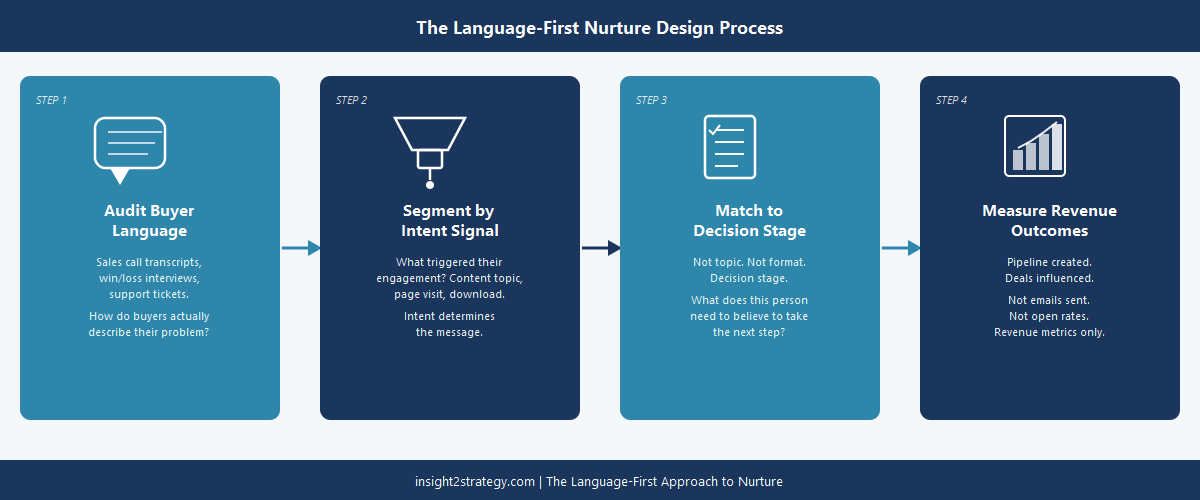
The companies that fix their nurture programs don’t start by writing better email copy. They start by auditing the language their buyers actually use — in sales call transcripts, in win/loss interviews, in support tickets — and rebuilding their sequences around that vocabulary.
That’s the difference between a lead nurturing strategy that generates pipeline and one that generates open rate reports.
📊 Implementation Framework
The four-step Language-First Nurture Design Process shown above — Audit Buyer Language → Segment by Intent Signal → Match Content to Decision Stage → Measure Revenue Outcomes — is the corrective framework for everything described in this post. Need help adapting this to your specific situation? Let’s discuss your implementation approach.
What to Do With This
If your nurture emails feel compelling to write but aren’t getting responses, the problem is often that the language you’re using doesn’t match the language your buyers use to describe their own problem.
The four realities above — earned conviction over pure education, signal-based precision over volume, mid-funnel reactivation over top-of-funnel-only, and non-response as diagnostic signal — are things you can start applying now.
If you’d rather have the diagnostic done for you: our Marketing Disconnect Diagnostic identifies exactly where the language gap lives in 1–2 business days.
|
This post is part of The B2B Marketing Reality Check The strategic framework for growth-stage B2B tech companies — now available in paperback and Kindle. Every topic we cover in this blog goes deeper in the book, with frameworks, diagnostics, and quick wins you can put to work immediately. Get the Free PDF →Want to work through the framework hands-on? Get the companion workbook → |
Frequently Asked Questions
Why do lead nurturing campaigns fail to convert?
Most lead nurturing campaigns fail not because of poor execution, but because of flawed assumptions about how buyers make decisions. The most common root cause: the nurture program speaks in company language (“optimize your demand generation”) while buyers think in problem language (“I keep spending money and can’t tell what’s working”). That language gap is where pipeline goes dark. Secondary causes include educational-only content that creates informed non-buyers, email volume that trains lists to ignore you, and TOFU-only programs that abandon valuable mid-funnel leads.
How should mid-funnel lead nurturing differ from top-of-funnel?
Top-of-funnel nurture focuses on problem identification and differentiation — establishing why a problem matters and why you solve it differently. Mid-funnel nurture (for stalled leads) requires a completely different message: objection handling, ROI reinforcement, case study proof, and reactivation messaging. Critically, mid-funnel leads already know you and already understand your category — dropping them back into a TOFU educational sequence ignores everything you already know about them. They need messages framed around their current decision stage, not your content calendar.
What should you do when leads don’t respond to nurture emails?
Non-response is almost always a relevance problem, not a timing problem. Before assuming a lead “isn’t ready,” diagnose the silence: Are you framing the wrong problem for this person? Are you using the right problem but in the wrong language? Is the message reaching someone with the wrong role or authority? The fix is to A/B test problem framing — not just subject lines — using language pulled from sales call transcripts and win/loss interviews. When you find the framing that resonates, treat it as a signal that changes your entire messaging architecture.
How many emails should a lead nurture sequence have?
The right number is the minimum needed to move a buyer through their specific decision stages — not a fixed number derived from industry benchmarks. A 12-email calendar-based drip will almost always underperform a 4-email behavior-triggered sequence, because the triggers reflect actual intent. Design backwards from the buyer’s decision criteria: what does this person need to believe at each stage to take the next step? Let that determine sequence length and cadence, not your content calendar or arbitrary “best practice” recommendations.
Ready to Fix Your Lead Nurturing Strategy?
Every business situation is unique. Let’s discuss how the Language-First Nurture approach applies to your specific pipeline challenges — and identify where the language gap lives in your current program.
No sales pitch. Just strategic insights tailored to your pipeline.
Insight2Strategy — Strategic marketing consulting for B2B companies who need pipeline, not just programs.
www.insight2strategy.com


Comments
Post a Comment