3 Launch Intelligence Quick Wins: What Smart Founders Do Before They Build Anything
3 Launch Intelligence Quick Wins: What Smart Founders Do Before They Build Anything
Strategic Analysis by: Insight2Strategy
Published: June 22, 2026
Executive Reading Time: 8 minutes
Executive Strategic Insights
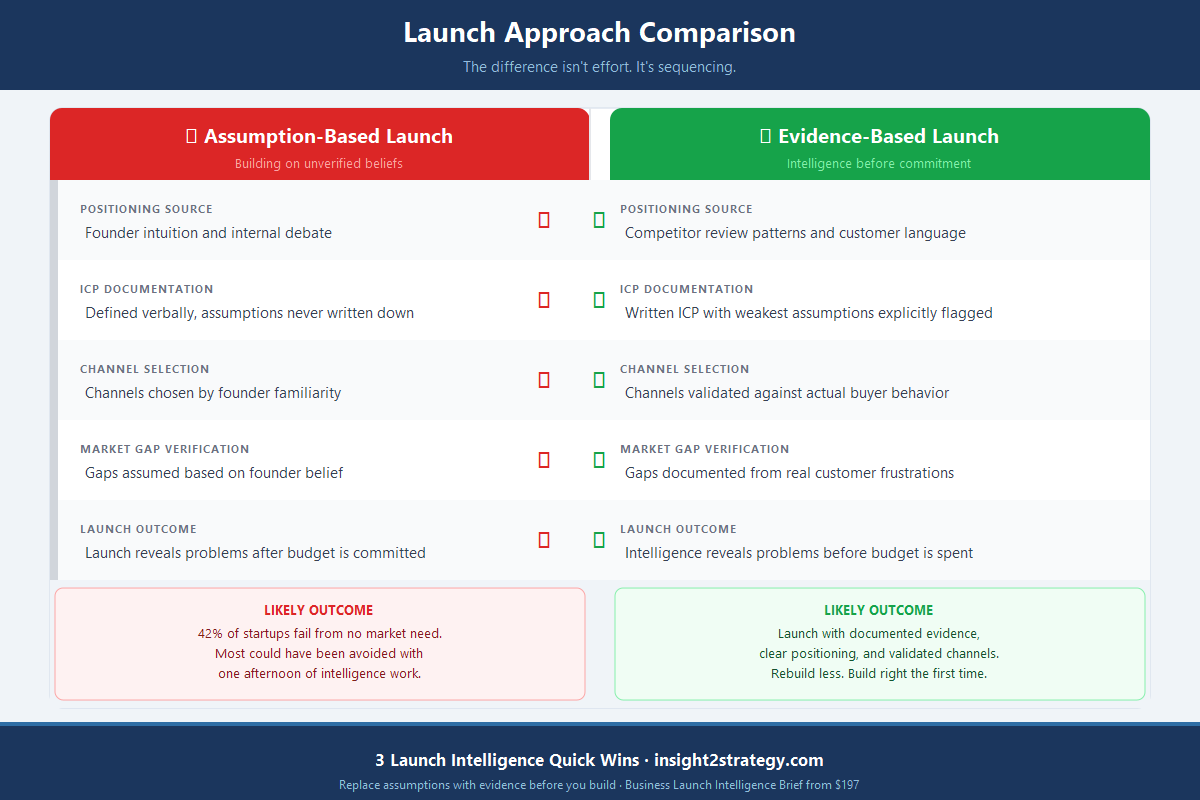
- 42% of startups fail from no real market need — not poor execution, not wrong timing. Most of that outcome is preventable with pre-launch intelligence work.
- The founders who avoid this outcome treat the pre-launch period as an intelligence operation, not a construction project.
- Competitive Gap Audit (~60 min): Mine competitors' negative reviews to document validated market gaps — not feature lists.
- ICP Hypothesis Challenge (~45 min): Write your ideal customer profile explicitly, then stress-test the three weakest assumptions.
- GTM Channel Validation (~90 min): Map where buyers actually consume content vs. where your launch plan assumes they are.
- All three quick wins are free to run, take under 90 minutes each, and together replace launch guesswork with directional evidence. Framework detailed below.
Most launch mistakes aren't made on launch day. They're made in the 90 days before it — when assumptions go unchallenged, competitive research gets skipped, and founders start building based on belief instead of evidence.
That's not just risky. It's expensive.
According to CB Insights' 2024 Startup Failure Post-Mortem Analysis, 42% of startups fail because there's no real market need — the single biggest cause of new venture failure. [CB Insights, 2024] And by the time most founders discover this, they've already spent months and significant capital building something the market didn't ask for.
The founders who avoid this outcome don't just "validate" their idea — they pressure-test it quickly, cheaply, and systematically. They treat the pre-launch period as an intelligence operation, not a construction project. The goal is to replace working assumptions with documented evidence before committing real budget.
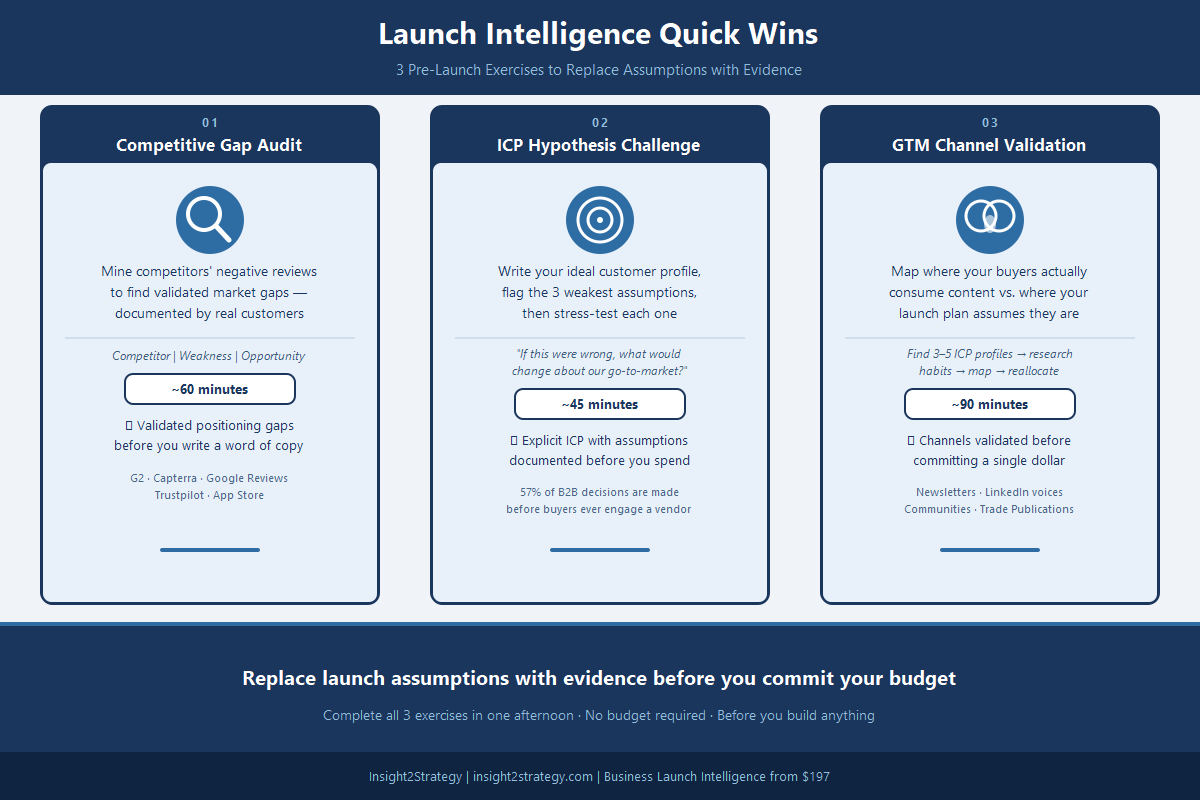
These three quick wins give you that directional signal — without months of expensive research. You can complete all three in a single afternoon.
How to Run a Competitive Gap Audit Before You Build
The Problem
Most founders approach competitive research as a feature comparison exercise — visiting competitor websites, cataloging their pricing, and noting what they offer. That analysis tells you what competitors want you to see: their polished messaging and idealized user experience. It completely misses the strategic goldmine — where they're failing their customers.
If you're only reading competitor landing pages, you're studying their marketing. You need to study their dissatisfied customers.
The Solution
Run a competitive gap audit focused exclusively on frustration, friction, and unmet needs. You're not looking for feature parity — you're looking for the specific gaps that make your competitors' best customers secretly willing to switch.
The Implementation (~60–90 minutes)
- Identify your top five competitors (direct or closely adjacent)
- Go to G2, Capterra, Google Reviews, Trustpilot, or relevant industry review platforms
- Filter for the 10 most recent reviews rated three stars or below
- Build a simple three-column document: Competitor | Their Weakness | Your Opportunity
You're not looking for isolated complaints. You're looking for patterns — the same friction point mentioned by multiple customers across multiple competitors. That pattern is a gap your market is actively waiting for someone to fill.
⚡ Quick Implementation Tip
The most valuable gaps rarely cluster around features. They cluster around experience, support responsiveness, communication clarity, and ease of onboarding. In a crowded market, these are where real switching decisions happen — and they're often underserved because they're harder to describe on a landing page than a feature list.
The Impact
After this exercise, you'll have a documented list of specific, validated market gaps — sourced from actual customer language, not internal debate. This becomes the foundation for your positioning strategy, product priorities, and early sales conversations.
Write Your ICP Hypothesis — Then Challenge It
The Problem
Every founder has a mental model of who their ideal customer is. The problem is that model almost always lives in their head — untested, never written down, filled with assumptions that have never been confronted with evidence.
When your ideal customer profile (ICP) is implicit, every product decision, every marketing message, and every sales conversation is subject to subtle drift. Shaped by whatever prospect is most recent, most vocal, or most comfortable to pursue. Without a written, explicit hypothesis, you can't actually tell when you're drifting from it.
The Solution
Make your ICP explicit — then ruthlessly challenge it. Writing it down isn't bureaucratic overhead; it's the first act of strategic discipline. You cannot pressure-test what you haven't articulated.
The Implementation (~45 minutes)
- Write your ICP in one paragraph: Who are they? What company type, size, or industry? What role do they hold? What does a typical week of work look like for them?
- Identify the three assumptions embedded in that description with the least evidence behind them
- For each assumption, ask: "If this were wrong, what would change about our go-to-market approach?"
That third question is where the strategic value lives. If your entire GTM approach would need to be rebuilt because one assumption turned out to be incorrect, that assumption needs validation before you commit budget to it.
📊 Implementation Framework
The "if this were wrong" question does more strategic work than most market research decks. Apply it to every ICP assumption with less than two data points of evidence behind it. If your GTM strategy would collapse because one assumption was wrong, that assumption needs evidence before you spend a dollar on it.
The Impact
This exercise doesn't require customer interviews — though those should follow. It requires strategic honesty: the discipline to treat your own working theory as a hypothesis rather than a confirmed fact.
Consider what's at stake: Gartner's B2B Buying Journey Research (2024) found that B2B buyers complete an average of 57% of their purchase decision before they ever engage a vendor. [Gartner, 2024] That means your positioning and messaging need to meet buyers where they already are — which is only possible when you know, specifically and accurately, who those buyers are and where they look.
How to Validate Your GTM Channels Against Real Buyer Behavior
The Problem
Most launch plans are built around the channels a founder is most familiar with — not the channels where their target buyers actually make decisions. The result is a marketing calendar that generates activity but not traction: reaching the wrong audiences in the wrong places, at the wrong moment in their decision process.
The Solution
There's a faster way to validate channel fit than running campaigns and waiting for results. Go find three to five people who match your ICP and observe where they already show up. Public profiles, LinkedIn engagement patterns, newsletter bylines, and community participation tell you more in 90 minutes than six months of underperforming ads.
The Implementation (~90 minutes)
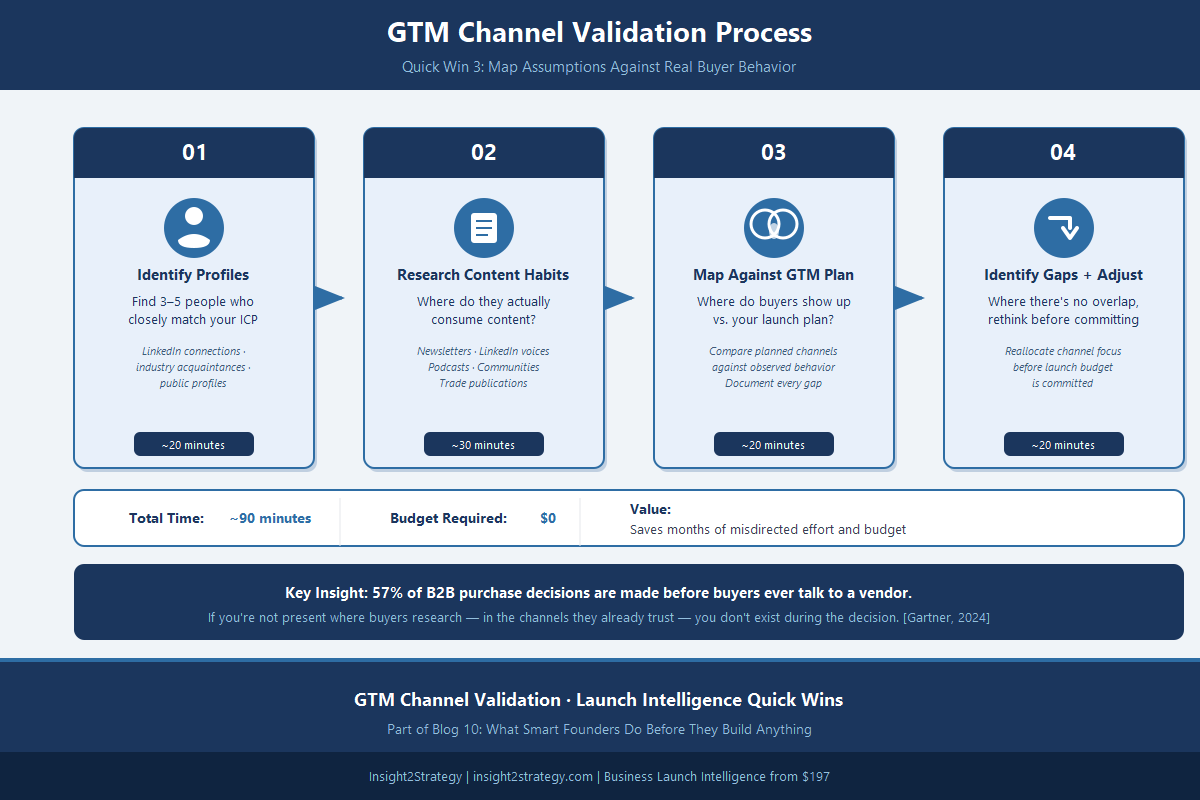
- Identify three to five people who closely match your ICP — LinkedIn connections, industry acquaintances, or public profiles from your target segment
- Research where they actually consume content: Which newsletters do they subscribe to? Which LinkedIn voices do they engage with consistently? Which communities, podcasts, or trade publications appear in their activity?
- Map those channels against your current GTM plan
- Document where the overlap is strong — and where there is none
If your plan assumes LinkedIn as your primary acquisition channel and your ICP is most active in niche industry newsletters and in-person trade associations, that's a material misalignment. Discovering it now costs 90 minutes. Discovering it after six months of underperforming campaigns costs far more.
⚡ Quick Implementation Tip
Focus on where your ICP is a participant, not just a passive member. Which newsletters do they forward? Which LinkedIn posts do they comment on, not just like? Which community threads do they contribute to? Participation patterns tell you far more about real attention than subscription lists.
The Impact
Channel validation before launch is one of the highest-leverage, lowest-cost activities available to any pre-launch founder. It requires no budget — only the discipline to let evidence override comfortable assumptions.
Intelligence First, Then Build
The founders who reach sustainable traction fastest aren't always the ones who start building first. They're the ones who spend the least time rebuilding after discovering their initial assumptions were wrong.
The competitive gap audit, the ICP hypothesis challenge, and the GTM channel validation take a combined three to four hours. They're genuinely the core of what we look for in any pre-launch market assessment — and you can run all three yourself before you spend a dollar.
As you head into the second half of 2026 and finalize your launch plans, the question worth asking isn't "How fast can I move?" It's "How much of what I'm about to commit is actually supported by evidence?"
Start there. Everything downstream moves faster when you do.
If you'd rather have a structured six-part version done for you, the Business Launch Intelligence Brief covers all of this and more for $197 in three business days. Or grab some time with us to talk through your specific situation.
Ready to Implement These Launch Intelligence Strategies?
Every pre-launch situation is unique. Let's discuss how these frameworks apply to your specific market, competitive environment, and go-to-market timeline.
No sales pitch. Just strategic insights tailored to your pre-launch situation.
|
This post is part of The B2B Marketing Reality Check The strategic framework for growth-stage B2B tech companies — now available in paperback and Kindle. Every topic we cover in this blog goes deeper in the book, with frameworks, diagnostics, and quick wins you can put to work immediately. Get the Free PDF →Want to work through the framework hands-on? Get the companion workbook → |
Frequently Asked Questions
How do I research competitors before launch if I don't have any customers yet?
You don't need your own customers to run a competitive gap audit — you need your competitors' dissatisfied customers. Review platforms like G2, Capterra, Google Reviews, and Trustpilot are filled with them. Filter for reviews rated three stars or below on your top five competitors, read 10 per competitor, and document the recurring friction points. You're looking for patterns across multiple competitors, not isolated complaints. The patterns represent gaps your market is actively waiting for someone to fill — and all of that research is publicly available at no cost.
How do I define my ideal customer before launch when I haven't sold to anyone yet?
Write your ICP as a hypothesis, not a fact. That's the critical reframe. Describe who you expect your ideal customer to be — company type, size, industry, role, day-to-day challenges — in one paragraph. Then identify the three assumptions in that description with the least evidence behind them. For each, ask: "If this were wrong, what would change about our go-to-market approach?" This exercise surfaces which assumptions carry the most strategic risk before you commit budget to acting on them. Customer interviews should follow, but this exercise tells you exactly which assumptions to prioritize validating first.
How do I validate my marketing channels before I've run any campaigns?
Identify three to five people who closely match your ICP — LinkedIn connections, industry contacts, or public profiles from your target segment — and spend 90 minutes observing where they actually engage. Which newsletters do they forward or comment on? Which LinkedIn voices do they respond to, not just follow? Which communities or trade publications appear in their activity? Map those channels against your current GTM plan. The overlap — and the gaps — tell you more about channel fit than any media planning assumption. You're not guessing; you're observing behavior that already exists.
When should I hire outside expertise for pre-launch market intelligence vs. handle it internally?
The three exercises in this post are designed to be founder-run with no external help. They require time and strategic honesty — not budget. Where outside expertise adds disproportionate value is when you need systematic validation across a larger sample (50+ customer interviews, multi-market analysis, structured competitive intelligence), when you're entering an unfamiliar market with limited existing networks, or when your team doesn't have the capacity to run the intelligence work while simultaneously building. The exercises above give you directional signal quickly and cheaply. If you find significant gaps or surprising findings, that's often the right moment to bring in structured support.
Insight2Strategy
Strategic intelligence for founders and business leaders who need directional clarity before they commit.
Schedule a Strategy Session | Business Launch Intelligence Brief | Insight2Strategy.com


Comments
Post a Comment