3 AI Quick Wins That Give Your Marketing Team 10+ Hours Back Per Week
3 AI Quick Wins That Give Your Marketing Team 10+ Hours Back Per Week
Strategic Analysis by: Insight2Strategy
Published: March 2, 2026
Executive Reading Time: 6 minutes
Executive Strategic Insights
- 95% of AI pilots fail to scale because they're too complex—start with quick wins instead
- 3 proven implementations that return 10+ hours per week with less than 1 hour setup
- No enterprise contracts or IT approval required—works with free AI tools
- 60-80% faster content production using AI-powered first drafts
- Compounding effect: Teams that start small build skills for larger AI adoption
Framework detailed below with implementation checklists for each quick win.
Your marketing team isn't short on talent or ideas. They're short on time.
Every week, skilled marketers spend hours on work that doesn't require creativity: reformatting content for different channels, transcribing meeting notes, compiling reports from five different dashboards. These tasks aren't difficult—they're just tedious. And they're stealing time from the strategic work that actually moves the needle.
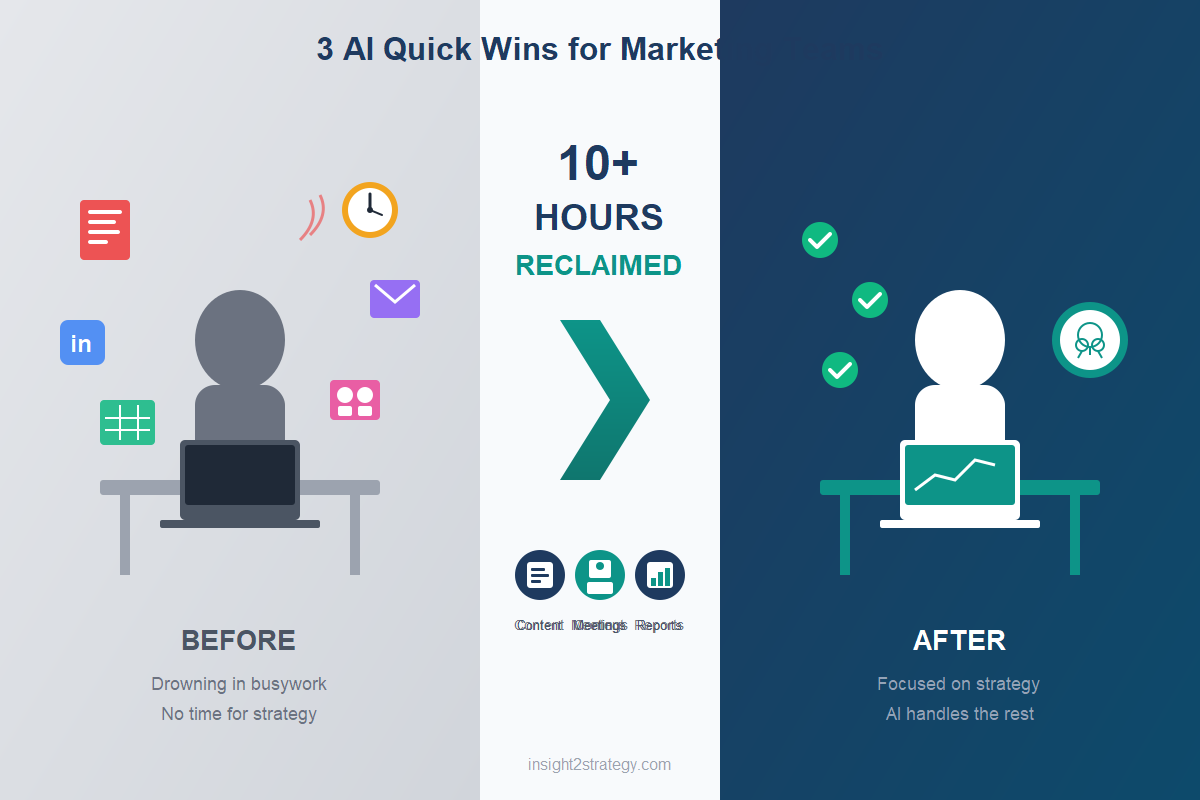
Here's the reality: According to McKinsey (2024), only 11% of companies have adopted AI at scale—and just 5% are seeing meaningful EBIT impact. Not because AI is complicated, but because most teams are trying to boil the ocean. They're building elaborate AI strategies when they should be grabbing the low-hanging fruit first.
MIT (2025) reports that 95% of AI pilots fail to scale, primarily because they're too complex to implement at the ground level. The solution? Start with quick wins that prove ROI within the first week.
These three quick wins take less than an hour to implement and consistently return 10+ hours per week. No enterprise contracts. No IT department approval. Just practical wins you can start this afternoon.
Following along? Get the AI Quick Wins Playbook below to implement these strategies step-by-step.
Quick Win #1: AI-Powered Content Drafting (Kill the Blank Page)
The Problem
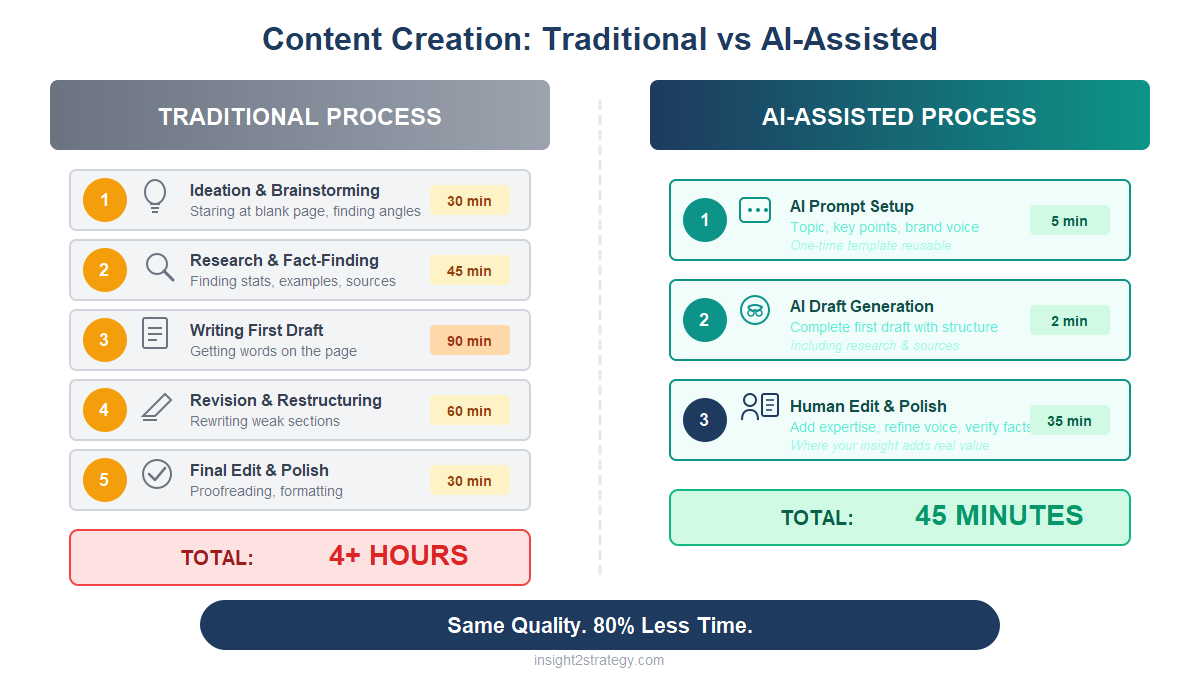
Marketing teams create strong content—blogs, webinars, whitepapers—but the creation process is painfully slow. Your content marketer stares at a blank document for 45 minutes before typing the first sentence. Then manually rewrites that content for every channel, turning one asset into a week-long production cycle.
The Solution
Use AI to generate first drafts in minutes, then spend your time editing and refining—work that actually benefits from human judgment. Modern AI tools reliably:
- Extract key insights from long-form content
- Rewrite them for LinkedIn, email, and sales enablement
- Adjust tone for executive vs. practitioner audiences
Implementation (30 Minutes to Start)
- Choose your AI tool (ChatGPT, Claude, Gemini—all work well)
- Create a "brand voice" prompt capturing your tone, audience, and style guidelines
- For each piece of content, provide: topic, key points, target word count, must-include elements
- Prompt AI to generate: 3 LinkedIn posts, 1 email summary, 5 insight bullets for sales
- Review, lightly edit, publish
⚡ Quick Implementation Tip
Start by documenting your brand voice in a single "master prompt" that you paste at the start of every AI session. Include your company's tone, target audience, and 2-3 example sentences. This alone cuts editing time by 50%.
Impact
Teams report 60-80% faster content production on first drafts. Marketers save 3-4 hours per asset, every week. One study shows 1-5 hours weekly saved on content tasks alone (CoSchedule, 2025)—translating to 10+ hours when scaled across ideation, drafting, and optimization.
Quick Win #2: AI Meeting Summaries That Actually Drive Action
The Problem
The average marketing manager spends 30% of their week in meetings. The "hidden" cost isn't just the hour in the Zoom room—it's the 45 minutes spent afterward chasing down action items and summarizing notes. Critical campaign details get lost in unread transcripts or forgotten in the transition from meeting to project management tool.
The Solution
AI meeting assistants that automatically capture, summarize, and distribute the parts that matter: decisions made, tasks assigned, and deadlines set.
Implementation (15 Minutes)
- Choose a meeting AI (Otter.ai, Fireflies, Microsoft Teams Premium, or Zoom's built-in features)
- Connect it to your calendar for automatic recording
- Create a custom prompt template: "Extract all deadlines, assigned owners, and creative blockers mentioned."
- Set up auto-distribution to Slack, Teams, or your project management tool
Impact
2-3 hours per week recovered from note-taking and recap writing. More importantly: fewer dropped balls and "wait, I thought you were handling that" moments. Teams report reduced missed follow-ups and clearer accountability.
📥 Get the Complete Framework
The AI Quick Wins Playbook includes ready-to-use prompt templates for all three quick wins, plus time-tracking worksheets to measure your results.
Quick Win #3: AI-Assisted Reporting (Stop the Spreadsheet Grind)
The Problem
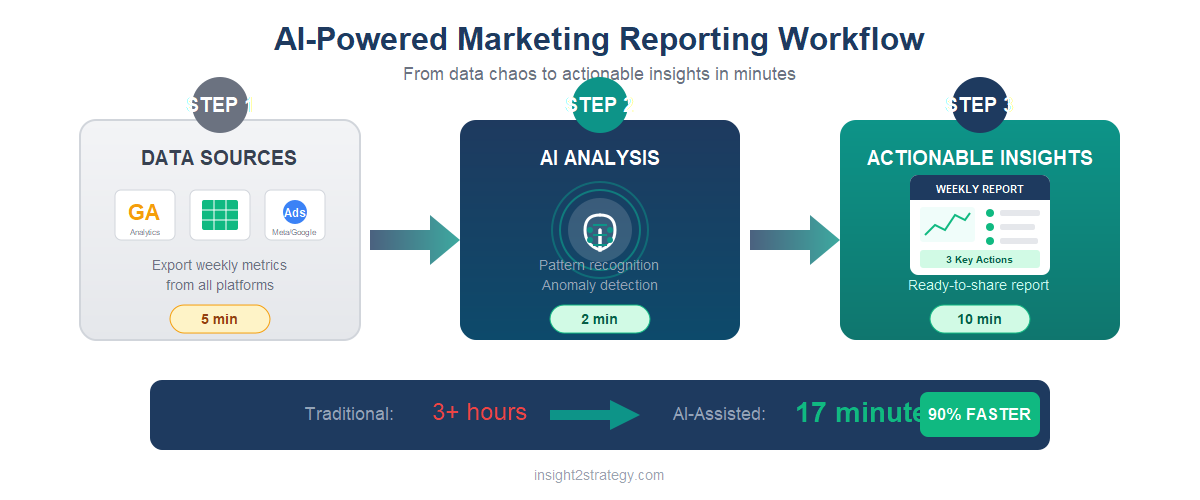
Every Monday morning, someone on your team pulls data from Google Analytics, exports spreadsheets from ad platforms, screenshots social metrics, and assembles them into a deck. The same deck, with the same format, week after week. It takes 2-4 hours and the "insights" section is usually just describing what the numbers already show.
The Solution
Use AI to aggregate data and generate narrative insights automatically.
Implementation (45 Minutes for Initial Setup)
- Export your key metrics as CSV files (or use tools with API connections)
- Upload to an AI environment (ChatGPT Advanced Data Analysis, Claude, or specialized tools like AgencyAnalytics)
- Create a prompt template: "Analyze this week's marketing data. Compare to last week. Identify top 3 insights and any anomalies worth investigating."
- Customize output format for your KPIs (leads, traffic, conversions)
- Review and share—AI handles aggregation and basic narrative
⚡ Quick Implementation Tip
Save your reporting prompt as a template. Each week, just paste it along with your new data. The AI remembers the format you want, so reports stay consistent while insights stay fresh.
Impact
3-5 hours per reporting cycle saved. But the real win is better insights—AI catches patterns humans miss when they're rushing to finish before the Monday meeting. PwC estimates AI will contribute $15.7 trillion to the global economy by 2030, largely through productivity gains like this.
Why These Three Work: The Compounding Effect
These wins share characteristics that make them stick:
- Low risk: You're not replacing human judgment, just eliminating drudgery
- Immediate ROI: See time savings within the first week
- Skill-building: Your team learns AI prompting through practical use
- No budget required: Most work with free tiers or existing tool upgrades
As McKinsey research highlights, AI scaling is 70% people and process, only 30% technology. These quick wins work because they meet your team where they are—not where some consultant thinks they should be.
When your team sees that AI can handle the drudgery, they stop fearing "replacement" and start embracing "augmentation."
Start This Week
Pick one. Just one. Implement it before Friday. Measure the time saved.
Then add another next week.
Within a month, you'll have 10+ hours back. Within a quarter, your team will be asking what else AI can handle—and they'll have the skills to figure it out themselves.
As we head into Q2 2026 with marketing budgets still tight (Gartner, 2025), the teams that adopt these AI quick wins first will outpace competitors—delivering more with the same headcount.
|
This post is part of The B2B Marketing Reality Check The strategic framework for growth-stage B2B tech companies — now available in paperback and Kindle. Every topic we cover in this blog goes deeper in the book, with frameworks, diagnostics, and quick wins you can put to work immediately. Get the Free PDF →Want to work through the framework hands-on? Get the companion workbook → |
Frequently Asked Questions
How long does it take to see results from these AI quick wins?
Most teams see measurable time savings within the first week. Content drafting shows immediate impact (your first AI draft takes minutes instead of hours). Meeting summaries and reporting improvements compound over 2-3 weeks as you refine your prompts.
What budget should we allocate for AI tools?
Start with free tiers—ChatGPT, Claude, and Gemini all offer free versions sufficient for these quick wins. Most teams spend $0-50/month initially. Paid subscriptions ($20-30/user/month) unlock advanced features like data analysis, but aren't required to get started.
Do we need IT approval or enterprise contracts?
Not for these quick wins. They use web-based tools that don't require installation or IT involvement. For sensitive data, check your company's AI policy, but most marketing content and meeting notes fall within acceptable use.
How do we measure ROI on AI adoption?
Track hours saved per task before and after implementation. The AI Quick Wins Playbook includes time-tracking worksheets. Common metrics: time to first draft, meeting follow-up completion rate, and hours spent on weekly reporting.
Get Your Free AI Quick Wins Playbook
Practical templates and checklists to give your marketing team 10+ hours back every week. Includes ready-to-use prompts for all three quick wins.
Download instantly. No sales pitch. Just actionable strategies you can implement this afternoon.
Download the AI Quick Wins Playbook
Get instant access to the AI Quick Wins Playbook — enter your email below and we'll send the download link right over.
Want to discuss how to adapt these strategies to your specific team?
Schedule a Strategy Discussion →What's the one repetitive task eating your marketing hours? Share in the comments—let's solve it together.
INSIGHT2STRATEGY
Strategic Tools for Growth-Focused Entrepreneurs
More Resources | Free Consultation
© 2026 Insight2Strategy. All rights reserved.


Comments
Post a Comment