4 Customer Targeting Quick Wins: Reach Your ICP Where They Actually Pay Attention
4 Customer Targeting Quick Wins: Reach Your ICP Where They Actually Pay Attention
Strategic Analysis by: Insight2Strategy
Published: July 13, 2026
Executive Reading Time: 7 minutes
Executive Strategic Insights
- B2B buyers spend only 17% of their purchase journey meeting with vendors — the other 83% is independent research and peer validation (Gartner)
- Knowing your ICP without knowing where they pay attention leaves the second half of the targeting equation unsolved
- Four implementable quick wins — information diet mapping, watering hole identification, inbound reverse-engineering, and 5-touch outbound — can establish channel presence this week
- These moves validate ABM fundamentals before you invest in a full program: who to target, where to reach them, and what earns a response
- The ICP Quick Wins Guide below includes the complete framework — clustering worksheet, channel research, buyer interview templates, outbound planner, and lead scoring builder
You've done the ICP work. You know exactly who your best customer is — their title, company profile, industry, and the triggers that make them reach for their budget.
Now the harder question: where do those people actually spend their professional attention?
This is the gap most growing businesses don't close. They invest in defining their ICP and then immediately default to familiar channels — LinkedIn ads, email blasts, webinars — without asking whether those channels are where their specific buyers are actually making decisions. The result is marketing spend that generates impressions but not conversations, and pipeline that never quite converts at the rate the ICP profile suggested it should.
Here's the strategic reality most teams miss: knowing your ICP is only half the equation. The other half is understanding where they research, gather, and form opinions — usually without a single vendor interaction. Gartner research shows that B2B buyers spend only 17% of their purchase journey actually meeting with potential suppliers. The other 83% is independent research, peer validation, and community conversations.
If you're not present in those spaces, you're not on the shortlist.
Four quick wins, implementable this week, can change that.
Following along? Get the ICP Quick Wins Guide below to implement these strategies step-by-step.
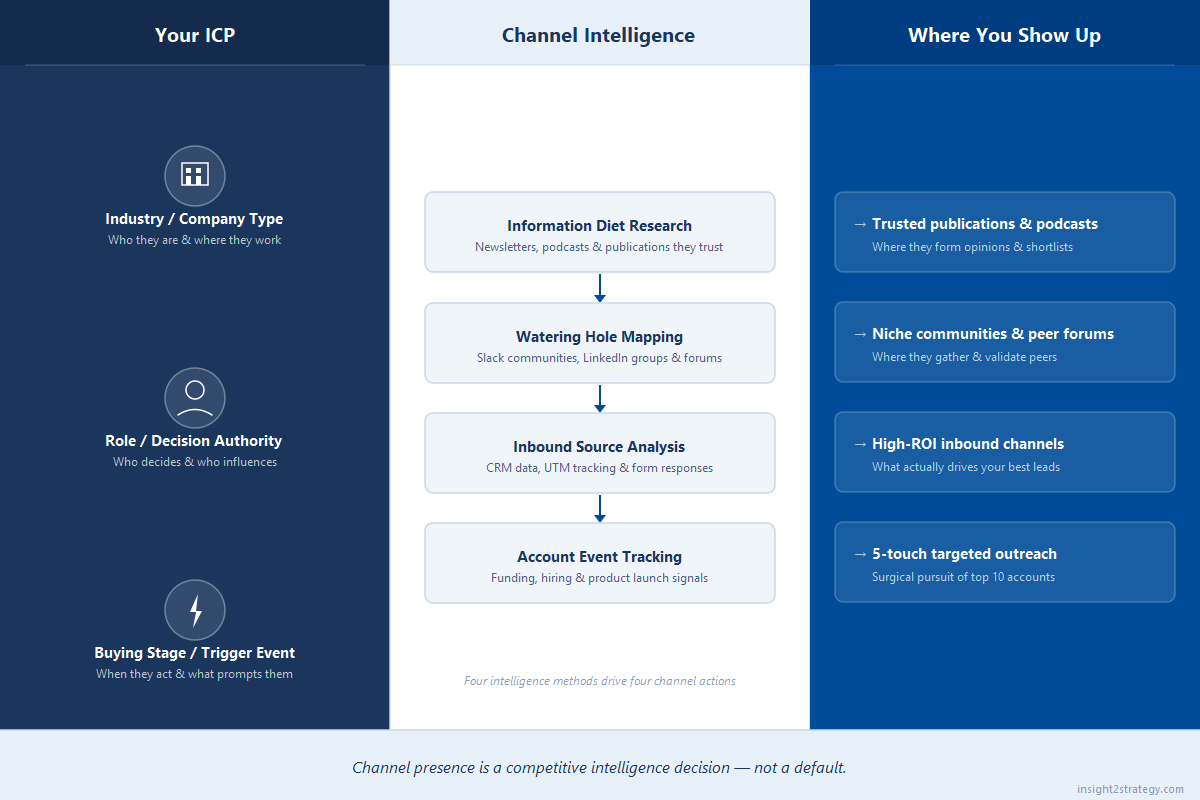
Quick Win 1: Map Your Best Customers’ Information Diet
The problem: You're distributing content on channels you're comfortable with — not channels your buyers actually trust.
Your ICP has a specific, habitual “information diet.” A narrow set of newsletters, podcasts, industry publications, conferences, and analysts they rely on to stay current, evaluate vendors, and make recommendations to colleagues. If you're not present in that diet, you're invisible at the most critical stages of the buying process.
Implementation (90 minutes):
Pull your top 10–15 best customers and send a brief, direct outreach — personal email or quick call — with three questions:
- What industry publications, newsletters, or blogs do you read every week?
- Which podcasts or events are actually worth your time?
- Whose analysis do you trust most when evaluating new approaches?
Document the patterns. You're looking for sources that appear across three or more customers. If 40% of your best customers mention the same podcast, that podcast is a strategic channel — not an optional tactic.
If you don't have direct access to customers, use proxies: scan the LinkedIn content your ICP engages with, look at speakers at industry events they attend, review job descriptions for their roles (often includes what professionals follow to stay current).
⚡ Quick Implementation Tip
Ask two separate questions: “Where do you stay current?” and “When you were evaluating [your service category], where did you actually go to form an opinion?” These produce different answers — the second reveals the peer forums and trusted advisors who influence purchasing decisions, not just general reading habits.
Why this matters: Forrester B2B research shows that buyers trust coworkers and internal management most (82%), followed by current vendors (79%), with independent experts and industry publications in the 66–72% trust range (Forrester Research). When you appear in those trusted environments, your content lands as relevant insight — not sales noise.
Impact: Test presence in your highest-signal channel before scaling — a guest article, content collaboration, or small sponsorship. The goal at this stage is validation, not volume.
Quick Win 2: Find the Watering Holes
The problem: You're broadcasting broadly when your ICP is having specific conversations in specific, trusted spaces you're not in.
Niche communities — industry Slack groups, targeted LinkedIn communities, active subreddits, private peer forums — are where your ideal customers ask questions, vet vendors, and make peer recommendations. These are not purchase-mode environments. They're trust-building environments. And that's exactly what makes them so valuable.
Implementation (2 hours):
Start with your information diet research — communities often surface in the same conversations as publications. Search actively:
- “Slack community + [your industry]” or use directories like Slofile
- LinkedIn groups with specific mandates and active moderation (not generic mega-groups with 50k members)
- Subreddits related to your ICP’s job function or industry challenges
- Professional networks like Pavilion or Chief that require membership (often worth it)
Ask your best customers directly: What Slack groups or forums do you actually participate in?
Join two or three. Spend the first two weeks listening, not selling. Observe the language your ICP uses to describe their problems — this language belongs in your messaging, your content, and your sales conversations. When you do contribute, answer questions, share useful insights, and offer perspective without pitching. Trust is the currency here, and it compounds.
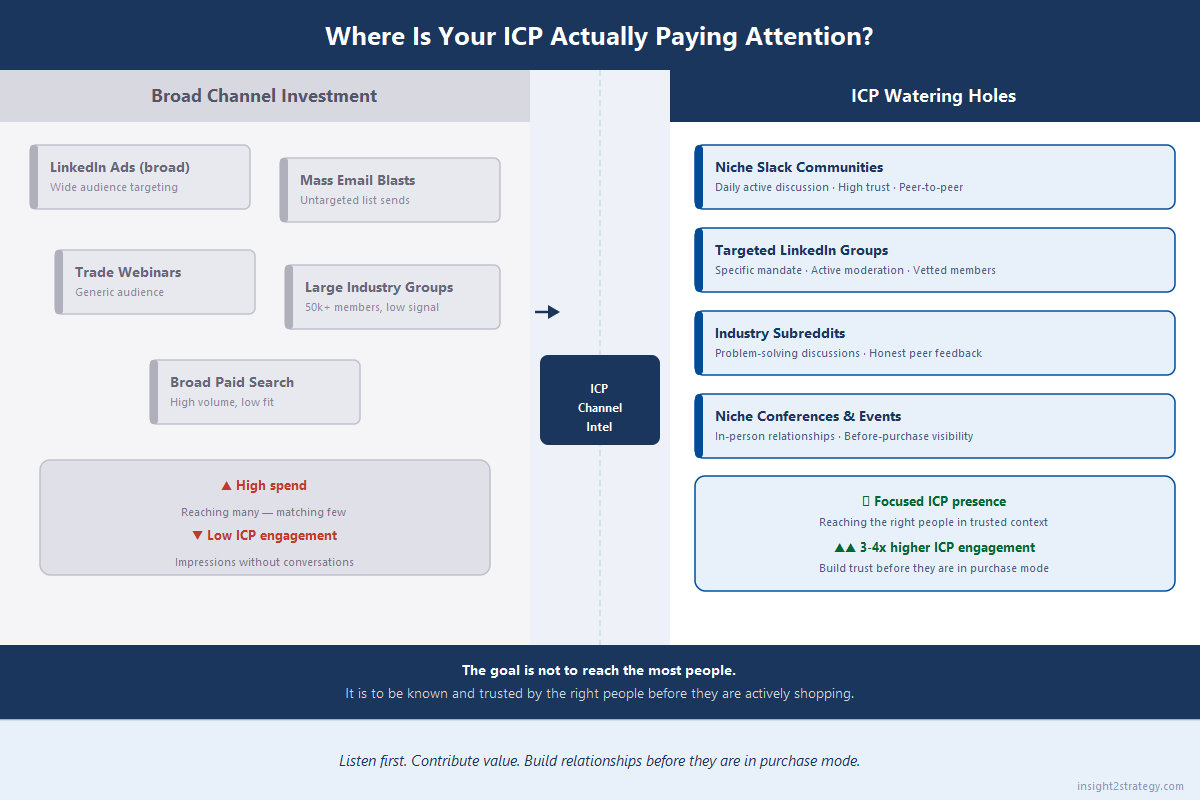
Why this matters: The goal is not to reach the most people — it's to be known and trusted by the right people before they're actively shopping. Presence in peer watering holes builds the kind of credibility that shortens sales cycles and reduces price sensitivity, because you arrive in deals with a reputation instead of a cold pitch.
📅 Get the Complete Channel Research Framework
The ICP Quick Wins Guide includes the full Channel Research Framework with buyer interview templates and the exact questions that surface decision-making channels vs. general reading habits. Sign up below for instant access.
How Do You Know Which Channels Are Actually Producing Your Best Customers?
The problem: You're investing across multiple channels without knowing which ones actually produce your best customers.
There's a meaningful difference between channels that generate volume and channels that generate quality. Most businesses optimize for volume and wonder why conversion rates disappoint. The answer is almost always that the channels driving strong inbound engagement aren't the same channels getting the most budget.
Implementation (45 minutes):
Pull your last 10 best inbound opportunities — the ones that matched your ICP, moved quickly through the funnel, and closed at strong margins. For each, answer:
- How did they first find us? (Original source, UTM parameters, referral source)
- What content did they engage with before reaching out?
- What did they write in the “how did you hear about us?” field? (The actual typed answer is often the most honest signal)
Look for patterns: repeated channels, specific content that consistently appears as the entry point, common timing triggers. Then compare that map against your current marketing budget allocation.
The gap between “channels we're investing in” and “channels that delivered our best customers” is usually the most actionable finding in this exercise — and the fastest way to reallocate spend from noise to signal.
Why this matters: More than 60% of B2B buyers prefer to research independently online before engaging with sales (Forrester Research). The channels driving your best inbound are earning trust during that independent research phase. This quick win tells you which channels are doing that work — so you can do more of it.
Quick Win 4: Build a 5-Touch Outbound Sequence for Your Top 10 Target Accounts
The problem: Your outbound is too generic to earn attention from your highest-value prospects.
Spray-and-pray outbound doesn’t work on sophisticated buyers — and your ICP almost certainly qualifies. What does work is surgical targeting: a small number of carefully selected accounts, a multi-touch sequence built on genuine relevance, and the discipline to execute it consistently.
Implementation (under 2 hours to build the template):
Identify your top 10 target accounts — companies that fit your ICP profile and where a closed deal would have material impact on your business. Then build a five-touch sequence over 2–3 weeks:
- Day 1 — Connection: Personalized LinkedIn request referencing something specific about their work, a recent post, or a company development
- Day 3 — Content Share: Send a relevant industry insight (not your content) — “saw this and thought of your situation with [challenge]”
- Day 7 — POV: Share a brief, specific perspective tied directly to their business context — a challenge they’re likely facing, framed as observation rather than pitch
- Day 12 — Direct Ask: A clear, respectful request for a 15-minute conversation around a specific business outcome they care about
- Day 17 — Trigger-Event Follow-Up: Timed to a relevant event — funding announcement, hiring surge, product launch, competitor news, earnings mention
Keep every touch under 50 words. The goal is to earn a conversation, not close a deal. Execute manually and with full personalization for each account — at 10 accounts, that’s achievable.
⚡ Quick Implementation Tip
Touch 5 — the trigger-event follow-up — has the highest response rate but the lowest execution rate. Most teams skip it because it requires monitoring for signals (funding, hiring, product launches). Set Google Alerts for each target account name + “funding” / “hired” / “launched” and follow decision-makers on LinkedIn. That’s 15 minutes of setup for the touch that consistently produces replies.
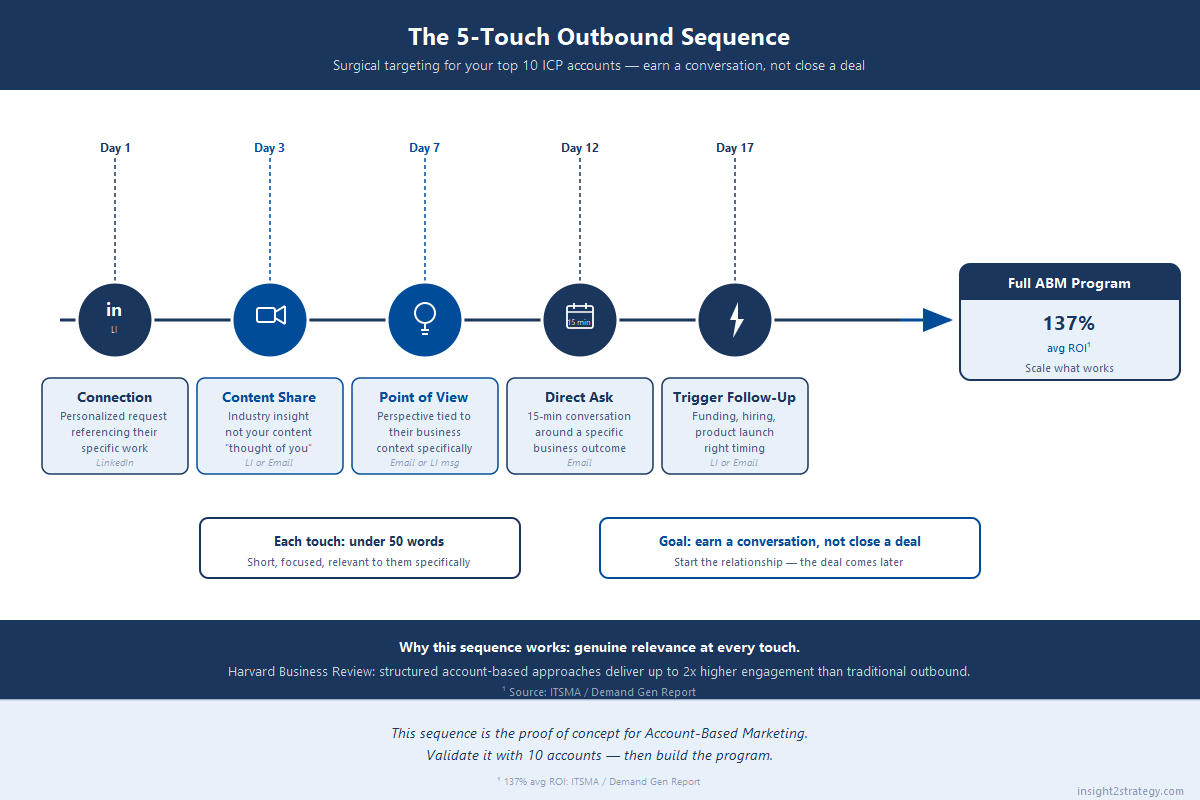
Why this matters: Research consistently shows that structured account-based approaches deliver significantly higher engagement rates than generic outbound. Organizations running mature ABM programs report that ABM outperforms traditional marketing initiatives for generating pipeline from high-value accounts — the reason a 10-account sequence is so much more efficient than mass outreach is that every touchpoint is built on genuine relevance, not volume. This sequence is how you validate that approach before building a full program.
From Targeting Quick Wins to a Systematic ABM Program
These four moves give you immediate traction. But they’re also the foundation of something more powerful.
Once you know who your ICP is, where they pay attention, how they engage, and which outbound approaches earn responses — you have everything you need to build a structured Account-Based Marketing program that systematically pursues your highest-value accounts.
That’s the transition from opportunistic targeting to repeatable revenue. From “we think we know our best customer” to “we’re closing deals with them every month.”
Download the ICP Quick Wins Guide to get the complete framework from both targeting blogs: Best Customer Clustering worksheet, channel research framework, buyer interview templates, ICP activation checklist, and lead scoring criteria builder. It’s the full playbook for turning ICP insight into pipeline.
Get the ICP Quick Wins Guide — Free
The complete targeting toolkit from both ICP blog posts. Best Customer Clustering worksheet, Channel Research Framework, Buyer Interview Templates, 5-Touch Outbound Planner, ICP Activation Checklist, and Lead Scoring Builder — all in one PDF.
Instant access. Download link delivered by email immediately.
Download the ICP Quick Wins Guide
Get instant access to the ICP Quick Wins Guide — enter your email below and we'll send the download link right over.
Want a structured version of this work done for you?
The ICP Validation Sprint validates your ideal customer profile in one week. The ABM Quick-Start Package gives you a 90-day playbook to systematically pursue your top accounts.
Schedule a Free Strategy Discussion →
|
This post is part of The B2B Marketing Reality Check The strategic framework for growth-stage B2B tech companies — now available in paperback and Kindle. Every topic we cover in this blog goes deeper in the book, with frameworks, diagnostics, and quick wins you can put to work immediately. Get the Free PDF →Want to work through the framework hands-on? Get the companion workbook → |
Frequently Asked Questions
What is an ICP and why does it matter for channel selection?
An Ideal Customer Profile (ICP) defines the company and buyer characteristics most likely to succeed with your product or service — industry, company size, role, and the specific triggers that drive purchasing decisions. Channel selection without an ICP means investing in channels your actual buyers don't use. The ICP tells you who to reach; channel intelligence tells you where to find them.
How do I find out what publications and podcasts my ideal customers actually read?
The most reliable method is direct outreach to your 10–15 best customers with three specific questions: what they read weekly, which events are worth their time, and whose analysis they trust for evaluating new approaches. If direct access isn't available, use LinkedIn to review the content your ICP engages with, check speaker rosters at industry events they attend, and scan job descriptions in their roles — these often reference what practitioners follow to stay current.
What is a “watering hole” in B2B marketing?
A watering hole is a niche community where your ideal customers gather for peer conversations, knowledge sharing, and vendor evaluation — before they're actively shopping. Industry-specific Slack groups, LinkedIn communities with active moderation, professional membership networks (Pavilion, Chief, etc.), and targeted subreddits are common examples. Unlike broadcast channels, watering holes are trust-based environments where participation builds credibility that shows up later in deal conversations.
How do I build a 5-touch outbound sequence without it feeling like spray-and-pray?
The difference is personalization and account selection. Start by choosing 10 accounts that genuinely fit your ICP and represent material revenue potential. Each touch must reference something specific to that account — a recent post, company development, or industry challenge directly relevant to them. Keep every message under 50 words. The goal of the sequence is to earn a 15-minute conversation, not close a deal. At 10 accounts, full personalization is achievable and dramatically outperforms volume-based outbound.
How long does it take to see results from these targeting quick wins?
The information diet mapping and watering hole identification (Quick Wins 1 and 2) are intelligence exercises — you'll have actionable channel insights within a week. The inbound reverse-engineering (Quick Win 3) can be completed in 45 minutes if you have CRM data; reallocating budget based on findings is a 1–2 week decision cycle. The 5-touch outbound sequence (Quick Win 4) takes under 2 hours to build and begins producing responses within the 17-day window. Full ABM program ROI typically materializes over a 60–90 day cycle.
When should I hire outside expertise vs. handle ICP targeting work internally?
Handle internally if you have direct customer access, a clear ICP hypothesis, and time to execute the research and outbound consistently. Bring in outside expertise when your ICP definition is contested internally, you've cycled through channel investments without clear signal on what works, or you're ready to scale from a 10-account pilot to a systematic ABM program. An outside perspective is especially valuable for the initial ICP validation — it's faster and less subject to internal biases about who the “ideal” customer should be.
If you’d rather have a structured version of this work done for you: the ICP Validation Sprint ($650) validates your ideal customer profile in one week, and the ABM Quick-Start Package ($1,000) gives you a 90-day playbook to systematically pursue your top accounts. Together, they’re the fastest path from targeting insight to pipeline impact. Free Consultation →


Comments
Post a Comment