3 Customer Targeting Quick Wins: Find Your ICP Before Your Competitors Do
3 Customer Targeting Quick Wins: Find Your ICP Before Your Competitors Do
Strategic Analysis by: Insight2Strategy
Published: July 6, 2026
Executive Reading Time: 8 minutes
📋 Executive Strategic Insights
- Most ICP exercises produce a demographic filter — industry, headcount, job title — that describes roughly half the addressable market and predicts almost nothing about buying behavior, sales cycle length, or renewal likelihood.
- The gap between demographic targeting and behavioral ICP is where growing companies quietly lose revenue — not in one catastrophic campaign, but in dozens of small mismatches that compound over time.
- Three quick wins this week, using data you already have: Best Customer Clustering (30–45 min), Negative ICP Exercise (20 min), and 3 Customer Interviews (20 min each). Do them in order — by Friday you’ll have clearer targeting, sharper messaging, and explicit disqualifiers that protect your team’s time.
- The Negative ICP is often more immediately valuable than the positive profile — defining who not to target creates explicit permission for sales to walk away early, protecting your best effort for accounts that actually fit.
- Three 20-minute customer interviews done well surface more actionable positioning insight than most companies get from months of internal strategy work — because buyers tell you the exact triggers and objections your marketing hasn’t been addressing.
- McKinsey research: companies excelling at genuine customer clarity — the kind that produces behavioral ICP targeting — generate 40% more revenue from those activities than average performers.
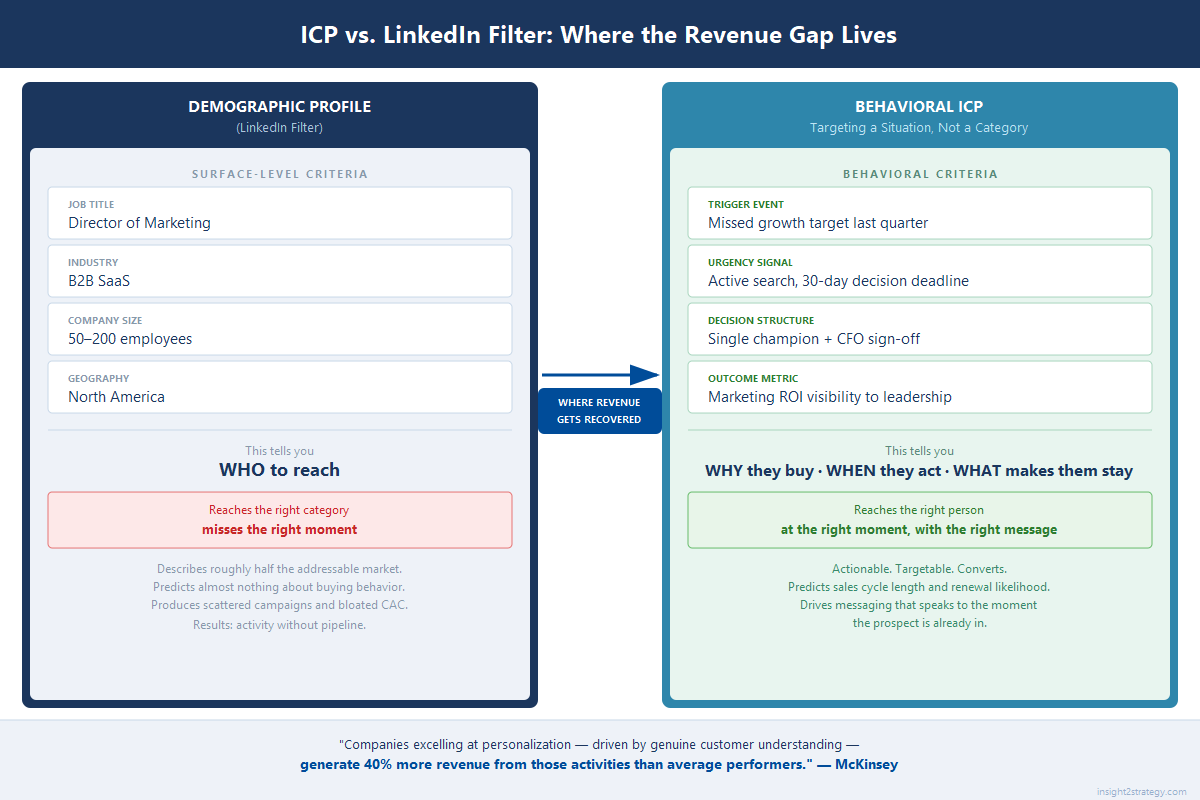
Most ICP exercises produce a demographic description:
“Director of Marketing at a B2B SaaS company with 50–200 employees.”
That’s not an ideal customer profile. That’s a LinkedIn filter.
And there’s a meaningful difference between the two. A LinkedIn filter tells you who to reach. An ideal customer profile tells you why they buy, when they’re ready to act, and what makes them stay. The first is a prospecting tool. The second is a strategic foundation.
The gap between those two things is where most growing companies quietly lose revenue — not in one catastrophic campaign, but in dozens of small mismatches that compound over time. Proposals to companies that technically fit the profile but never close. Customers who signed but churned in 90 days. Marketing spend that generates activity but not pipeline.
The data reflects it. McKinsey research found that companies excelling at personalization — the kind driven by genuine customer understanding — generate 40% more revenue from those activities than average performers (McKinsey, 2021). Gartner reports that 77% of B2B buyers describe their last significant purchase as “very complex or difficult,” frequently citing unclear vendor positioning and generic messaging as root causes (Gartner research).
Vague targeting produces vague results.
The good news: you don’t need a $50,000 research project or months of customer segmentation work. You can meaningfully sharpen your ICP this week using data you already own.
Here are three quick wins that give you the strategic clarity your targeting has been missing. Do them in order. By Friday you’ll have clearer targeting, sharper messaging, and a list of explicit disqualifiers that protect your team’s time.
Quick Win 1: Run a “Best Customer Clustering” Exercise
The Problem
Most customer profiles are built from aspirations, not evidence. Leadership describes their ideal customer as the company they wish they could serve — usually something like “fast-growing B2B company with budget and executive buy-in.”
That profile describes roughly half the market. It doesn’t tell you anything useful about who will actually close, convert, or renew.
The fundamental problem is methodology. Building an ICP top-down from desired outcomes produces a list of characteristics that sounds reasonable but predicts almost nothing about real buying behavior, sales cycle length, or renewal likelihood.
The Solution
Your best existing customers are the most accurate model of your next best customers. The data is sitting in your CRM or billing system. The task is to look at it differently — not as revenue history, but as behavioral evidence.
The Implementation
This exercise runs in 30–45 minutes with a spreadsheet and your existing customer data.
- Export your top 10 customers from your CRM. Define “best” by the metrics that actually matter to your business: lifetime value, gross margin, retention, expansion revenue, or net promoter score. Revenue alone is a weak proxy — a high-revenue account with disproportionate support overhead may be less valuable than a smaller account that runs on autopilot.
- Look beyond firmographics. Firmographic data (industry, headcount, geography) describes what a company looks like. Behavioral data describes how they buy. Add columns and analyze each customer for:
- Trigger event: What was happening in their business when they started looking for a solution? (Funding round, leadership change, competitive threat, regulatory deadline, missed growth target)
- Urgency signal: Were they actively searching with a defined timeline, or exploring with no pressure?
- Decision structure: Who owned the decision? Clear champion, or was consensus required?
- Outcome metric: What specific result did they achieve, and how quickly?
- Find the clusters. Ask: What do my top 3 customers have in common that my middle 4 don’t? Common high-value insights: 70% of best customers came in at a specific growth phase. Top accounts all had a catalyst event within 90 days of first contact. Highest-retention customers share a specific operational characteristic — tech stack, team structure, or regulatory requirement.
- Write a behavioral ICP statement. Translate the clusters into a description that captures a situation, not just a profile. Not “Series A SaaS companies.” Something like: “Marketing teams at $3M–$10M ARR that recently missed a growth target and have a lean team trying to justify spend to a CFO.”
⚡ Quick Implementation Tip
Start your clustering in a Google Sheet — one row per customer, columns for Trigger Event, Urgency Signal, Decision Structure, and Outcome Metric. The pattern that appears in 7 of 10 rows is your real ICP filter. If you can’t fill in a column from memory, that’s a signal your CRM data needs strengthening before the next batch of prospects enters your pipeline.
The Impact
You move from targeting a category to targeting a moment. That shift changes everything downstream — your ad targeting, your sales qualification criteria, your content strategy, and your discovery conversations. Campaigns built on behavioral ICPs address the situation the buyer is actually in, not the situation you imagine they might be in.
Quick Win 2: Run a “Negative ICP” Exercise
The Problem
Most ICP work is additive — companies ask “who should we target?” and build toward a profile. The equally important question — “who should we not target?” — almost always gets skipped.
The result: sales teams spend cycles on opportunities that looked right on paper but were never going to close. Marketing campaigns attract leads that technically match the demographic profile but consistently churn, escalate, or never hit their success metrics. And without explicit disqualifiers, your team will keep making the same expensive mistakes — because they saw the red flags and explained them away.
The Solution
Pull your 5–10 worst customers from the last 18 months and build an explicit disqualification checklist. “Worst” means: high churn risk, high support burden, low margin, or deals that took 3× longer than average and produced smaller-than-average contracts.
The Implementation
- Identify the accounts. Use churn data, support ticket volume, NPS scores, or gross margin if you have it. If your data isn’t that clean, ask your Customer Success and Sales leaders: “Which accounts do you dread seeing in your inbox?”
- Run a structured retrospective. For each bad-fit account: What were the red flags before they signed? What objections did the team explain away instead of treat as disqualifiers? What did they need that you couldn’t efficiently deliver?
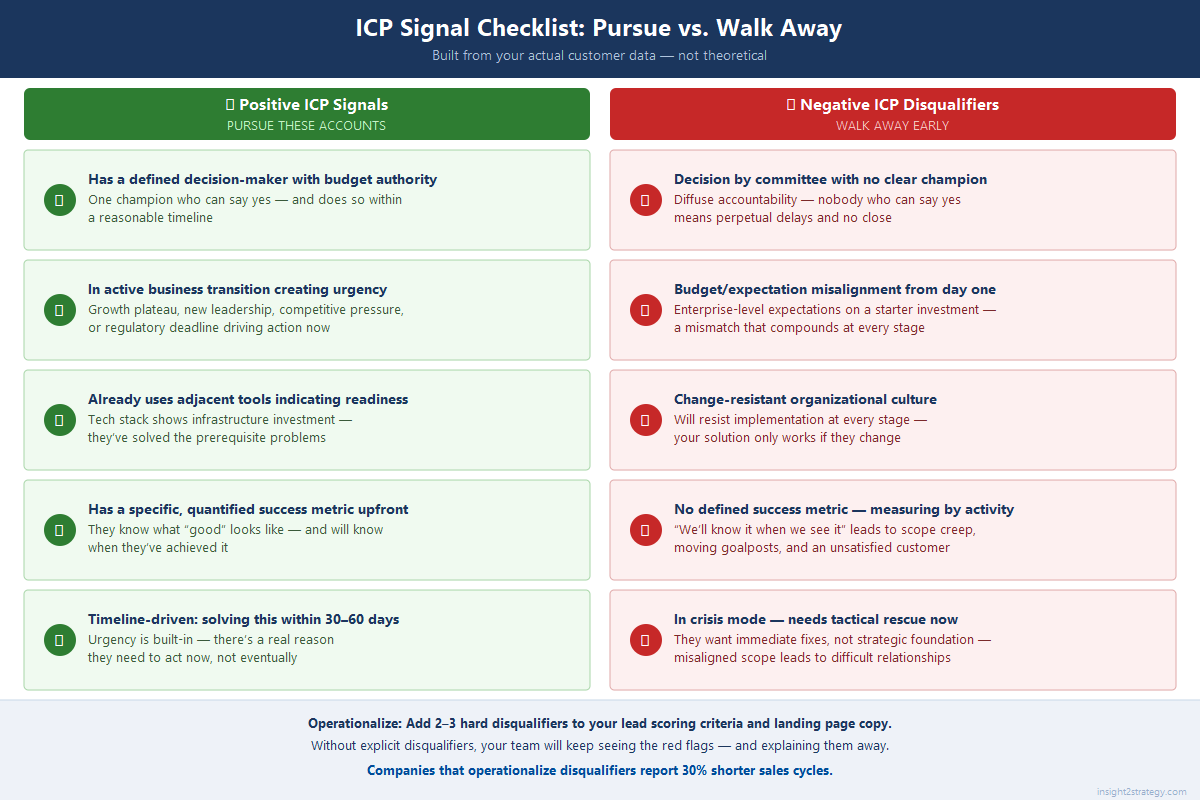
- Build your disqualifier list. Common patterns include:
- Decision by committee with no clear champion — long sales cycles, diffuse accountability, no one who can say yes
- Budget/expectation misalignment — they want enterprise outcomes from a starter investment
- Change-resistant culture — organizations that will resist at every implementation stage
- Wrong timing — companies in crisis mode that need tactical rescue, not strategic foundation work
- No defined success metric — measuring by activity instead of outcome
- Operationalize it. Add 2–3 hard disqualifiers to your qualification criteria. Update landing page copy to pre-filter (“This isn’t right for you if…”). Build a one-question disqualifier into your initial outreach sequence.
The Impact
The Negative ICP exercise immediately improves sales efficiency by creating explicit permission to walk away from wrong-fit opportunities early. Companies that operationalize explicit disqualifiers consistently see shorter sales cycles — because reps stop investing time in opportunities that technically match the profile but will never close. That’s not just a conversion rate improvement — it’s a capacity reallocation that lets your sales and delivery teams focus their best effort on accounts that actually fit.
📊 Implementation Framework
The Negative ICP exercise is most powerful when run as a structured team session with Sales, Customer Success, and Marketing in the same room. Each team sees different red flags. CS sees churn signals post-close. Sales sees objections that got rationalized away. Marketing sees which campaigns attracted the wrong accounts. Combining those perspectives produces a disqualifier list that all three teams will actually use.
Need help adapting this framework to your specific situation and building explicit qualification criteria your team will use consistently? Let’s discuss your implementation approach →
Quick Win 3: Interview 3 of Your Best Customers About Their Decision
The Problem
Quantitative data tells you what happened. It doesn’t tell you why. Your CRM shows which customers stayed and expanded. It doesn’t show what they were thinking when they almost chose your competitor — or what tipped the decision in your favor.
That gap between what customers do and why they do it is where most marketing copy fails. Messages built on internal assumptions about what’s valuable consistently underperform messages built on actual customer language. The terms buyers use to describe their problems rarely match the terms companies use to describe their solutions.
The Solution
Three well-executed, focused conversations with decision-makers from your best accounts will surface more actionable positioning insight than most companies get from months of internal strategy work. Not thirty interviews — three.
The Implementation
Identify three customers who were personally involved in the buying decision (not just end users) and are actively successful with your product or service. Reach out to the decision-maker and ask for 20 minutes, framed as research to help you find more clients like them.
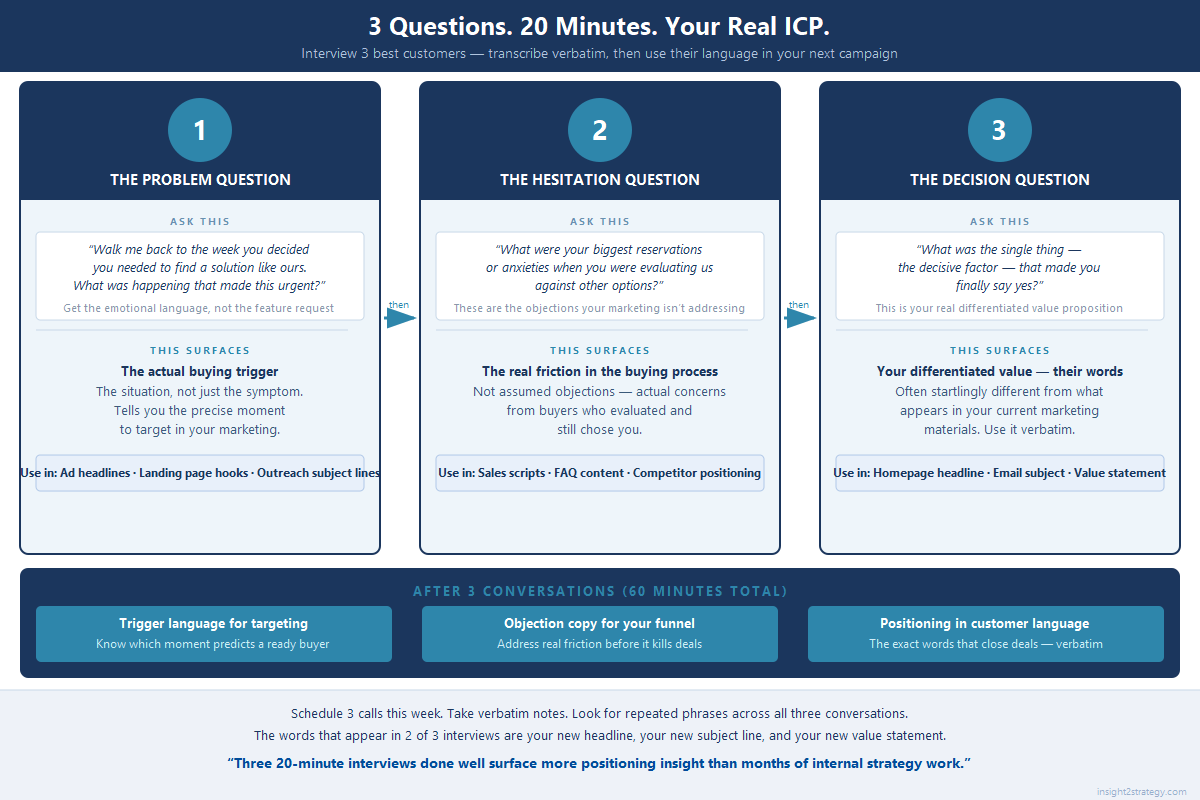
Ask only three questions. Take verbatim notes — the exact phrasing matters as much as the content.
Question 1 — The Problem Question:
“Walk me back to the week you decided you needed to find a solution like ours. What was happening in your business that made this a priority right then?”
This surfaces the actual trigger — the situation, not just the symptom. The answer tells you the precise moment to target in your marketing.
Question 2 — The Hesitation Question:
“What were your biggest reservations or anxieties when you were evaluating us against other options?”
This identifies the real objections your marketing needs to preemptively address — not the ones you assume matter, but the ones that actually created friction for buyers who ultimately said yes.
Question 3 — The Decision Question:
“What was the single thing — the decisive factor — that made you finally say yes?”
This is your differentiated value proposition, stated in your customer’s language. It is often startlingly different from what appears in your marketing materials.
The Impact
Three interviews done well give you customer language you can use directly in your next campaign. Headlines, email subject lines, and discovery questions built from real buyer language consistently outperform internally generated messaging — because they speak to the situation your prospect is already in, using words they already use to describe it.
⚡ Quick Implementation Tip
Record or take verbatim notes — the exact phrasing matters as much as the content. After all three interviews, look for words or phrases that appear in 2 of 3 conversations. That repeated language is your next homepage headline, your next email subject line, and your next sales discovery opening. One client rewrote their homepage from “Automate reporting” to a phrase their customer used — and doubled organic demo requests in 30 days.
When Quick Wins Aren’t Enough
These three exercises sharpen your targeting using data you already have. That’s real and meaningful progress — companies that run them consistently see improved conversion rates, shorter sales cycles, and more efficient marketing spend.
They do share an honest constraint worth naming: they’re built on your current customer base. If your past acquisition has been opportunistic rather than strategic, your existing customers may already reflect suboptimal targeting. The clustering exercise finds patterns in what you have. It doesn’t validate whether what you have is the highest-value segment available to you.
Your ICP isn’t a static document. It’s a competitive advantage. The companies that win aren’t targeting more customers — they’re targeting the right customers earlier and more precisely than everyone else.
If you’d rather take this further with a structured model, our ICP Validation Sprint builds a validated customer scoring framework from your actual data — completed in 2–3 business days. And if you’re pre-launch without customer data to cluster yet, the Business Launch Intelligence Brief ($197) includes an ICP validation section built from market research. For a full strategic assessment including unit economics and pricing architecture, the Business Opportunity Deep Dive ($747) goes deeper.
The quick wins are your starting point — and they deliver real results on their own.
Ready to Build a Validated ICP for Your Business?
Stop competing with generic targeting. Let’s discuss how to sharpen your customer profile and build qualification criteria your entire revenue team will actually use.
No sales pitch. Just strategic insights tailored to your targeting situation.
|
This post is part of The B2B Marketing Reality Check The strategic framework for growth-stage B2B tech companies — now available in paperback and Kindle. Every topic we cover in this blog goes deeper in the book, with frameworks, diagnostics, and quick wins you can put to work immediately. Get the Free PDF →Want to work through the framework hands-on? Get the companion workbook → |
Frequently Asked Questions
How many customers do I need to run a Best Customer Clustering exercise?
You need at minimum 5 to see meaningful patterns, ideally 10. If you have fewer than 5, supplement with detailed notes from sales calls or customer success conversations. The goal is to identify patterns across accounts — even 3–5 clear data points will surface high-signal insights about what makes a customer successful with your offering.
How long does the full process take from start to finish?
Realistically, 3–4 hours of focused work spread over a week. The clustering exercise runs 30–45 minutes. The Negative ICP exercise runs 20–30 minutes. Scheduling and conducting three customer interviews typically takes 3–5 business days depending on customer availability, with each interview running 20–25 minutes. You can have a working behavioral ICP by the end of the week.
What if our CRM data is incomplete or inconsistent?
Work with what you have. Even incomplete data reveals directional patterns. Start by exporting what’s clean — even partial records for your top 10 accounts. The behavioral signals you need (trigger events, urgency signals, decision structure) often live in sales notes or customer success records rather than structured CRM fields. Pull those manually if needed. The exercise is still valuable with imperfect data — it also tells you what data you need to start capturing going forward.
How often should we update our ICP?
Revisit at minimum once a year, and trigger a review anytime you experience a significant event: 20%+ increase in churn, expansion into a new market segment, a product or pricing change, or a shift in average sales cycle length. The Negative ICP criteria tend to go stale faster than the positive profile — update disqualifiers after every batch of bad-fit customers you process. The patterns from those accounts are your best early warning system.
When do the quick wins stop being enough?
The quick wins are built on your current customer base — they find patterns in what you have. If you suspect your past acquisition has been opportunistic rather than strategic, or if you’re pre-launch without customers to cluster, you need an approach that validates the target segment from external data rather than internal patterns. That’s where a structured ICP Validation Sprint or a Business Launch Intelligence Brief becomes the right next tool. The quick wins are also the ideal preparation before those deeper engagements — they establish your baseline and sharpen the questions worth pursuing.
Insight2Strategy
B2B strategy consulting for growing companies. Data-driven frameworks. Executive-level clarity.
ICP Validation Sprint | Free Strategy Consultation | insight2strategy.com


Comments
Post a Comment