3 Sales-Marketing Alignment Quick Wins That End the Blame Game
3 Sales-Marketing Alignment Quick Wins That End the Blame Game
Strategic Analysis by: Insight2Strategy
Published: June 8, 2026
Executive Reading Time: 8 minutes
Executive Strategic Insights
- The real problem is structural, not cultural. Sales-marketing conflict stems from missing systems: no shared lead definition, no real-time feedback channel, no shared view of why deals win or lose.
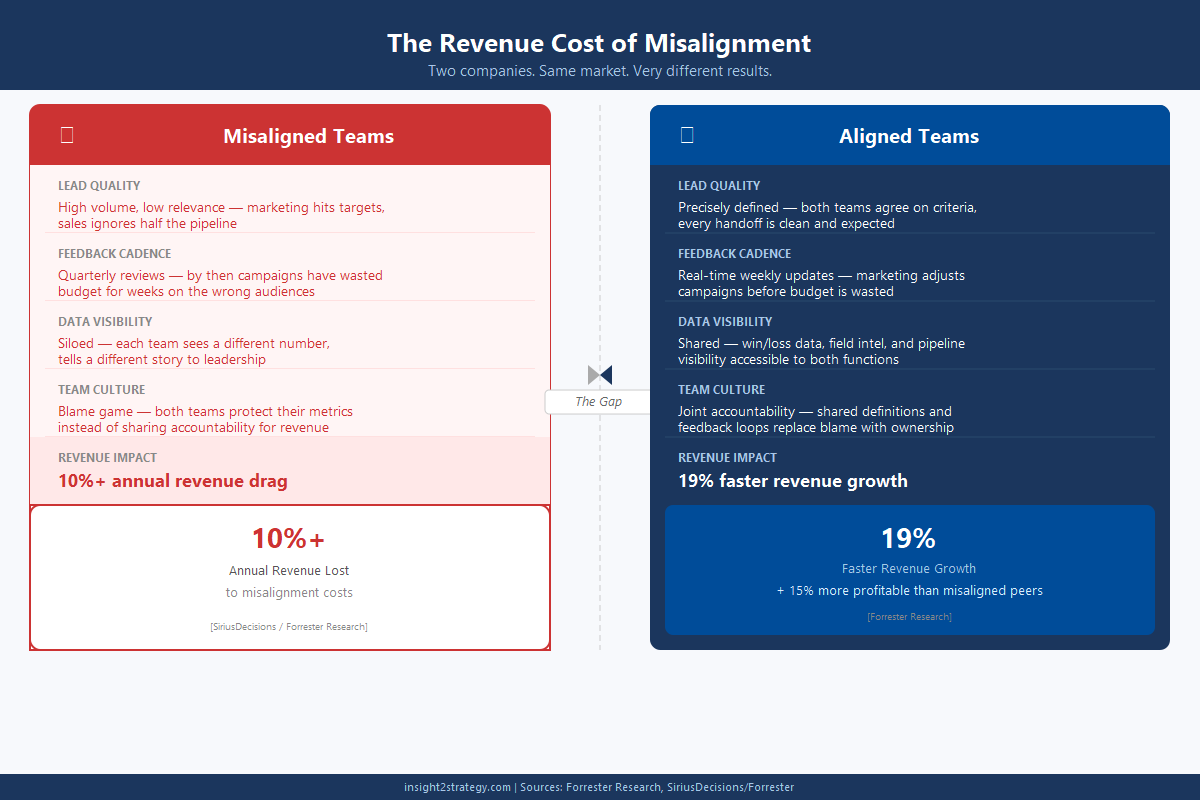
- The financial cost is material. Misalignment costs B2B companies 10%+ of annual revenue; aligned teams grow 19% faster and are 15% more profitable [Forrester Research].
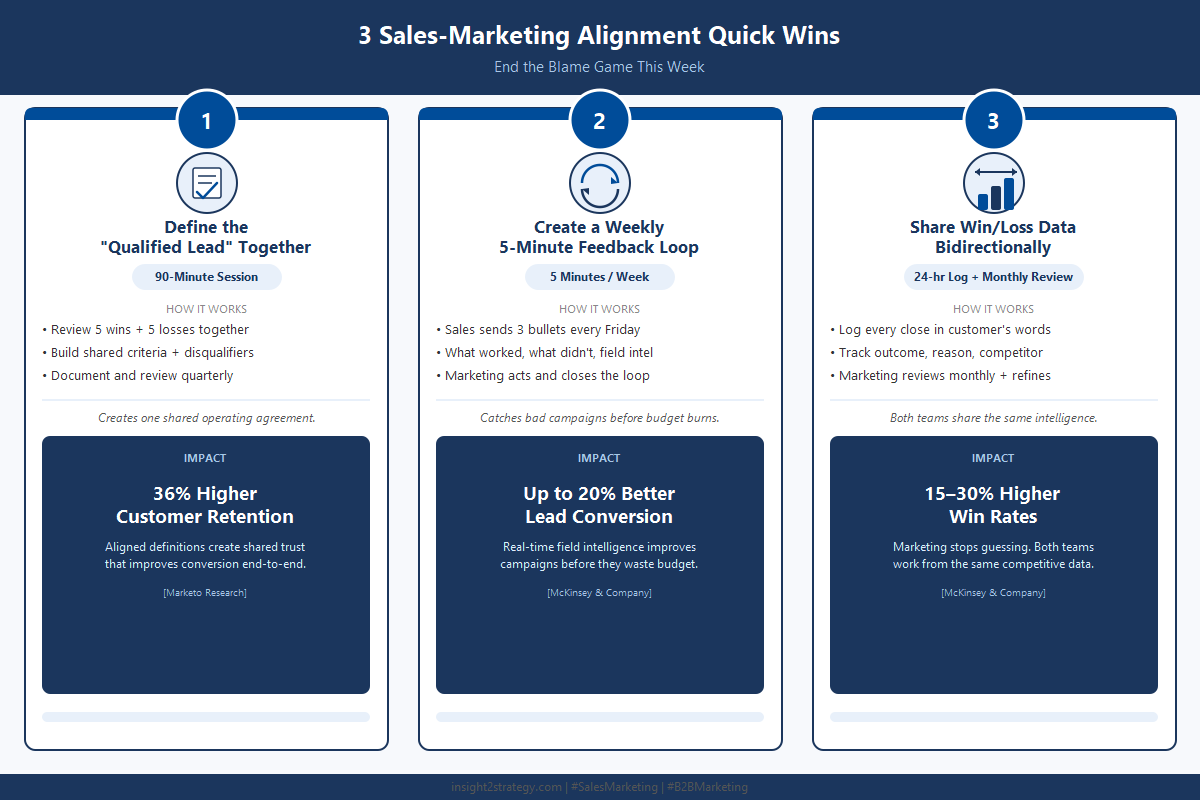
- Quick Win 1: A single 90-minute session to define a qualified lead in writing — together — eliminates the most persistent source of sales-marketing tension.
- Quick Win 2: A 3-bullet weekly update from sales to marketing (5 min/week) creates a real-time learning loop that compounds quarterly.
- Quick Win 3: A shared win/loss log converts anecdotal field intelligence into strategic marketing input — and improves win rates by 15–30% [McKinsey].
- The fix is faster than most teams expect. None of these require a reorg, new software, or a transformation initiative. Implementation starts this week.
Sales says marketing generates unqualified leads. Marketing says sales doesn't follow up.
Both teams are right about the symptom — and wrong about the cause.
The real culprit isn't performance. It's the absence of shared systems: no shared definition of what "qualified" means, no real-time feedback channel, and no shared visibility into why deals actually win or lose. The result is finger-pointing, wasted budget, and revenue left on the table every single quarter.
The numbers confirm it's expensive. Companies with strong sales-marketing alignment achieve 19% faster revenue growth and 15% higher profitability than their misaligned peers [Forrester Research]. Meanwhile, misalignment costs the average B2B organization 10% or more of annual revenue through missed pipeline, wasted campaigns, and duplicated effort [SiriusDecisions/Forrester].
That's not a "soft skills" problem. That's a P&L problem.
The good news: fixing it doesn't require a reorganization, a new CRM, or a six-month transformation initiative. It requires three operational changes — each implementable this week — that create the shared language, shared feedback, and shared intelligence both teams need.
Quick Win 1: Define "Qualified Lead" in Writing — Together
The Problem
Ask sales what a "good lead" looks like: "Someone ready to buy."
Ask marketing: "Someone who fits our ICP and engaged with our content."
Both are valid. Both are completely incompatible. Which is why:
- Marketing celebrates hitting lead volume targets
- Sales ignores half the pipeline
- Leadership questions both teams
- Nobody fixes the underlying cause
According to Gartner, only 27% of B2B leads are actually sales-ready when first generated [Gartner]. The remaining 73% require nurturing — but if sales and marketing disagree on what "ready" means, those leads never get the right treatment at the right time.
The Solution
Create one shared, written definition of a qualified lead. Not implied. Not in a slide deck. Explicit, agreed upon, and documented.
This includes:
- Firmographic criteria: Industry, company size, geography
- Behavioral signals: Demo requests, pricing page visits, repeat content engagement
- Authority indicators: Decision-maker vs. influencer vs. researcher
- Disqualifiers: Students, competitors, wrong market segment, no budget authority
Implementation (90 Minutes)
Block a single working session with one representative from sales leadership and one from marketing.
Agenda:
- Start with real deals — look at 5 recent wins and 5 recent losses
- Identify patterns — what made good leads "good"? What wasted sales time?
- Define criteria together — build a one-page checklist for qualification
- Agree on handoff rules — when does marketing pass to sales? What context must be included?
Document it. Share it. Review it quarterly (30 minutes max).
⚡ Quick Implementation Tip
Start with losses, not wins. When you examine your last 5 lost deals first — before looking at wins — both teams discover patterns faster and arrive at agreement with less defensiveness. The shared "aha" about a bad lead type does more to align teams in 20 minutes than a year of quarterly reviews.
Impact
This single exercise eliminates the most persistent source of sales-marketing tension. Instead of arguing about lead quality, both teams work from the same operating agreement. Organizations with tightly aligned lead definitions see 36% higher customer retention rates [Marketo Research] — because alignment at the top of the funnel improves conversion all the way through.
Quick Win 2: Create a Weekly 5-Minute Feedback Loop
The Problem
Marketing launches campaigns in a vacuum. Sales sees what actually resonates in real conversations — but never tells marketing until the quarterly review. By then, the campaign has already burned through budget.
Forrester research shows that only 8% of companies have strong alignment between their sales and marketing processes, with a lack of structured feedback cited as a primary driver of the gap [Forrester Research].
The result: marketing keeps generating the same types of leads. Sales keeps rejecting them. Nobody learns. Nobody wins.
The Solution
A 5-minute weekly update from sales to marketing. Not a meeting. Not a report. Not a dashboard. A three-bullet message sent at the end of each week.
Implementation
Every Friday, sales sends one message — Slack, email, or whatever tool the team already uses — with exactly three bullets:
Template (copy and use):
- Bullet 1: What messaging worked this week and why (e.g., "Leads from the webinar on [topic] were highly qualified — two are already in advanced discussions")
- Bullet 2: What fell flat and what objection killed it (e.g., "LinkedIn campaign leads were mostly researchers without budget authority")
- Bullet 3: One key market insight (e.g., "Three prospects this week mentioned they're specifically comparing us to Competitor X on implementation speed")
Marketing acknowledges and closes the loop: "Got it — pausing that campaign, shifting budget to the webinar format."
No templates to fill out. No dashboards to update. Consistency matters more than complexity.
Impact
This creates a real-time learning loop that compounds weekly. Marketing adjusts targeting, refines messaging, and doubles down on what's working — based on actual field data rather than assumptions. Sales feels heard, and becomes more invested in marketing's success.
Companies that implement structured sales-to-marketing feedback see up to 20% improvement in lead conversion rates [McKinsey & Company]. The 5-minute investment pays for itself the first week a failing campaign gets caught before it runs another month.
Quick Win 3: Share Win/Loss Data Bidirectionally
The Problem
Most companies track wins. Very few systematically track losses. Even fewer share that data across teams.
So sales knows why deals are lost — but keeps it informal. Marketing guesses at positioning gaps. Leadership lacks clarity on competitive threats.
The result: marketing builds messaging around product features while sales is losing deals for entirely different reasons — reputation, implementation concerns, competitive positioning — that never make it into the marketing brief.
The Solution
Create a simple, shared win/loss log. Not a CRM overhaul. Not a complex analytics system. A living document both teams can access and contribute to.
Implementation
Track every closed deal (won or lost) with four fields:
| Field | Examples |
|---|---|
| Outcome | Won / Lost |
| Primary reason | In the customer's own words — not sales shorthand |
| Competitor involved | Which alternative, if any |
| Key insight | What should marketing do differently? |
Lost examples:
- "Lost to Competitor X — prospect cited their faster implementation timeline as deciding factor"
- "Lost — budget cut at end of quarter, timing issue not a fit issue"
Won examples:
- "Won — messaging around ROI and time-to-value resonated strongly, prospect referenced our blog post"
Sales fills it in within 24 hours of close. Marketing reviews it monthly with one question: What should we create or change based on what we're seeing?
⚡ Quick Implementation Tip
Use the customer's exact words — not your interpretation. "They said our onboarding looked too complex" is intelligence marketing can act on. "Lost — poor fit" is not. The discipline of recording what was actually said, rather than what was concluded, is what makes win/loss logs valuable. Most log failures trace back to interpretation replacing quotation.
Impact
This converts anecdotal field intelligence into strategic marketing input. Marketing stops guessing. Sales stops repeating the same explanations to leadership. Both teams start working from the same competitive picture.
Companies that systematically use win/loss analysis improve their win rates by 15–30% [McKinsey & Company] — not because they hired better salespeople, but because marketing stopped building campaigns based on assumptions and started building them based on what buyers actually say.
The Competitive Intelligence Gap: Why the Blame Game Keeps Returning
Even with all three quick wins in place, many teams find the conflict resurfaces — especially in competitive deals.
Here's the pattern: marketing builds messaging around internal product features. Sales is losing deals to the same three competitors, every quarter, for reasons that have nothing to do with features. The competitor's customers are saying something in reviews, in case studies, in word-of-mouth — and it's reshaping how your prospects evaluate you before sales ever gets involved.
That's not a messaging execution problem. It's an intelligence gap.
Marketing doesn't have the competitive intelligence that would change their strategy. Sales doesn't have the language to articulate competitive differentiation in terms buyers actually respond to. Both teams are operating on incomplete information — and customers can tell.
📊 Close the Intelligence Gap
One of the most direct ways to address this: stop guessing about your competitors and start listening to their customers. Our Competitive Intelligence Snapshot gives both your sales and marketing teams the same playbook — built from what your competitors' customers are actually saying, not what competitors claim about themselves — delivered in 2–3 business days.
Both teams get the same information. Both teams align on the same competitive narrative. Deals stop dying for reasons that were entirely preventable.
Learn more about the Competitive Intelligence Snapshot →
Sales-Marketing Alignment Is an Operating System, Not a One-Time Meeting
As you assess mid-year performance heading into the second half of 2026, sales-marketing misalignment is one of the most reliable culprits behind underperforming pipeline — and one of the least examined.
Alignment isn't about getting teams to love each other. It's about strategic, measurable, functional collaboration that turns "us vs. them" into "revenue vs. target." The systems that enable that collaboration are simple. The missing piece, in most organizations, is that nobody sat both teams down together and built them.
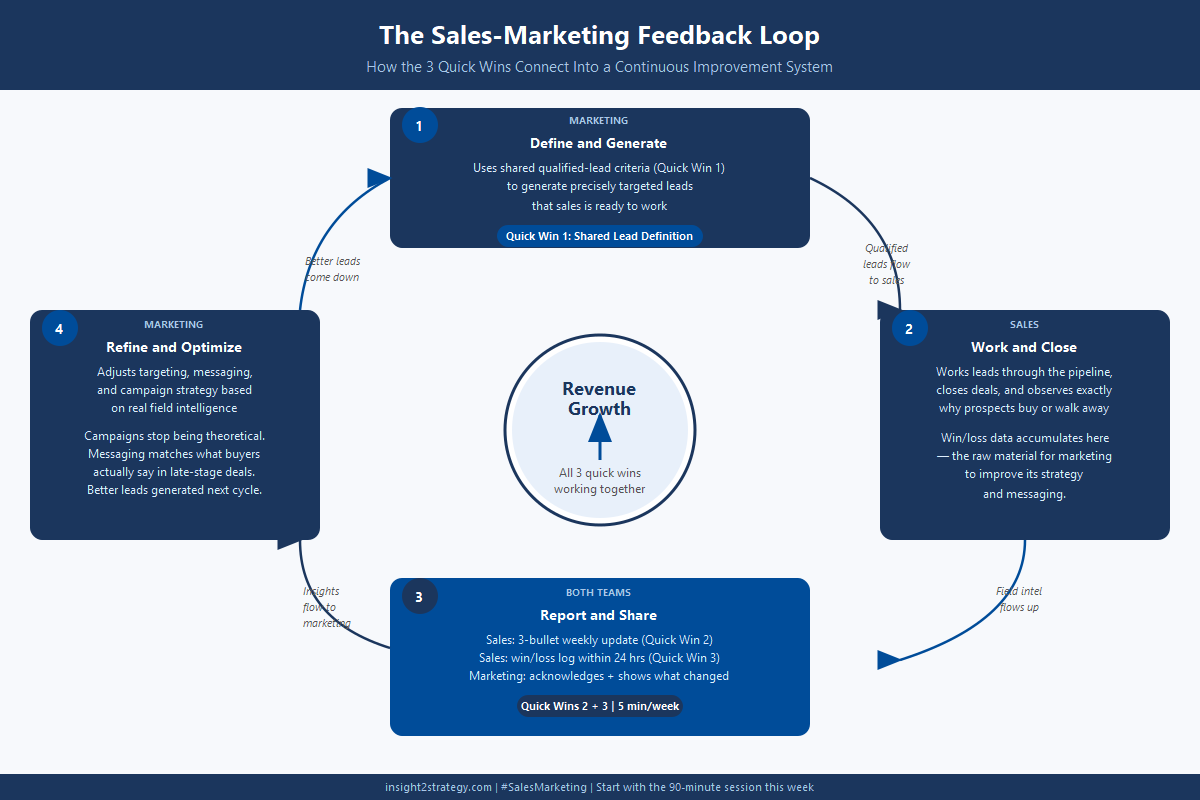
Define qualified leads together. Create a weekly feedback loop. Build a shared win/loss log. In two weeks, you'll see fewer arguments. In a quarter, you'll see measurably better pipeline conversion. In a year, you'll wonder why you spent so long treating a structural problem like a people problem.
Start with the 90-minute session — this week, not next quarter.
Ready to Implement These Sales-Marketing Alignment Strategies?
Every organization's misalignment looks slightly different. Let's discuss how these frameworks apply to your specific situation — and which quick win will have the highest impact in your organization first.
No sales pitch. Just a direct conversation about what's driving the conflict in your organization and the fastest structural fix.
|
This post is part of The B2B Marketing Reality Check The strategic framework for growth-stage B2B tech companies — now available in paperback and Kindle. Every topic we cover in this blog goes deeper in the book, with frameworks, diagnostics, and quick wins you can put to work immediately. Get the Free PDF →Want to work through the framework hands-on? Get the companion workbook → |
Frequently Asked Questions
Why do sales and marketing teams struggle to align?
The root cause is almost always structural, not interpersonal. Both teams are doing exactly what they were set up to do — optimizing for different metrics, with different definitions of success, and different views of what "qualified" means. When there's no shared written definition of a qualified lead, no real-time feedback channel between teams, and no shared visibility into why deals win or lose, conflict is the predictable outcome. It looks like a culture problem but it's missing infrastructure.
How do you create a shared definition of a qualified lead?
The most effective approach is a single 90-minute working session where both sales and marketing examine real deal data together — 5 recent wins and 5 recent losses. The goal is to reverse-engineer what made good leads "good" and what wasted sales time, then document the output as a one-page checklist. The criteria should cover firmographic fit, behavioral signals, authority level, and explicit disqualifiers. Review it quarterly for 30 minutes. The documented agreement replaces the informal assumptions that cause ongoing friction.
How can sales give marketing real-time feedback without adding meetings?
A 3-bullet message at the end of each Friday — via Slack, email, or whatever tool the team already uses — is enough. Sales reports: (1) what messaging worked and why, (2) what fell flat and what objection killed it, (3) one key thing prospects are saying. Marketing closes the loop by confirming what they're changing. No meeting, no dashboard, no report. Five minutes of consistency generates more useful intelligence than an annual review.
How do you use win/loss data to align sales and marketing?
The key is capturing the customer's exact words within 24 hours of deal close — not a summary, not sales shorthand, but what was actually said. A simple four-field log (outcome, primary reason in customer's words, competitor involved, one marketing implication) gives marketing actionable intelligence without requiring a CRM overhaul. Marketing reviews the log monthly and asks one question: what should we create or change? Over time, both teams converge on the same understanding of competitive positioning and buyer decision criteria.
How long does it take to see results from sales-marketing alignment changes?
The weekly feedback loop produces visible results within 2–4 weeks — marketing can adjust failing campaigns before the next planning cycle. The qualified lead definition reduces argument volume almost immediately once it's documented. Win/loss intelligence accumulates over 60–90 days before patterns become statistically significant enough to drive strategic messaging changes. Pipeline conversion improvements are typically measurable within one quarter.
About Insight2Strategy
We help growth-stage B2B companies turn market intelligence into competitive strategy. Our work focuses on the decisions that drive revenue — competitive positioning, go-to-market strategy, and sales-marketing alignment.


Comments
Post a Comment