3 Market Education Quick Wins That Turn 'Just Looking' Into 'Ready to Buy'
3 Market Education Quick Wins That Turn 'Just Looking' Into 'Ready to Buy'
Strategic Analysis by: Insight2Strategy
Published: March 16, 2026
Executive Reading Time: 6 minutes
Executive Strategic Insights
- Pipeline Problem: 75% of B2B buyers prefer rep-free research - if you're not educating them early, you're invisible during decision-making
- Root Cause: Deals stall because prospects don't understand their problem well enough to make confident decisions
- Strategic Solution: Market education content that reframes problems, maps solution landscapes, and accelerates internal consensus
- Business Impact: 3x faster conversion rates and 65% higher close probability when buyers receive early education
- Implementation Timeline: Three quick wins deployable in weeks, not quarters
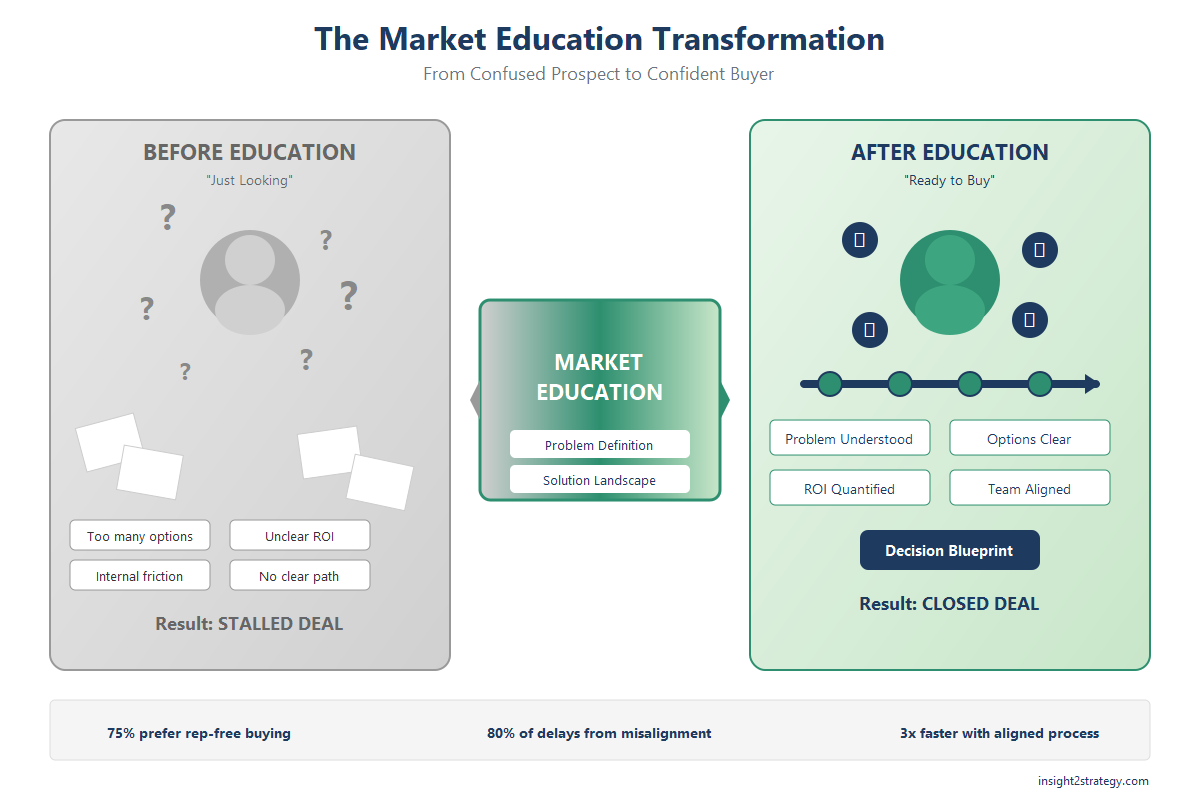
Your pipeline looks healthy on paper. Leads are coming in. Traffic is up. But deals keep stalling in that frustrating middle zone where prospects are "still evaluating" or "need to loop in more stakeholders."
Here's the uncomfortable truth: most of those prospects aren't stuck because they're indecisive. They're stuck because they don't yet understand their own problem well enough to make a confident buying decision.
According to Gartner, 75% of B2B buyers now prefer a rep-free sales experience [Gartner, 2025]. They're researching independently, comparing options, and forming conclusions long before your sales team gets a chance to influence them. Meanwhile, buyers spend only about 17% of their total purchase journey meeting with potential suppliers—the rest is independent research and internal consensus building [Gartner, 2024].
If your marketing isn't educating prospects during that critical window, you're invisible during the most important phase of the buying journey.
Following along? Schedule a strategy session to discuss how these approaches apply to your specific market.
The companies that convert "just looking" into "ready to buy" are the ones investing in market education—not product pitches disguised as thought leadership, but genuine content that helps buyers:
- Understand the real problem (not just the symptoms they feel)
- Evaluate solution options with confidence
- Build internal consensus for a purchasing decision
Here are three market education quick wins you can deploy this quarter to accelerate pipeline velocity and shorten sales cycles.
Quick Win #1: Problem Definition Content That Reframes the Stakes
Problem:
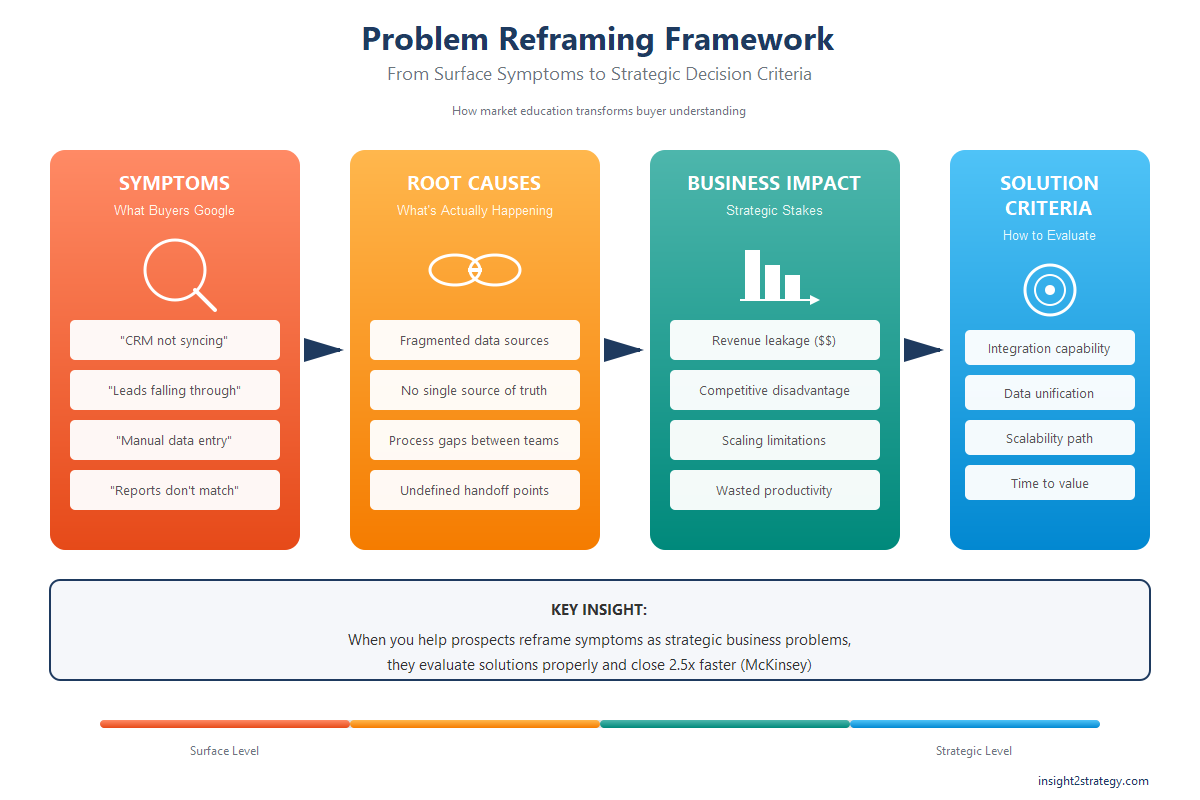
Prospects Google their symptoms, not their root cause. They search for "CRM not syncing" or "leads falling through cracks" without understanding the underlying operational dysfunction. When they define the problem incorrectly, they evaluate solutions incorrectly—and your sophisticated offering looks like overkill or irrelevant.
Solution:
Publish authoritative problem-definition content that elevates the conversation from tactical symptoms to strategic implications. Help prospects see that their "sync issue" is actually a revenue leak caused by fragmented customer data.
Implementation:
Create a Problem Explainer asset—a diagnostic blog post, short video, or LinkedIn carousel. Structure it around:
- Symptoms buyers recognize and search for
- Root causes creating those symptoms
- Business impact on revenue, cost, or competitive position
- Decision criteria for evaluating solutions
- Severity indicators for understanding urgency
⚡ Quick Implementation Tip
Start by analyzing your last 20 sales calls. What symptoms do prospects mention first? What root causes are you uncovering in discovery? Build your Problem Explainer around that pattern—you're already having this conversation, now make it scalable through content.
This can be deployed in 1-2 weeks with minimal budget—just customer research and content creation.
Impact:
McKinsey research shows that buyers who receive problem-framing education early are 2.5x more likely to engage vendors who provided that education [McKinsey, 2024]. You're not just generating awareness—you're shaping how they evaluate everyone in the category. Prospects become more qualified because they now see the real problem and why it matters economically.
Quick Win #2: The Solution Landscape Map That Builds Trust Through Honesty
Problem:
Confused buyers don't buy. When prospects can't distinguish between solution types—point solution vs. platform, DIY vs. managed service, cheap option vs. strategic investment—they default to "let's wait and see." Confusion creates delay, not decisions.
Solution:
Publish an unbiased category landscape that maps out solution approaches, including trade-offs your competitors won't admit. This positions you as a trusted advisor rather than another vendor with something to sell.
Implementation:
Create a Buyer's Guide or Comparison Matrix covering:
- Major solution approaches in your category
- Pros and cons of each (including your own approach)
- Cost and resource implications for each path
- Best-fit scenarios for different company types
- Red flags and common mistakes to avoid
Be conspicuously honest. Acknowledge when your solution isn't the right fit for certain buyers. This counterintuitive transparency builds enormous credibility with your actual target market.
📊 Implementation Framework
The Solution Landscape Map doesn't require complex analysis. List the 3-5 major approaches in your category, then be honest about trade-offs. This transparency positions you above the fray—you're the guide, not just another option.
Need help mapping your competitive landscape strategically? Let's discuss your category positioning.
Format options include:
- Vendor comparison matrices
- Build vs. buy frameworks
- Tooling ecosystem maps
- "Buyer's Guide to [Category Name]" PDFs
Impact:
Forrester data indicates that trust-building education increases close probability by 65% when buyers perceive the vendor as a guide rather than a pitch source [Forrester, 2024]. When prospects are ready to choose your type of solution, you're already the frontrunner because you helped them understand the landscape honestly.
Quick Win #3: The Decision Blueprint That Accelerates Internal Consensus
Problem:
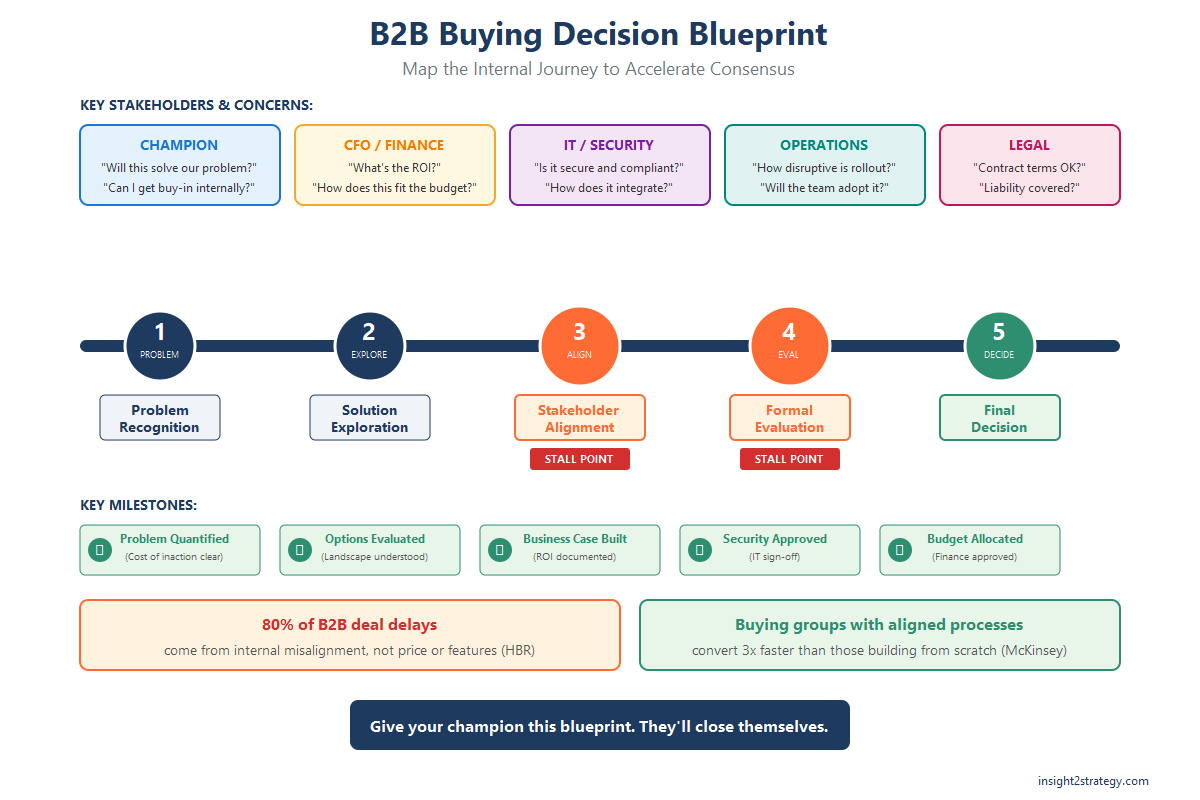
B2B purchases die in committee. Your champion loves your solution but can't articulate the business case to their CFO, can't anticipate IT's security concerns, and can't sequence the internal approval process. According to Harvard Business Review, internal misalignment contributes to nearly 80% of B2B deal delays [HBR, 2024]—particularly in emerging categories where buying processes aren't well-established.
Solution:
Publish a Buying Blueprint that maps out the internal decision process your prospects face. Give your champions the tools to sell internally without your direct involvement.
Implementation:
Create a Decision Guide (PDF, blog post, or interactive tool) that covers:
- Typical stakeholders involved in this type of purchase
- Questions each stakeholder cares about (CFO wants ROI, IT wants security, Operations wants minimal disruption)
- Common objections and how to address them
- Evaluation milestones and timeline expectations
- Data inputs needed to build a compelling business case
⚡ Quick Implementation Tip
Your sales team already knows this. Sit down with your top rep and ask: "What questions does the CFO always ask? What concerns does IT raise?" Document that institutional knowledge into a Decision Blueprint your prospects can use before they ever talk to sales.
Format can vary: 2-page PDF, mini-guide on the blog, onboarding-style checklist, or LinkedIn carousel. The goal is clarity, not persuasion.
Impact:
McKinsey reports that buying groups with aligned evaluation processes convert 3x faster than those building the process from scratch [McKinsey, 2024]. Your Decision Blueprint doesn't just help prospects buy from you—it helps them buy at all. You reduce friction and increase deal velocity without changing anything on the sales side.
The Strategic Shift: From Selling to Teaching
Market education isn't a marketing tactic—it's a strategic posture. The companies winning in 2026 are the ones treating education as revenue enablement that happens before sales ever speaks to a prospect.
These three quick wins—Problem Definition Content, Solution Landscape Maps, and Decision Blueprints—can be deployed in weeks, not quarters. They don't require massive content budgets or elaborate production. They require a willingness to be genuinely helpful before asking for the sale.
The payoff is substantial:
- Shorter sales cycles because buyers arrive educated
- Higher win rates because you shaped how they evaluate
- Better-qualified leads because confused "tire-kickers" self-select out
- Stronger champion relationships because you made their internal job easier
If your strategy relies on waiting for prospects to educate themselves, you're losing revenue to competitors who are willing to teach them first.
Ready to Implement These Market Education Strategies?
Every business situation is unique. Let's discuss how these frameworks apply to your specific challenges and opportunities.
No sales pitch. Just strategic insights tailored to your business.
|
This post is part of The B2B Marketing Reality Check The strategic framework for growth-stage B2B tech companies — now available in paperback and Kindle. Every topic we cover in this blog goes deeper in the book, with frameworks, diagnostics, and quick wins you can put to work immediately. Get the Free PDF →Want to work through the framework hands-on? Get the companion workbook → |
Frequently Asked Questions
How long does market education take to show results?
Most companies see initial impact within 60-90 days of publishing their first education assets. Problem Definition Content typically generates engagement fastest (2-4 weeks), while Decision Blueprints show ROI through shortened sales cycles (visible within one quarter). The key is consistency—publish one high-quality education asset monthly rather than sporadic bursts.
What budget should we allocate for market education content?
These three quick wins can be deployed with minimal budget—primarily time investment from your team. A Problem Explainer requires 8-12 hours of customer research and content creation. A Solution Landscape Map needs 10-15 hours including competitive analysis. A Decision Blueprint takes 6-10 hours leveraging your sales team's existing knowledge. Total cost: internal time or $3,000-$5,000 if outsourced to a strategic content partner.
When should we hire outside expertise vs. handle market education internally?
Build internally if you have: (1) deep customer insight from regular sales/support interactions, (2) a content creator who understands strategic business frameworks, and (3) executive buy-in for education-first positioning. Hire strategic support when you lack category expertise, need to compress timeline, or require an outside perspective to challenge internal assumptions about how buyers actually think.
How do we measure ROI on market education initiatives?
Track three metrics: (1) Engagement quality—time on page, content downloads, and sales follow-up requests indicate education resonance, (2) Sales cycle velocity—compare average days-to-close before and after education content deployment, and (3) Deal quality—measure win rates and average deal size for leads who engaged with education content vs. those who didn't. Most companies see 15-25% improvement in qualified lead conversion within two quarters.
Won't educating buyers about all solution options help our competitors?
Counterintuitively, no. Transparency positions you as the category authority—the trusted guide rather than another sales pitch. Prospects who receive honest education from you are 2.5x more likely to engage with you specifically (McKinsey). You're not helping competitors; you're demonstrating confidence in your positioning. Confused buyers delay decisions or choose based on price alone. Educated buyers choose based on strategic fit—which favors vendors who helped them understand the landscape.
Verified Statistics & Citations
| Statistic | Source | Year |
|---|---|---|
| 75% of B2B buyers prefer rep-free experience | Gartner | 2025 |
| 17% of purchase journey spent with suppliers | Gartner | 2024 |
| 2.5x more likely to engage vendors providing early education | McKinsey | 2024 |
| 65% higher close probability with trust-building education | Forrester | 2024 |
| 80% of B2B deal delays from internal misalignment | Harvard Business Review | 2024 |
| 3x faster conversion with aligned buying processes | McKinsey | 2024 |
About Insight2Strategy
We help growing B2B companies build strategic market positioning and revenue-generating content engines. Our approach combines deep market analysis with practical implementation frameworks that drive measurable business results.
Ready to transform your market education approach?
Schedule a Complimentary Strategy Session
Author: Joe Morrison | Email: joe_morrison@insight2strategy.com
Website: www.insight2strategy.com | LinkedIn: Follow Insight2Strategy


Comments
Post a Comment