3 Marketing Measurement Quick Wins: Stop Tracking Vanity, Start Tracking Value
3 Marketing Measurement Quick Wins: Stop Tracking Vanity, Start Tracking Value
Strategic Analysis by: Insight2Strategy
Published: May 18, 2026
Executive Reading Time: 8 minutes
Executive Strategic Insights
- Most marketing dashboards are built from platform defaults, not business decisions — resulting in 30–50 metrics that look like intelligence but function like noise.
- One question separates decision-grade metrics from vanity: "If this doubled tomorrow, would we change our strategy or investment?"
- Most teams discover 80%+ of their current dashboard is vanity or context — not decision-grade. The audit takes 60 minutes.
- A 3-metric revenue attribution view (one per funnel stage) reveals exactly where your funnel is working and where it's leaking — without a data science team.
- Baseline documentation before every campaign transforms marketing from reactive defense to proactive accountability with finance and leadership.
- All three quick wins are implementable this week — no new tools, no analytics project required.
Your marketing dashboard has 47 metrics.
Your CEO asks one question:
"Is marketing contributing to revenue?"
And suddenly none of those metrics seem very helpful.
You've got page views. Email open rates. Social impressions. A dozen campaign dashboards tracking clicks and engagement. But if you can't answer that one question in under 60 seconds, there's a good chance you're tracking the wrong things.
This isn't a technology problem. Most growing businesses suffer from what could be called "data obesity" — so much access to information that activity gets mistaken for achievement. According to research referenced by Gartner, marketing analytics influence only 53% of marketing decisions, meaning nearly half the metrics companies actively monitor never actually change what the business does next. And according to Gartner's 2025 CMO Spend Survey, 40% of CMOs cite improving ROI measurement as their single top performance priority this year — not creative quality, not channel expansion. Measurement.
The good news? You don't need a new analytics platform, a data science team, or a six-month analytics initiative to fix this. Three focused changes — each implementable this week — can transform how marketing performance is understood across your entire organization.
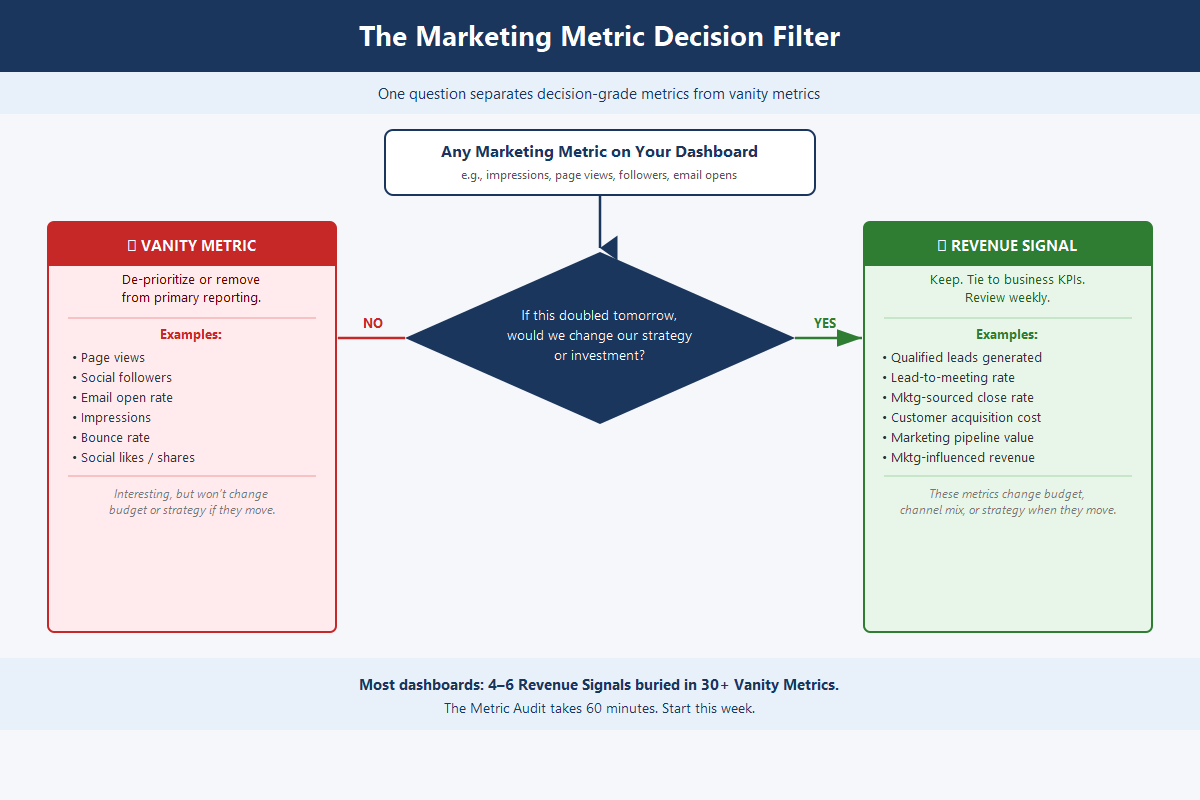
Quick Win 1: Run a Metric Audit — Which Metrics Actually Change Decisions?
Open your marketing dashboard.
Now ask one question for every metric you track:
"If this number doubled tomorrow, would we make a different decision — change budget, pause a channel, adjust messaging, or add headcount?"
If the answer is no, that metric is vanity.
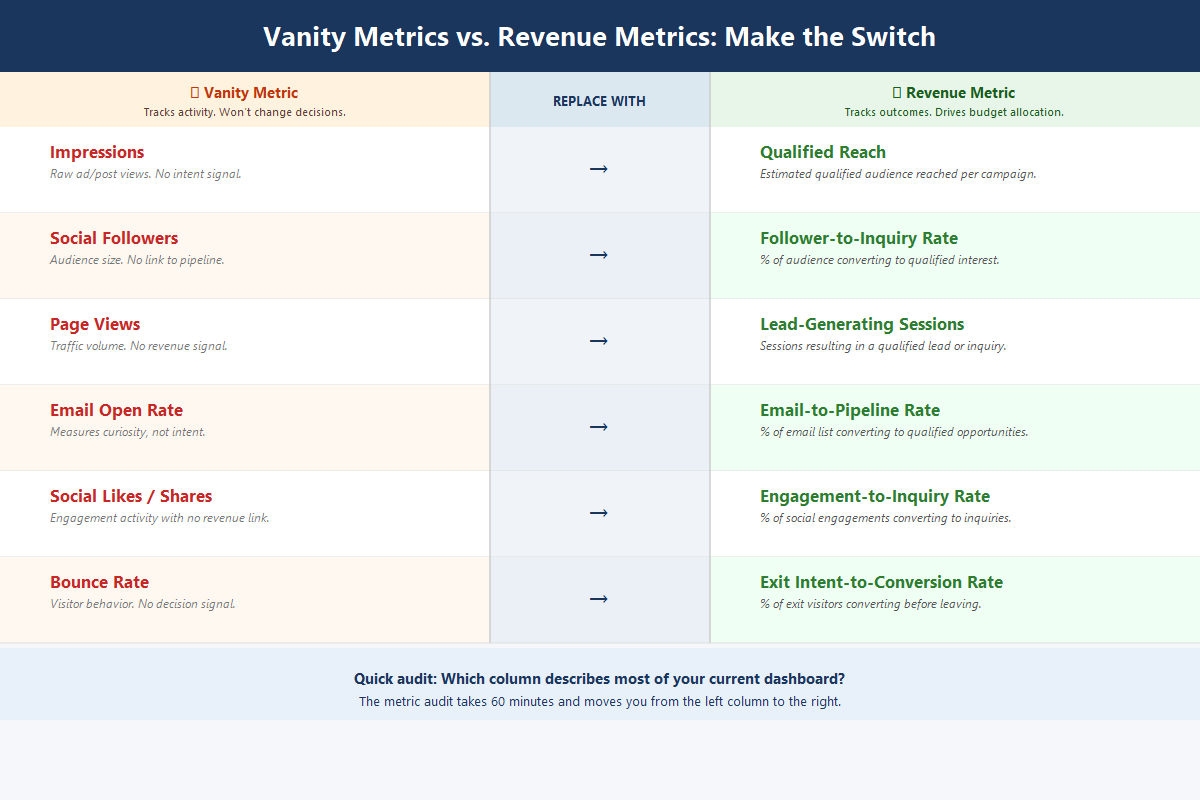
Vanity metrics are numbers that look impressive but don't change strategy. Social media followers, page views, ad impressions, email open rates — these can provide useful context, but they rarely explain whether marketing is actually driving pipeline or revenue. Teams end up celebrating "success" while the sales pipeline stays flat.
A more useful framework is three buckets:
- Decision Metrics — Directly influence budget, channel mix, or strategy. These belong on your primary dashboard.
- Context Metrics — Helpful for understanding performance nuances but not decision drivers. Secondary tab.
- Vanity Metrics — Interesting, maybe trackable somewhere, but not actionable at the executive level. Remove.
Most marketing teams discover that 80%+ of their current dashboard lives in buckets 2 or 3. That's not a failure — it's the natural result of platform default reporting being mistaken for business intelligence over years of accumulation.
Implementation (60 minutes):
- Export your current dashboard — every metric currently reported anywhere
- Apply the decision question to each metric one by one
- Sort into three buckets; aim for 5–7 decision-grade metrics maximum
- Set a recurring monthly 15-minute review to remove anything that creeps back in
⚡ Quick Implementation Tip
Start with your most recent monthly report. For each metric listed, write YES or NO next to it using the decision-filter question. Don't debate — first instinct is usually right. Anything that gets a NO immediately moves to the "remove" pile. Most teams can complete a 40-metric dashboard audit in one focused hour.
Once you isolate the metrics that actually drive decisions, you can build reporting that gives leadership clear answers instead of more numbers.
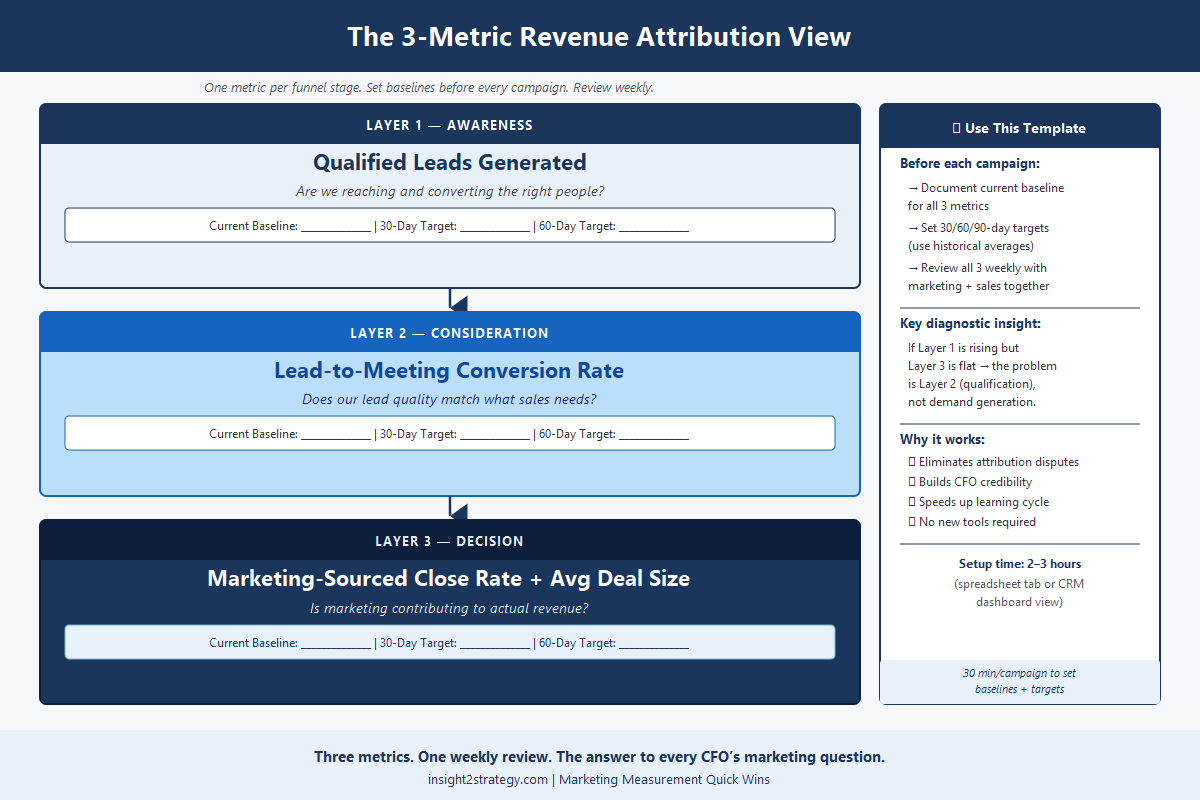
Quick Win 2: Build a 3-Metric Revenue Attribution View
Once the noise is cleared, replace it with a single revenue-focused view containing exactly three metrics — one for each funnel stage.
Top of Funnel (Acquisition):
Qualified leads generated with clear marketing attribution. Not total traffic or impressions — qualified leads. People who fit your target profile and expressed meaningful interest.
Examples: MQLs with defined criteria, high-intent web visits (pricing page), demo requests
Middle of Funnel (Pipeline):
Conversion rate from marketing-sourced leads to sales conversations. This tells you whether your lead quality actually matches what your sales team needs to work with.
Examples: Lead-to-meeting rate, lead-to-opportunity conversion, marketing-generated pipeline value
Bottom of Funnel (Revenue):
Marketing-attributed closed revenue and average deal size. This is the metric your CFO is asking about when the quarterly budget discussion happens.
Examples: Marketing-influenced revenue, marketing-sourced close rate, CAC by channel
Three metrics. One unified view. Track them together weekly and within 30 days you'll have a clear, honest picture of where your funnel is working and where it's leaking.
Here's the diagnostic insight that makes this framework valuable beyond just reporting: if your top-of-funnel metric is rising but your bottom-of-funnel is flat, the problem isn't demand generation. It's qualification quality or the handoff between marketing and sales. That's a very different strategic problem — and without middle-funnel visibility, you'd have no way to pinpoint it.
McKinsey research shows that companies applying disciplined marketing analytics can free up 15–20% of marketing spend through improved ROI optimization. Better measurement isn't just better reporting — it's budget efficiency.
📊 Implementation Framework
The 3-Metric Revenue Attribution View works even without a sophisticated BI platform — a shared spreadsheet tab, reviewed weekly in a 15-minute marketing/sales standup, delivers the core benefit. The critical step is agreeing on definitions upfront: What counts as a "qualified lead"? What's your 90-day attribution window? Get those aligned in writing before you build the dashboard. Need help adapting this framework to your specific sales cycle and CRM setup? Let's discuss your implementation approach.
Quick setup (2–3 hours):
- Ensure UTM parameters are on every campaign link
- Connect your ad platforms to your CRM (HubSpot, Salesforce, or a simple Zapier integration)
- Build one dashboard — even a spreadsheet tab — that pulls these three numbers weekly
- Define "marketing-sourced" consistently across your team: any meaningful touchpoint in the last 90 days
Quick Win 3: Set a Baseline Before Your Next Campaign — The Step Most Teams Skip
This is the quick win most teams skip — and it's the one that costs them the most credibility with finance and leadership.
When you launch a campaign without documenting current baseline values, there's no legitimate way to measure its impact after the fact. Post-campaign, you'll have numbers but no context: did those numbers represent real improvement, a seasonal trend, or something completely unrelated to the campaign?
Before your next campaign launches, document the current values of your three revenue metrics. Then define expected values at 30, 60, and 90 days if the campaign performs as intended.
Example baseline document:
| Metric | Current Baseline | 30-Day Target | 60-Day Target | 90-Day Target |
|---|---|---|---|---|
| Qualified leads/month | 42 | 52 | 64 | 78 |
| Lead-to-meeting rate | 18% | 20% | 22% | 25% |
| Marketing-sourced revenue | $85K | $100K | $120K | $145K |
Instead of vague post-campaign reporting like "engagement was strong and brand visibility improved", you can say:
"Marketing-sourced pipeline increased 27% in 60 days against a target of 22%."
That's a fundamentally different conversation with leadership.
This approach does three things executives care about:
- Creates accountability without micromanagement. Marketing reports against a pre-agreed target rather than having performance evaluated retroactively in ways that invite dispute.
- Accelerates the learning cycle. When results diverge from forecast at 30 days, you have specific data to act on — not a vague sense that something isn't working.
- Builds credibility with finance. When marketing can show it set a measurable target, ran a campaign, and delivered a specific delta, it operates like a revenue function, not a cost center.
A Forrester report found that 45% of business and technology leaders say inaccurate or incomplete data hampers their ability to support business strategy. Baseline measurement is the simplest fix for this gap — and it costs 30 minutes before each campaign launch.
⚡ Quick Implementation Tip
Build a simple baseline template in a shared spreadsheet that auto-populates the three metric fields and date-stamps each entry. Run it for two campaigns before evaluating results — the value compounds as you build historical context. Your second campaign's baseline is your first campaign's 90-day outcome, so the system gets more useful over time without additional effort.
Implementation (30 minutes per campaign):
- Snapshot today's values for your three revenue metrics
- Add expected values at 30/60/90 days (conservative — use historical averages or industry benchmarks)
- Review at each milestone and adjust spend accordingly
- Document the delta — improvement against baseline, not just absolute numbers
What Measurement Can't Fix
These three quick wins will give you absolute clarity on what is happening in your marketing funnel. They can't always tell you why.
If your metrics look solid internally — qualified leads at reasonable volume, conversion rates holding — but pipeline growth is still stalling, the problem may be timing, market readiness, or product-market fit at the segment level. Good measurement confirms something isn't working. Diagnosing why requires a different lens.
One of the hardest things to measure is whether the market is actually ready for what you're selling. If your internal metrics look good but pipeline isn't growing, market readiness may be the missing variable.
Our Market Readiness Score evaluates whether your target segment is actually ready to buy — and delivers a concrete 0–100 score with a GO/NO-GO recommendation, not qualitative feedback. It's the next diagnostic to run when measurement is solid but results still don't match effort.
And if you're already spending $3K+/month on marketing and these quick wins still aren't giving you clarity on what's driving results, the Marketing ROI Diagnostic ($897) does this analysis across your entire budget — channel by channel, in actual dollars — in 3 business days.

|
This post is part of The B2B Marketing Reality Check The strategic framework for growth-stage B2B tech companies — now available in paperback and Kindle. Every topic we cover in this blog goes deeper in the book, with frameworks, diagnostics, and quick wins you can put to work immediately. Get the Free PDF →Want to work through the framework hands-on? Get the companion workbook → |
Frequently Asked Questions
How long does the metric audit actually take?
For most teams with a defined existing dashboard, 60 minutes is realistic. The work happens in two stages: 30 minutes to apply the decision-filter question to every current metric, and 30 minutes to consolidate into decision, context, and vanity buckets and identify gaps. Teams with poorly documented dashboards (metrics spread across 4–5 different platform reports) should budget 90–120 minutes for the first run.
What if we don't have UTM tracking or a CRM in place?
Start with what you have. The 3-metric view can be built with basic tools: a simple web form tracking qualified inquiries, a spreadsheet logging lead-to-meeting outcomes, and your existing sales data. UTM tracking and CRM integration improve accuracy over time — but don't let the absence of perfect infrastructure delay building the core view. An imperfect 3-metric baseline is worth more than a perfect 47-metric dashboard you can't act on.
How do I define "qualified" for the top-of-funnel metric?
This is the most important conversation to have with your sales team before building the attribution view. A qualified lead should meet two criteria: (1) they fit your defined target profile (company size, industry, role), and (2) they expressed meaningful intent (demo request, pricing inquiry, direct contact — not a blog read). Document this definition in writing and update it quarterly. The definition matters more than the platform tracking it.
How often should we revisit and update our baseline metrics?
Review baseline performance monthly — not daily. Marketing attribution cycles are typically 30–90 days, so daily reviews create noise rather than signal. Formally revisit your baseline targets quarterly: compare actuals against 90-day projections, identify systematic gaps, and adjust forward-looking targets. The goal is a feedback loop, not a surveillance dashboard.
When should we bring in outside expertise vs. handle this internally?
Run the metric audit and basic 3-metric view internally — these require business judgment, not technical expertise. Consider outside help when: (1) your dashboard audit reveals major measurement gaps you're not sure how to close, (2) your baseline data shows a consistent pattern you can't explain (top-of-funnel strong, revenue flat for 3+ months), or (3) you're preparing for a significant budget increase and need channel-by-channel ROI evidence to justify it.
The Bottom Line
Most companies don't have a marketing performance problem. They have a marketing measurement problem.
When dashboards are overloaded with vanity metrics, teams can't clearly see what's working — or what isn't. And when leadership can't see clearly, marketing budget becomes one of the first things to question.
Three changes fix this:
- Run a metric audit — strip the vanity, keep the 5–7 metrics that actually change decisions
- Build a 3-metric revenue attribution view — one metric per funnel stage, reviewed weekly
- Set campaign baselines — document current values and expected targets before every launch
Do this consistently, and marketing stops being a black box.
It becomes a predictable, defensible growth function.
And the next time your CEO asks "Is marketing contributing to revenue?" you'll have the answer ready in seconds — not excuses.
Start with the metric audit. One hour. This week.
Ready to Implement These Marketing Measurement Strategies?
Every business situation is unique. Let's discuss how these frameworks apply to your specific funnel, your current dashboard, and your leadership reporting requirements.
No sales pitch. Just strategic insights tailored to your business.
Joe Morrison is the founder of Insight2Strategy, a strategy consultancy that helps growing businesses cut through marketing confusion to find strategies that actually drive revenue. Schedule a free consultation.


Comments
Post a Comment