From Strategy to Results: The 2026 Marketing Integration Framework That Turns Planning Into Predictable Revenue
From Strategy to Results: The 2026 Marketing Integration Framework That Turns Planning Into Predictable Revenue
Strategic Analysis by: Insight2Strategy
Published: February 2, 2026
Executive Reading Time: 11 minutes
Executive Strategic Insights
- 70% of business transformations fail due to execution gaps, not flawed strategy—integration is the missing link between planning and revenue
- The Four-Part Crisis: Strategy trapped in documents, channels operating as silos, AI bolted on rather than integrated, and backward-looking measurement
- Strategic Core Foundation: Unite ICP, UVP, and messaging into operational infrastructure that drives daily decisions, not quarterly reviews
- Priority Sequenced Execution: Stop random acts of marketing—sequence foundation activities, revenue-generators, and growth accelerators systematically
- AI as Integration Infrastructure: Deploy AI to connect strategy to execution to measurement, not as isolated point solutions creating new silos
- Operating Rhythms Prevent Drift: Weekly, monthly, and quarterly cadences transform frameworks into operational discipline and predictable results
Framework detailed below with 90-day implementation roadmap
When Perfect Plans Produce Zero Results
Here's a scene that plays out in boardrooms every January: The marketing team presents a gorgeous strategy deck. Leadership nods. Everyone agrees the plan is solid. Three months later, nothing's working. Leads aren't converting. Campaigns feel disconnected. The sales team is frustrated. And that beautiful strategy? It's gathering digital dust.
The brutal truth? Strategic planning doesn't drive revenue—execution does. And most companies are terrible at connecting the two.
The numbers tell a sobering story. Research shows that 70% of business transformations fail to achieve their objectives, primarily due to poor execution rather than flawed strategy. Even more concerning: only 6% of organizations qualify as "AI high performers" achieving significant EBIT impact, despite widespread AI adoption reaching 88% of companies.
This isn't a strategy problem. It's an integration problem.
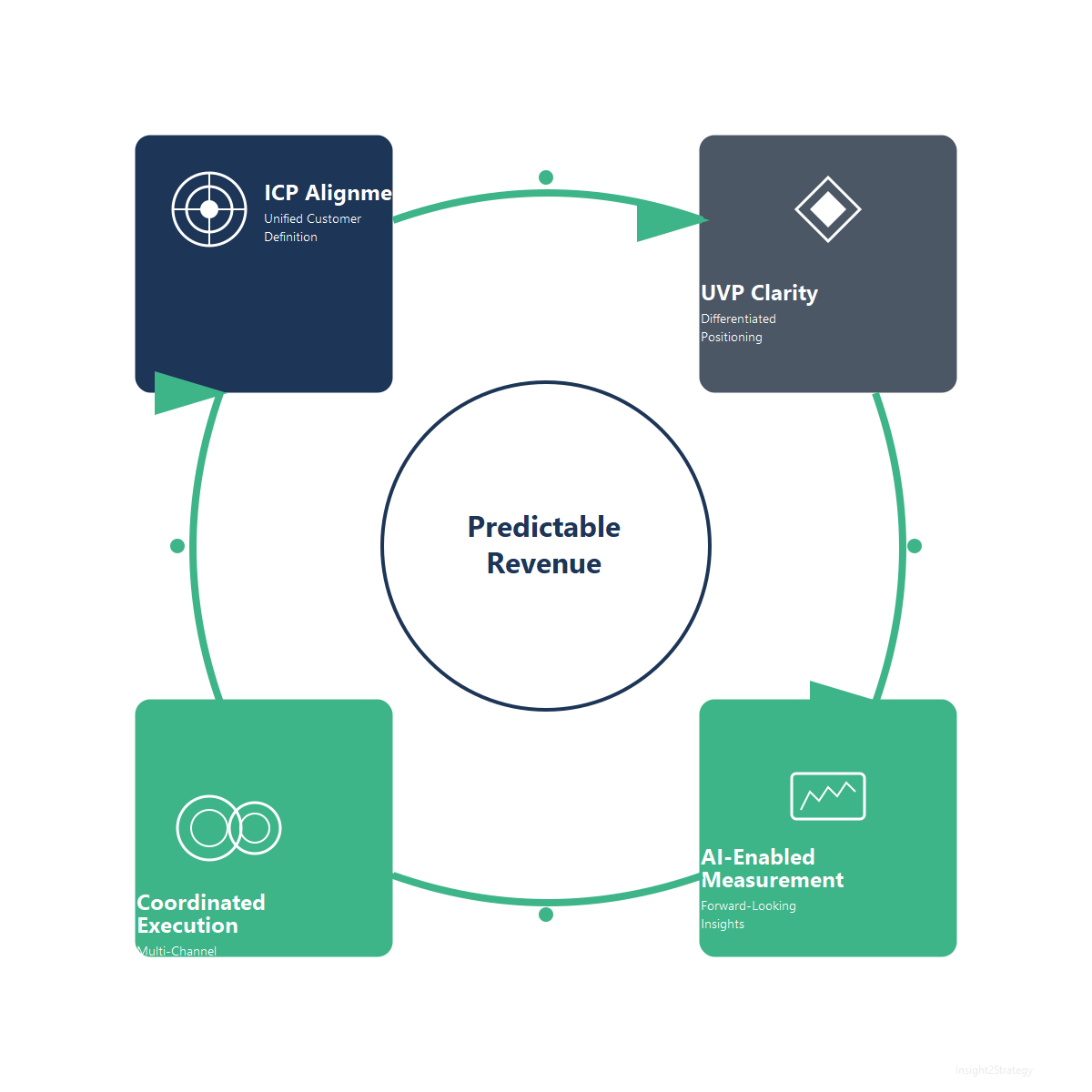
This article introduces the 2026 Marketing Integration Framework—not another planning template, but a practical system for connecting your Ideal Customer Profile (ICP), Unique Value Proposition (UVP), measurement infrastructure, and AI capabilities into coordinated execution that actually produces results.
And because frameworks without tools are just theory, we've created the 2026 Marketing Strategy Integration Workbook—a comprehensive guide with templates, exercises, and implementation roadmaps to operationalize everything you'll learn here.
Following along? Get the 2026 Marketing Strategy Integration Workbook below to implement these strategies step-by-step.
The Four-Part Integration Crisis Killing Your Marketing ROI
Before we fix the problem, let's diagnose it. Most marketing failures stem from four disconnects that prevent even brilliant strategies from producing results:
Disconnect #1: Strategy lives in documents, not workflows
Your ICP is defined in a slide deck. Your UVP exists in a messaging guide. Your success metrics are in a spreadsheet. None of them talk to each other, and none inform daily execution decisions. This documentary approach to strategy means teams reference plans once during quarterly reviews, then return to reactive execution for the next 89 days.
Disconnect #2: Channels operate as independent kingdoms
Social media runs campaigns based on engagement metrics. Email focuses on open rates. Paid media optimizes for clicks. Nobody's optimizing for the same business outcome. The result? Your LinkedIn content contradicts your email nurture sequences, which don't align with your sales conversations. Customers receive mixed messages while teams celebrate channel-specific metrics that don't move revenue.
Disconnect #3: AI tools are bolted on, not integrated
Companies adopt AI for personalization, or predictive analytics, or content generation—but these tools don't connect to strategy, don't inform each other, and create more data silos instead of breaking them down. MIT's 2025 research reveals the scale of this problem: 95% of enterprise AI pilots fail to deliver measurable financial impact, not because the technology doesn't work, but because organizations lack integrated processes to operationalize insights into action.
Disconnect #4: Measurement happens backward, not forward
Teams spend 80% of measurement time creating reports about what happened last month and 20% using insights to improve what happens next month. That ratio should be reversed. Backward-looking measurement produces beautiful dashboards that document failure rather than prevent it.
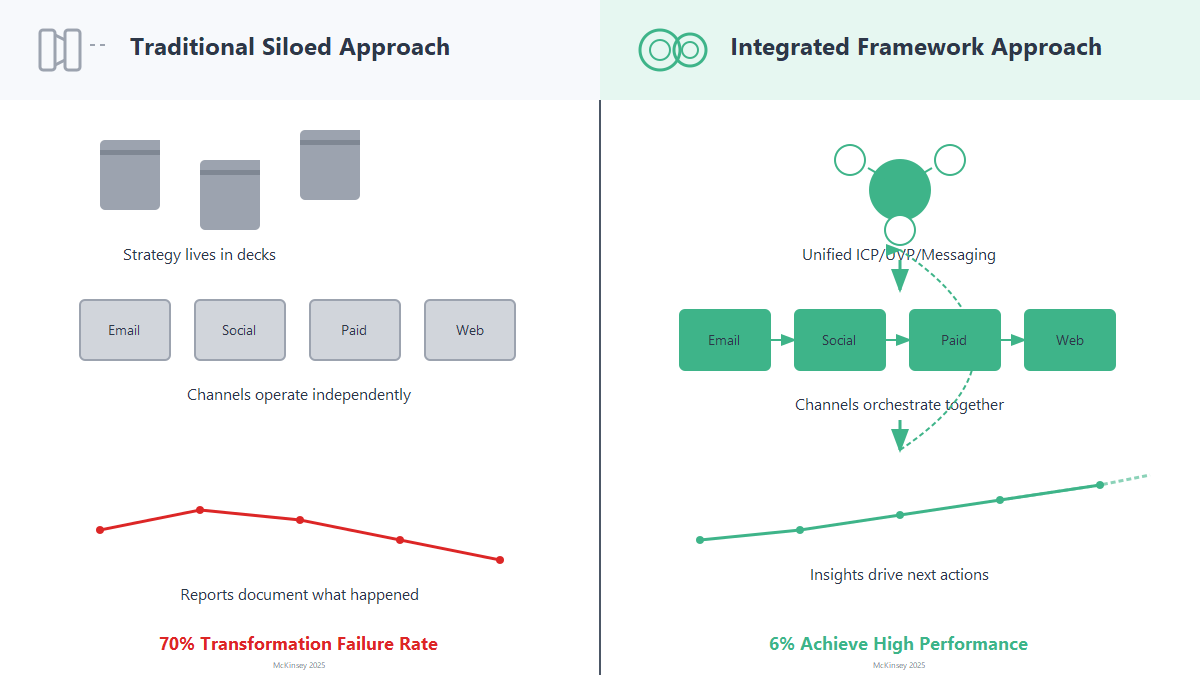
The 2026 Marketing Integration Framework solves all four disconnects simultaneously through a system that treats marketing as operational infrastructure, not creative project management.
Pillar 1: Unite Your ICP, UVP, and Messaging Into a Single Strategic Core
Integration starts with alignment. You can't execute a coordinated strategy if different teams are targeting different audiences with different messages optimizing for different outcomes.
The first pillar creates what we call the Strategic Core—a unified foundation that every channel, campaign, and initiative builds from. This isn't about creating another planning document. It's about establishing a single source of truth that drives daily execution decisions.
Component 1: Unified ICP Definition
Not just demographics, but behavioral triggers, pain points, decision-making criteria, and anti-ICP characteristics (who you should deliberately avoid). This lives in a single source of truth that sales, marketing, and product all reference. Most companies define ICP during annual planning, then ignore it during execution. Integrated organizations embed ICP criteria into campaign approval workflows, lead scoring algorithms, and content calendars.
Component 2: Differentiated UVP Architecture
Most value propositions fail the specificity test: if a competitor could claim the same thing, it's not differentiated. Your UVP should answer three questions with precision:
- WHO: Specific target beyond broad demographics
- WHAT OUTCOME: Quantified result, not vague benefit
- HOW DIFFERENTLY: Unique approach that competitors can't claim
⚡ Quick Implementation Tip
Example of weak UVP: "We help businesses grow through digital marketing." (Any agency could say this.) Example of strong UVP: "We help B2B SaaS companies with 50-200 employees achieve 40% higher trial-to-paid conversion rates through behavioral analytics-driven nurture sequences that competitors aren't using."
Component 3: Coordinated Messaging Framework
Every channel should tell the same story in channel-appropriate ways. Your LinkedIn content, email nurture sequences, sales conversations, and website copy should reinforce each other, not contradict each other. This doesn't mean identical copy across channels—it means consistent strategic narrative adapted to platform dynamics and audience expectations.
The Integration Test: Can every team member articulate the same ICP, UVP, and core messages without referring to documents? If not, you don't have a Strategic Core—you have strategic confusion.
📊 Want the Complete Framework?
The workbook includes exercises to test alignment across your organization and templates to document your Strategic Core in a format that drives execution, not just planning.
Pillar 2: Sequence Execution to Eliminate Random Acts of Marketing
Once your Strategic Core is aligned, the next challenge is sequencing. Without it, marketing teams fall into reactivity: someone suggests a webinar, another team wants a whitepaper, leadership asks about a new social channel. Everything feels urgent. Nothing produces compound results.
The framework introduces Priority Sequenced Execution (PSE)—a three-tier approach that ensures activities build on each other rather than compete for resources.
Tier 1: Foundation Activities (must happen first)
- ICP validation with real customer data, not assumptions
- UVP testing across channels to verify resonance
- Measurement infrastructure setup that enables forward-looking insights
- Core content asset creation that aligns to buyer journey
Think of Tier 1 as pouring the foundation. Skipping this to jump to visible activities is like building the penthouse before the structure exists.
Tier 2: Revenue-Generating Activities (enabled by Tier 1)
- Targeted lead generation campaigns informed by validated ICP
- Nurture sequences aligned to tested buyer journey stages
- Sales enablement content that reinforces UVP messaging
- Conversion optimization based on measurement infrastructure
Tier 2 activities fail when attempted without Tier 1 foundations because they lack the strategic alignment needed to produce consistent results.
Tier 3: Growth Accelerators (amplify Tier 2 results)
- Brand awareness campaigns that expand market reach
- Partnership development for channel expansion
- Thought leadership content for category creation
- Community building for customer engagement
The critical insight: Tier 3 activities fail when attempted before Tiers 1 and 2 are solid. Yet most companies start with Tier 3 because it's exciting, visible, and easy to justify in meetings. Brand campaigns without validated ICP targeting waste budget on wrong audiences. Thought leadership without proven UVP messaging confuses rather than persuades.
PSE doesn't mean you can't do multiple things simultaneously. It means you sequence dependencies correctly and avoid the trap of spreading resources across incompatible priorities.
Pillar 3: Deploy AI as Integration Infrastructure, Not Point Solutions
Here's where most AI strategies go wrong: companies adopt tools for specific use cases (chatbots for support, predictive analytics for lead scoring, generative AI for content) without connecting them to the Strategic Core or each other.
The data validates this pattern: While 88% of organizations use AI in at least one business function, only 39% report any EBIT impact from AI use, and most say it's less than 5%. The gap isn't technology capability—it's integration execution.
The framework treats AI differently—as integration infrastructure that connects strategy to execution to measurement rather than as standalone tools solving isolated problems.
AI Integration Point 1: Strategic Intelligence
AI analyzes your ICP characteristics across your customer base, identifies patterns in high-value customers, and flags drift in targeting. This feeds back into your Strategic Core, keeping your ICP definition current with real data instead of outdated assumptions. Instead of annual ICP reviews based on gut feel, AI provides continuous validation and refinement signals.
AI Integration Point 2: Execution Coordination
AI optimizes when and how different channels activate based on customer behavior signals. Instead of running campaigns on arbitrary schedules (first Monday of the month, because that's when we always launch), AI coordinates touchpoints based on intent signals and engagement patterns. This turns channel silos into orchestrated experiences.
AI Integration Point 3: Predictive Measurement
Instead of reporting what happened last month, AI predicts what will happen next month based on leading indicators. This shifts measurement from backward-looking (reports for documentation) to forward-looking (decision intelligence for optimization). Teams make better decisions faster because they see problems forming rather than documenting problems that already occurred.
McKinsey's research confirms what we see with clients: AI scaling is 70% people and process, 30% technology. The Integration Framework provides the 70% people and process infrastructure that makes the 30% technology actually work.
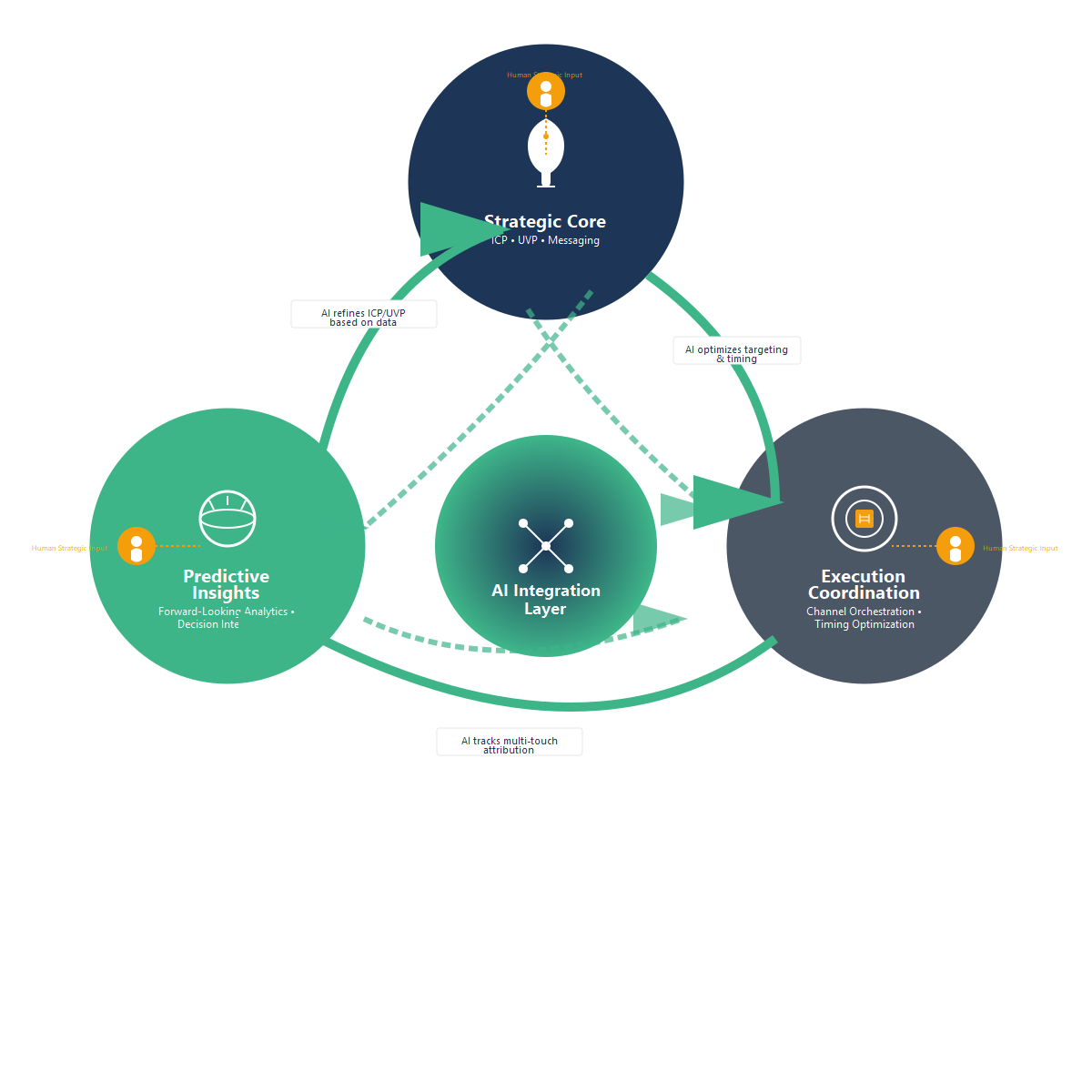
The workbook includes an AI capability mapping exercise that helps you identify which AI applications support integration (prioritize these) versus which create new silos (deprioritize or redesign these).
Pillar 4: Build Coordinated Execution Through Cross-Functional Operating Rhythms
The final pillar transforms paper plans into operational discipline. Even perfect frameworks drift back into silos within 60 days without operating rhythms that keep teams aligned and execution coordinated.
The framework establishes three operating cadences—inspired by the Marketing Integration Council concept—that prevent strategic drift:
Weekly Strategic Alignment (30 minutes)
Every Monday, cross-functional team reviews:
- What launched last week and what we learned
- What launches this week and potential conflicts
- Any Strategic Core drift to address
- Quick wins to celebrate
This prevents silos from reforming and catches misalignment before it compounds. The 30-minute time constraint forces teams to focus on decisions and obstacles rather than status updates (which should be asynchronous).
Monthly Performance Integration (90 minutes)
First Monday of each month, deeper review:
- Progress against revenue objectives
- Channel performance relative to integrated goals (not channel-specific vanity metrics)
- AI insights and what they mean for strategy adjustment
- Resource reallocation based on what's working
This keeps measurement forward-looking and ensures insights drive decisions, not just reports. Teams ask "what should we do differently next month" rather than "what happened last month."
Quarterly Strategic Refresh (Half-day session)
End of each quarter:
- ICP validation against latest customer data
- UVP testing results and refinements needed
- AI deployment performance and expansion opportunities
- Next quarter's sequenced priorities using PSE model
This keeps your Strategic Core current and your execution aligned with market reality, not outdated assumptions from annual planning.
⚡ Quick Implementation Tip
The operating rhythms are where integration becomes operational. Without them, even perfect frameworks drift back into silos within 60 days as daily urgencies override strategic priorities.
Implementation: Your 90-Day Integration Roadmap
Theory is worthless without practical implementation. Here's how to operationalize the framework with clear success gates that signal readiness to advance:
Weeks 1-4: Strategic Foundation
- Complete ICP alignment exercise (all teams)
- Document unified UVP with specificity test
- Establish agreed-upon success metrics
- Conduct team alignment workshop
Success gate: All teams can articulate identical ICP, UVP, and metrics without referring to documents. If teams give different answers when asked separately, foundation isn't solid enough to proceed.
Weeks 5-8: Channel Integration
- Map customer journey for your specific ICP
- Audit existing content against journey stages
- Create orchestration calendar for next quarter using PSE model
- Establish cross-channel consistency standards
Success gate: First coordinated multi-touch campaign planned and scheduled with clear handoffs between channels. Campaign brief should reference Strategic Core explicitly.
Weeks 9-12: AI Deployment
- Map AI capabilities to business challenges (not technology to use cases)
- Prioritize using effort/impact matrix
- Define human-AI workflows with clear roles
- Deploy first high-impact AI application
Success gate: AI delivering measurable improvement in one area with clear process for scaling to other areas. "Measurable" means specific metric movement, not "team says it's helpful."
The workbook provides detailed templates for each phase, including facilitation guides for alignment workshops, orchestration calendar templates, and AI prioritization frameworks.
Conclusion: Integration Is the New Competitive Advantage
The companies that dominate 2026 won't be those with the most creative strategies or the biggest AI budgets. They'll be the ones that integrate strategy, execution, and measurement into coordinated systems that produce predictable revenue.
The four pillars—Strategic Core alignment, Priority Sequenced Execution, AI as integration infrastructure, and cross-functional operating rhythms—provide the structure to make this happen. But structure without tools is just theory.
That's why we created the:
Get Your 2026 Marketing Strategy Integration Workbook
Turn strategic insights into coordinated execution with our comprehensive implementation guide
This comprehensive workbook includes:
- Strategic Core alignment templates and exercises
- Priority Sequencing frameworks and examples
- AI capability mapping and prioritization tools
- Operating rhythm agendas and facilitation guides
- 90-day implementation roadmap with success gates
- Troubleshooting guide for common integration challenges
Download instantly. No sales pitch. Just actionable strategies you can implement immediately.
Download the 2026 Marketing Integration Workbook
Get instant access to the 2026 Marketing Integration Workbook — enter your email below and we'll send the download link right over.
Want to discuss how to adapt these strategies to your specific situation?
Schedule a Strategy Discussion →The gap between strategy and results is killing most marketing ROI. The 2026 Marketing Integration Framework closes that gap. The workbook gives you the tools to implement it. The only question left is: will you integrate before your competitors do?
|
This post is part of The B2B Marketing Reality Check The strategic framework for growth-stage B2B tech companies — now available in paperback and Kindle. Every topic we cover in this blog goes deeper in the book, with frameworks, diagnostics, and quick wins you can put to work immediately. Get the Free PDF →Want to work through the framework hands-on? Get the companion workbook → |
Frequently Asked Questions
Why do most marketing strategies fail in execution?
Most marketing strategies fail not because of flawed thinking, but because of four critical disconnects: strategy trapped in documents rather than workflows, channels operating as independent silos, AI tools bolted on instead of integrated, and measurement focused backward instead of forward. The 2026 Marketing Integration Framework solves all four simultaneously by treating marketing as operational infrastructure, not creative project management.
How do I implement the Marketing Integration Framework in my organization?
Implementation follows a structured 90-day roadmap with clear success gates. Weeks 1-4 focus on Strategic Foundation (ICP, UVP, metrics alignment). Weeks 5-8 tackle Channel Integration (journey mapping, orchestration calendars). Weeks 9-12 deploy AI strategically (capability mapping, workflow definition). Each phase has specific success criteria before advancing to ensure solid foundations. The workbook provides detailed templates and facilitation guides for each phase.
What budget should we allocate for marketing integration implementation?
Integration is primarily a process and alignment investment, not a technology investment. Most of the work involves clarifying strategy, aligning teams, and establishing operating rhythms—activities that require time commitment but minimal budget. AI deployment costs vary based on your existing technology stack and specific use cases. Start with free/low-cost alignment exercises in the workbook before making technology investments.
When should we hire outside expertise vs. handle integration internally?
Consider strategic consultation if: (1) Module 1 alignment reveals significant cross-team conflicts you can't resolve internally, (2) AI prioritization is unclear and you need expert guidance on capability mapping, (3) execution keeps drifting off-strategy despite your best efforts, or (4) you want to compress the 90-day roadmap to 30-45 days with expert facilitation. The workbook is designed for internal implementation, but expert guidance can accelerate results.
How do we measure ROI on marketing integration efforts?
Integration ROI shows up in three ways: (1) Short-term (30 days) - measurable improvement in team alignment and reduction in conflicting initiatives, (2) Medium-term (90 days) - increased lead quality from better ICP targeting and improved conversion rates from coordinated messaging, and (3) Long-term (6-12 months) - predictable revenue growth from systematic execution and faster sales cycles from sales-marketing alignment. The framework's operating rhythms include measurement protocols to track these outcomes.
Verified Statistics & Citations
All statistics in this article have been verified with authoritative sources:
- 70% transformation failure rate: McKinsey & Company - Why do most transformations fail?
- 6% AI high performers with EBIT impact: McKinsey - The State of AI 2025
- 88% AI adoption rate: McKinsey - The State of AI 2025
- 95% AI pilot failure rate: MIT NANDA - The GenAI Divide Report via Fortune
- 39% report EBIT impact from AI, most under 5%: McKinsey - The State of AI 2025
- 70% people/process, 30% technology for AI scaling: McKinsey - The State of AI 2025
About Insight2Strategy
We help businesses turn strategic planning into predictable revenue through integrated marketing frameworks, AI deployment strategy, and execution excellence.
Learn more: Insight2Strategy.com
Schedule consultation: Free 30-Minute Strategy Session
Word Count: 2,847 words | Reading Time: 11 minutes | Published: February 5, 2026
Lead Magnet: 2026 Marketing Strategy Integration Workbook


Comments
Post a Comment