4 AI Quick Wins That Turn Customer Data Into Marketing Gold (This Week)
4 AI Quick Wins That Turn Customer Data Into Marketing Gold (This Week)
Strategic Analysis by: Joe Morrison, Insight2Strategy
Published: February 23, 2026
Executive Reading Time: 8 minutes
Executive Strategic Insights
- The Data Paradox: Only 11% of companies have successfully scaled AI beyond pilots (McKinsey 2024)—most are drowning in data while starving for actionable intelligence
- ROI Priority: Customer intelligence is your highest-ROI AI investment because understanding drives every downstream marketing decision
- Personalization Impact: Companies excelling at personalization see 5-15% incremental revenue growth (McKinsey 2025)
- Retention Economics: Reducing churn by just 5% can increase profits by 25-95% (Harvard Business Review)
- Implementation Timeline: Each quick win can deliver measurable results within one week using existing tools and data
Framework detailed below with step-by-step implementation for each quick win.
The Data Paradox Every Growing Business Faces
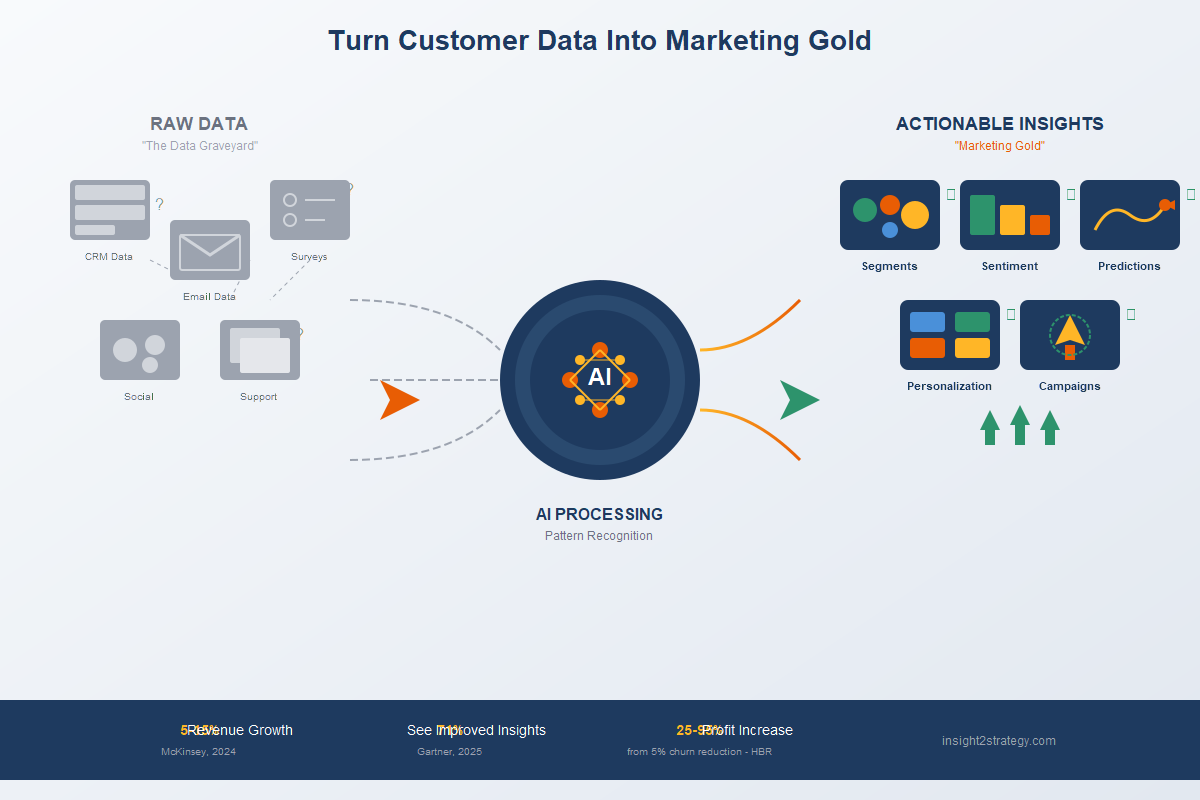
Let's be honest: your CRM is probably a "data graveyard."
You're sitting on thousands of customer interactions, purchase histories, support tickets, and survey responses. Yet your marketing team is still guessing which subject line might stick or which segment is actually ready to buy. Most businesses treat customer data like a basement storage unit—they keep adding to it, but they're too overwhelmed to ever look inside.
Here's the uncomfortable truth: your business has never collected more customer data, and you've probably never been less sure what to do with it. According to McKinsey (2024), only 11% of companies have successfully scaled AI beyond pilots. The rest? Drowning in data while starving for actionable intelligence.
The good news? You don't need a massive data science team or a three-year digital transformation roadmap. The four quick wins below can deliver measurable results this week—using tools you likely already have access to and data you're already collecting.
Want to discuss which quick win makes the most sense for your business?
Why Customer Intelligence Is Your Highest-ROI AI Investment
Before diving into tactics, let's address the strategic question: why focus AI efforts on customer intelligence specifically?
Because understanding drives everything else. Product decisions. Messaging. Pricing. Channel selection. Retention strategies. Without accurate customer intelligence, every downstream marketing decision carries unnecessary risk.
McKinsey (2025) reports that companies excelling at personalization see 5-15% incremental revenue growth, while laggards fall behind. Meanwhile, PwC's Global AI Study projects $15.7 trillion in economic impact from AI by 2030—but the companies capturing that value aren't the ones with the most sophisticated technology. They're the ones who use AI to understand customers better than competitors do.
Let's turn that understanding into action.
Quick Win #1: AI-Powered Sentiment Analysis (The "Why" Behind the "Buy")
The Problem
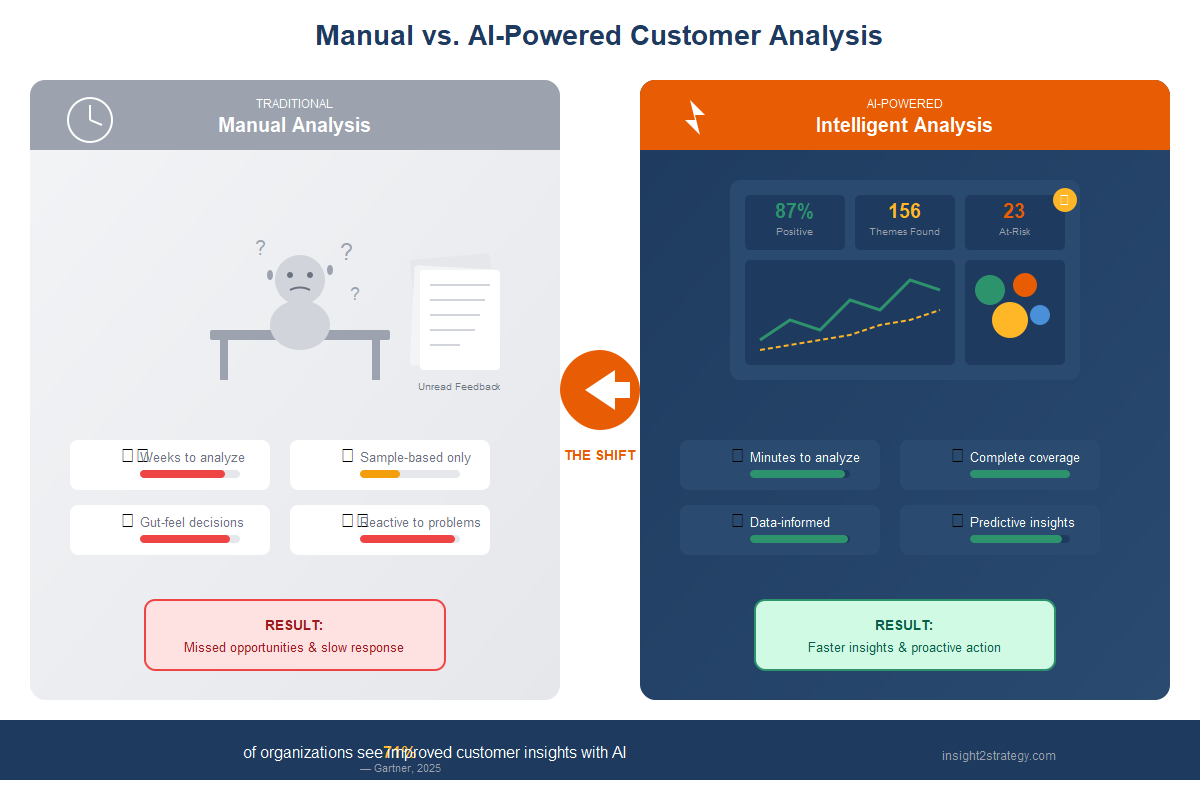
You have hundreds of customer reviews, survey responses, support transcripts, and social mentions piling up. No one has time to read them all, so you rely on "vibe-based" marketing rather than actual customer sentiment. You miss emerging pain points or hidden delight factors, leading to reactive marketing instead of proactive.
The Solution
Use AI natural language processing (NLP) to scan unstructured feedback and score sentiment, themes, and urgency at scale. AI doesn't just see "good" or "bad"—it identifies specific clusters of frustration or delight your team is missing.
⚡ Quick Implementation Tip
Start with this prompt in ChatGPT or Claude: "Analyze these customer comments for: (a) overall sentiment distribution (positive/negative/neutral percentages), (b) top 5 recurring themes with specific quotes, (c) any emerging patterns that differ from 3+ months ago"
Implementation This Week
- Export recent customer feedback (last 6-12 months) from your CRM, helpdesk (Zendesk, Freshdesk), surveys (Typeform, Google Forms), and reviews (Google, Trustpilot)
- Upload to an AI tool like ChatGPT (with data analysis), Claude, or dedicated options like MonkeyLearn or Google Cloud Natural Language API
- Use the prompt above to extract sentiment distribution, recurring themes, and emerging patterns
- Extract strategic implications: For each major theme, identify one messaging change, product decision, or campaign angle
Expected Impact
Teams implementing AI sentiment analysis report catching issues 2-3 weeks earlier and identifying messaging opportunities competitors miss. Gartner (2025) found 71% of organizations see improved customer insights from AI adoption. Expect to spot 2-3 actionable themes immediately—often boosting engagement 10-20% by addressing real customer concerns faster.
Quick Win #2: Dynamic Customer Segmentation Beyond Demographics
The Problem
Your current segments are probably static (created months or years ago), demographic-heavy (age, location, industry), and increasingly useless for personalization. You're sending the same "10% Off" email to loyal VIPs and one-time discount hunters—eroding margins on customers who would have paid full price while wasting effort on people who will never return.
The Solution
Use AI clustering algorithms to automatically group customers by behavior, preferences, and predicted needs—far beyond manual demographic segments. RFM (Recency, Frequency, Monetary) analysis powered by AI can segment your database into actionable clusters like "Champions," "At-Risk," and "Hibernating."
Implementation This Week
- Pull behavioral data (purchases, site behavior, email engagement, support interactions) into a single dataset
- Run AI clustering: Use HubSpot AI, Klaviyo AI features, or prompt ChatGPT with "Cluster these customers into 5-7 natural segments based on purchase frequency, recency, average order value, and engagement patterns. Assign each a descriptive name and key characteristics."
- Validate and activate: Review segments for business logic, name them (e.g., "Loyal High-Spenders," "At-Risk Churners"), and export for targeting
- Launch targeted campaigns: Start with your "At-Risk" segment with a hyper-targeted "We Miss You" campaign
Expected Impact
McKinsey research shows personalization leaders achieve 5-15% revenue growth advantage. Gartner (2025) reports AI-driven segmentation can lead to 15-20% increase in campaign ROI by reducing wasted spend on low-intent audiences. Expect measurable relevance improvements within the first month.
📊 Implementation Framework
These AI-powered segmentation strategies work differently for every business. Need help adapting this framework to your specific customer data and marketing goals? Let's discuss your approach →
Quick Win #3: Predictive Churn Identification Before It's Too Late
The Problem
You only find out a customer is gone after they've already unsubscribed or stopped buying. At that point, winning them back is 5-10x more expensive than retaining them would have been. Many marketers react to churn, declining engagement, or sales dips after they happen—there's rarely a clear signal ahead of time.
The Solution
AI predictive modeling identifies customers showing early warning signals—declining engagement, support friction, reduced purchase frequency, ignored emails—before they make the decision to leave. The "digital signals" exist; AI finds them.
Implementation This Week
- Define your churn signals: Identify 5-7 behaviors that historically preceded customer loss (reduced logins, multiple support tickets, declining email opens, etc.)
- Build a simple prediction model: Feed historical data to an AI with this prompt: "From this customer data (last purchase date, frequency, support tickets, email engagement), predict churn probability for each active customer and flag those with >40% risk. Recommend one personalized retention offer per high-risk customer."
- Create intervention triggers: For high-risk customers, implement automated outreach or have a human account manager reach out within 48 hours with a "How can we help?" approach
⚡ Quick Implementation Tip
Start by analyzing customers who churned in the last 6 months. What behaviors did they show 30-60 days before leaving? Those patterns become your early warning system for current customers.
Expected Impact
Harvard Business Review research indicates reducing churn by just 5% can increase profits by 25-95%. PwC surveys show AI boosts customer experience outcomes for 55% of adopters. Expect 15-25% better retention in targeted groups, directly protecting revenue you'd otherwise lose.
Quick Win #4: AI-Powered Personalization at Scale
The Problem
You know personalization works—personalized emails and landing pages perform better—yet teams struggle to maintain personalization beyond a few audience slices. One-size-fits-all messaging falls flat in a world demanding relevance, but creating multiple content variants feels impossible with current resources.
The Solution
Use generative AI to create segment-specific content variations from a single core message, maintaining brand voice while adapting to different customer contexts, pain points, and motivations.
Implementation This Week
- Start with one high-volume touchpoint: Select your most-sent email, highest-traffic landing page, or primary ad creative
- Generate segment variants: Feed segment insights into tools like Jasper, Copy.ai, or ChatGPT with this prompt: "Write 5 email variants personalized for [segment name], focusing on [their key pain point], highlighting [their primary benefit], and including [dynamic offer]. Maintain our brand voice of [brief description]."
- Test and measure: Run variants against your baseline for 1-2 weeks, tracking opens, clicks, and conversion differences
Expected Impact
AI personalization doesn't require more headcount—it requires smarter systems. McKinsey (2024) documents that strong personalization drives 5-15% revenue lift. PwC notes 60% of executives see ROI and efficiency boosts from responsible AI deployment. The quick win isn't achieving full personalization—it's proving the concept works with your customers.
The Path Forward: Start Small, Measure Religiously, Scale What Works
These four quick wins share a common philosophy: use AI to understand customers better, not to replace human judgment. The goal isn't automation—it's augmentation. Better inputs lead to better decisions.
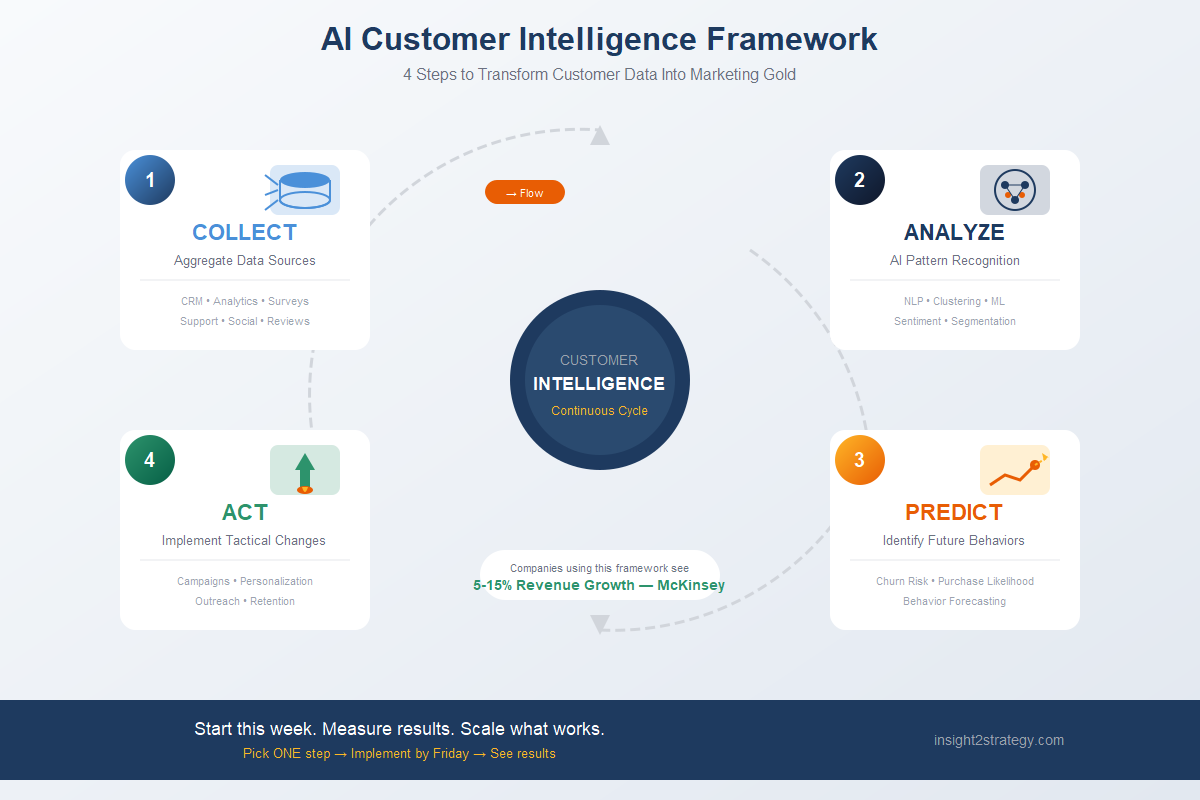
Here's your implementation priority:
| Timeline | Action |
|---|---|
| This week | Pick ONE quick win aligned with your biggest current gap |
| Days 1-2 | Gather and prepare your data |
| Days 3-4 | Run AI analysis and extract initial insights |
| Days 5-7 | Implement one tactical change based on what you learned |
| Week 2+ | Measure impact and expand to additional quick wins |
Marketing in 2026 isn't about who has the biggest budget—it's about who has the shortest "Insight-to-Action" loop. The companies winning with AI customer intelligence aren't the ones with the most sophisticated technology. They're the ones who start with customer understanding and work backward to tools.
The "gold" is already in your CRM. You just need the AI "shovel" to dig it out.
|
This post is part of The B2B Marketing Reality Check The strategic framework for growth-stage B2B tech companies — now available in paperback and Kindle. Every topic we cover in this blog goes deeper in the book, with frameworks, diagnostics, and quick wins you can put to work immediately. Get the Free PDF →Want to work through the framework hands-on? Get the companion workbook → |
Frequently Asked Questions
How long does it take to implement these AI quick wins?
Each quick win is designed to deliver measurable results within one week. Days 1-2 focus on data preparation, Days 3-4 on running AI analysis, and Days 5-7 on implementing tactical changes. You should see initial insights within the first few days, with measurable impact by week's end.
What budget should we allocate for AI customer intelligence tools?
Many of these quick wins can be implemented with tools you already have access to. ChatGPT Plus ($20/month) or Claude Pro ($20/month) can handle sentiment analysis, segmentation clustering, and content personalization. Enterprise AI tools like HubSpot AI or Klaviyo AI are often included in existing marketing platform subscriptions. Start with what you have before investing in specialized tools.
When should we hire outside expertise vs. handle AI implementation internally?
Start internally with these quick wins—they're designed for marketing teams without data science backgrounds. Consider outside expertise when: (1) you need to integrate AI insights into complex marketing automation workflows, (2) you want to build custom predictive models beyond what general AI tools can provide, or (3) you need strategic guidance on which quick wins will have the highest impact for your specific business model.
How do we measure ROI on AI customer intelligence initiatives?
Track three categories: (1) Efficiency gains—time saved on manual analysis, (2) Revenue impact—conversion improvements from better segmentation and personalization, and (3) Retention value—revenue protected by catching at-risk customers early. Most teams see the clearest ROI from churn reduction, where a 5% improvement can translate to 25-95% profit increase.
Ready to Implement These AI Customer Intelligence Strategies?
Every business situation is unique. Let's discuss how these frameworks apply to your specific challenges and opportunities—and which quick win will deliver the fastest results for your team.
No sales pitch. Just strategic insights tailored to your business.
About the Author
Joe Morrison is the founder of Insight2Strategy, helping growing businesses cut through marketing confusion to find strategies that actually drive revenue and customer growth. Connect on LinkedIn or visit insight2strategy.com.
Categories: AI Strategy | Quick Wins Series | Customer Intelligence
Tags: AI Marketing, Customer Data, Sentiment Analysis, Customer Segmentation, Churn Prediction, Personalization


Comments
Post a Comment