Why Your 2026 Marketing Strategy and AI Strategy Must Be One Strategy (Not Two Separate Initiatives)
Why Your 2026 Marketing Strategy and AI Strategy Must Be One Strategy (Not Two Separate Initiatives)
Strategic Analysis by: Insight2Strategy
Published: January 26, 2026
Executive Reading Time: 12 minutes
Executive Strategic Insights
- 95% of enterprise AI pilots fail to deliver measurable ROI — The culprit is strategic separation, not technology limitations (MIT, 2025)
- Companies with integrated AI-enabled marketing see 25% higher success rates compared to those running separate strategies (CoSchedule, 2025)
- AI scaling is 70% people and process, only 30% technology — Most organizations invert this ratio and wonder why pilots never scale (McKinsey, 2024)
- Four essential shifts required — From bolt-on tools to embedded capabilities, separate budgets to unified investment, experimental pilots to production-grade governance, and tech projects to cultural transformation
- Companies with robust AI governance achieve 34.1% better marketing performance than those without formal governance structures (Influencer Marketing Hub, 2025)
- Framework detailed below — Eight-step implementation roadmap for AI-enabled marketing integration in 2026
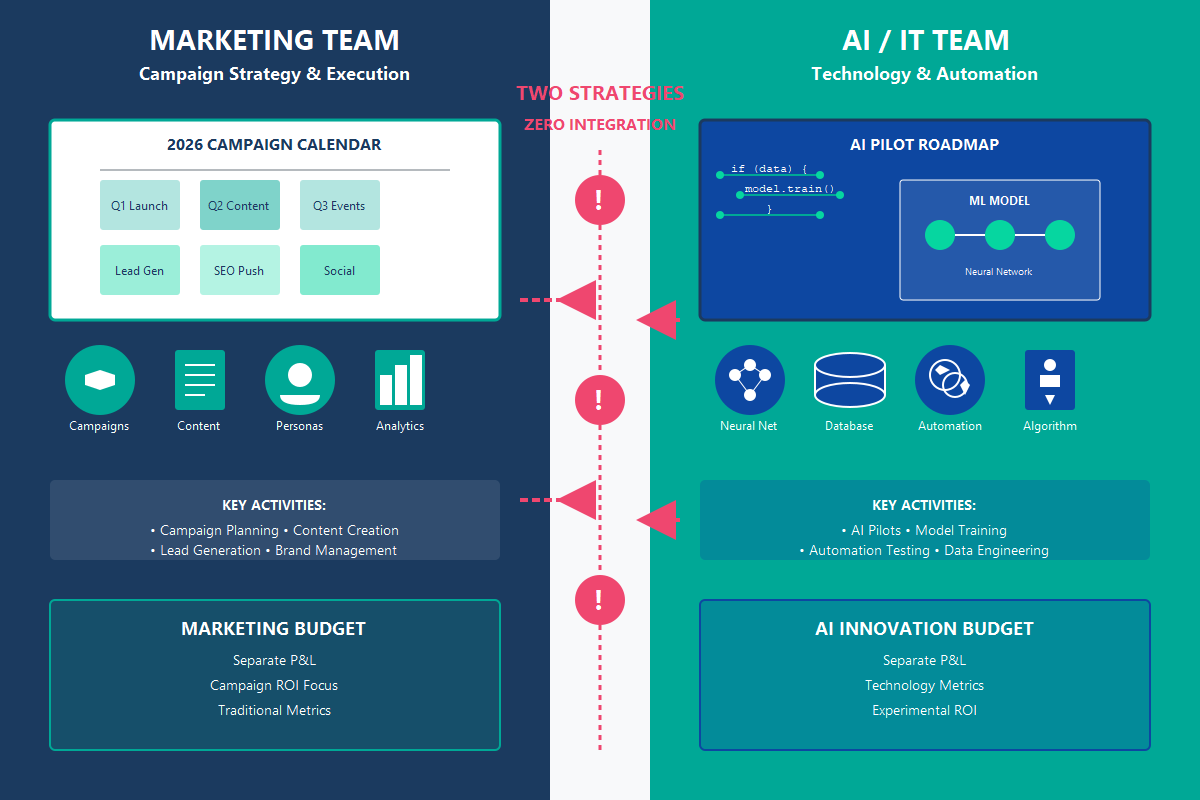
Picture this: Your marketing team just wrapped their 2026 strategy session. Three days of whiteboarding, fifty slides, and a pristine deck outlining Q1 campaigns, content calendars, and lead gen targets. Meanwhile, across the hall, your IT team finished their 2026 roadmap—complete with AI pilots, automation experiments, and a chatbot proof-of-concept.
Two strategies. Two timelines. Two budgets. Zero integration.
If this sounds familiar, you're not alone—and you're in serious trouble.
According to McKinsey's 2024 State of AI research, only 11% of companies have successfully adopted AI at scale across business functions. The reason isn't a lack of AI capability—it's a lack of strategic integration. When marketing strategy and AI strategy live in separate documents, you get what MIT's 2025 analysis revealed: a staggering 95% failure rate for AI pilots to deliver measurable business impact.
Following along? Schedule a strategy discussion to explore how integrated AI-enabled marketing applies to your business.
Here's what most business leaders miss: In 2026, there is no such thing as a "marketing strategy" and an "AI strategy." There's only an AI-enabled marketing strategy—a unified approach where AI capabilities are embedded into every aspect of how you attract, engage, and convert customers.
Companies that haven't figured this out yet aren't just behind. They're burning money on disconnected initiatives that will never deliver ROI.
The Real Cost of Separate Strategies: Why Silos Kill ROI
Let's talk about what actually happens when you treat AI as something separate from your marketing plan.
Your marketing team builds campaigns based on intuition and last quarter's data. They segment audiences manually, personalize content in batches, and measure success weeks after campaigns launch. It works—sort of. But it's increasingly ineffective in a world where customer expectations change by the hour and competitors are automating personalization at scale.
Meanwhile, your AI initiatives sit isolated in a sandbox. The data science team builds predictive models that marketing never uses. IT experiments with automation tools that don't connect to your martech stack. Finance asks for ROI metrics that don't exist because the AI work isn't tied to actual business outcomes.
This disconnect creates three critical problems that directly impact your bottom line:
Problem #1: Misaligned KPIs and Wasted Resources
When strategies split, so do success metrics. Marketing optimizes for lead volume and campaign engagement. AI teams optimize for model accuracy and processing speed. Nobody's optimizing for revenue growth or customer lifetime value—the metrics that actually matter to your business.
CoSchedule's 2025 State of AI in Marketing study found that companies with non-integrated AI approaches report 25% lower marketing success rates compared to those with unified strategies. That's not a minor efficiency gap—that's the difference between hitting your growth targets and missing them entirely.
Problem #2: Data That Doesn't Connect
Your marketing automation platform holds customer engagement data. Your CRM tracks sales interactions. Your AI models need clean, integrated data to generate insights worth acting on. But when strategies are separate, data stays siloed.
Marketing can't access AI-generated predictions. AI teams can't feed real-time campaign performance back into their models. Everyone has partial information, and partial information leads to poor decisions—what McKinsey research identifies as a primary reason why AI scaling is 70% people and process, only 30% technology.
⚡ Quick Implementation Tip
Start with a data audit: Map where your customer data lives today and identify gaps between marketing platforms and AI systems. Most integration failures stem from data infrastructure problems discovered too late.
Problem #3: Technology That Doesn't Scale
This is where the 95% failure rate comes from. AI pilots fail not because the technology doesn't work, but because nobody planned for integration from day one. You bolt on a chatbot that doesn't connect to your lead nurturing workflow. You add content generation tools that produce off-brand copy. You invest in predictive analytics that sit unused because they're not built into your team's actual decision-making process.
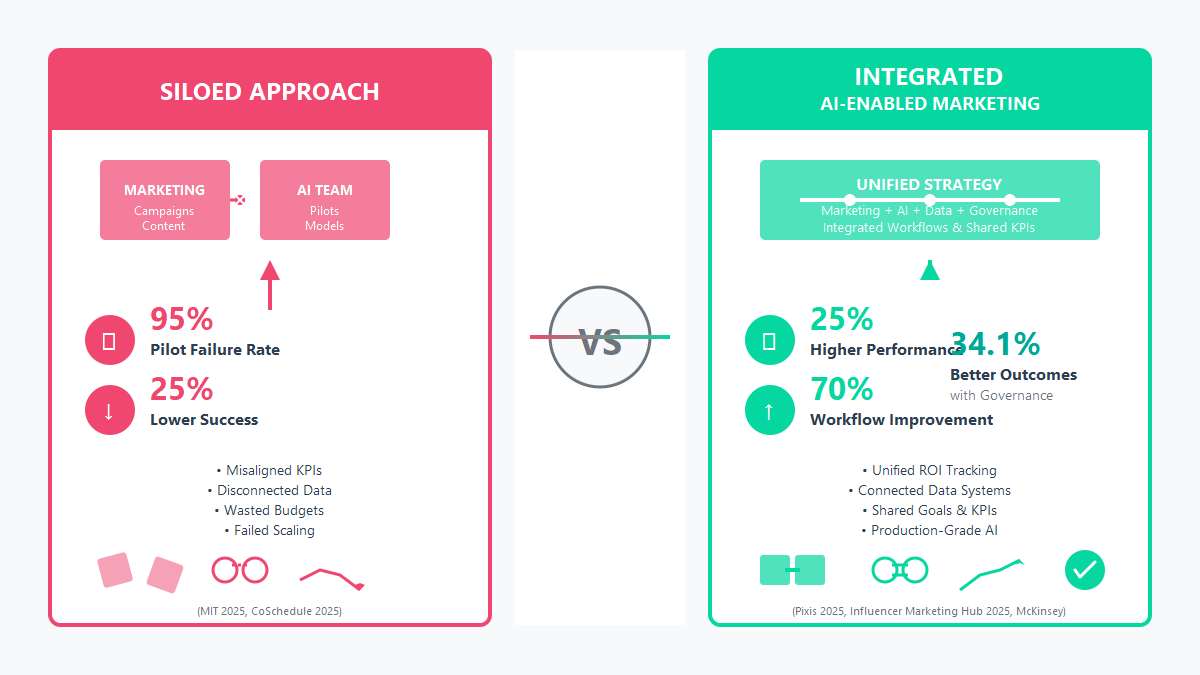
The hard truth? Separate strategies guarantee you'll be part of that 95% failure statistic. Integration isn't optional anymore—it's the prerequisite for AI to deliver actual business value.
What True Integration Actually Looks Like: Four Essential Shifts
Stop thinking about AI as something you add to marketing. Start thinking about AI-enabled marketing as the default way your business operates in 2026.
This requires four fundamental shifts in how you approach strategy, operations, governance, and culture:
Shift #1: From Bolt-On Tools to Embedded Capabilities
Real AI integration means your marketing workflows are designed around AI from the ground up, not retrofitted after the fact.
Take personalization as an example. The old way: Your team creates three versions of an email campaign, segments your database into broad categories, and hits send. The AI-enabled way: Your system analyzes individual customer behavior in real-time, generates personalized content dynamically, predicts optimal send times for each recipient, and adjusts messaging based on engagement patterns—all automatically.
This isn't science fiction. According to Pixis's 2025 AI Marketing Statistics, 70% of marketers who have deeply integrated AI into their workflows report tangible improvements in efficiency and outcomes. These aren't minor gains—we're talking about 20-30% improvements in conversion rates when AI handles dynamic optimization instead of humans guessing at what might work.
The key word is "embedded." Tools you bolt on stay bolt-ons. Capabilities you design into your core workflows become competitive advantages.
Shift #2: From Separate Budgets to Unified Investment
Here's a question that reveals whether you're truly integrating: Who owns the budget for your AI-enabled marketing capabilities?
If the answer involves two different departments with separate P&Ls, you're still siloed. Integrated strategy means integrated investment. Your 2026 marketing budget should include AI infrastructure, data engineering, model development, and ongoing optimization as core line items—not as "innovation experiments" funded separately by IT.
This shift requires a different conversation with your CFO. Instead of justifying AI spend based on technology adoption, you justify integrated investment based on marketing performance improvement. You're not asking for money to "pilot a chatbot"—you're investing in reducing customer acquisition cost by 15% through AI-enhanced lead qualification.
📊 Strategic Framework
Gemini's Four Strategic Pillars Framework provides a useful structure for unified investment:
- Data & Audience Architecture: Building clean, first-party data that AI can trust
- Decisioning & Orchestration: Using AI to determine what message to send, when, and to whom
- Dynamic Content & Creative at Scale: Generating personalized assets on the fly
- Measurement & Continuous Optimization: Tracking holistic outcomes, not vanity metrics
Shift #3: From Experimental Pilots to Production-Grade Governance
The reason 95% of AI pilots fail to scale? Most organizations treat AI governance as something you figure out later. By the time "later" arrives, you've built systems that can't meet compliance requirements, don't align with brand standards, and create more risk than value.
AI-enabled marketing at scale requires production-grade governance from day one:
Data Governance: Your AI models are only as good as your data. If customer data is scattered, inconsistent, or non-compliant with privacy regulations, your AI will either produce garbage outputs or create legal liability. Integration means building unified data infrastructure that AI and marketing teams both access—with proper security, privacy controls, and audit trails.
Brand Governance: Generative AI can produce content at scale, but scale without quality control creates "AI slop"—generic, off-brand content that damages your reputation. Effective governance means human oversight of AI outputs, clear brand guidelines that AI systems are trained on, and quality checks before content reaches customers.
Performance Governance: How do you know if your AI-enabled marketing is working? You need measurement frameworks that track business outcomes, not just AI metrics. Influencer Marketing Hub's 2025 Benchmark Report found that companies with robust AI governance see 34.1% significant improvements in marketing performance compared to those without formal governance structures.
Shift #4: From Tech Projects to Cultural Transformation
This is where most integration efforts actually fail—not in the strategy or technology, but in the organization's ability to change how people work.
Gartner's 2025 research identified talent and change management as the top challenge for 81% of martech leaders. When you move to AI-enabled marketing, you're asking your team to work differently. Marketers need to become comfortable interpreting AI recommendations, validating model outputs, and focusing their creativity on strategic decisions rather than tactical execution.
This cultural shift requires intentional change management:
- Cross-functional teams where marketers and data scientists work together daily
- Training programs that build AI literacy across your marketing organization (upskill 80% of your workforce)
- Celebrate wins when AI-enabled approaches outperform traditional methods
- Create new roles that bridge marketing and data science
- Rebuild incentive structures around outcomes that AI can improve
⚡ Quick Implementation Tip
Form a pilot cross-functional team with 2-3 marketers and 1-2 data/analytics people. Give them one specific use case to integrate (e.g., AI-driven email personalization). Let them learn together, document what works, then scale the model across other teams.
Implementation Roadmap: Eight Critical Steps
Based on consolidating best practices from successful AI-enabled marketing transformations, here's your practical implementation path:
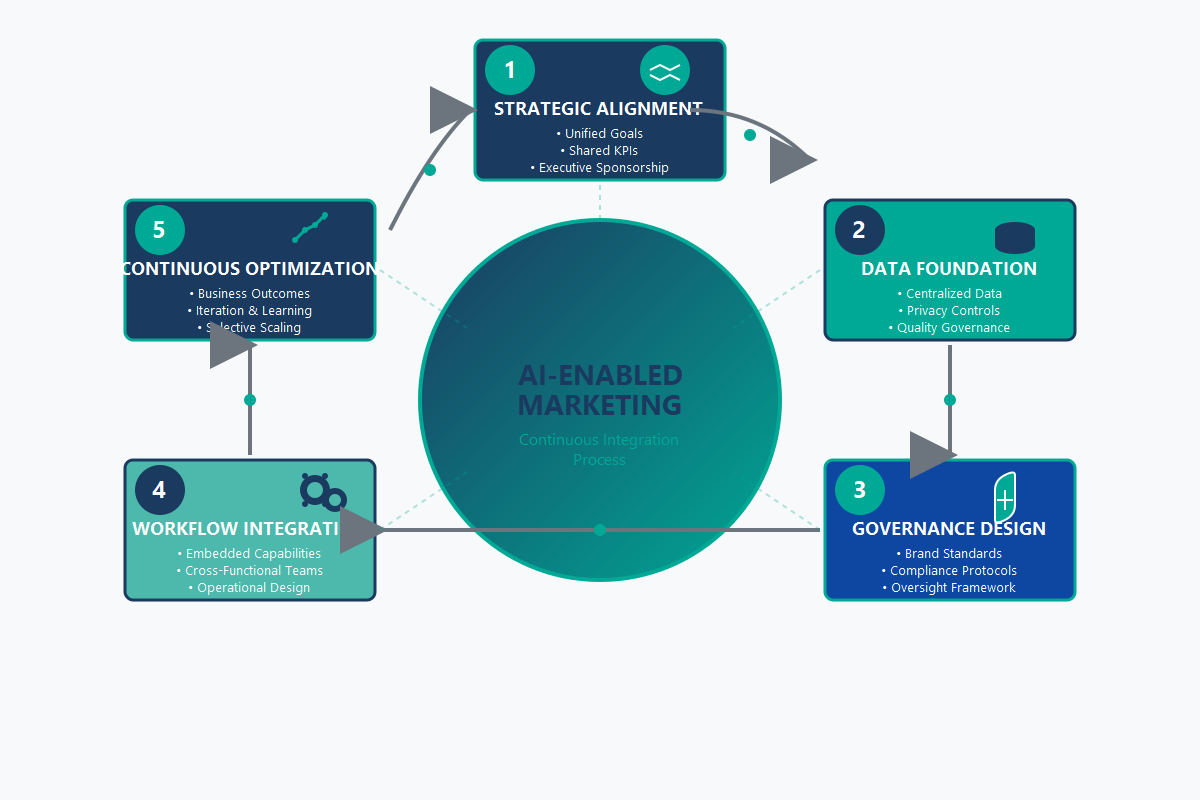
1. Start with an AI-marketing audit — Map current marketing processes, tools, data flows, and identify gaps, redundancies, and integration opportunities.
2. Define unified KPIs — Combine marketing and financial metrics (CAC, LTV, conversion rates, retention) ensuring AI plays a role in improving these business outcomes, not operating as separate metrics.
3. Build the data foundation — Ensure customer data is centralized, clean, privacy-compliant, and accessible across marketing and AI teams with proper governance.
4. Form a cross-functional AI-marketing task force — Include marketing leads, data/analytics, operations, and executive sponsorship with clear accountability and shared goals.
5. Design governance framework — Establish data governance, brand standards, compliance protocols, and performance measurement before deploying AI capabilities.
6. Pilot integrated workflows — Choose 1-2 high-impact marketing use-cases (personalized content sequencing, AI-driven segmentation, automated ad optimization), test thoroughly, and measure business impact.
7. Measure outcomes, not outputs — Track impact on ROI, conversion rates, LTV, and CAC, not just "AI tasks completed" or model accuracy scores.
8. Scale selectively and iterate — Double down on workflows driving measurable value; decommission those delivering minimal impact; treat AI-enabled marketing as a living system requiring continuous refinement.
💡 Need Help With Implementation?
Every business situation is unique. The frameworks above provide structure, but successful implementation requires adapting them to your specific challenges, resources, and organizational context.
Let's discuss how these strategies apply to your business: Schedule Your Strategy Session →
The 2026 Reality: Integration Is No Longer Optional
Here's what the data tells us about where this is heading.
PwC projects AI will contribute $15.7 trillion to the global economy by 2030. The companies capturing that value won't be the ones with the most advanced AI technology—they'll be the ones who integrated AI into their core business operations earliest and most effectively.
For marketing specifically, the gap between integrated and non-integrated approaches is already measurable and widening. The 25% performance gap from CoSchedule's research isn't narrowing—it's expanding. As AI capabilities improve, companies with integrated strategies compound their advantages. Companies still running separate strategies fall further behind, quarter after quarter.
By the end of 2026, we expect to see a clear competitive bifurcation: Winners who treated AI integration as strategic priority number one, and laggards still trying to figure out how to connect their AI pilots to actual business outcomes.
Which category will your company be in?
|
This post is part of The B2B Marketing Reality Check The strategic framework for growth-stage B2B tech companies — now available in paperback and Kindle. Every topic we cover in this blog goes deeper in the book, with frameworks, diagnostics, and quick wins you can put to work immediately. Get the Free PDF →Want to work through the framework hands-on? Get the companion workbook → |
Frequently Asked Questions: AI Marketing Integration
How long does AI marketing integration typically take?
Based on our client work, initial integration (Steps 1-6 above) takes 3-6 months for most mid-market companies. However, AI-enabled marketing is a continuous transformation, not a one-time project. Plan for an 18-24 month journey to reach full maturity, with measurable improvements visible within the first quarter.
What budget should we allocate for AI marketing integration?
Rather than a separate AI budget, integrate these costs into your marketing P&L. Expect 20-30% of your marketing technology budget to shift toward AI-enabled capabilities over 12-18 months. More important than the dollar amount is the strategic commitment—companies that succeed treat this as core marketing investment, not experimental innovation spend.
When should we hire outside expertise vs. handle integration internally?
Hire external strategic guidance for: initial assessment, governance framework design, and cross-functional team structure. Build internal capabilities for: ongoing workflow optimization, content creation, and performance measurement. The 70/30 rule applies here too—invest 70% in building internal change management and process capabilities, 30% in external technology expertise.
How do we measure ROI on AI marketing integration?
Track business outcomes, not AI metrics. Focus on: reduction in customer acquisition cost (CAC), improvement in customer lifetime value (LTV), increase in conversion rates across the funnel, and reduction in time-to-value for marketing campaigns. Companies with robust measurement see ROI within 6-9 months of starting integrated workflows.
Your Next Step: From Understanding to Action
If you're reading this and recognizing your organization in the "separate strategies" description, you're not alone—and you're not out of options.
The good news: You don't need to rebuild everything overnight. Successful integration starts with honest assessment of where you are today, clear vision of where you need to be, and a practical roadmap for closing that gap.
Ready to Implement Integrated AI-Enabled Marketing?
Every business situation is unique. Let's discuss how these AI marketing integration frameworks apply to your specific challenges and opportunities.
Our strategic consultation will help you:
- Assess your current marketing operations and AI initiatives
- Identify integration opportunities and governance gaps
- Design a practical implementation timeline for your context
- Build organizational readiness for change management
No sales pitch. Just strategic insights tailored to your business.
About Insight2Strategy
Insight2Strategy helps B2B companies transform marketing and business development strategies into measurable revenue growth. Our strategic consulting focuses on market positioning, competitive intelligence, and go-to-market execution that drives real business outcomes.
Ready to discuss your marketing and AI integration strategy? Schedule a consultation | Visit our website


Comments
Post a Comment