The 2025 Marketing Audit That Actually Predicts 2026 Success (Most Companies Are Looking at the Wrong Metrics)
The 2025 Marketing Audit That Actually Predicts 2026 Success
Strategic Analysis by: Insight2Strategy
Published: January 5, 2026
Executive Reading Time: 8 minutes
Executive Strategic Insights
- Only 26% of executives trust their marketing ROI measurement - Most companies confuse activity tracking with business outcome measurement
- 40-50% of marketing spend has no traceable connection to customer acquisition - This money can be reallocated to proven channels
- 60% of B2B marketers can't demonstrate MarTech ROI - Many tools serve the tool vendor's strategy, not yours
- Companies with predictable marketing engines grow 25% faster - The test: Can you create "If-Then" statements about your marketing ROI?
- Framework detailed below: Four strategic questions that separate guessing from knowing what actually drives customer acquisition
You've got a spreadsheet full of 2025 marketing numbers. Traffic is up. Email open rates look decent. Your social engagement graphs trend upward. But here's the uncomfortable question: Can you actually tell me which campaigns brought in customers who stayed and spent money?
If you're staring at that question with uncertainty, you're not alone. Most businesses confuse marketing reporting with marketing auditing. They track activity (clicks, impressions, leads) without connecting it to what actually matters: customer acquisition cost, retention, and revenue impact.
Only 26% of executives believe their marketing organizations are effectively measuring and reporting on ROI [Gartner, 2023]. That's not a measurement problem—that's a fundamental disconnect between what marketing tracks and what business needs to know.
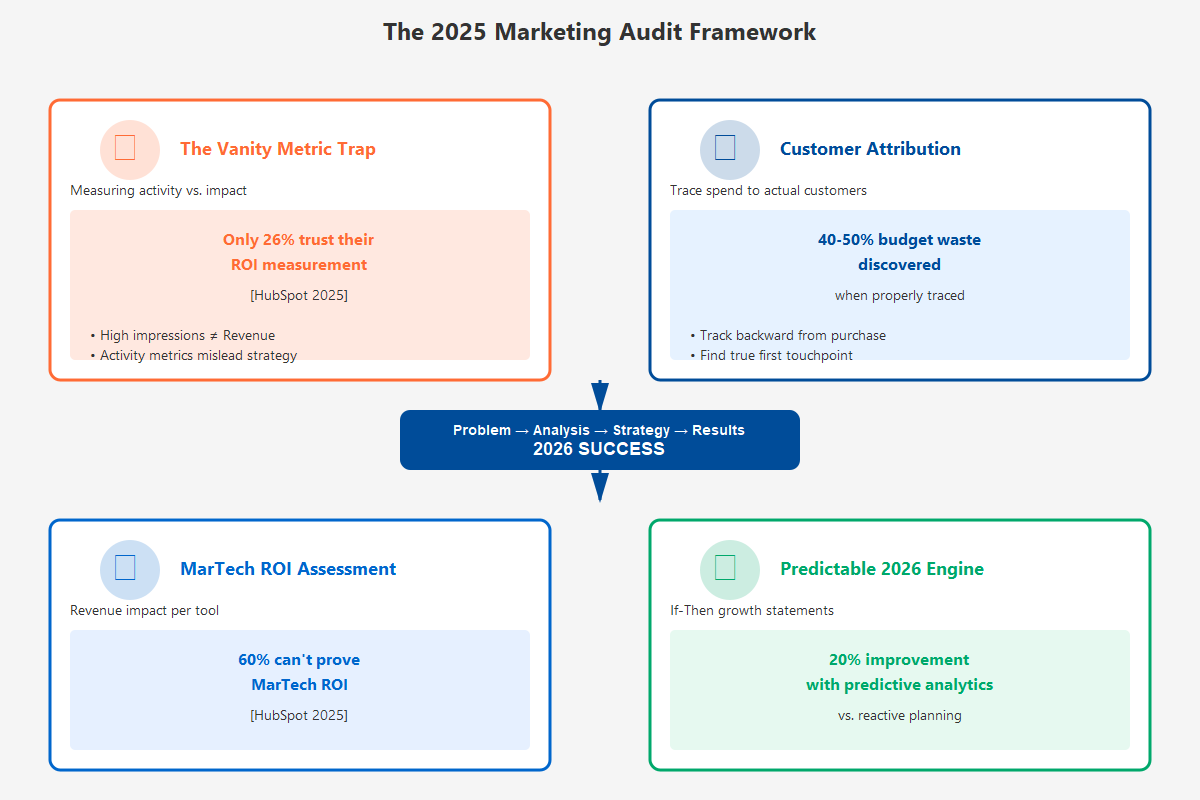
Here's what makes 2025 different: The businesses that thrived this year weren't the ones with the biggest marketing budgets. They were the ones who could answer four specific questions about what actually worked. Before you finalize your 2026 budget, these are the same four questions you need to answer about your 2025 marketing.
Need help conducting your 2025 marketing audit? These four questions are simple, but applying them to real-world data requires strategic expertise.
The Vanity Metric Trap: Why Your Reports Might Be Lying
Let's start with an uncomfortable truth: most marketing reports are designed to look good, not to drive decisions. They lead with impressive-sounding numbers—10,000 impressions! 500 new followers! 25% email open rate!—that have almost no correlation with business outcomes.
Research shows that 41% of marketers say they can't effectively measure marketing across channels [Supermetrics, 2025], and 43% of CMOs believe less than half of their marketing data can be trusted [Business Wire / Adverity Research, 2025]. Even more concerning, 45% of the data marketers use to make business decisions is incomplete, inaccurate, or out of date [Demand Gen Report / Adverity, 2025].
⚡ Quick Implementation Tip
Pull up your most recent marketing dashboard. For each metric displayed, ask: "If this number doubled tomorrow, would it guarantee more revenue?" If the answer is no, it's a vanity metric that's distracting you from what matters.
This disconnect creates what we call "The Shiny Metric Trap." Teams optimize for metrics that are easy to measure (clicks, likes, traffic) instead of metrics that actually matter (customer acquisition cost, customer lifetime value, revenue attribution). The result? You're flying blind on the only question that matters: where did the revenue actually come from?
The businesses that can answer this question accurately have a massive competitive advantage. They know exactly which channels deliver customers at what cost. They can confidently scale what works and cut what doesn't. Everyone else is guessing.
Question 1: What Percentage of Your 2025 Marketing Spend Can You Trace to Actual Customers?
Not leads. Not prospects. Not "marketing qualified leads." Actual paying customers who gave you money.
This is where most audits fall apart. Companies can tell you exactly how much they spent on Facebook ads, but they can't tell you if a single customer came from those ads. They know their email list grew, but they can't trace email subscribers to closed deals.
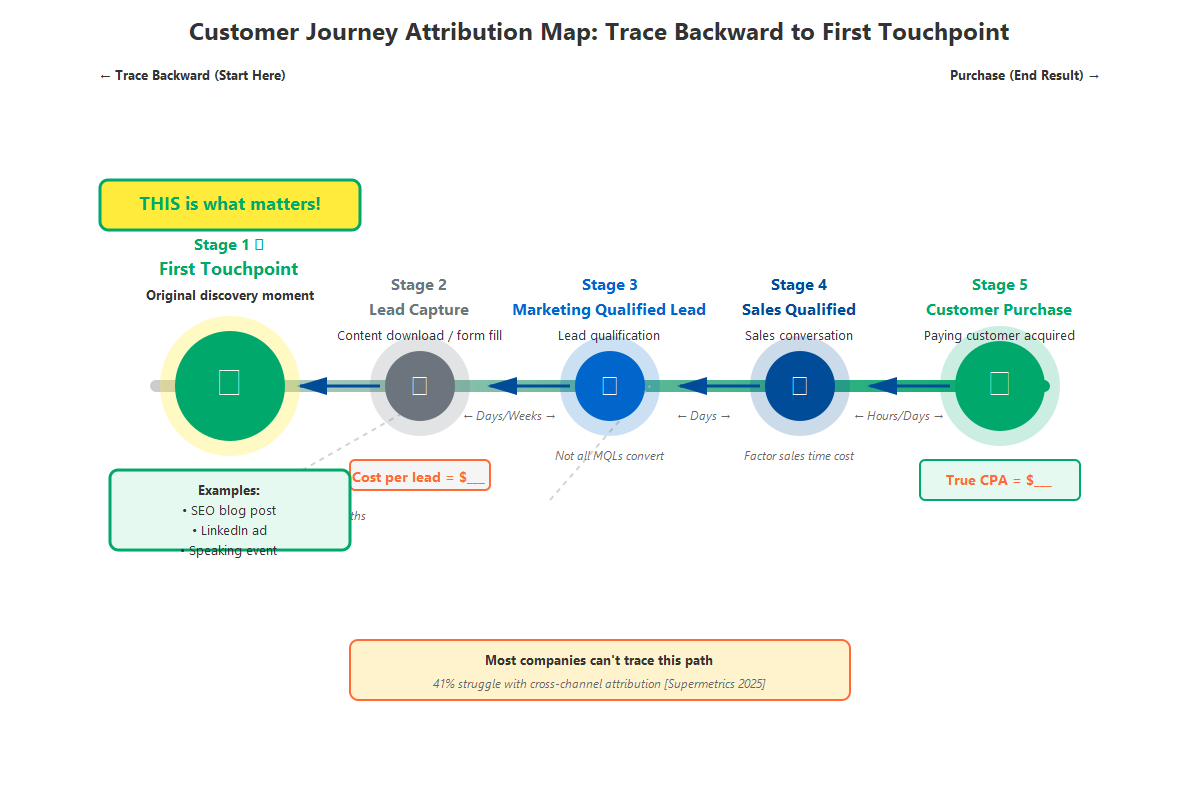
Here's the practical test: Pull your 2025 marketing expenses. List every campaign, every channel, every dollar spent. Now, using your CRM or sales records, trace each expense to actual customer acquisition. If you can't make that connection, that's marketing spend with unproven ROI.
The math is brutal but clarifying. For most businesses we work with, when they first run this analysis, they discover 40-50% of their marketing spend has no traceable connection to customer acquisition. That's not a guess—that's money you can reallocate to channels that actually work.
⚡ Quick Implementation Tip
The action item: List your top 10 customers from 2025. Work backward through your CRM or sales notes to identify their first marketing touchpoint—the single moment that introduced them to your business. Now look at what percentage of your 2025 budget went to that channel. Most businesses discover they over-invested in high-volume, low-quality channels and under-invested in the channels that actually brought their best customers.
Companies that align marketing and sales strategies see 20% higher revenue growth [HubSpot, 2024]—and that alignment starts with measuring what actually worked.
Question 2: Which 2025 Channels Delivered High Volume but Low-Value Customers?
Volume is seductive. It feels good to say "we generated 500 leads this quarter." But if 450 of those leads never converted, or if the 50 who did convert churned within 90 days, that's not marketing success—it's a funnel problem.
Here's where cost per acquisition (CPA) becomes your most important metric—but you need to calculate true CPA, not just cost per lead. True CPA includes:
- Direct advertising spend
- Content creation costs
- Tool and platform fees
- Team time (yes, salary costs matter)
- Sales time required to close the deal
When you run these numbers honestly, many "low-cost" channels suddenly become expensive. That $50 Facebook lead might have cost $2,000 in total resources to convert into a customer. Meanwhile, that $500 speaking engagement might have generated three customers at $700 each in true CPA.
📊 Implementation Framework
Top ROI performers demonstrate this clearly: SEO leads with 748% ROI, email at 261%, and webinars at 213% [Data-Mania, 2025]. But these impressive numbers only matter if you're measuring quality, not just quantity. Need help calculating your true CPA and identifying your highest-ROI channels? Let's discuss your specific situation.
Businesses often stick with trendy channels without checking performance, ignoring data silos. This can inflate acquisition costs by 2-3x. A service firm might find LinkedIn converts better than Instagram for B2B—the key is actually running the numbers to find out.
Question 3: How Much Did You Waste on Marketing Technology That Didn't Impact Revenue?
The average B2B company now uses 12+ marketing tools. Email automation. Social scheduling. SEO trackers. Analytics platforms. CRM systems. Content management. The list goes on.
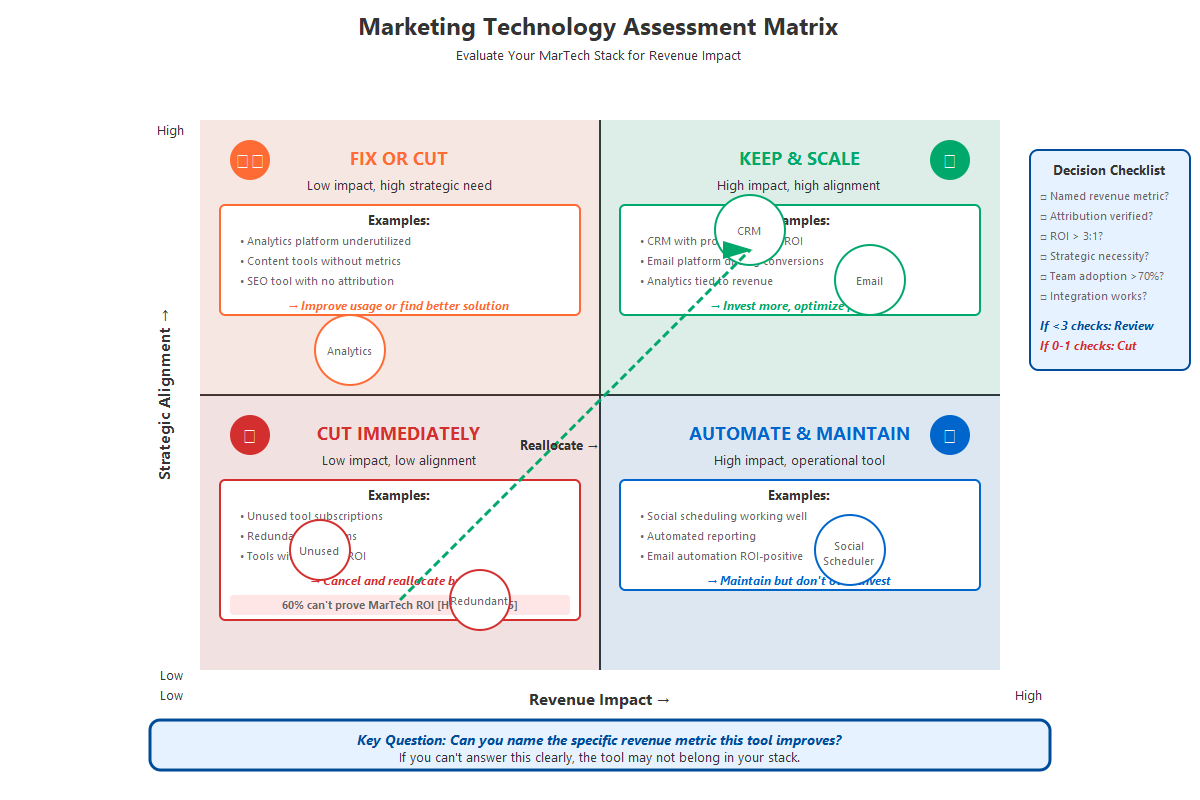
Here's the uncomfortable question: for each tool, can you point to a specific revenue metric it improved?
Research shows 60% of B2B marketers struggle to demonstrate the quantitative impact of marketing technology investments [DemandGen Report, 2024]. That's a polite way of saying most companies are paying for tools they can't prove deliver value.
⚡ Quick Implementation Tip
Run this audit: List every marketing tool you paid for in 2025. Next to each tool, write the specific revenue metric it impacted. "Made things easier" doesn't count. "Saved time" doesn't count unless you can show what you did with that time that generated revenue. If you can't fill in that second column with an actual number, you're wasting money.
This isn't about being anti-technology. It's about ensuring your marketing technology serves your strategy, not the other way around. The most common mistake we see is businesses that add tools hoping to solve strategy problems. A new CRM won't fix a poor lead qualification process. Better social scheduling won't fix content that doesn't resonate with your audience.
The fix: Start with strategy. What needs to improve? What specific outcome would indicate improvement? Only then ask: what tool, if any, would help achieve that outcome? And once you deploy the tool, measure whether it actually delivered the outcome you needed.
Question 4: How Do You Turn Your 2025 Results Into a Predictable 2026 Engine?
Here's the difference between a marketing audit and a marketing report: A report tells you what happened. An audit tells you what to do next.
The test of a good audit is whether it makes your 2026 marketing predictable. Can you say with confidence: "If we invest $X in channel Y, we'll acquire Z customers at $W cost-per-acquisition"? That's not guessing. That's marketing as a predictable growth engine.
Predictive marketing analytics can increase lead qualification rates by up to 20% [Aberdeen Group, 2023]. But that only works if you're measuring the right inputs. Companies with integrated marketing-performance tracking grow 25% faster than those relying on campaign-based analytics [Deloitte CMO Survey, 2025].
📊 Implementation Framework
Here's how to build predictability: 1) Start with your 2026 revenue goal (actual dollars). 2) Work backward to required customers (revenue ÷ avg LTV). 3) Calculate required conversion rates at each stage. 4) Determine required marketing investment based on proven 2025 CPA. The magic happens when you can create an "If-Then" statement about your marketing ROI. Need help building this framework for your business? Let's talk strategy.
That level of predictability only comes from honest measurement of what actually worked in 2025.
The 90-Minute Audit That Changes Everything
You don't need a complex attribution model or expensive analytics platform to run this audit. You need 90 minutes, access to your financial records and CRM, and willingness to face uncomfortable truths.
Block the time. Grab a spreadsheet. Answer these four questions with actual data:
- What percentage of your 2025 marketing spend can you trace to actual customers?
- Which channels delivered high volume but low-value customers?
- How much did you waste on marketing technology that didn't impact revenue?
- Can you turn your 2025 results into a predictable 2026 engine?
For most businesses, this 90-minute exercise reveals 30-40% budget waste, identifies 2-3 high-ROI channels deserving more investment, and exposes the gap between activity and impact.
The urgency: 83% of B2B marketing decision-makers expect increased investment in 2026 [Forrester, 2025]. The businesses that will dominate 2026 are the ones conducting this audit in January, not discovering problems in July.
Why Most Companies Skip This (And Pay the Price)
We know why this audit gets skipped. It's uncomfortable. It might reveal that the expensive campaign the CEO loved didn't generate a single customer. It might show that the "innovative" strategy the team championed for six months produced zero results.
But here's the harder truth: 75% of companies with a formalized, documented marketing strategy outperform those without one [CoSchedule, 2023]. The gap between winners and losers in 2026 won't be creativity or budget size. It'll be measurement discipline.
The companies that can't answer these four questions will keep optimizing for vanity metrics while wondering why revenue stays flat. The companies that face the data honestly will reallocate budgets, double down on what works, and turn marketing from a cost center into a predictable growth engine.
Ready to Conduct Your 2025 Marketing Audit?
This audit framework is simple, but applying it to your messy, real-world 2025 data is complex. You need to account for multi-touch attribution, separate correlation from causation, factor in lag time between marketing activity and revenue impact, and identify which "successful" campaigns actually cannibalized existing customers versus bringing in new revenue.
That's where expert guidance makes the difference between an accurate audit and an exercise in self-deception.
We'll help you answer these four questions with precision, identify your hidden ROI drivers, and build your 2026 marketing budget around channels that actually deliver predictable customer growth.
No sales pitch. Just strategic insights tailored to your business.
Frequently Asked Questions
How do I conduct a marketing audit for my business?
Start with the four-question framework outlined above. Block 90 minutes, access your financial records and CRM, and systematically trace your marketing spend to actual customer acquisition. The key is being willing to face uncomfortable truths about what didn't work, not just celebrating what did.
What's the difference between cost per lead and true customer acquisition cost?
Cost per lead only measures the expense to generate a lead. True customer acquisition cost includes direct advertising spend, content creation costs, tool and platform fees, team time (salary costs), and sales time required to close the deal. Many "low-cost" lead generation channels become expensive when you factor in all resources required to convert leads into paying customers.
How do I trace marketing spend to actual customer acquisition?
Start by listing your top 10-20 customers from 2025. Work backward through your CRM or sales notes to identify their first marketing touchpoint—the single moment that introduced them to your business. Then calculate what percentage of your marketing budget went to that channel versus the revenue those customers generated. This reveals your true ROI by channel.
How do I make my marketing more predictable and measurable?
Build predictability by working backward from your revenue goal: 1) Set specific revenue target, 2) Calculate required customers (revenue ÷ avg customer LTV), 3) Determine required conversion rates at each funnel stage, 4) Calculate required marketing investment based on proven cost-per-lead from quality channels. The goal is creating "If-Then" statements: "IF we invest $X in channel Y, THEN we'll acquire Z customers at $W CPA."
What are vanity metrics vs. revenue metrics?
Vanity metrics are easy to measure but don't correlate with business outcomes: impressions, likes, followers, website traffic, email open rates. Revenue metrics directly connect to business results: customer acquisition cost, customer lifetime value, revenue attribution by channel, conversion rates at each funnel stage, true ROI by campaign. The test: If a metric doubled tomorrow, would it guarantee more revenue?
How do I evaluate my marketing technology ROI?
List every marketing tool you pay for. Next to each tool, write the specific revenue metric it improved. If you can't name a concrete revenue impact (not "made things easier" or "saved time"), you're wasting money. Then ask: Does this tool serve your strategy, or are you adapting your strategy to the tool? Start with strategic outcomes, then select tools—not the other way around.
Verified Statistics & Sources
All statistics verified from 2023-2025 sources:
- 26% of executives trust marketing ROI measurement - Gartner CMO Spend Survey, 2023
- 41% can't measure marketing across channels - Supermetrics Marketing Data Report, September 2025
- 43% of CMOs distrust half their data - Business Wire / Adverity Research, September 2025
- 45% of marketing data is inaccurate - Demand Gen Report / Adverity, September 2025
- 20% higher revenue growth with aligned marketing/sales - HubSpot State of Marketing, 2024
- 748% ROI for SEO, 261% for email - Data-Mania B2B Marketing ROI Benchmarks, 2025
- 60% can't prove MarTech ROI - DemandGen Report, 2024
- 20% improvement with predictive analytics - Aberdeen Group, 2023
- 25% faster growth with integrated tracking - Deloitte CMO Survey, 2025
- 83% expect increased 2026 investment - Forrester B2B Marketing Budgets, July 2025
- 75% with formalized strategy outperform - CoSchedule, 2023
About Insight2Strategy
We help growing B2B companies cut through marketing confusion to find strategies that actually drive revenue and customer growth. Our focus: turning marketing from a cost center into a predictable growth engine.


Comments
Post a Comment