If You're Marketing to Everyone, You're Selling to No One—The 2026 ICP Reality Check (Using Your 2025 Data)
If You're Marketing to Everyone, You're Selling to No One—The 2026 ICP Reality Check (Using Your 2025 Data)
Strategic Analysis by: Insight2Strategy
Published: January 12, 2026
Executive Reading Time: 12 minutes
Executive Strategic Insights
- Strategic Misalignment: The disconnect between your assumed Ideal Customer Profile and actual 2025 purchasing data isn't a marketing problem—it's a C-suite strategic issue affecting unit economics and enterprise value
- Data-Driven Transformation: Organizations with clearly defined ICPs see 68% higher win rates, but behavioral intelligence delivers 5-7× higher ROI than demographic-only targeting
- Cross-Functional Imperative: Strategic ICP refinement requires executive sponsorship across sales, product, marketing, and customer success—not just marketing optimization
- Cultural Challenge: The hardest part isn't identifying ideal customers; it's creating organizational incentives that reward strategic focus over volume metrics
- Quarterly Discipline: Living ICPs require ongoing executive review cycles monitoring both outcomes (CAC, LTV, win rates) and organizational behaviors
- Unit Economics Focus: Success means walking away from prospects who don't match your high-value behavioral profile—the actual test of strategic discipline
Framework detailed below.
The Uncomfortable Truth About Your Customer Strategy
Here's the uncomfortable truth most CEOs and marketing leaders avoid: that "everyone is our customer" strategy you've been running isn't optimism—it's a slow bleed on your P&L. As we enter 2026, the executive teams seeing genuine market traction aren't the ones with the broadest campaigns. They're the ones who used their 2025 data to answer one brutally specific question: Who actually bought from us, and why?
The disconnect between your assumed Ideal Customer Profile and your actual 2025 purchasing data isn't just a marketing problem—it's a strategic misalignment that starts at the top. When McKinsey reports that companies with undefined ICPs experience measurably slower profit growth, they're talking about strategic drift: sales chasing phantoms, product building for ghosts, and executive leadership wondering why ARR targets keep slipping quarter after quarter.
The data is stark: organizations that clearly define their ideal customer profile see 68% higher win rates compared to those that don't [SuperOffice, 2024]. But here's the kicker—even well-meaning ICPs often miss the mark because they're built only on firmographics (industry, size, revenue). Research shows that B2B firms targeting based on psychographics and behavioral data see 5–7× higher ROI, with conversion rates climbing by approximately 30% compared to purely demographic-based ICPs [Multiple industry sources, 2024-2025].
This isn't about refining your targeting. It's about strategic transformation that shows up in your unit economics, your enterprise value, and your competitive positioning. And your 2025 transaction data is the only evidence that matters.
Want strategic insights on ICP refinement?
The C-Suite Cost of Guesswork ICP
The failure mode isn't obvious in quarterly reviews. Your marketing team reports MQL growth. Sales shows pipeline expansion. But when you pressure-test those numbers against actual closed revenue and customer retention, the story changes dramatically.
For many intermediate-level businesses, the Ideal Customer Profile remains a static document—a collection of easy-to-gather data points like industry, company size, and revenue. While these firmographics offer a useful starting point, they are fundamentally poor predictors of customer value and retention. According to D&B's B2B data report, 35% of companies identify data accuracy as a top challenge for sales and marketing [Dun & Bradstreet, 2024].
Consider the executive implications: Your sales compensation structure rewards closing any deal, not profitable deals. Your product roadmap responds to the loudest customer voices, not the most valuable ones. Your board presentation shows customer count growth, but customer acquisition costs and churn rates tell a different story.
⚠️ The Compounding Effect
The "Guesswork ICP" forces your sales team to waste cycles chasing prospects who will never truly realize the value of your product, inflating your Cost of Customer Acquisition (CAC) and dragging down lifetime value (LTV). Companies with misaligned targeting often experience 27% slower profit growth over three years [BOL Agency, 2024]. Your competitors with focused ICPs are pulling away—not in market share, but in unit economics and enterprise value.
This isn't a marketing problem—it's a strategic misalignment that requires C-suite involvement and cross-functional authority. The compounding effect? Your competitors with focused ICPs are pulling away, not in market share, but in unit economics and enterprise value.
How Do You Transform Demographics Into Predictive Behavioral Intelligence?
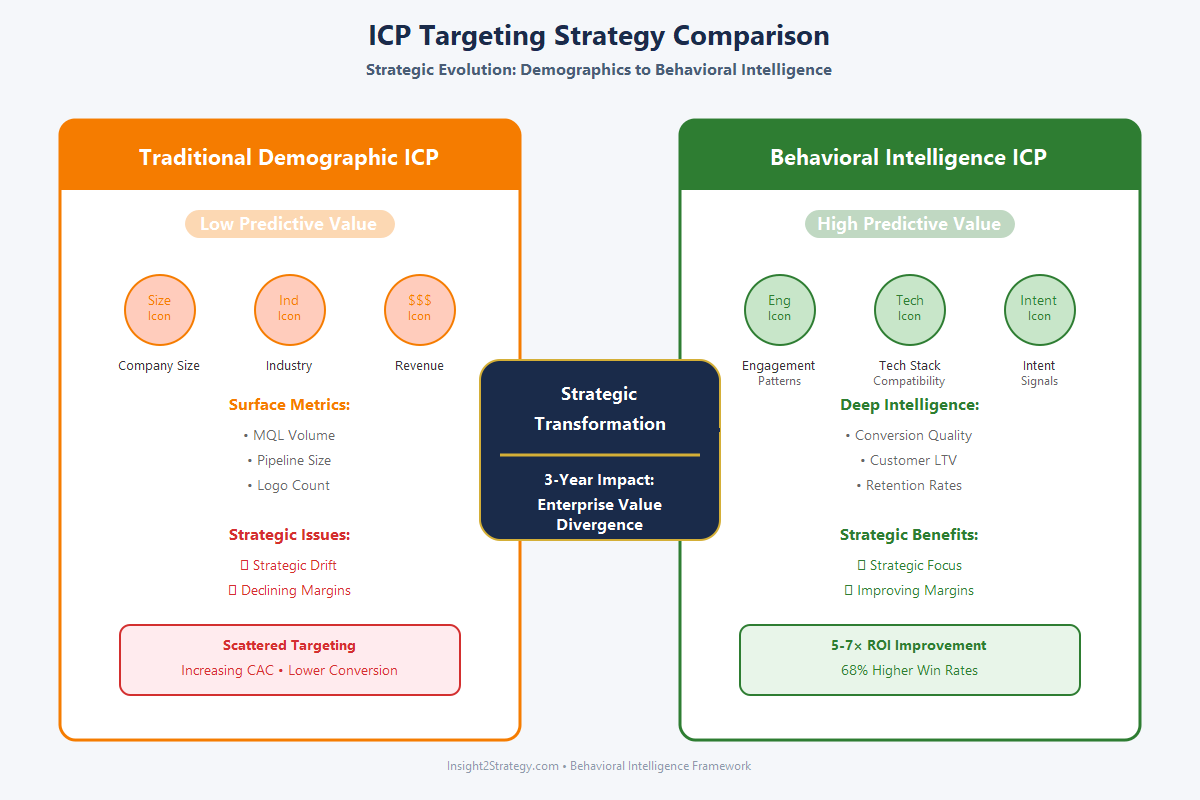
The critical shift required for 2026 is moving your customer segmentation strategy from what a company is (demographics) to how a company operates and interacts with you (behavioral and technographic data). Your best customers from 2025—the ones who renewed, expanded their contracts, and referred new business—did not just look a certain way; they acted a certain way.
The transformation required is conceptual, not tactical. Consider what separates your high-value customers:
Behavioral Intelligence:
- Did they engage with specific high-value content (white papers, pricing pages) before talking to sales?
- What was their average time-to-close compared to other prospects?
- Which features did they adopt first, and how quickly did they reach value milestones?
Technographic Signals:
- What complementary (or competing) technology are they already using?
- For B2B SaaS companies, knowing a prospect uses a specific CRM or ERP system is often a much stronger signal than simply knowing their industry [Industry research, 2025].
Intent Data:
- Are they actively searching for solutions to the problem your product solves right now?
- What signals indicate buying readiness versus casual research?
⚡ Quick Implementation Tip
Pull your 2025 closed deals and map the specific content they engaged with before sales contact. Look for patterns: Did your high-value customers download the same white paper? Visit pricing pages multiple times? Engage with specific feature pages? These behavioral signals are more predictive than company size.
This focus on predictive data is not merely a theoretical exercise—it has profound impact on resource allocation. While studies show that only 5% of companies see meaningful EBIT impact from initial data initiatives, the successful scaling of data-driven ICP strategies is rooted in this fundamental understanding of true customer value [McKinsey, 2024].
The executive decision this creates: Are you willing to walk away from logo opportunities that don't match your high-value behavioral profile? Because that's the actual test of strategic focus.
📊 Need Help Identifying Your Behavioral Patterns?
Translating 2025 data into predictive behavioral intelligence requires both analytical rigor and strategic judgment. Let's discuss how to identify the signals that separate your high-value customers from the rest.
The Strategic Framework for 2026 ICP Refinement
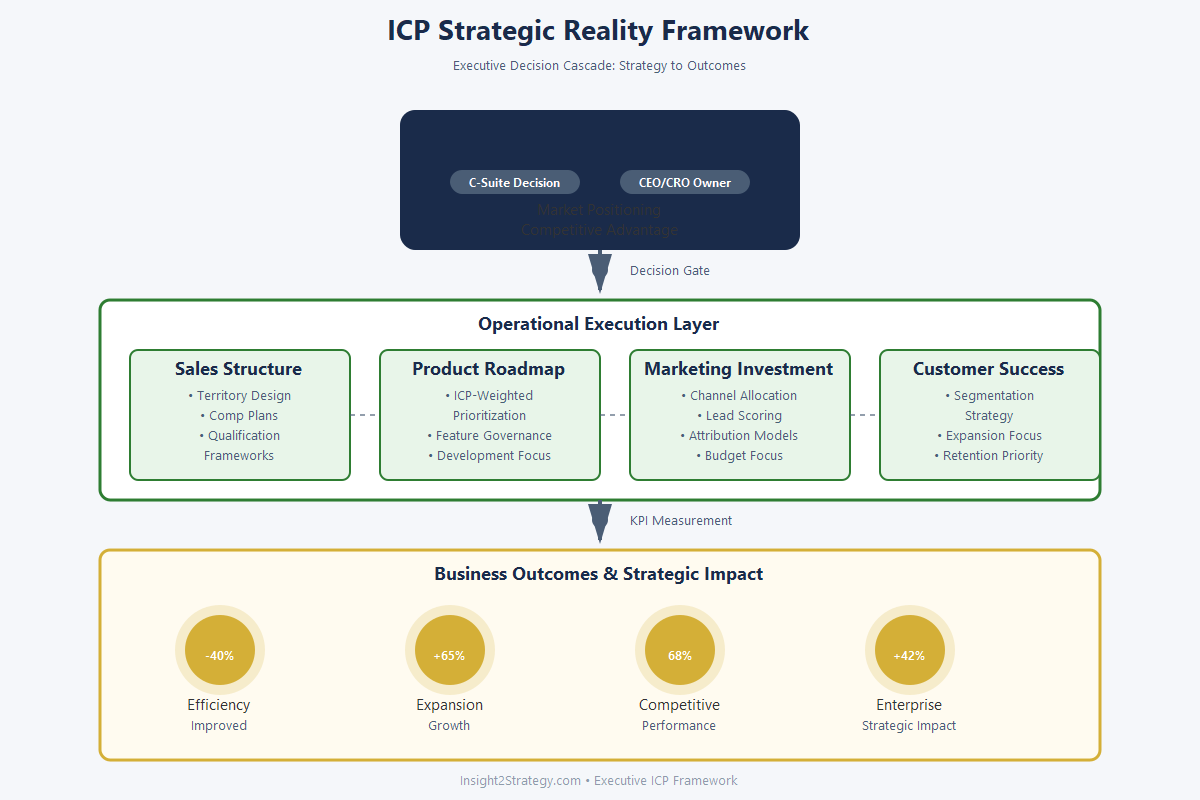
This isn't a marketing project—it's a cross-functional strategic initiative that requires executive sponsorship. The framework addresses three levels: strategic (what does this change about our positioning?), operational (how does this change our execution?), and cultural (what behaviors must we reward differently?).
Strategic Layer: Data-Driven Market Positioning
Begin with your 2025 revenue reality. Segment your customer base not by what they paid, but by total customer lifetime economics: acquisition cost, time-to-value, expansion revenue, retention rates, and support burden. Your top 10-20% should emerge clearly—not as the biggest names, but as the most profitable relationships.
The Audit Process:
- Pull 2025 deals, churned clients, and highest-LTV customers from your CRM (Salesforce, HubSpot)
- Map firmographic, technographic, and behavioral traits for each segment
- Compare your top 10-20% against your bottom 50% to identify statistically significant differences
- Identify commonalities through cluster analysis if your tech stack supports it
The strategic question: What patterns separate these customers from the rest? This requires C-suite involvement because the answers often contradict your go-to-market assumptions. Perhaps your most profitable customers are smaller than your ICP targeting suggested. Perhaps they come from adjacent industries you've been ignoring. Perhaps they follow a buying pattern you haven't been optimizing for.
Operational Layer: Predictive Modeling and Cross-Functional Alignment
Use the discrepancies identified in your audit to build a new, predictive ICP hypothesis for 2026. Replace old assumptions (e.g., "Any company in manufacturing") with verifiable, high-signal traits (e.g., "Manufacturing companies with $50M-$100M revenue, using System X ERP, whose key decision-maker downloaded our 'Cost-of-Delay' whitepaper").
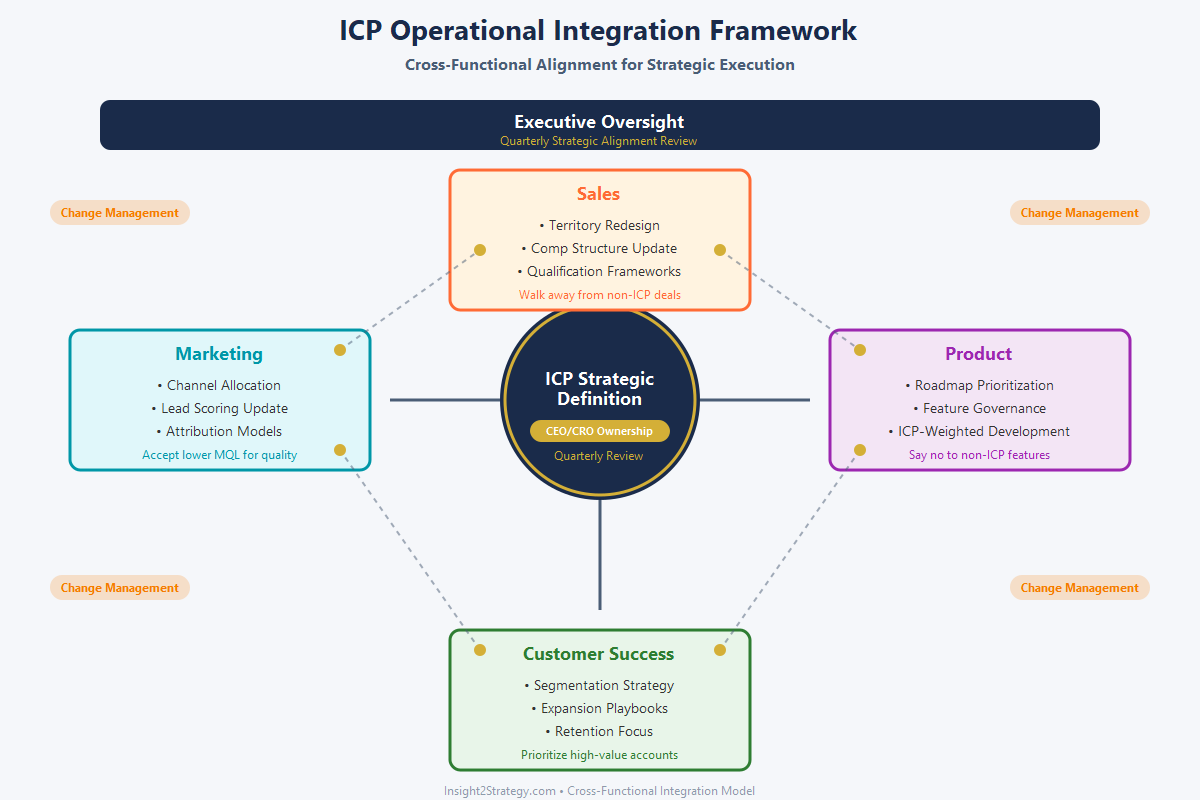
Cross-Functional Integration Requirements:
Sales Alignment:
- Restructure territories and comp plans around high-value ICP segments
- Create qualification frameworks that reward strategic discipline
- Walk away from easier but less profitable deals
Product Integration:
- Weight roadmap priorities by ICP alignment, not request volume
- Say "no" to feature requests from non-ICP customers
- Feed traits of best customers back into product development
Marketing Optimization:
- Flow investment to channels attracting high-value prospects
- Update lead scoring models to prioritize predictive traits
- Accept lower MQL counts in exchange for higher conversion rates
Customer Success Strategy:
- Segment support and expansion efforts by ICP fit
- Prioritize high-value account retention
- Use ICP data to inform upsell strategies
⚡ Quick Implementation Tip
Pilot the new ICP segments in one campaign before full rollout. Measure uplift against control group—aim for 12% revenue lift from effective segmentation [marketingltb, 2025]. Use this data to secure buy-in from skeptical stakeholders and scale gradually with dashboard tracking for quarterly adjustments.
Operationally, coordinate rollout with change management: Pilot the new segments in one campaign, measure uplift (aim for 12% revenue lift from segmentation [marketingltb, 2025]), then scale. Govern with dashboards tracking segment performance, adjusting quarterly to adapt to market shifts.
Cultural Layer: Incentive Realignment and Strategic Discipline
A refined ICP is useless if it lives in a spreadsheet. The hardest part isn't identifying your ideal customer—it's creating organizational incentives that reward focus over volume. This requires executive courage and board-level commitment.
Cultural Transformation Requirements:
- Sales leaders must defend deal qualification that reduces pipeline volume
- Marketing must accept lower MQL counts when conversion rates improve
- Product must resist feature creep from non-ICP customers
- Customer success must prioritize high-value account retention over overall customer count
Lead with training sessions and incentive alignment—e.g., tie bonuses to ICP-aligned wins. Monitor via KPIs like customer acquisition cost reduction (target 15% improvement via better retention [McKinsey, 2024]), and iterate through feedback loops.
This integration requires robust governance framework, as research shows that "AI scaling is 70% people/process, 30% technology" [McKinsey, 2024]. The process of using the data matters more than the data itself. Without executive air cover, teams will default to volume metrics because they're easier to hit and harder to argue against.
Implementation: Making ICP a Living, Quarterly-Reviewed Document
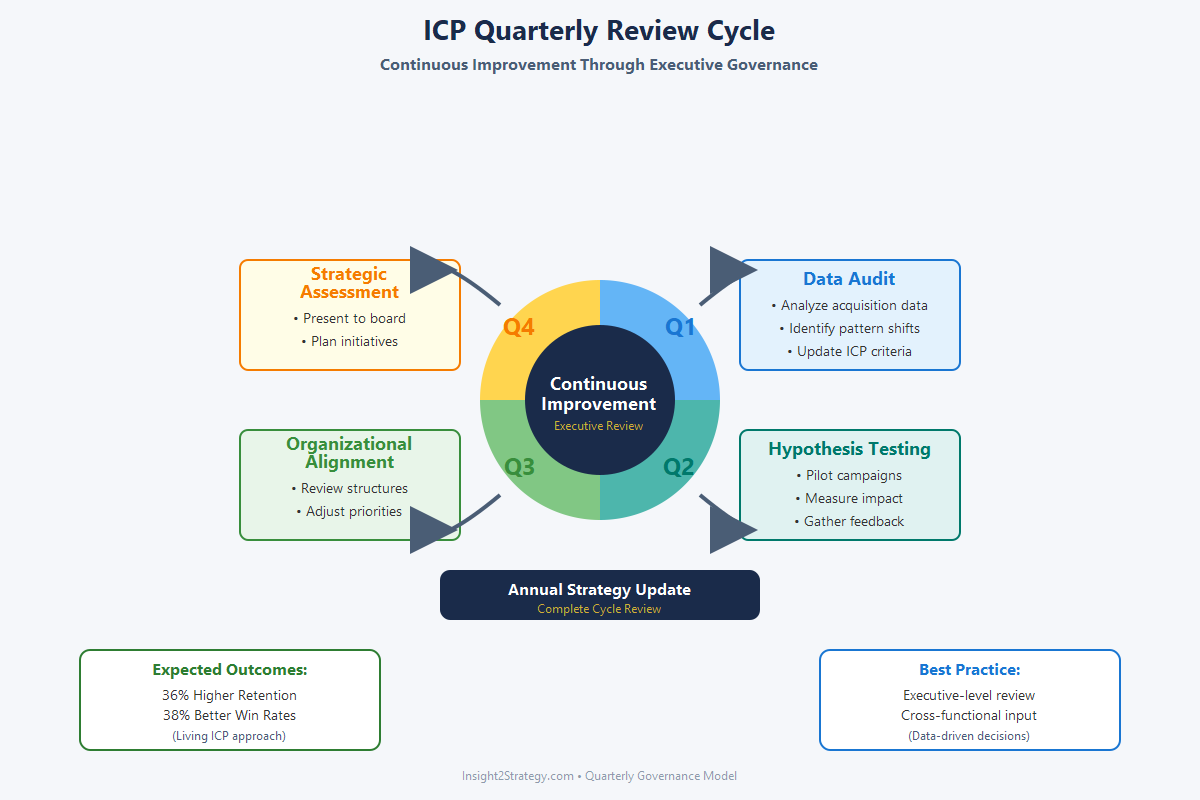
Strategic focus requires ongoing discipline. Institute a quarterly review cycle with cross-functional stakeholders (sales, marketing, customer success):
Q1: Data Audit
- Analyze previous quarter's customer acquisition and retention data
- Identify shifts in high-value customer patterns
- Update ICP criteria based on new evidence
Q2: Hypothesis Refinement
- Test ICP adjustments through pilot campaigns
- Measure impact on key metrics (CAC, conversion rates, time-to-close)
- Gather qualitative feedback from customer-facing teams
Q3: Organizational Alignment
- Review compensation structures and territory assignments
- Adjust product roadmap priorities based on ICP insights
- Reallocate marketing budgets to highest-performing ICP channels
Q4: Strategic Assessment
- Present unit economics improvements to board
- Plan strategic initiatives for following year
- Celebrate wins and learn from ICP misses
Companies that treat ICP as a living document see 36% higher customer retention rates and 38% better win rates [SuperOffice, 2024].
The Strategic Outcomes: What Success Looks Like
Calculate the true unit economics of your top 20% versus your bottom 50%. Include not just acquisition costs, but time-to-close, onboarding burden, support costs, expansion rates, and retention. The math is usually unambiguous: focusing your entire GTM motion on attracting and serving more customers like your top 20% will generate better returns than continuing to serve everyone.
Expected Strategic Outcomes from ICP Refinement:
Financial Impact:
- CAC reduction of 15-40% through improved targeting efficiency
- LTV expansion of 30-65% via better customer fit and retention
- Gross margin improvement from reduced support burden
- Faster payback periods on customer acquisition investments
Competitive Positioning:
- Market leadership in target ICP segments versus broad market participation
- Pricing power improvement when you're the obvious choice for ideal customers
- Product-market fit strengthening as development focuses on core ICP needs
- Partner ecosystem alignment around shared ICP characteristics
Organizational Effectiveness:
- Sales cycle velocity increase when selling to high-fit prospects
- Product development efficiency from clear feature prioritization
- Marketing ROI improvement from concentrated channel investment
- Employee satisfaction gains from serving customers who value your solution
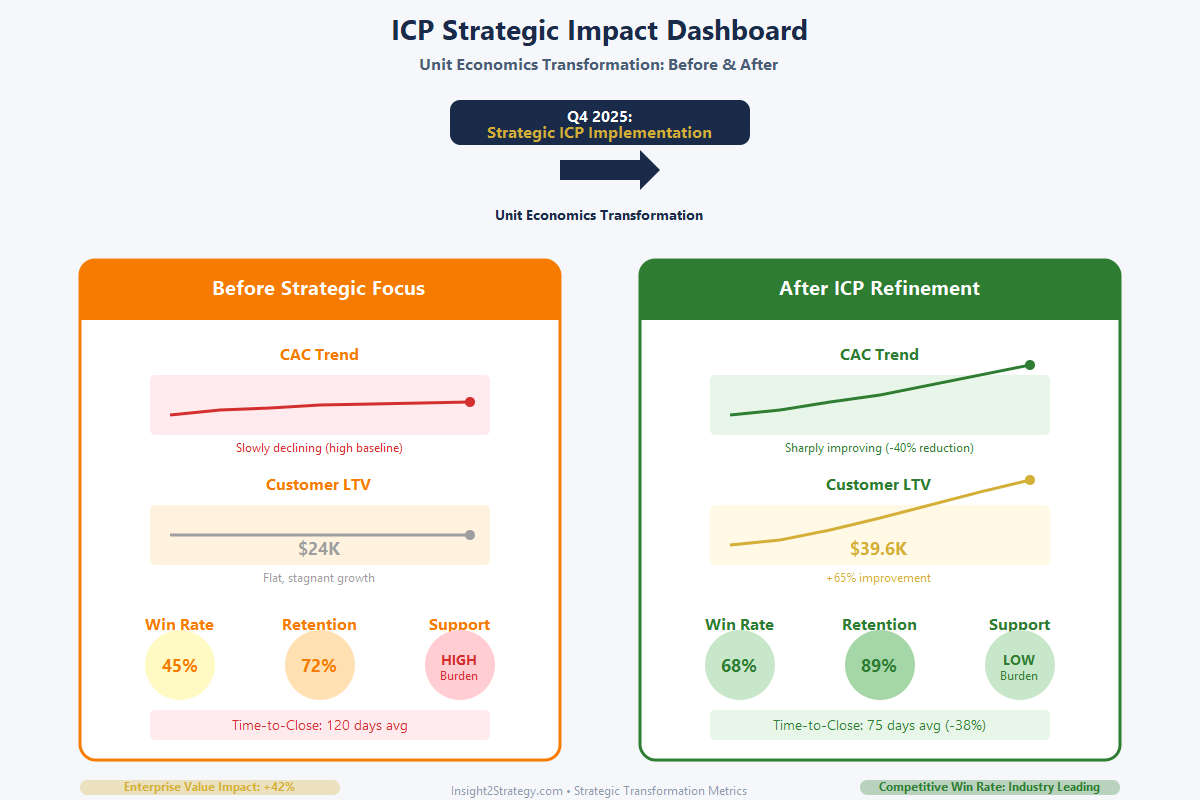
📊 The Unit Economics Reality
But this requires executive confidence to make strategic bets based on historical data, knowing that narrowing your targeting might initially reduce pipeline volume. The companies that win in 2026 are the ones whose leadership teams trust their data more than their assumptions.
Conclusion: Strategic Focus Requires Executive Courage
The days of broad, untargeted marketing are over. In a competitive landscape, the only way to achieve scalable, predictable, and profitable growth is through laser-focused customer targeting. Your 2025 customer data is your most valuable asset, providing the clearest signal yet of who you should be pursuing in 2026.
Refining your ideal customer profile isn't optional—it's the foundation for sustainable growth in 2026. This ICP reality check—moving from generic demographic segmentation to a technically accurate, behaviorally predictive model—is the single most important strategic task for your marketing team this quarter.
By leveraging 2025 data through structured frameworks, you'll avoid the pitfalls of broad targeting and unlock higher win rates, conversions, and retention. The question isn't whether your marketing team can execute better targeting. The question is whether your leadership team is ready to make hard choices about who you serve, what you build, and how you compete.
Stop marketing to everyone and start selling to the right one.
Ready to Turn Your 2025 Data Into Your 2026 Growth Strategy?
If you're a CEO, CMO, or CRO ready to stop relying on guesswork and want to build a truly predictive ICP for 2026, let's talk. This isn't about optimizing campaigns—it's about strategic transformation that shows up in your unit economics, your enterprise value, and your competitive positioning.
No sales pitch. Just strategic insights tailored to your business. We'll dive into your data and craft a tailored plan for strategic focus that drives measurable business outcomes.
|
This post is part of The B2B Marketing Reality Check The strategic framework for growth-stage B2B tech companies — now available in paperback and Kindle. Every topic we cover in this blog goes deeper in the book, with frameworks, diagnostics, and quick wins you can put to work immediately. Get the Free PDF →Want to work through the framework hands-on? Get the companion workbook → |
Frequently Asked Questions About ICP Refinement
How often should we update our ideal customer profile?
Strategic ICP refinement should follow a quarterly review cycle as outlined in this framework. However, major market shifts, product pivots, or competitive dynamics changes warrant immediate reassessment. The key is treating ICP as a living document with ongoing governance, not a set-it-and-forget-it annual exercise.
What's the difference between firmographics and behavioral data in ICP?
Firmographics describe what a company is: industry, size, revenue, location. Behavioral data reveals how a company acts: engagement patterns, technology adoption, buying signals, feature usage. Research shows behavioral intelligence delivers 5-7× higher ROI because it predicts actual customer value and retention, not just demographic fit.
How do I identify my top 10-20% customers for ICP analysis?
Calculate true unit economics for each customer segment: CAC + time-to-close + onboarding cost + ongoing support burden versus LTV (including expansion revenue) + retention rate + referral value. Your top 10-20% will emerge as the most profitable relationships, often contradicting assumptions based purely on deal size or brand name recognition.
What budget should we allocate for ICP refinement initiatives?
ICP refinement is primarily a strategic analysis and organizational alignment initiative, not a technology purchase. Budget for: (1) Data analysis resources (internal or consultant), (2) CRM/analytics tool enhancements if needed, (3) Change management and training programs, (4) Pilot campaign testing. Most organizations see positive ROI within 2-3 quarters through improved CAC and LTV metrics.
How do I get cross-functional buy-in for ICP refinement?
Start with the data: Present unit economics comparison of top 20% versus bottom 50% customers to executive leadership. The math is usually unambiguous and compelling. Then pilot with one segment to demonstrate measurable improvements (target 12% revenue lift). Use pilot results to secure broader organizational commitment and budget for full rollout with proper governance structure.
Verified Statistics & Research Citations
All statistics verified as of January 2026:
- 68% higher win rates with clearly defined ICP [SuperOffice, 2024]
- 5-7× higher ROI from psychographic targeting vs. demographic-only [Industry research compilation, 2024-2025]
- ~30% conversion rate improvement with behavioral data integration [Multiple B2B studies, 2024]
- 35% of companies cite data accuracy as top challenge [Dun & Bradstreet Report, 2024]
- 27% slower profit growth with misaligned targeting [BOL Agency research, 2024]
- 10% higher conversion rates with proper segmentation [McKinsey State of AI Report, 2024]
- 5% meaningful EBIT impact from initial data initiatives [McKinsey, 2024]
- 70% people/process, 30% technology for successful AI scaling [BCG AI Adoption Report, 2024]
- 12% revenue lift from effective segmentation [Marketing LTB, 2025]
- 15% CAC reduction target via better retention [McKinsey, 2024]
- 36% higher retention, 38% better win rates with living ICP [SuperOffice, 2024]
About Insight2Strategy
We partner with executive teams to transform strategic insights into measurable business outcomes. Our frameworks are built on real-world implementation experience with growing B2B companies.


Comments
Post a Comment