Your Marketing Budget Is About to Get Slashed (The Fourth Quarter Defense Every Executive Needs)
Your Marketing Budget Is About to Get Slashed (The Fourth Quarter Defense Every Executive Needs)
Strategic Analysis by: Insight2Strategy
Published: November 10, 2025
Executive Reading Time: 8 minutes
Executive Strategic Insights
- Marketing budgets remain flat at 7.7% of revenue with 59% of CMOs reporting insufficient resources to execute strategy
- The disconnect: Marketing reports vanity metrics while executives need revenue attribution, CAC, and LTV:CAC ratios
- The 72-hour framework: Audit by business impact (3 tiers), build ROI stories, create one-page defense document
- Historical proof: Companies maintaining marketing during 2008 recession gained 4.3% more market share
- Implementation toolkit: Complete Budget Defense Framework Template with scenario planning included
The Budget Meeting You're Dreading
Mid-November. The CFO wants to "chat about efficiencies." The CEO mentions "tightening our belt for 2026." And somehow, everyone's looking at you—the person responsible for marketing spend—like you're the reason the company needs to find savings.
Here's the frustrating part: your marketing is actually working. Leads are up. The pipeline is growing. But when budget discussions start, none of that seems to matter.
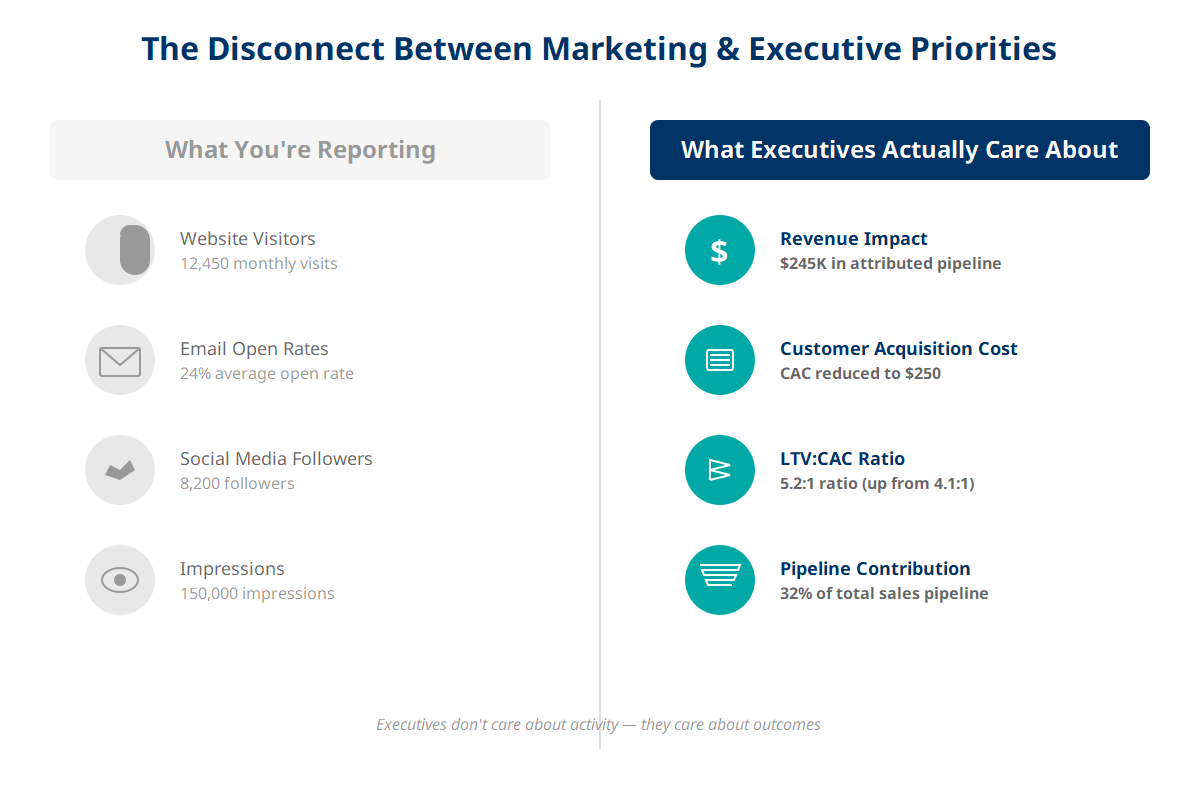
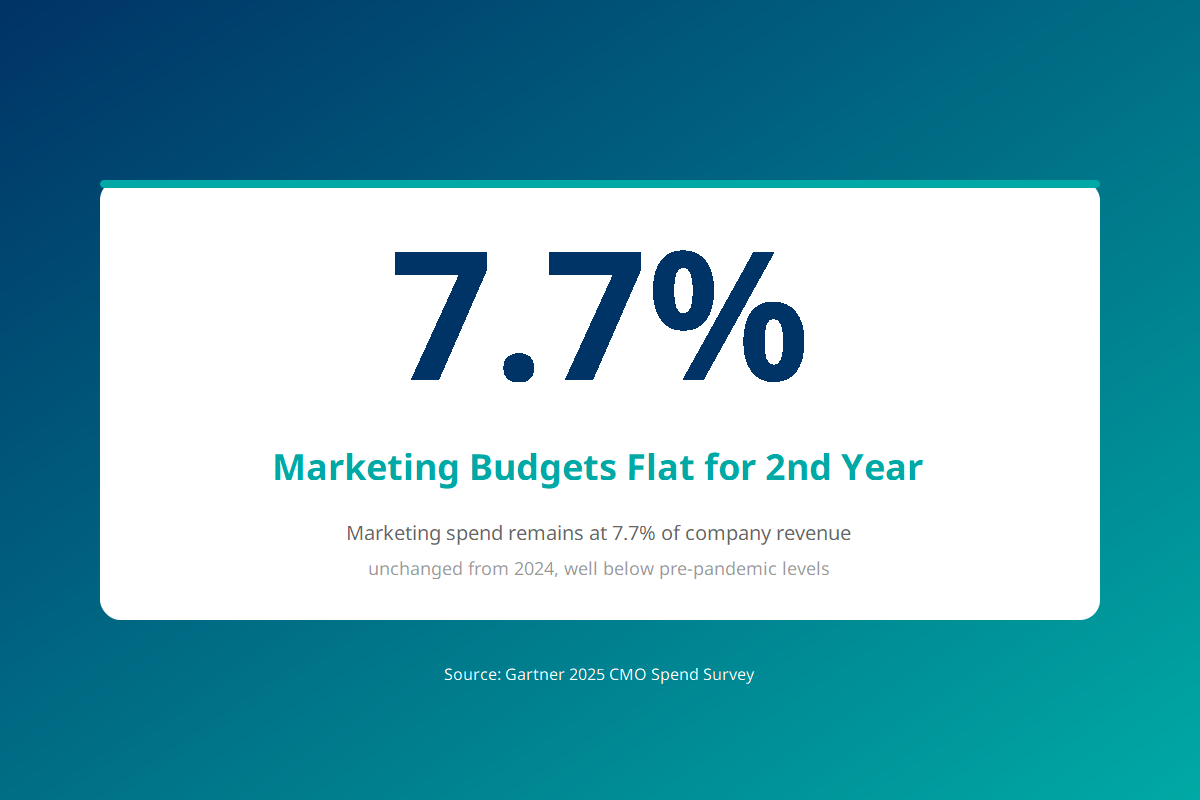
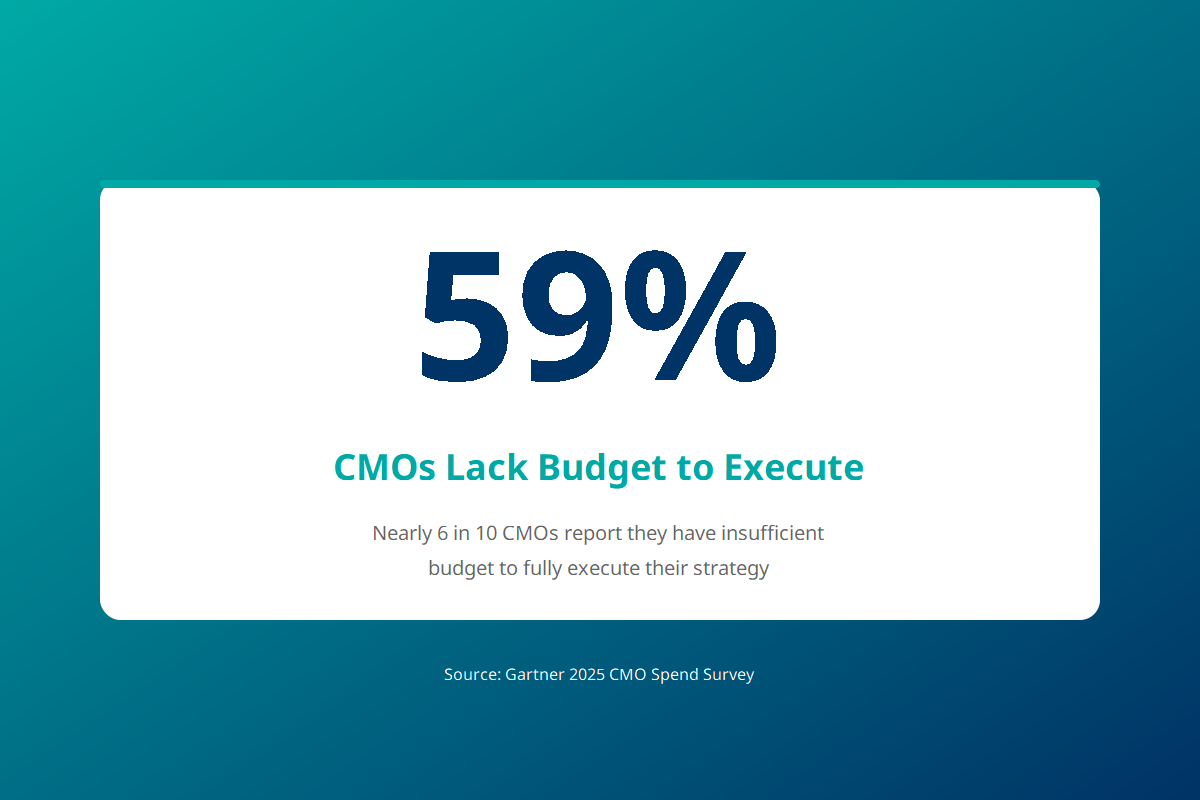
According to Gartner's 2025 CMO Spend Survey, marketing budgets have flatlined at 7.7% of overall company revenue—holding steady from 2024 but remaining well below pre-pandemic levels. With 59% of CMOs reporting they have insufficient budget to execute their strategy, the pressure isn't easing. And when economic uncertainty lingers, marketing becomes the obvious place to cut because most executives still see it as an expense, not an investment.
If this sounds familiar, you're not alone. But here's what most marketing leaders miss: the problem isn't that your marketing doesn't deliver value. The problem is you're not defending it the way executives make budget decisions.
Let's fix that.
Following along? Get our Budget Defense Framework Template to implement these strategies step-by-step.
Get the Framework Template →Why Your Numbers Aren't Working in Your Favor
You've got dashboards. You've got reports. You're tracking everything. So why does defending your budget still feel like an uphill battle?
Because you're speaking marketing language in a room full of people who only understand finance language.
When you talk about engagement rates, brand awareness, or email open rates, executives hear "nice to have." When you talk about revenue contribution, customer lifetime value, and marketing's impact on profit margins, they hear "essential investment."
The difference isn't subtle. Only 52% of senior marketing leaders have successfully demonstrated marketing's contribution to business outcomes, and the primary skeptics are CFOs (40%) and CEOs (39%) who still view marketing as a cost center rather than a growth driver. That's not because marketing doesn't deliver ROI—it's because the metrics don't connect to what keeps executives up at night: revenue growth, profit margins, and competitive positioning.
⚡ Quick Implementation Tip
Before your next budget meeting, prepare three numbers: your current CAC, your customer LTV, and your LTV:CAC ratio. A ratio of 3:1 or higher signals healthy marketing investment. Below 3:1 indicates inefficiency. Above 5:1 suggests you're under-investing in growth.
The Real Metrics That Matter
Here's what actually moves the needle in budget discussions:
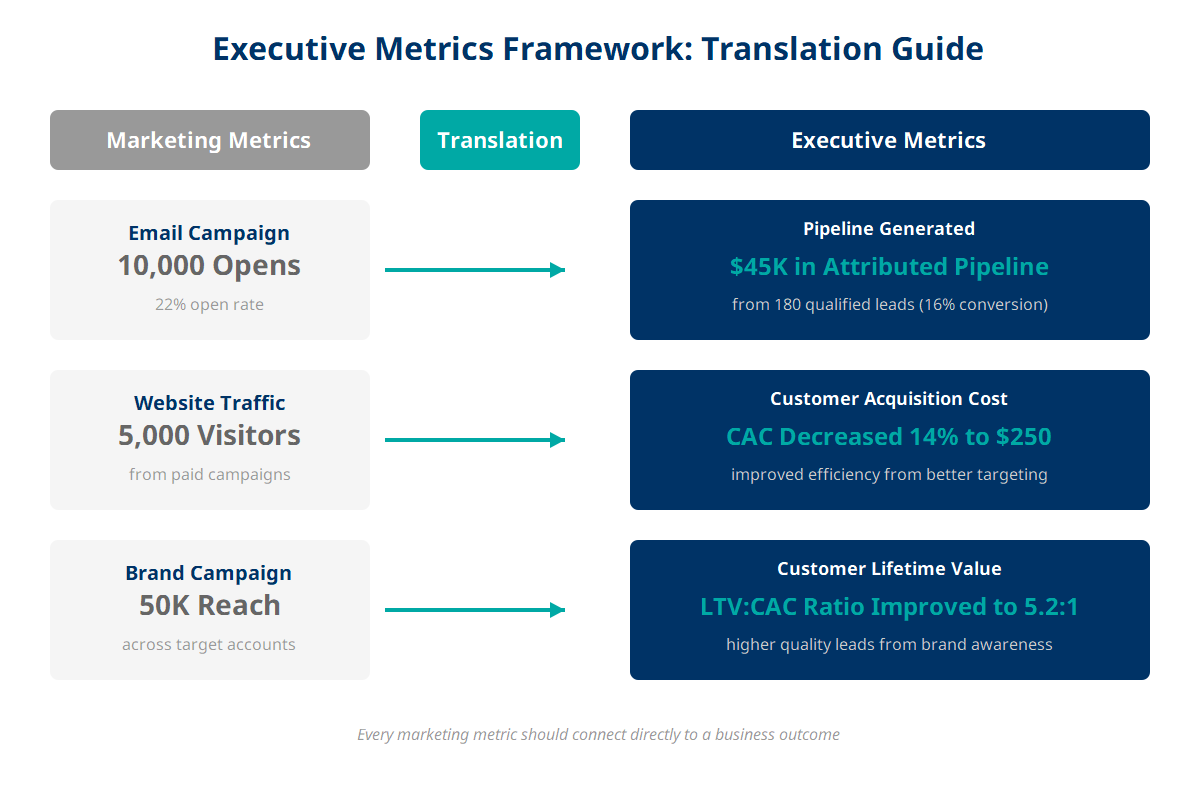
Customer Acquisition Cost (CAC): How much does it cost to acquire a customer through marketing? More importantly, how has that number changed quarter over quarter? If you can show you're acquiring customers more efficiently, you're making the investment case.
Revenue Attribution: Which marketing activities directly contributed to closed deals? Multi-touch attribution isn't perfect, but it's infinitely better than hoping executives just "get" that marketing creates value.
Customer Lifetime Value to CAC Ratio (LTV:CAC): This is the metric that makes CFOs smile. If you're spending $1,000 to acquire a customer worth $5,000 over their lifetime, that's a 5:1 ratio—and that's an investment, not an expense.
The companies that maintain—or even increase—marketing budgets during tough times aren't magically better at marketing. They're just better at connecting marketing metrics to business outcomes.
The Framework: Your 72-Hour Budget Defense Plan
You don't have time to rebuild your entire reporting structure before the budget meeting. What you need is a framework you can implement this week that positions your marketing spend as strategic investment, not discretionary spending.
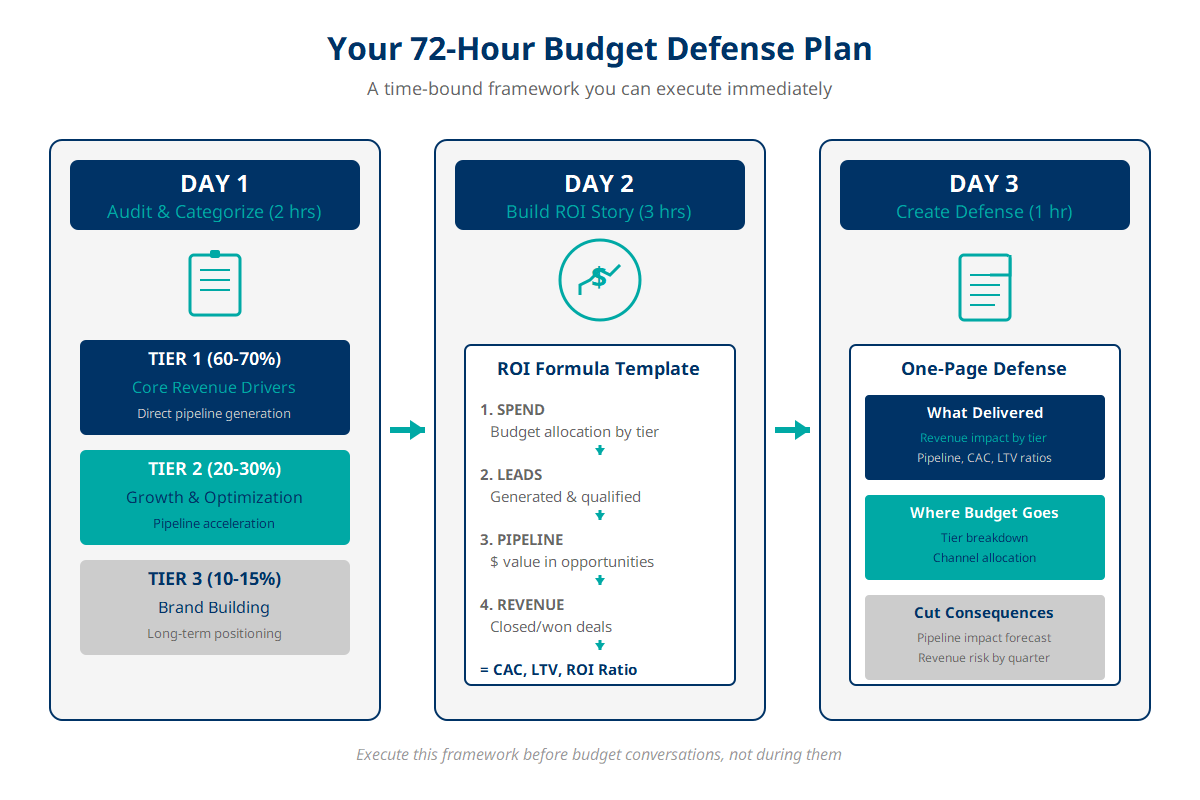
Day 1: Audit and Categorize by Business Impact (2 hours)
Stop thinking about your budget by channel (social, email, content, paid ads). Start thinking about it by business impact.
Tier 1 – Core Revenue Drivers (60-70% of budget)
These are activities with proven, direct ROI. The campaigns that consistently generate qualified leads. The channels that drive repeat purchases. The content that moves prospects through your pipeline. This is your non-negotiable spend. Research shows that high-performing companies typically allocate 70% of their marketing budget to proven tactics that deliver consistent ROI.
Tier 2 – Growth and Optimization (20-30% of budget)
These are your tests, experiments, and new channel explorations. Important for growth, but if you had to cut, you'd cut here first—and you can explain exactly why these are lower priority.
Tier 3 – Brand and Long-Term Investment (10-15% of budget)
This is your brand building, thought leadership, and relationship development. Harder to measure directly, but essential for market position and long-term growth.
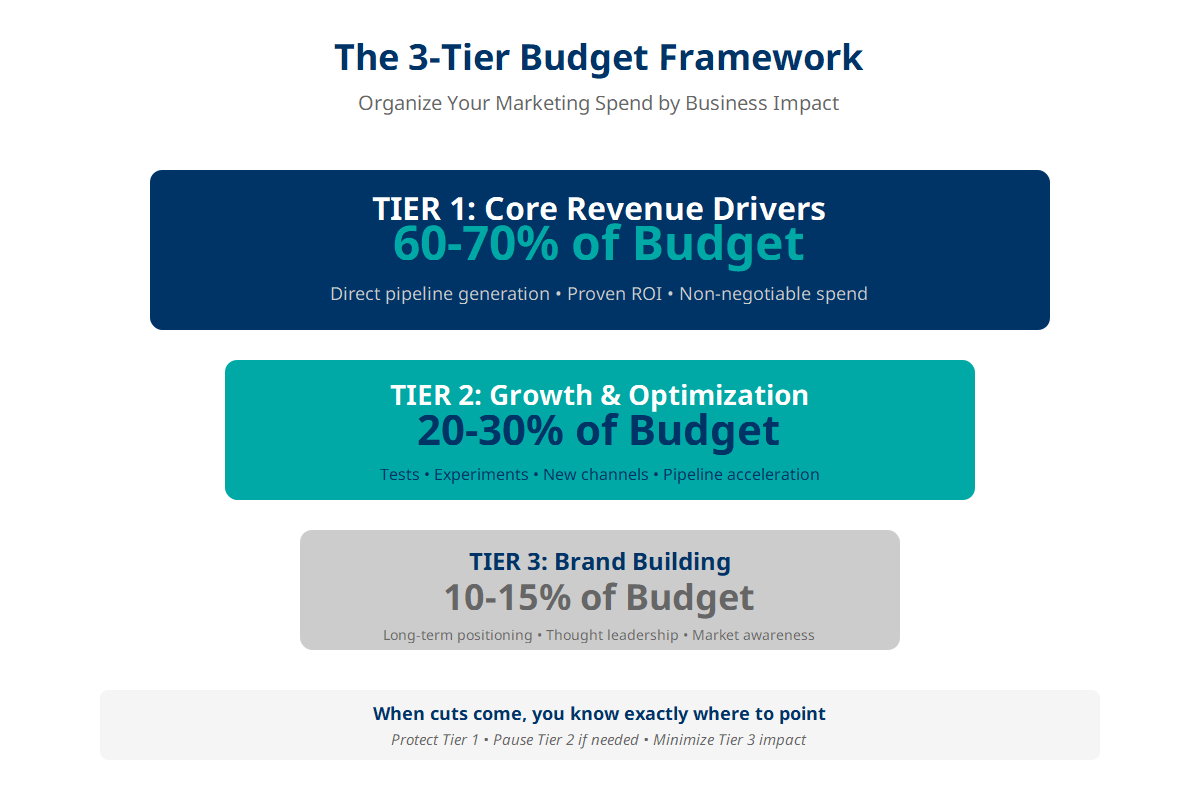
The power of this framework: when someone says "we need to cut 15%," you don't panic. You point to Tier 2, explain what you'd pause, and show exactly how you're protecting the channels that drive revenue.
Day 2: Build Your ROI Story (3 hours)
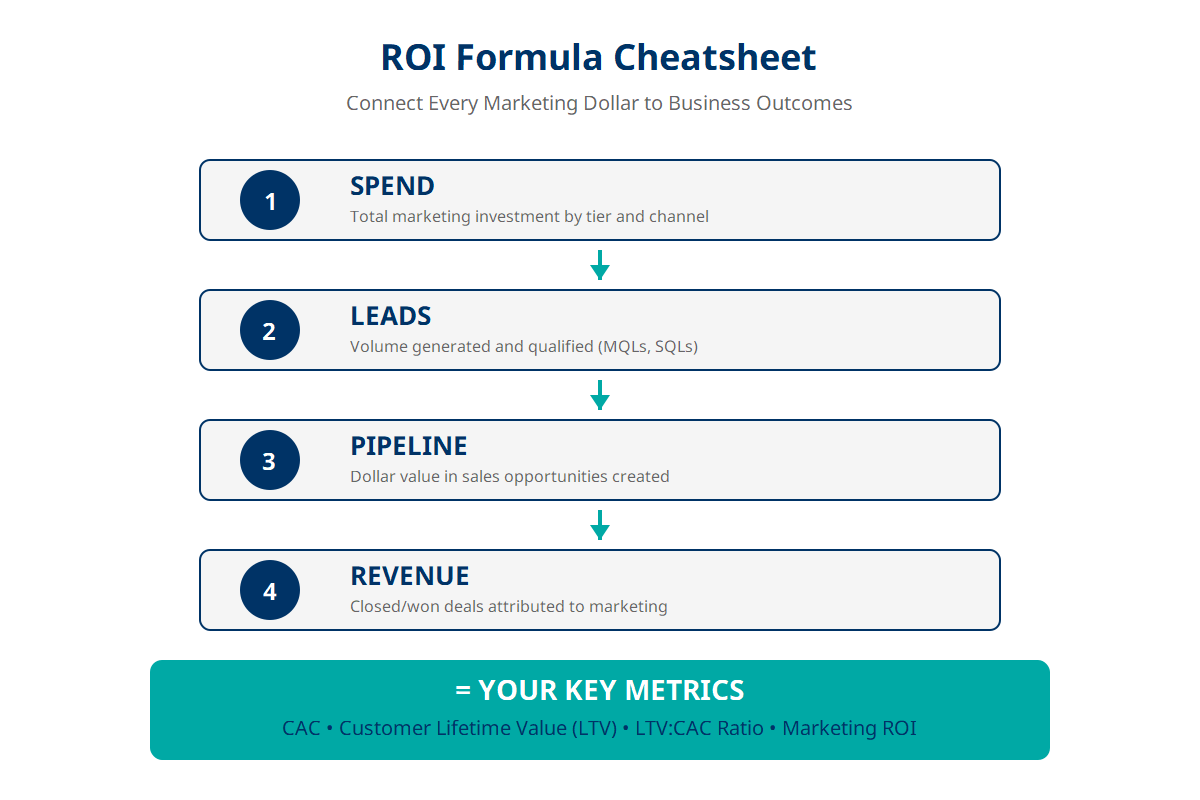
Take your three biggest marketing initiatives from the past quarter. For each one, trace the complete path from marketing spend to business impact.
Initiative 1: We spent $X on [specific campaign]
- Generated Y qualified leads
- Z% converted to opportunities worth $[pipeline value]
- Current closed/won rate suggests $[revenue] in closed deals
- CAC for this channel: $[amount]
- Customer LTV: $[amount]
- ROI: [ratio]
Do this for your top three channels or campaigns. Suddenly, you're not defending "marketing spend"—you're defending specific investments with measurable returns.
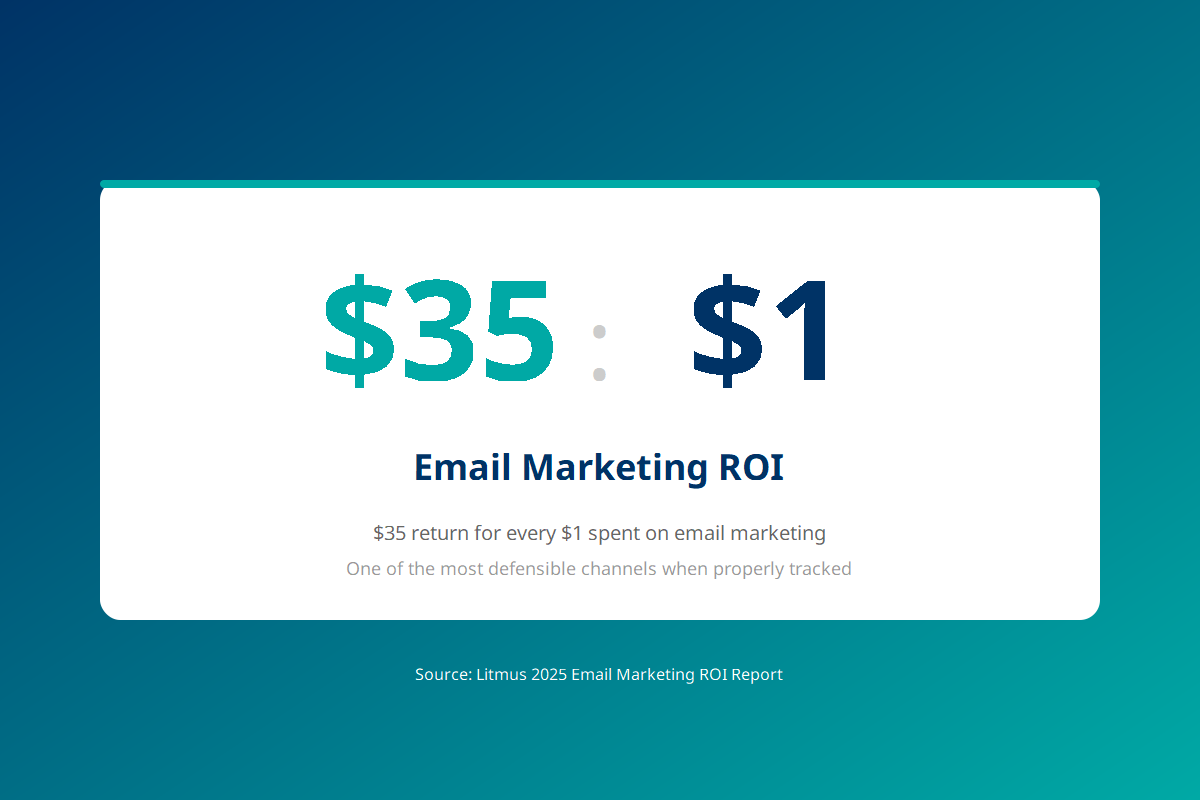
Consider this real-world approach: Email marketing continues to deliver an average ROI of $35 for every $1 spent, making it one of the most defensible channels when properly tracked. Your job is to have these numbers ready—not scrambling to find them when the CFO asks.
📊 Want the Complete Framework?
This 72-hour implementation plan includes templates for ROI calculation, tier categorization worksheets, and scenario planning tools. Our comprehensive Budget Defense Framework Template includes step-by-step implementation guides you can use this week. Get instant access below.
Day 3: Create Your One-Page Defense (1 hour)
This is the document that saves your budget. One page. Three sections.
Section 1: What Marketing Delivered This Quarter
- Total pipeline generated: $[amount]
- New customers acquired: [number]
- Average CAC: $[amount] (down/up X% from last quarter)
- Current LTV:CAC ratio: [ratio]
Section 2: Where the Budget Goes
Show your three tiers with percentages. Explain the strategic logic. Make it clear you're already optimizing continuously, not waiting for budget pressure to make smart decisions.
Section 3: What Changes if Budget Gets Cut
Be specific. "A 15% cut means pausing Tier 2 initiatives, which will reduce new lead generation by approximately 20% in Q1 2026." Help them understand the trade-offs, not just the savings.
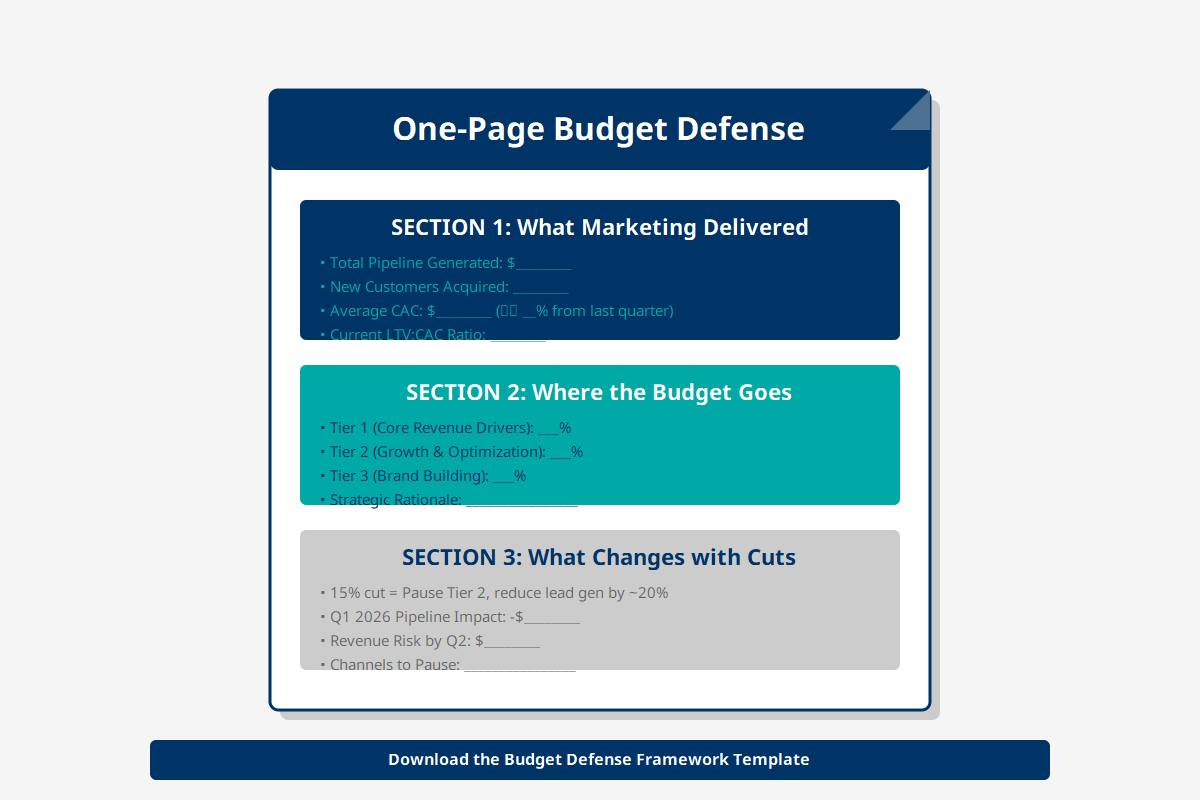
This one-page approach transforms the conversation. You're not defending "marketing." You're defending specific revenue-generating investments with clear consequences if they're cut.
What Happens When You Don't Defend Strategically
Let's talk about what actually happens when marketing budgets get slashed without strategy.
The immediate impact is obvious: fewer campaigns, less reach, slower lead generation. But the real damage shows up 6-12 months later. Your competitors who maintained spending are now capturing market share while you're playing catch-up. The pipeline you built all year starts drying up.
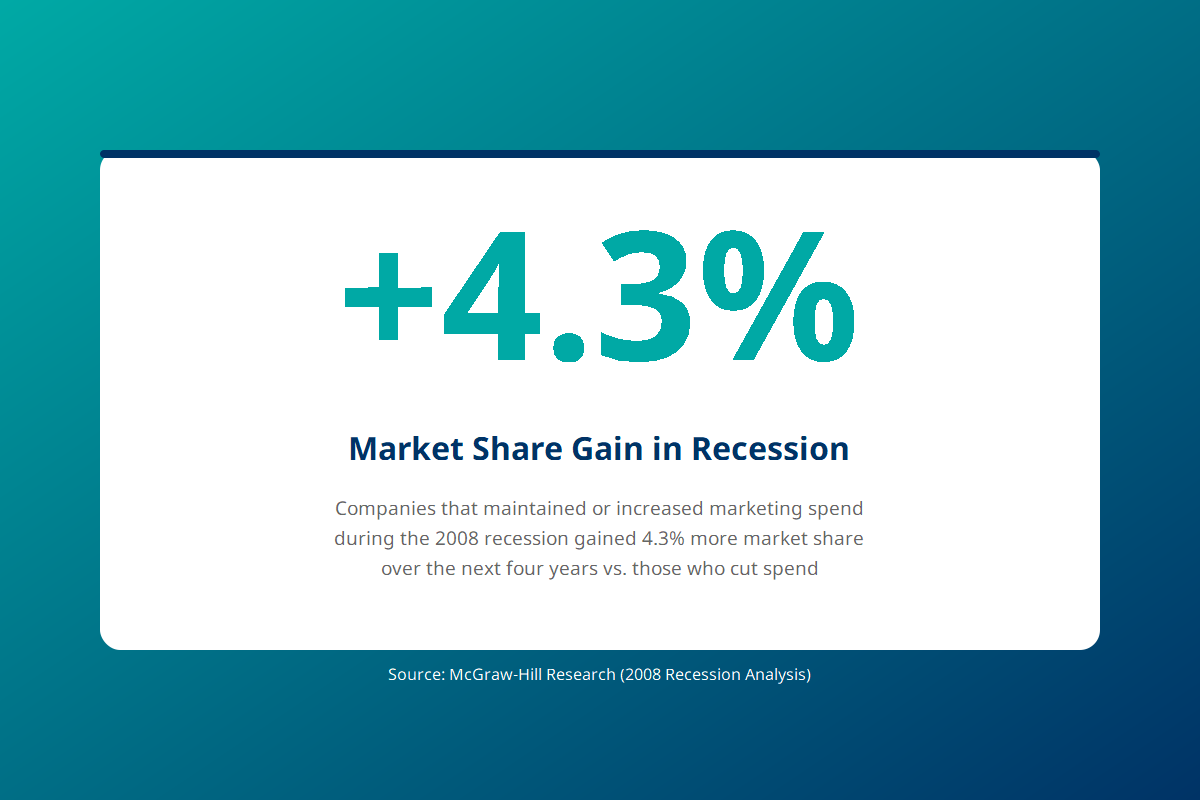
Consider the data: During the 2008 recession, companies that maintained or increased their marketing spend saw an average 4.3% increase in market share over the next four years, while those who cut spend saw a decline. The pattern repeats in every downturn.
We've seen this repeatedly with clients. One mid-sized B2B company cut their marketing budget by 30% in Q4 2024. By Q2 2025, their sales team was complaining about lead quality and quantity. By Q3, they were asking marketing to "do more with less." By Q4, they were desperately trying to rebuild the momentum they'd lost—at double the cost.
The companies that weather budget pressures aren't necessarily the ones with bigger budgets. They're the ones that position marketing as a strategic growth function, not a discretionary expense—before cuts are discussed.
Get Your Budget Defense Framework Template
The exact framework used by 500+ marketing leaders to protect—and grow—their budgets. Includes ROI calculators, tier categorization worksheets, and scenario planning tools you can use this week.
Download the Budget Defense Framework
Get instant access to the Budget Defense Framework — enter your email below and we'll send the download link right over.
Prefer to discuss your specific situation?
Schedule a Free Strategy Discussion →The Bottom Line
Mid-November is when budget decisions get locked for 2026. If you're reading this, you still have time to shift the conversation from "what can we cut?" to "what investments drive growth?"
The executives making these decisions aren't trying to undermine your work. They're trying to make smart financial choices with incomplete information. Your job isn't to convince them marketing matters—it's to show them exactly how your marketing spend connects to business outcomes they care about.
Start with the 72-hour framework. Build your one-page defense. And most importantly, stop reporting metrics that mean nothing to the people holding the budget.
Your marketing is probably working better than you think. The question is whether you can prove it in language executives understand—before the cuts happen.
|
This post is part of The B2B Marketing Reality Check The strategic framework for growth-stage B2B tech companies — now available in paperback and Kindle. Every topic we cover in this blog goes deeper in the book, with frameworks, diagnostics, and quick wins you can put to work immediately. Get the Free PDF →Want to work through the framework hands-on? Get the companion workbook → |
Frequently Asked Questions
How long does implementing the 72-hour framework typically take?
The framework is designed for busy marketing leaders. Day 1 (audit and categorization) takes approximately 2 hours. Day 2 (building ROI stories) requires 3 hours. Day 3 (creating the one-page defense) takes 1 hour. Total time investment: 6 hours spread across three days, or you can complete it in one intensive session.
What if I don't have perfect attribution data?
Start with what you have. Even directional attribution is better than none. Use first-touch attribution for top-of-funnel awareness, last-touch for direct response campaigns, and multi-touch where possible. The key is showing the connection between marketing spend and pipeline generation, even if imperfect.
What budget should we allocate for budget defense preparation?
Budget defense isn't about spending money—it's about organizing existing data. The framework uses metrics you should already be tracking. If you need to implement attribution tools, budget $500-$5,000 depending on company size, but most marketing leaders can complete this with existing systems.
When should we consider hiring outside expertise vs. handling internally?
Handle budget defense internally if you have clear data access and 6+ hours to implement the framework. Consider outside expertise if: (1) you lack confidence in your attribution model, (2) you're facing immediate budget cuts and need rapid intervention, or (3) you want strategic positioning guidance for executive-level conversations.
How do we measure ROI on our budget defense investment?
Track three metrics: (1) Budget preserved vs. initial cut proposals, (2) Time saved in budget discussions (fewer justification meetings), (3) Executive confidence in marketing investment (measured through follow-up conversations). Most clients report saving 15-30% of budgets that would have been cut, translating to hundreds of thousands in preserved marketing capability.
Verified Statistics & Citations
- Gartner, 2025 CMO Spend Survey: Marketing budgets remain at 7.7% of overall company revenue (flat from 2024); 59% of CMOs report insufficient budget to execute strategy; 52% of senior marketing leaders have successfully demonstrated marketing's contribution to business outcomes.
Source: Gartner CMO Spend Survey 2025 - McKinsey, 2023: High-performing companies allocate 70% of marketing budget to proven tactics; companies that maintain marketing spend during recessions gain market share.
Source: McKinsey & Company research on marketing resource allocation - Litmus, 2025: Email marketing delivers an average ROI of $35 for every $1 spent.
Source: Litmus Email Marketing ROI Report 2025 - McGraw-Hill Research: Companies that maintained or increased marketing spend during the 2008 recession saw an average 4.3% increase in market share over the next four years.
Source: McGraw-Hill Research Study analysis (historical data)
About Insight2Strategy
We help growing businesses make strategic decisions backed by data and market intelligence. Our approach combines deep analysis with practical implementation frameworks that drive measurable results.
Visit Insight2Strategy → | Free Consultation | More Strategic Insights


Comments
Post a Comment