Why Your Sales Team Hates Your Marketing Leads (And the Alignment Framework That Fixes It Before 2026)
Why Your Sales Team Hates Your Marketing Leads (And the Alignment Framework That Fixes It Before 2026)
Strategic Analysis by: Insight2Strategy
Published: November 17, 2025
Executive Reading Time: 12 minutes
Executive Strategic Insights
- The Strategic Cost: Sales-marketing misalignment causes 38% lower win rates and prevents companies from building competitive advantages through systematic learning loops
- Root Cause: This isn't a communication problem—it's an architectural issue where separate functions have conflicting metrics and incentive structures
- The Framework: Three foundational principles (Unified Revenue Accountability, Shared SLAs, Systematic Intelligence Loops) must be implemented together for sustainable alignment
- ROI Impact: Companies with aligned sales and marketing teams grow 19% faster and are 15% more profitable than misaligned competitors
- Implementation Timeline: Expect 3-6 months for full rollout, but Q4 2025 is the ideal time to start before 2026 planning locks in place
- Executive Requirement: This requires board-level commitment and willingness to fundamentally redesign revenue function architecture—not a project for middle management
The Monday Morning War Room That's Costing You Revenue
Every Monday morning, the same pattern repeats itself in boardrooms across growing companies: Sales complains that marketing's leads are unqualified junk. Marketing insists they're hitting their MQL targets. Finance asks why pipeline conversion keeps declining despite increased marketing spend. And the CEO sits there wondering why two departments that should be working together can't stop fighting long enough to actually drive revenue.
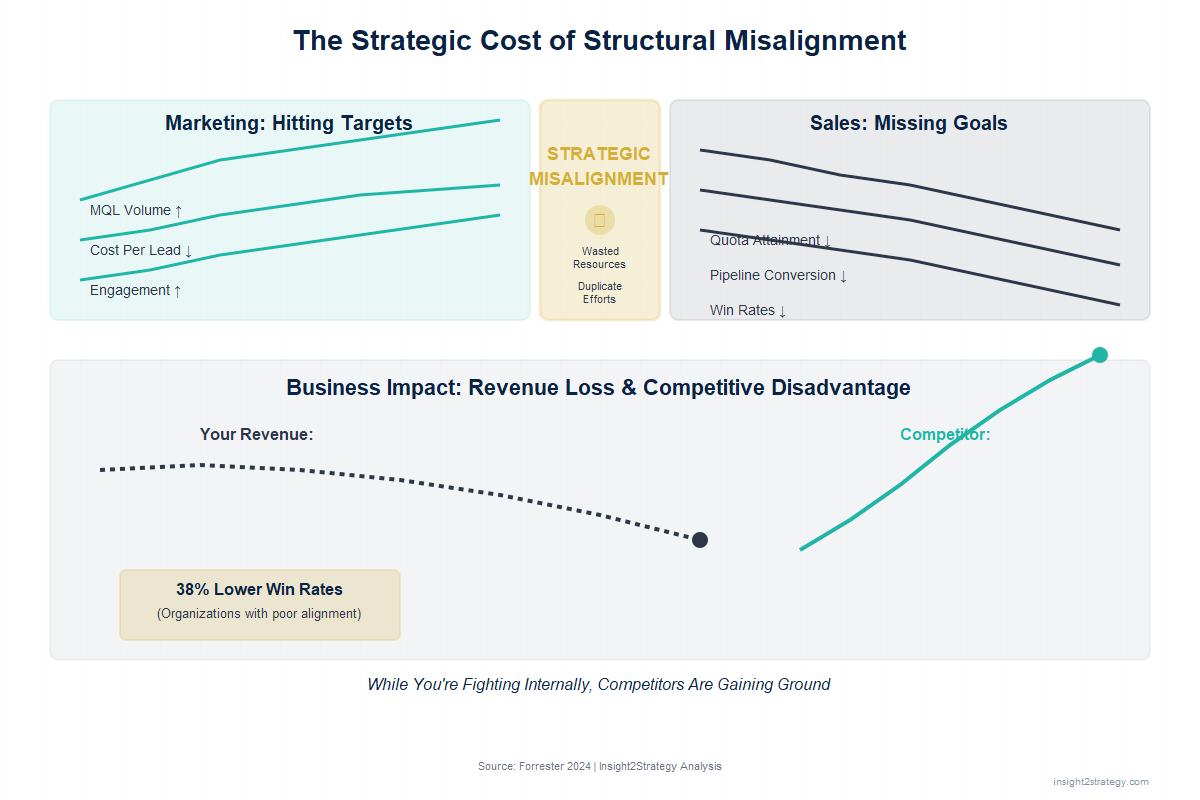
This isn't a personality conflict or a communication problem. According to Forrester's Q2 2024 Sales And Marketing Alignment Survey, 65% of sales and marketing professionals believe there is a lack of alignment in their organizations [Forrester, 2024]. But here's what most executives miss: this misalignment is a strategic architecture issue that directly impacts your ability to compete effectively, grow efficiently, and build sustainable competitive advantages.
As we head into the final stretch of 2025 and you finalize your 2026 budget and strategic plan, this misalignment could be the difference between hitting your growth targets and explaining to your board why you fell short. The good news? Companies with highly aligned sales and marketing teams grow 19% faster and are 15% more profitable than their peers [Forrester, 2020]. The challenge? Most "alignment" efforts fail because they're tactical interventions trying to solve architectural problems.
⚡ Quick Implementation Tip
Before your next leadership meeting, calculate your actual MQL-to-closed-deal conversion rate. If it's below 5%, you have an alignment problem that's costing you measurable revenue. This single metric reveals whether your sales and marketing functions are working together or against each other.
The Strategic Cost of Misalignment: Beyond the Obvious Metrics
When executives think about sales-marketing misalignment, they typically focus on lead quality complaints and conversion rates. But the strategic costs run much deeper and show up in ways that threaten your competitive position. According to HubSpot's 2025 State of Marketing Report, 79% of sales reps say marketing leads are poorly qualified, and 56% of marketers admit they rarely receive feedback from sales after handoff [HubSpot, 2025]. This broken feedback loop isn't just frustrating—it's expensive.
Organizations with poor alignment see 38% lower sales win rates compared to their aligned counterparts [HubSpot and Aberdeen Group, 2025]. But the hidden costs go even deeper.
First, there's the opportunity cost of strategic focus. When sales doesn't trust marketing leads, they default to their own prospecting—essentially rebuilding a parallel demand generation function. You're paying twice for the same capability while neither delivers optimal results. Marketing optimizes for volume metrics that don't translate to revenue, while sales ignores potentially qualified leads because they've learned not to trust the source.
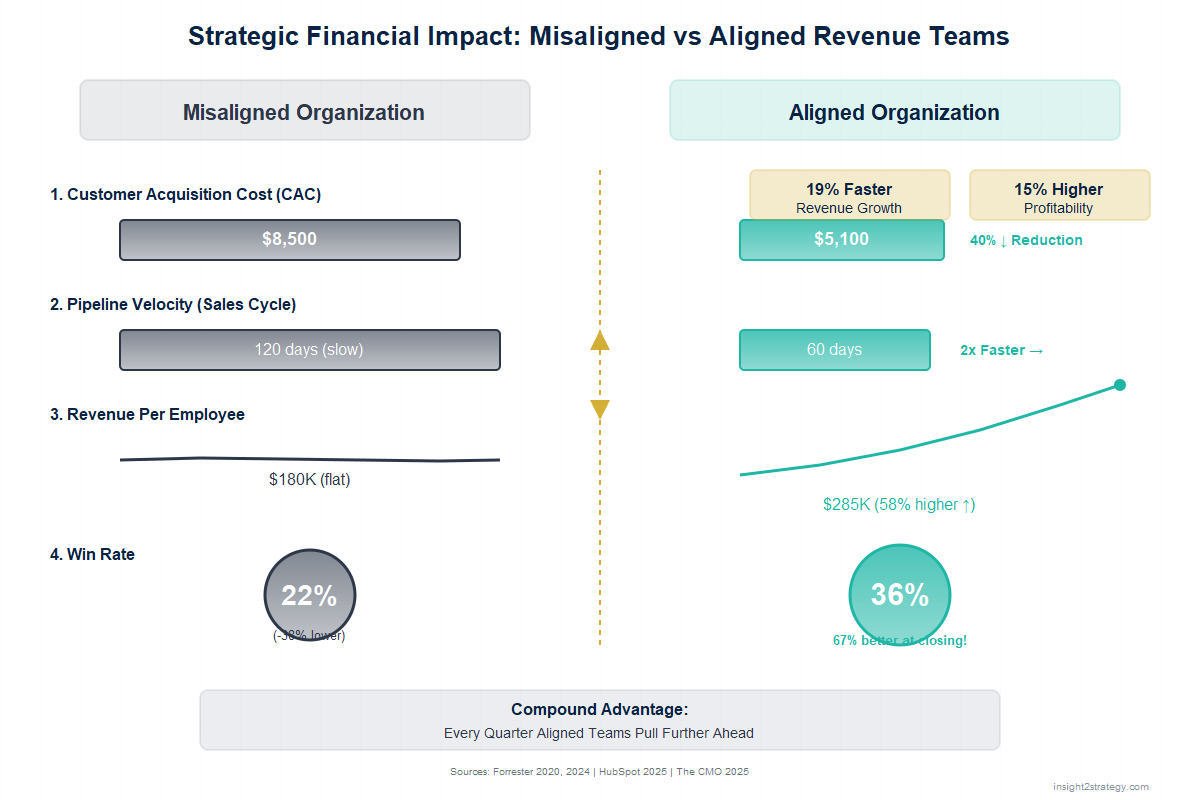
Second, misalignment creates strategic incoherence in your go-to-market approach. Marketing tells one story to generate leads. Sales tells a different story to close deals. Your customers experience this disconnect, which undermines trust and extends your sales cycle. In competitive markets, this incoherence creates an opening for competitors with tighter strategic execution.
Third, and perhaps most critically, misalignment prevents you from building the data-driven feedback loops necessary for strategic agility. When sales doesn't systematically feed intelligence back to marketing about what's happening in the market, your marketing strategy is flying blind. You can't adapt to competitive moves, changing buyer preferences, or emerging opportunities because the information flow is broken.
💡 Strategic Insight
The companies that win in your market aren't necessarily the ones with bigger budgets—they're the ones with tighter strategic alignment that allows them to iterate faster, execute more coherently, and build compounding advantages through systematic learning.
Why Traditional Approaches to Alignment Fail: Understanding the Root Causes
Most executives try to solve this problem through organizational bandaids: joint planning sessions, shared dashboards, or appointing someone to "own" alignment. These tactical interventions rarely work because they don't address the underlying strategic architecture that creates misalignment in the first place.
The fundamental issue is that sales and marketing are typically structured as separate functions with different success metrics, different incentive structures, and different strategic objectives. Marketing is measured on lead volume and cost per lead. Sales is measured on closed deals and quota attainment. These metrics don't just differ—they actively conflict.
The Definition Gap
The core issue is a misalignment in the definition of a quality lead. Marketing defines quality based on engagement and content consumption—downloads, webinar attendance, email opens. Sales defines it based on buying readiness and fit—budget, authority, need, and timeline. Without a shared definition, your teams are working toward two different outcomes.
For most companies, an MQL is essentially someone who downloaded a whitepaper or attended a webinar. That activity signifies interest in content, not intent to buy. Your sales team knows this, which is why they hate your MQLs. When they spend their precious time chasing leads that aren't sales-ready, they lose confidence in the marketing pipeline and revert to their own prospecting methods.
The difference between a lead that downloads a brochure and one that is actively researching a solution, has the budget, and meets your ideal customer profile is the difference between pipeline noise and predictable revenue.
The Handoff Model Problem
The second structural problem is the handoff model itself. Most companies think about lead flow as a linear handoff: Marketing generates leads, then "hands them off" to sales. This model treats the customer journey as discrete phases owned by different departments, which creates accountability gaps. When a lead doesn't convert, marketing blames sales for poor follow-up. Sales blames marketing for poor lead quality. The customer falls through the gap, and nobody takes ownership of the outcome.
The Feedback Loop Breakdown
The third problem is the lack of systematic feedback mechanisms. In well-designed business systems, information flows bidirectionally. Sales should be continuously feeding market intelligence back to marketing about what's working, what objections they're hearing, and what competitive dynamics they're facing. This information should directly inform marketing strategy. But in most companies, this feedback loop is informal at best and nonexistent at worst.
Add in disjointed technology stacks—marketing automation platforms that don't sync seamlessly with sales CRMs—and you get data silos where marketing sees one view of the customer journey and sales another. Cultural factors compound the problem: Sales teams, often incentivized purely on closes, have little motivation to provide feedback on leads, perpetuating the cycle.
These aren't problems you can solve with better communication or stronger relationships between department heads. They're architectural problems that require architectural solutions.
📊 Implementation Framework
Ready to redesign your revenue architecture? The Strategic Alignment Framework below provides three foundational principles that must be implemented together. This isn't a quick fix—expect 3-6 months for full rollout—but aligned teams are 67% better at closing deals. Need help adapting this to your specific situation? Let's discuss your implementation approach.
The Strategic Alignment Framework: Redesigning Your Revenue Architecture
Fixing this problem requires moving beyond tactical interventions to fundamentally redesigning how sales and marketing operate within your business. This is executive-level work that demands board-level commitment, cross-functional coordination, and a willingness to challenge sacred cows about how marketing and sales "should" work.
The Strategic Alignment Framework rests on three foundational principles that must be implemented together, supported by five operational steps. This isn't a quick fix—expect 3-6 months for full rollout—but the ROI is clear: Aligned teams are 67% better at closing deals [The CMO, 2025].
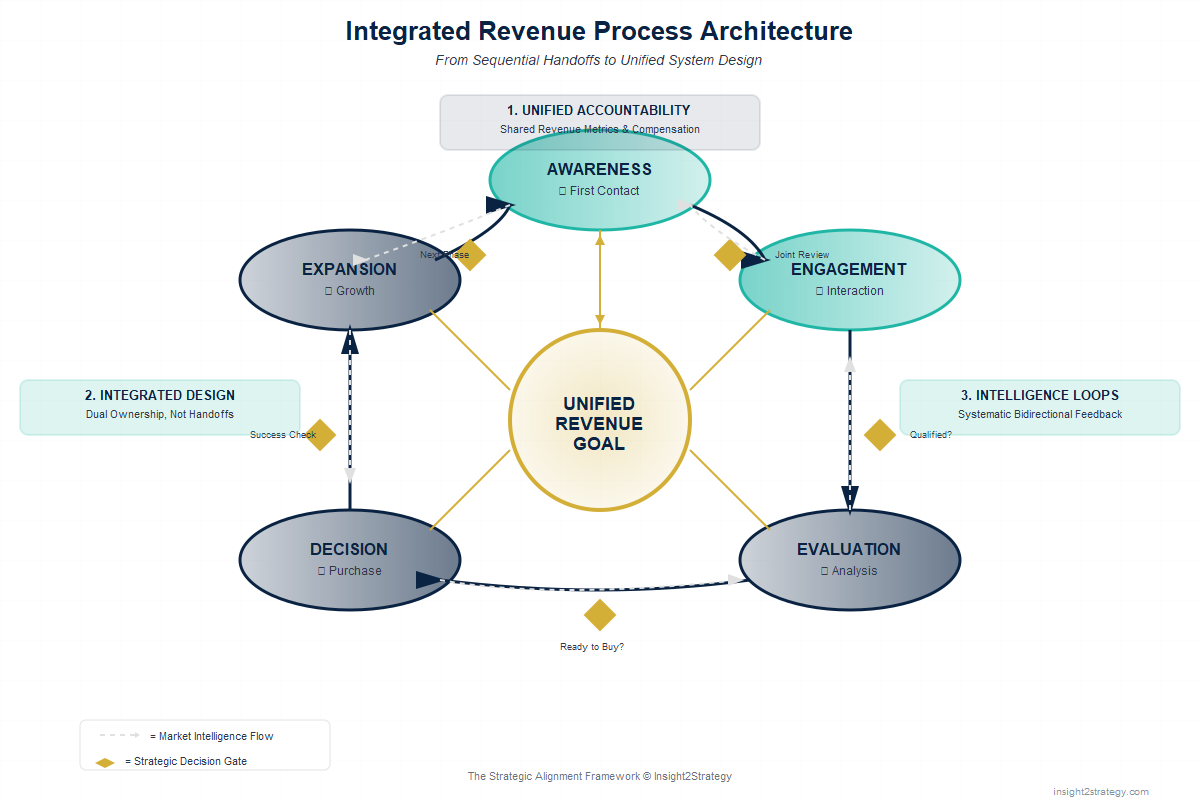
Foundational Principle 1: Unified Revenue Accountability
The first principle is moving from separate marketing and sales objectives to unified revenue accountability. This means both functions share the same north star metric: revenue generated, not leads generated or deals closed in isolation.
Operationally, this requires creating joint revenue targets that both marketing and sales leadership are accountable for delivering. It means redesigning compensation structures so that both teams have meaningful incentives tied to overall revenue performance, not just their functional metrics. And it means elevating the conversation from "how many MQLs did we generate" to "what revenue did we generate and what's our cost of customer acquisition."
This is harder than it sounds because it requires executives to give up familiar metrics and embrace more complex measurement. But it's essential for creating strategic alignment, because until both teams win or lose together based on the same outcome, they'll continue optimizing for their own departmental goals at the expense of overall business performance.
Operational Step: Set the 2026 revenue goal together as a shared number, with both teams' compensation tied to it. Don't let Sales and Marketing set separate goals.
Foundational Principle 2: Shared Lead Definitions and Service Level Agreement
The second principle is establishing shared definitions backed by a formal Service Level Agreement (SLA). This means creating jointly agreed-upon criteria for what constitutes a Marketing Qualified Lead (MQL) and Sales Qualified Lead (SQL).
Use proven frameworks like BANT (Budget, Authority, Need, Timeline) or MEDDIC (Metrics, Economic Buyer, Decision Criteria, Decision Process, Identify Pain, Champion) to define qualification criteria. Marketing commits to scoring leads against these criteria, and Sales commits to specific follow-up SLAs—response times, number of touch attempts, and feedback requirements.
This isn't about personalities; it's about clearly defining standards that both teams agree to uphold. The SLA should be written, signed, and reviewed regularly. It defines lead scoring thresholds, follow-up response times, and feedback cadence.
Operational Step: Draft the SLA before year-end. It doesn't have to be perfect, but it must be measurable and signed by both department heads.
Foundational Principle 3: Systematic Intelligence Loops (Closed-Loop Reporting)
The third principle is building systematic intelligence loops that enable strategic learning and adaptation. This means creating formal mechanisms for sales to feed market intelligence back to marketing, and for marketing to feed performance data forward to sales.
This isn't about scheduling more meetings. It's about building data systems and operational rhythms that make bidirectional information flow automatic. When a deal closes, marketing automatically sees what touchpoints influenced that decision. When a deal is lost, sales systematically captures why and feeds that intelligence to marketing. When marketing launches a new campaign, sales automatically gets insight into the narrative and positioning so they can reinforce it.
Implement closed-loop reporting using integrated CRM and marketing automation tools. Sales must provide structured feedback on every lead—not just the ones that close. This feedback includes: why the lead was disqualified, what the lead's actual pain points were, and whether the lead profile matched the target ICP. Marketing uses this data to continuously refine targeting, scoring, and messaging.
Operational Step: This is not a monthly meeting; this is a weekly data exchange embedded in your CRM. Schedule the first monthly Revenue Review meeting before December, mandatory for CMO and Head of Sales.
⚡ Quick Implementation Tip
Start with Step 1 before year-end: Get both teams in a room to define MQL and SQL criteria using real deal data from the last quarter. Use BANT or MEDDIC as your framework. Document the agreed criteria and have both department heads sign it. This single action can immediately reduce friction and improve lead quality perception.
Implementation Steps: Making It Operational
Beyond the three foundational principles, successful implementation requires five operational steps:
Step 1: Define Together
Start by co-creating MQL and SQL criteria in joint workshops. Involve both teams in defining what makes a "good" lead. Use real deal data to align thresholds—such as deal size, industry, and buying intent. Audit your current lead definitions and map out where they diverge.
Step 2: Measure with Unified Dashboards
Build a shared dashboard that tracks how leads move through each stage. Use your CRM to create a single, unified view that both Sales and Marketing review together. Track metrics like: MQL-to-SQL conversion rate, Sales Accepted Lead (SAL) conversion rate, Pipeline Value by Campaign Source, Pipeline Velocity, and Sales Feedback Quality Score. If marketing can see which campaigns generate SQLs (not just MQLs), they can adjust in real time.
Step 3: Collaborate Regularly
Foster regular collaboration through bi-weekly alignment meetings and cross-functional pods for major campaigns. Encourage job shadowing—let marketers join sales calls to understand objections firsthand. This isn't perfunctory communication; it's strategic coordination where both teams review pipeline health, lead quality trends, and process improvements together.
Step 4: Align Incentives and Technology
Tie bonuses to shared metrics like overall revenue growth, not just departmental KPIs. Invest in unified platforms that enable real-time data sharing, reducing manual handoffs. Fix your tech stack integration so marketing automation and sales CRM operate as one system.
Step 5: Optimize Continuously
Treat the alignment framework like an ongoing process, not a one-time fix. Track progress with dashboards showing alignment metrics. Evaluate results quarterly and adjust based on performance. For example, if conversion rates dip, revisit lead scoring models. These intelligence loops are what enable you to build competitive advantage over time. Each cycle through the loop makes both marketing and sales slightly more effective. Compound that over quarters and years, and you build systematic advantages that competitors can't easily replicate.
What to Do Before Year-End: The November Action Plan
As you head into the final stretch of 2025 and finalize 2026 planning, this is the ideal time to fix the alignment problem. Your sales team is closing out Q4 deals, your marketing team is finalizing budgets, and your leadership team is setting revenue targets. Use this convergence to force the alignment conversation.
With 2025 closing, use Q4 to:
- Audit Your Current Lead Definitions: Sit down with both teams and map out what your current MQL and SQL definitions actually mean. Where do they diverge? Where is the handoff failing? Use real data to understand your current state.
- Draft the Service Level Agreement: Create a written, signed SLA defining lead scoring thresholds, follow-up response times, and feedback cadence. It doesn't have to be perfect, but it must be measurable and have buy-in from both department heads.
- Build the Revenue Dashboard: Use your CRM to create a single, unified dashboard that both Sales and Marketing review together. Make sure it tracks the metrics that matter: MQL-to-SQL conversion, SAL progression, Pipeline Value by Source, and Feedback Quality.
- Set the 2026 Revenue Goal Together: The 2026 revenue target is a shared number. Both teams should have their compensation tied to it. This is non-negotiable for creating true alignment.
- Schedule the First Revenue Review: Before December, schedule your first monthly Revenue Review meeting. Make it mandatory for the CMO and Head of Sales. This meeting reviews pipeline health, lead quality trends, and process improvements.
- Host a Joint Strategy Session: Use Q4 to host a joint planning session to finalize 2026 pipeline goals and alignment initiatives. Get both teams in the same room with leadership support.
Don't wait until January when targets reset and you're already behind. The groundwork you lay now determines whether your 2026 revenue goals feel predictable or painful.
⏰ Timing is Everything
November 2025 is your window. Marketing is finalizing 2026 budgets. Sales is setting quotas. Leadership is approving revenue targets. This natural convergence makes it the perfect time to implement the Strategic Alignment Framework. By December, budgets lock and you've missed your window until Q2 2026.
The Executive Decision: Strategy Before Tactics
As you finalize your 2026 strategy, the question isn't whether you can afford to fix sales-marketing alignment. The question is whether you can afford not to.
Your competitors are solving this problem. The companies that will dominate your market in five years are the ones building tightly aligned revenue engines that can iterate faster, execute more coherently, and compound learning systematically. The companies that treat sales and marketing as separate fiefdoms with different goals will find themselves consistently outmaneuvered by more strategically coherent competitors.
This isn't a project you can delegate to middle management. It's not a process optimization you can handle through incremental improvements. It's a strategic architecture decision that requires executive leadership, board-level commitment, and the willingness to fundamentally redesign how core parts of your business operate.
The good news is that you don't need to solve this overnight. The Strategic Alignment Framework can be implemented in phases, starting with unified metrics and gradually moving toward full integration. But you do need to start, because every quarter that passes with misaligned sales and marketing is a quarter where you're building competitive disadvantages instead of advantages.
Ready to Fix Your Revenue Architecture?
Sales-marketing alignment isn't an HR problem, a communication challenge, or a technology issue. It's a strategic architecture problem that directly impacts your ability to compete effectively, grow efficiently, and build sustainable competitive advantages.
The companies that win aren't the ones with the biggest marketing budgets or the best salespeople. They're the ones that design coherent revenue engines where marketing and sales function as integrated parts of a unified system, continuously learning and adapting based on systematic feedback loops.
The war between Sales and Marketing isn't inevitable—it's a symptom of broken processes and misaligned incentives. If you want to eliminate the chaos, stop the finger-pointing, and build a predictable revenue engine for 2026, you need the Strategic Alignment Framework implemented with executive commitment.
Ready to Implement the Strategic Alignment Framework?
Every business situation is unique. Let's discuss how these three foundational principles apply to your specific challenges and opportunities—and create a phased implementation plan that fits your organization's readiness.
No sales pitch. Just strategic insights tailored to your business. We'll discuss your current state, identify your biggest alignment gaps, and outline a practical path forward for 2026.
Wrestling with this challenge as a CEO, CMO, or Head of Sales?
This is exactly the kind of strategic transformation we help leadership teams execute at Insight2Strategy. We don't offer quick fixes or tactical bandaids—we help you redesign the fundamental architecture of how your revenue functions operate.

|
This post is part of The B2B Marketing Reality Check The strategic framework for growth-stage B2B tech companies — now available in paperback and Kindle. Every topic we cover in this blog goes deeper in the book, with frameworks, diagnostics, and quick wins you can put to work immediately. Get the Free PDF →Want to work through the framework hands-on? Get the companion workbook → |
Frequently Asked Questions About Sales-Marketing Alignment
Why does my sales team hate marketing leads?
The core issue is a definition gap: Marketing defines quality based on engagement (downloads, webinar attendance), while Sales defines it based on buying readiness (budget, authority, need, timeline). When an MQL is just someone who downloaded content, it signals interest—not intent to buy. Sales knows this, which is why they hate MQLs and revert to their own prospecting.
What is the difference between MQL and SQL?
A Marketing Qualified Lead (MQL) shows engagement with your content but hasn't been vetted for sales readiness. A Sales Qualified Lead (SQL) has been evaluated against criteria like BANT (Budget, Authority, Need, Timeline) and is ready for direct sales engagement. The gap between these definitions—and who owns the qualification process—is where most alignment problems occur.
How long does sales-marketing alignment take to implement?
Expect 3-6 months for full rollout of the Strategic Alignment Framework. However, you can see immediate improvements by starting with unified revenue goals and shared lead definitions in Q4 2025. The key is phased implementation: Begin with foundational principles (unified accountability, shared SLAs, intelligence loops), then layer in operational steps over time. Don't try to fix everything at once.
What are the benefits of sales and marketing alignment?
Companies with highly aligned sales and marketing teams grow 19% faster and are 15% more profitable than misaligned competitors [Forrester, 2020]. Aligned teams also see 67% better close rates [The CMO, 2025] and 38% higher win rates compared to misaligned organizations [HubSpot/Aberdeen, 2025]. Beyond metrics, alignment creates strategic advantages through faster iteration, coherent execution, and systematic learning loops that compound over time.
How do I get executive buy-in for sales-marketing alignment?
Frame it as a strategic architecture issue, not a tactical fix. Show your leadership the revenue impact: Calculate your current MQL-to-closed-deal conversion rate and compare it to industry benchmarks (5%+). Quantify the cost of misalignment using the 38% lower win rate statistic. Position this as board-level strategic work that requires executive commitment—not a middle management project. Use the Q4 2025 timing as urgency: budgets and targets are being set now for 2026.
What technology do we need for sales-marketing alignment?
You need integrated CRM and marketing automation platforms that enable real-time data sharing. The specific tools matter less than the integration quality. Focus on: (1) Unified dashboards that both teams can access, (2) Automated lead scoring based on agreed criteria, (3) Closed-loop reporting that captures sales feedback on every lead, and (4) Bidirectional data flow so marketing sees what closes and sales sees campaign context. Start by auditing your current tech stack integration—manual handoffs are the enemy of alignment.
Verified Statistics & Citations
All statistics in this post have been verified for accuracy:
- 65% of sales and marketing professionals believe there is a lack of alignment - Forrester Q2 2024 Sales And Marketing Alignment Survey [Forrester, 2024]
- Companies with highly aligned teams grow 19% faster and are 15% more profitable - Forrester Research [Forrester, 2020]
- 79% of sales reps say marketing leads are poorly qualified - HubSpot 2025 State of Marketing Report [HubSpot, 2025]
- 56% of marketers admit they rarely receive feedback from sales - HubSpot 2025 State of Marketing Report [HubSpot, 2025]
- Organizations with poor alignment see 38% lower sales win rates - Aggregated data from HubSpot and Aberdeen Group [2025]
- Aligned teams are 67% better at closing deals - The CMO, verified via Aberdeen Group origins [The CMO, 2025]
About Insight2Strategy
We help growing businesses cut through marketing confusion to find strategies that actually drive revenue and customer growth. No fluff, no jargon—just strategic insights that work.


Comments
Post a Comment