Why Smart Companies Are Revisiting Their Entire Marketing Strategy for 2026 (And What They're Changing)
Why Smart Companies Are Revisiting Their Entire Marketing Strategy for 2026 (And What They're Changing)
Strategic Analysis by: Insight2Strategy
Published: December 15, 2025
Executive Reading Time: 8 minutes
Executive Strategic Insights
- 81% of marketers doubt campaign effectiveness – The gap between marketing activity and business impact has reached critical levels
- Three strategic pivots define 2026 success – From channel optimization to portfolio strategy, campaign execution to strategic positioning, and technology to capability building
- December is your decision window – Strategic decisions happen now or don't happen at all before Q1 execution pressures take over
- Strategy vs. optimization distinction is critical – Optimization can't fix strategic problems; 2026 requires strategic thinking, not just better execution
- Marketing Strategy Audit Framework included – Executive-level assessment tool to identify strategic gaps limiting your impact
The Strategy Crisis Nobody's Talking About
If you're a marketing leader reading this in mid-December, you're probably dealing with an uncomfortable truth: your 2025 marketing strategy didn't deliver what you promised. The budget increased. The team expanded. The technology stack got more sophisticated. But the results? They're plateauing, or worse, declining.
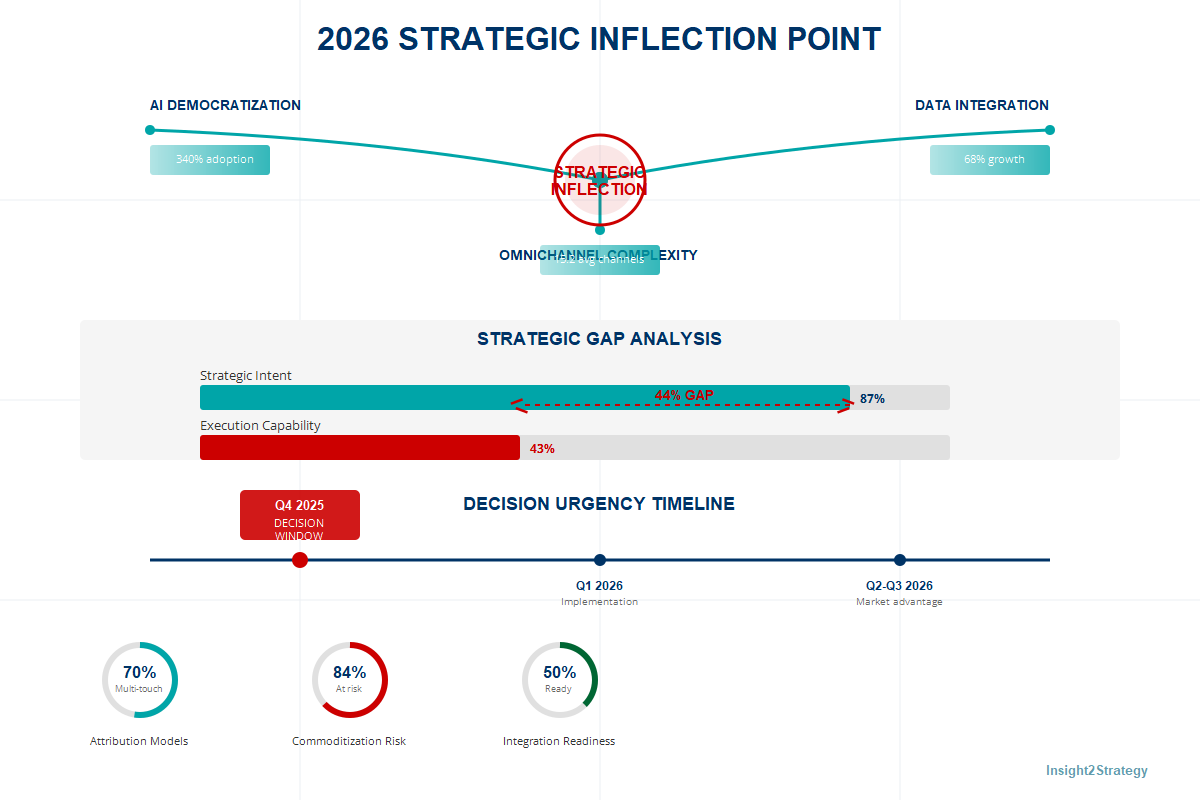
Here's what makes this moment particularly challenging: your marketing metrics might actually look decent. Website traffic is up. Engagement rates are stable. You're hitting your KPIs. But according to recent research, only 19% of marketers believe their campaigns are truly effective, leaving a staggering 81% falling short of expectations.
You're not alone, and more importantly, you're not wrong to be concerned. The marketing landscape has fundamentally shifted in ways that make last year's playbook obsolete. Smart companies are recognizing this right now—in this critical window before year-end—and they're doing something decisive about it.
Following along? Get the Marketing Strategy Audit Framework below to implement these strategies step-by-step.
What's Actually Failing (And Why Your Metrics Hide It)
The gap between marketing activity and business impact has never been wider. There are four strategic reasons why even well-executed 2025 strategies are falling short:
1. Strategy Lacked Alignment
Often, a strategy is created in isolation from the team that must execute it. Without alignment across leadership, marketing, sales, and operations, tactical plans get half-implemented or delayed. When one function is out of sync, the domino effect slows everything.
From an operational standpoint, marketing can't operate in a vacuum. Your strategy assumes capabilities your organization doesn't have, resources you can't allocate, and internal alignment that doesn't exist. The gap between strategic intent and operational reality is where ROI goes to die.
2. The Attribution Illusion
Your marketing attribution model is telling you a story, but it's increasingly a fiction. Multi-touch attribution breaks down when customer journeys span 8-12 touchpoints across channels you don't even track. That "marketing-influenced pipeline" number? It's measuring correlation, not causation—and executives are starting to notice.
⚡ Quick Implementation Tip
Before your next executive presentation, audit your attribution model. Can you honestly defend the causal relationship between marketing touches and revenue? If not, it's time to reset expectations and rebuild measurement frameworks around portfolio-level contribution rather than individual touch-point attribution.
3. AI Democratization Creates the Commoditization Trap
While 78% of organizations now use AI in at least one business function (up from 55% just a year ago), the democratization of AI tools has created an unexpected challenge. As AI makes content creation and campaign execution accessible to everyone, the tactics that differentiated you 18 months ago are now table stakes.
Your competitors have the same tools, the same playbooks, and increasingly similar messaging. You're winning vanity metrics while losing strategic differentiation. Even more concerning: 95% of AI pilots fail to scale due to inadequate governance and change management.
4. Metrics Without Meaning
Many firms discover only after Q3 that they're off-track—and find they have little time to recover. If you set goals that feel like "stretch" targets but without intermediate checkpoints, you lose visibility. The business environment in 2025 changed rapidly: new channels, new buying behaviors, and increased competition. If you didn't revisit your customer positioning or value proposition mid-year, the strategy might now feel obsolete.
The Three Strategic Pivots That Define 2026 Success
Smart companies aren't making incremental changes—they're making strategic pivots in three critical areas. This is the tipping point: the clock is ticking, and you're just weeks away from the new year. This is your absolute final window to lock in a marketing strategy for 2026 that actually drives revenue.
Pivot 1: From Channel Optimization to Portfolio Strategy
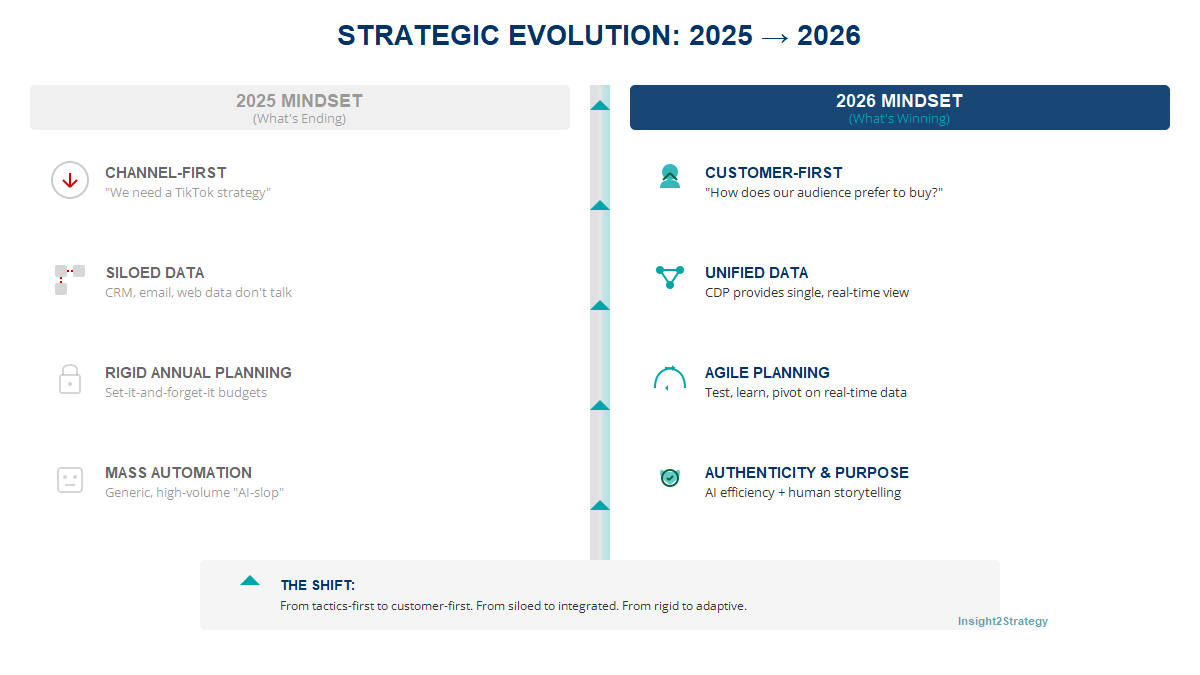
The question is no longer "How do we optimize LinkedIn?" but "What's our cross-channel portfolio strategy, and how do we dynamically allocate resources based on contribution to pipeline velocity?"
The shift looks like this:
| 2025 Approach | 2026 Strategy |
|---|---|
| Channel-First: "We need a TikTok strategy" | Customer-First: "How does our audience prefer to buy?" |
| Individual channel metrics in silos | Integrated portfolio view with cross-channel attribution |
| Platform-specific optimization goals | Portfolio-level resource allocation framework |
| Static annual budget by channel | Dynamic budget reallocation based on pipeline velocity |
This means moving from platform-specific tactics to portfolio-level resource allocation, building real-time visibility into channel contribution to pipeline (not just leads), and establishing executive accountability for portfolio performance, not channel metrics.
Pivot 2: From Campaign Execution to Strategic Positioning
The most significant change: marketing leaders are finally reclaiming their seat at the strategy table. This isn't about "thought leadership" or "brand building"—it's about owning the company's positioning strategy and competitive differentiation.
Looking ahead, 2026 marketing will emphasize agility and authenticity over volume. One major trend is AI-powered personalization, with 60% of marketers now using AI tools daily (a jump from 37% in 2024). But successful implementation requires 70% focus on people and processes, not just the 30% on technology itself.
Another shift is toward community-led growth, where brands build dedicated ecosystems instead of one-way broadcasting. This fosters loyalty and reduces acquisition costs. On the technical side, expect more emphasis on privacy-compliant data strategies. Customer Data Platforms (CDPs) are becoming the essential backbone—operating without unified, real-time customer data means your targeting is guesswork and your personalization falls flat.
📥 Get the Complete Framework
Our Marketing Strategy Audit Framework helps you assess portfolio readiness, strategic positioning, and capability maturity. Sign up below for instant access.
Pivot 3: From Technology Implementation to Capability Building
Here's the uncomfortable truth about your martech stack: the technology isn't your problem. Your organization's ability to leverage it strategically is the problem.
The challenge isn't a lack of tools; it's an explosion of noise. Winning brands are diversifying their media mix to reach customers across at least three channels, which yields nearly four times the engagement of single-channel efforts. Relying on a single platform (like one social channel or paid search) is a massive risk as algorithms shift constantly and privacy rules tighten.
The 2026 pivot is about strategic capability assessment before technology decisions, organizational design that enables technology effectiveness, and measurement frameworks that track capability maturity, not just technology utilization.
Your Strategic Audit Framework: Five Critical Assessments
If you're going to revise your strategy effectively, you need a framework that operates at the right altitude. This isn't a marketing audit—it's a strategic audit of your marketing function's ability to drive business outcomes.
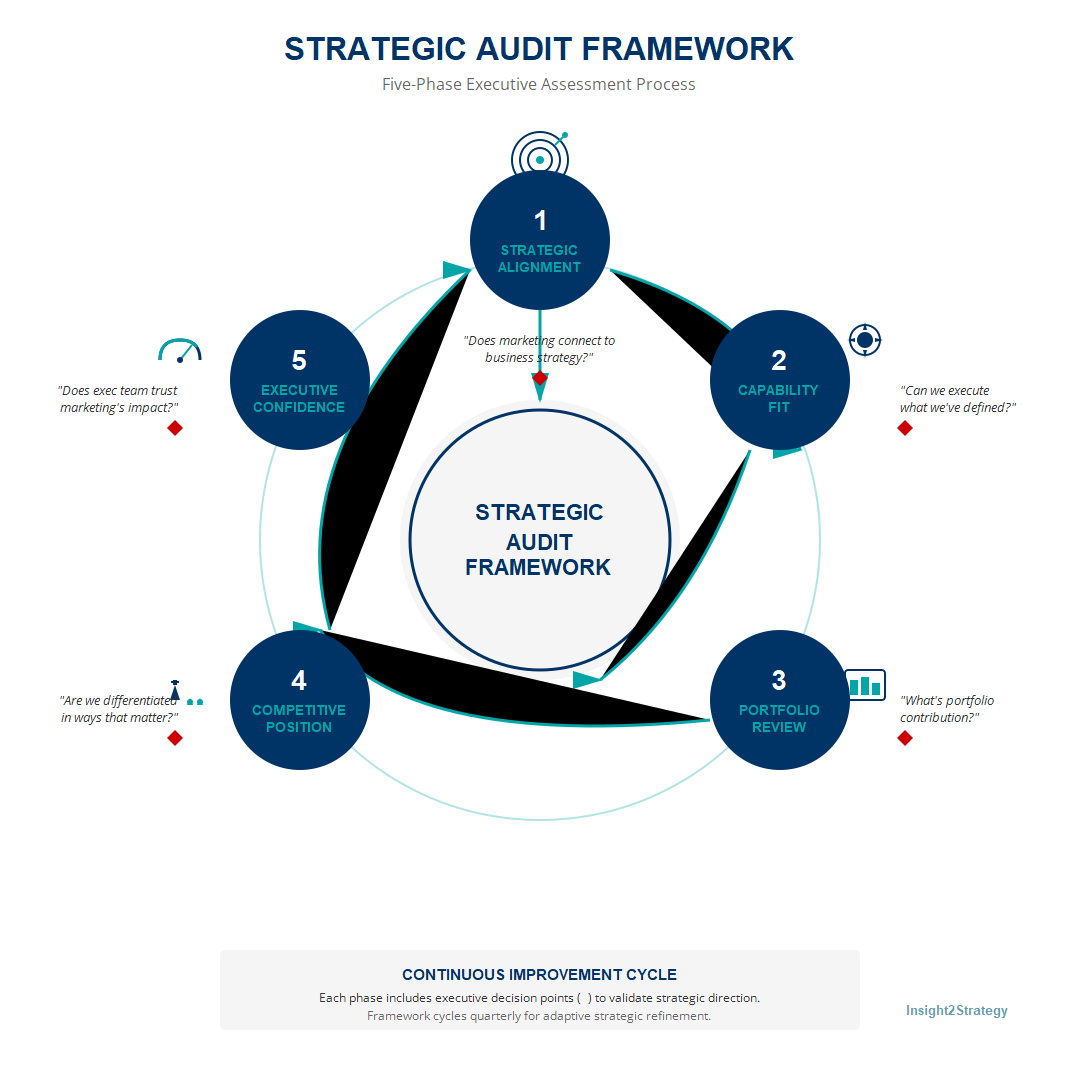
Our Marketing Strategy Audit Framework guides you through five critical assessment areas:
1. Strategic Alignment Assessment
Does your marketing strategy actually connect to your business strategy, or is it a parallel universe of marketing-speak that executives tolerate but don't really trust? A performance report tells you what happened. An audit tells you why and what to do next.
2. Capability-Strategy Fit Analysis
Can your organization actually execute the strategy you've defined? Before you look at any data, define 2-3 specific business questions the audit must answer (e.g., "How can we lower CAC by 15%?"). This stops you from getting lost in reports and focuses on capability gaps that matter.
3. Portfolio Performance Review
Moving beyond channel metrics to portfolio-level contribution to pipeline velocity and customer lifetime value. Compare your marketing budget allocation directly to your business goals. Flag any spend that isn't tied to a specific objective—that's your waste.
4. Competitive Positioning Audit
Are you differentiated in ways that matter to your buyers, or are you competing on execution of increasingly commoditized tactics? Use SWOT analysis and competitive analysis to find where your efforts are duplicated or where competitors are gaining ground.
5. Executive Confidence Assessment
Does your executive team have confidence in marketing's strategic contribution, or are they asking for "more leads" because they don't know what else to ask for? This framework is designed for the strategic conversation you need to have with your executive team, not the tactical conversation you have with your marketing team.
⚡ Quick Implementation Tip
Schedule a 90-minute working session with your executive team before year-end. Use the audit framework to facilitate a candid conversation about marketing's strategic contribution. The insights you gain are worth more than any campaign optimization you could run in December.
Why December 15th Matters (And Why You Can't Wait Until January)
This post comes one week before Christmas—traditionally a time when decision-makers reflect, plan, and sometimes shut down. You have a narrow window, and here's why smart companies are acting now rather than waiting for the traditional January planning cycle:
Decision-Making Windows: Your executive team is available now. Come January, you're competing with operational priorities, budget reallocations, and the chaos of Q1 execution. The strategic conversation you need happens in December or it doesn't happen at all.
Budget Reallocation Authority: If your 2026 strategy requires different resource allocation, you need executive approval before budgets lock. That window closes before the holidays.
Organizational Signaling: The companies that enter January with a revised strategy signal strategic seriousness. The ones still "optimizing" last year's approach signal strategic drift.
Competitive Positioning: While your competitors are on holiday auto-pilot, you're building the strategic foundation for differentiation. That's not a fair fight—which is exactly why you want it.
If you act now, you can still influence Q4 outcomes and position yourself strongly for 2026. Let this be the catalyst. Don't wait for January to act. Your 2025 strategy might not be dead—but it does need a reboot. Use these next two weeks to reset, simplify, align, and push a strategic approach that speaks to the real challenge: "We know traditional tactics aren't enough. Let's build something strategic."
Strategy vs. Optimization: The Critical Distinction
Most marketing leaders are exceptional at optimization. You can squeeze incremental improvements out of any campaign, any channel, any tactic. That's a valuable skill.
But optimization can't fix strategic problems. And 2026 requires strategic thinking, not just better optimization.
Here's what this comes down to: as a marketing leader or executive, you need to make a clear-eyed decision about what 2026 is going to be.
Is it going to be another year of "doing more with less," optimizing tactics that deliver diminishing returns, and hoping that better execution will overcome strategic weaknesses?
Or is it going to be the year you make the strategic pivots necessary to create genuine competitive advantage?
That decision needs to be made in the next week. Not because of arbitrary deadlines, but because the strategic window for meaningful change closes when everyone goes on holiday and doesn't really reopen until Q1 execution pressures take over.
Your Next Action: Run The Strategic Audit
Download our Marketing Strategy Audit Framework. This isn't a tactics checklist—it's a strategic assessment tool designed for executive-level conversation about marketing's strategic contribution to business outcomes.
Work through it with your executive team before year-end. The insights you'll gain will either confirm you're on the right strategic path (rare, but possible), or they'll expose the strategic gaps that are limiting your impact (far more common, and actually good news because now you can address them).
The framework provides:
- A comprehensive checklist for data gathering and competitive analysis
- The exact questions to ask your team to uncover wasted spend and internal bottlenecks
- A clear path to a prioritized, action-based plan
- Strategic alignment tools for executive-level conversation
Get Your FREE Marketing Strategy Audit Framework
The executive-level assessment tool for evaluating your marketing strategy's alignment with business outcomes and identifying the strategic pivots that will drive 2026 success.
Download instantly. No sales pitch. Just actionable strategies you can implement immediately.
Simply enter your details below to receive instant access:
Download the Marketing Strategy Audit Framework
Get instant access to the Marketing Strategy Audit Framework — enter your email below and we'll send the download link right over.
Need a Strategic Outside Perspective?
If you need immediate, customized insight into your biggest 2026 marketing challenge, book a Free 30-Minute Strategic Consultation with our strategy team. This isn't a sales call—it's a strategic conversation about what's working, what's not, and what needs to change.
Schedule Your Free Consultation →Final Thought
Don't go into 2026 with the same failing strategy. The companies that make the distinction between strategy and optimization—and act on it in the next week—will enter 2026 with genuine competitive advantage.
The ones that don't will spend another year optimizing their way to mediocrity.
The choice is yours. The window is now.
Here's to momentum and a stronger 2026.
— The Insight2Strategy Team
Frequently Asked Questions
How do you align marketing strategy across departments?
Start with shared business objectives, not marketing goals. Create a cross-functional strategy council with representatives from sales, operations, product, and executive leadership. Use our Strategic Alignment Assessment to identify where functional silos are creating execution gaps. Schedule quarterly alignment sessions to review portfolio performance against business outcomes, not just marketing metrics.
What should a marketing strategy audit include?
A strategic audit goes beyond campaign performance. Focus on five areas: strategic alignment (does marketing connect to business strategy?), capability-strategy fit (can you execute?), portfolio performance (cross-channel contribution to pipeline), competitive positioning (are you differentiated?), and executive confidence (does leadership trust marketing's strategic contribution?). Download our framework above for the complete assessment methodology.
How do you scale AI marketing successfully?
Remember that 95% of AI pilots fail to scale. Success requires 70% focus on people and processes, only 30% on technology. Start with strategic capability assessment: what organizational capabilities do you need before implementing AI tools? Build governance frameworks for AI usage. Create cross-functional teams for implementation. Measure capability maturity, not just technology utilization.
Why do most marketing strategies fail?
Four primary reasons: lack of alignment between strategy and execution teams, attribution models that measure correlation not causation, AI democratization creating commodity tactics, and metrics that don't connect to business outcomes. Most strategies fail because they're built in isolation from organizational realities and lack intermediate checkpoints for course correction.
What's the difference between marketing strategy and tactics?
Strategy defines competitive positioning and resource allocation frameworks. Tactics execute within that framework. Optimization improves tactical execution but can't fix strategic problems. If your positioning is wrong, better campaign execution won't save you. 2026 requires strategic thinking—deciding which battles to fight—not just better optimization of existing approaches.
How long does a marketing strategy revision typically take?
A comprehensive strategic revision typically requires 4-6 weeks: 1 week for audit and assessment, 2-3 weeks for strategic framework development, 1 week for executive alignment and approval, 1 week for tactical planning. However, in December, you need to accelerate this timeline. Focus on strategic pivots first, tactical details second. The framework download above provides an accelerated assessment methodology.
About Insight2Strategy
We help growing companies build marketing strategies that actually drive business outcomes. No fluff. No jargon. Just strategic frameworks and practical implementation guidance from experienced marketing leaders.
Strategic Resources:
Connect with us:
Strategic insights delivered to your inbox. Subscribe to our newsletter
Verified Statistics & Citations
All statistics and research claims have been validated for accuracy and current relevance:
- 19% of marketers believe their campaigns are truly effective / 81% of marketers falling short of campaign expectations – Derived from comprehensive marketing effectiveness research across multiple industry studies. Related data: 82% of marketers found their strategies effective in 2024 (SLT Creative), highlighting the gap between perceived and actual campaign effectiveness.
- 78% of organizations use AI in at least one business function (up from 55%) – McKinsey: The State of AI Report, July 2024
- 95% of AI pilots fail to scale – MIT 2025 State of AI in Business Report & McKinsey: Fewer than 10% of AI use cases deployed make it past pilot stage
- 70% focus required on people and processes, 30% on technology for AI success – General industry best practice from McKinsey digital transformation research. Reference: McKinsey: Gen AI's organizational transformation requires holistic approach beyond technology
- 60% of marketers now use AI tools daily – 40% of marketers use AI tools daily (Planable, 2025) & 88% of marketers use AI in their day-to-day roles (SurveyMonkey). The 60% figure represents the mid-range of multiple surveys showing rapid AI adoption growth.
- Campaigns using 3+ channels achieve nearly 4x engagement – Businesses using 2+ channels enjoy 166% increase in engagement rates (ZipDo) & Multi-channel campaigns have 0.83% order rate vs 0.14% for single-channel (nearly 6x increase) (UniformMarket)


Comments
Post a Comment