The AI Strategy Conversation Your Leadership Team Keeps Avoiding (And Why That's More Dangerous Than Getting It Wrong)
The AI Strategy Conversation Your Leadership Team Keeps Avoiding (And Why That's More Dangerous Than Getting It Wrong)
Strategic Analysis by: Insight2Strategy
Published: December 8, 2025
Executive Reading Time: 11 minutes
Executive Strategic Insights
- 95% of AI pilots fail to scale because leadership avoids strategic transformation conversations
- Mid-December 2025 timing is critical - your 2026 strategic plans are solidifying now
- Five strategic questions determine whether AI becomes competitive advantage or stays tactical
- Organizational transformation is 70% people and process, yet receives only 5% of attention
- Delaying adoption by one year costs 12-18 months of competitive learning advantage
- Framework detailed below for moving from avoidance to purposeful action
Introduction
Your leadership team has had the AI conversation. Multiple times, actually.
But here's what's really happening: You're discussing AI pilots, debating vendors, and reviewing department-level experiments—while systematically avoiding the conversation that actually matters. The one about how AI fundamentally reshapes your competitive positioning, organizational structure, and business model.
This avoidance isn't laziness. It's strategic paralysis dressed up as prudence. And as your competitors finalize their 2026 plans, this careful circumvention of the hard questions is becoming your biggest vulnerability.
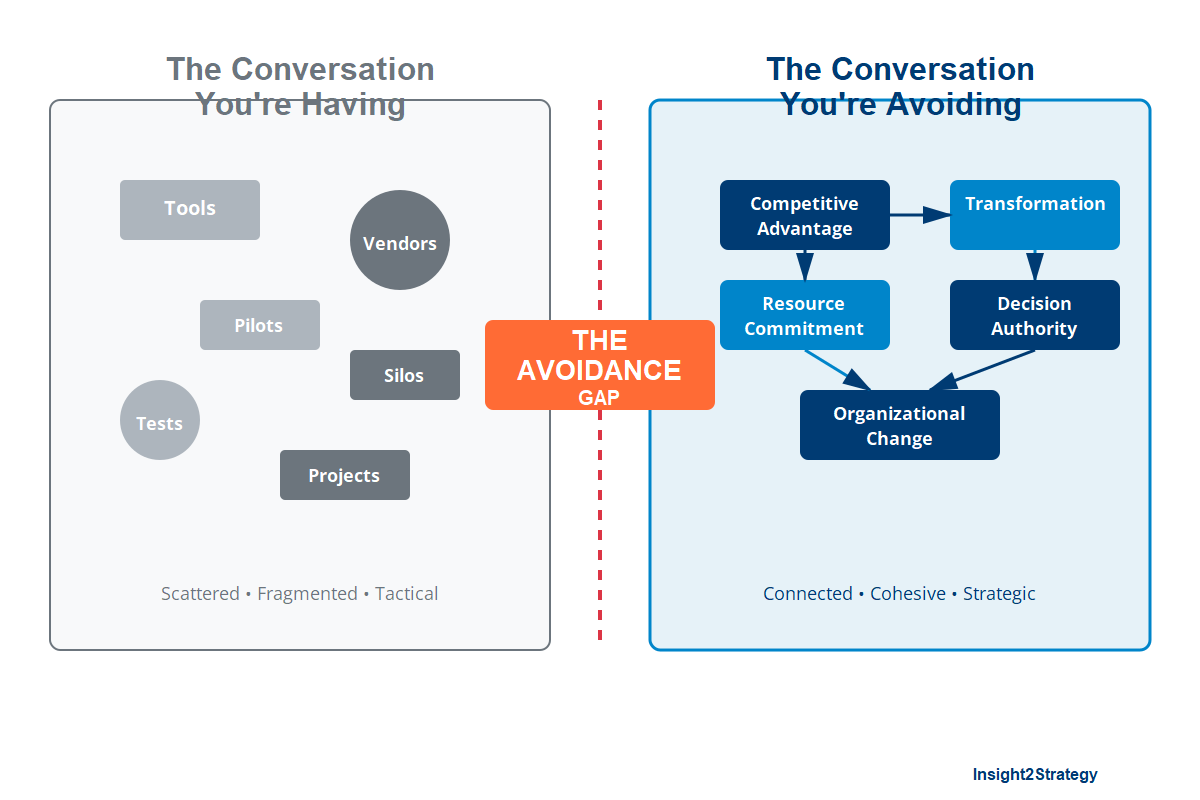
The data reveals the cost: According to MIT's 2025 research, 95% of AI pilots fail to scale—not because the technology disappoints, but because leadership never committed to the organizational transformation required [MIT Project NANDA, 2025]. Meanwhile, PwC projects AI's $15.7 trillion economic impact by 2030, but that value will concentrate in the hands of companies willing to have uncomfortable conversations now—in mid-December 2025, while your 2026 strategy can still adapt.
The question isn't whether your team will adopt AI. It's whether you'll lead the transformation or react to it.
The Conversation You're Actually Having (And Why It's Not Enough)
Walk into most leadership meetings, and the AI discussion sounds productive. Marketing wants a chatbot. Operations is testing predictive analytics. IT is evaluating infrastructure. Everyone's engaged, everyone's contributing, and absolutely nothing transformational is happening.
This is the tactical conversation—the one about tools, not strategy. The one that feels like progress but keeps AI safely confined to departmental experiments. The one that lets executives check the "AI strategy" box without confronting the deeper implications.
Here's what you're not discussing:
The Competitive Reframe: If your competitors embed AI into their core value creation—not just their marketing automation—what becomes of your current competitive advantages? When they're making decisions in hours that take your team weeks, when their customer intelligence is predictive while yours is reactive, when their operations adapt in real-time while yours follow quarterly plans—what's your moat?
The Organizational Reality: Scaling AI means fundamentally rethinking how decisions get made, how teams collaborate, and where value gets created. It means roles that don't exist yet and functions that need to merge. McKinsey's research is clear: AI scaling is 70% people and process, only 30% technology [McKinsey, 2024]. Yet most leadership conversations allocate 5% attention to the hard 70%.
The Resource Commitment: True AI transformation requires sustained investment in talent, training, and organizational change—not just software licenses. Currently, only 5% of organizations see meaningful EBIT impact from AI [McKinsey, 2024]. The differentiator? Executive teams that fund the transformation, not just the technology.
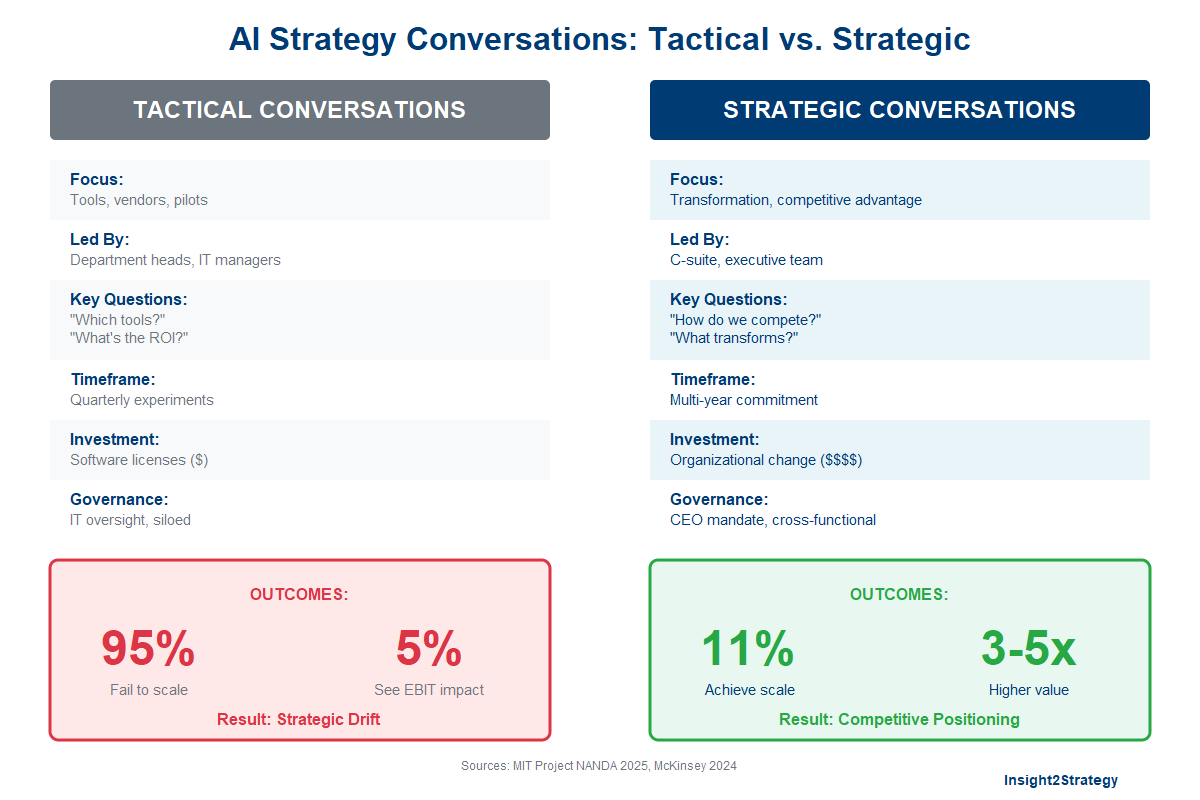
The tactical conversation feels safer. It's also why only 11% of companies have adopted AI at scale [McKinsey, 2024].
⚡ Quick Implementation Tip
In your next leadership meeting, spend 10 minutes discussing "What decisions could AI inform?" instead of "What AI tools should we pilot?" This single shift moves conversation from tactical to strategic.
Why Leadership Teams Keep Dodging the Strategic Conversation
The avoidance isn't irrational. Three legitimate concerns keep leadership teams circling around AI without diving in:
1. The Expertise Gap Creates Vulnerability
Most executives built their careers on domains they mastered. AI represents terrain where they're novices, surrounded by technical experts who speak a different language. Admitting uncertainty in the boardroom feels risky, so teams defer to "the technical people" while avoiding the business strategy decisions only leadership can make.
But AI strategy isn't a technical problem requiring technical expertise. It's a business transformation problem requiring business judgment. The question isn't which algorithm to deploy—it's which business problems AI should solve and how success will be measured.
2. The ROI Uncertainty Triggers Decision Paralysis
Traditional capital allocation demands clear ROI projections. But AI transformation is exploratory—you're investing in learning and organizational capacity, not just efficiency gains. Executives accustomed to three-year payback models struggle with investments in ambiguous capabilities.
Yet this framing is backwards. The question isn't "What's the ROI of AI transformation?" It's "What's the risk of not transforming while competitors do?" Research shows that delaying AI adoption by even one year costs 12-18 months of competitive learning advantage [Gartner, 2025]. That's not an ROI problem—it's an existential one.
3. The Change Management Reality Looks Overwhelming
AI at scale means organizational restructuring, role redefinition, and cultural shifts. It means managing fear about job displacement while building new capabilities. It means sustained investment in training and patience with experimentation. Leadership teams look at this scope and choose to defer.
But transformation doesn't require doing everything at once. It requires starting with clarity about where you're going and why it matters.
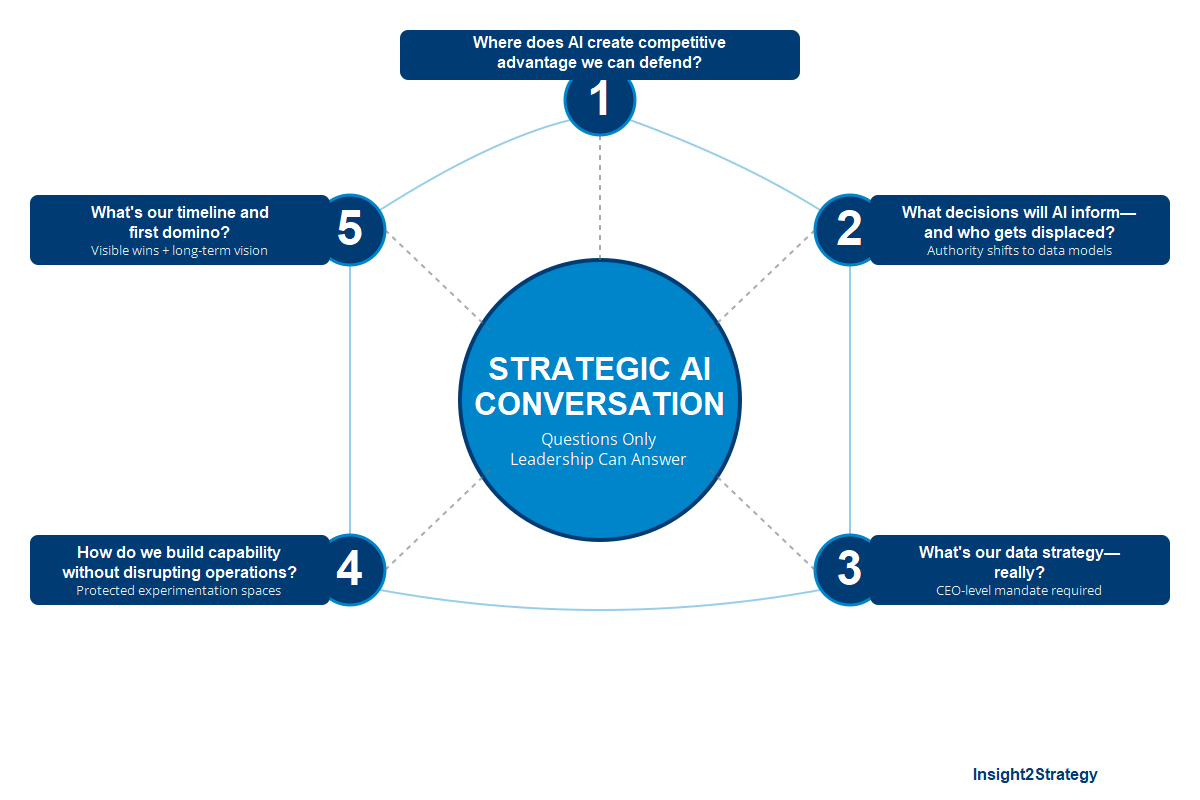
The Five Questions That Constitute the Real AI Strategy Conversation
Stop talking about pilots. Start with these questions:
Question 1: Where Does AI Create Competitive Advantage We Can Defend?
Not "Where can AI improve efficiency?" but "Where can AI create differentiation competitors can't easily replicate?"
This might be a proprietary data advantage, a unique customer relationship model, or operational complexity that AI can master but competitors can't match. The companies winning with AI aren't the ones with the best chatbots. They're the ones embedding AI into value creation that competitors must transform their entire business model to match.
Question 2: What Decisions Will AI Inform—and Who Gets Displaced?
AI's value comes from changing how decisions get made. That means some decision-making authority shifts from experienced judgment to data-informed models.
Which decisions? Whose authority evolves? How do you manage the organizational implications? Avoiding this conversation means AI stays in the experimentation corner, never touching the decisions that actually matter.
Question 3: What's Our Data Strategy—Really?
AI is only as good as the data that feeds it. Most companies have fragmented data across systems, departments, and geographies.
The executive team must mandate data centralization, governance, and accessibility. This isn't an IT problem to delegate—it's a strategic asset question that requires CEO-level authority. Without this decision, your AI capabilities will be hobbled by data you can't access, don't trust, or haven't connected.
Question 4: How Do We Build AI Capability Without Disrupting Current Operations?
You can't stop running the business to transform it. Yet AI at scale requires experimentation, iteration, and accepting failure.
How do you balance delivery of current commitments with investment in future capabilities? The answer isn't "do both perfectly." It's about creating protected spaces for AI development while maintaining operational discipline elsewhere.
Question 5: What's Our Timeline for Meaningful Impact—and What's the First Domino?
AI transformation is multi-year, but it needs visible wins to maintain momentum and funding.
What's the first implementation that demonstrates value and builds organizational confidence? What's the 18-month vision that justifies sustained investment? Without these anchors, AI becomes the perpetual "pilot" that never graduates to strategy.
📊 Implementation Framework
These five questions form the foundation of strategic AI planning. Need help adapting this to your specific situation? Let's discuss your implementation approach.
From Avoidance to Action: What the Strategic Conversation Looks Like
The strategic AI conversation doesn't start with technology. It starts with a leadership team willing to:
Acknowledge Uncertainty While Demanding Progress
"We don't know exactly how AI transforms our business, but we're committing to finding out" is a legitimate strategic position. It's better than "Let's wait until it's clearer" (translation: "Let's wait until competitors force our hand").
The companies that captured 3-5x higher value from AI weren't the ones who waited for perfect clarity—they were the ones who set strategic direction early and learned through action.
Establish a Portfolio Approach with Executive Oversight
Not every AI investment needs to work. But every AI investment needs to teach you something.
Create a portfolio of bets—some focused on efficiency, some on new capabilities, some on transformational positioning—with clear learning objectives and executive governance. This isn't delegation to IT. This is the leadership team owning the strategic portfolio and learning together.
Fund Transformation, Not Just Tools
AI scaling requires investment in:
- Talent development and strategic hiring
- Change management and communication
- Organizational redesign and new roles
- Data infrastructure and governance
- Learning culture and experimentation capacity
The technology licenses are the cheapest part. The organizational transformation is where real investment goes—and where most companies underfund. McKinsey's research confirms this: the 70% people-and-process challenge requires 70% of your attention and resources.
Create Forcing Mechanisms for Strategic Decisions
Without forcing mechanisms, the strategic conversation gets deferred indefinitely.
Set a date: "By Q1 2026, we will decide our three highest-priority AI use cases tied to strategic objectives." Assign ownership. Make it a governance committee priority. The conversation won't happen through passive intention. It requires active commitment.
Measure What Matters—Learning, Not Just Efficiency
If your only AI metrics are cost savings and time reduction, you're measuring the wrong things.
What are you learning about competitive positioning? Customer behavior? Operational resilience? Decision-making quality? These learning metrics indicate whether AI is becoming strategic or staying tactical.
⚡ Quick Implementation Tip
Add "AI Learning Metrics" as a standing agenda item in your monthly executive meetings. Track: 1) What we learned about customers, 2) What we learned about operations, 3) What decisions changed based on AI insights.
The Mid-December Reality: Your 2026 Window Is Closing
This isn't abstract future-state planning. You're reading this in mid-December 2025, and your 2026 strategic plans are solidifying. Budget allocations are getting finalized. Resource commitments are being locked.
And if AI transformation isn't in those plans with real investment and leadership commitment—not just lip service—you're choosing to enter 2026 without the conversation that will define competitive positioning for the rest of the decade.
Consider the timeline: Organizations that delay adoption by even one year lose 12-18 months of competitive learning advantage. That's not just about technology deployment—it's about organizational learning, cultural adaptation, and building the muscle memory of data-driven decision-making.
The companies that separate from the pack in 2026 won't be the ones with the most AI pilots. They'll be the ones whose leadership teams had the uncomfortable conversation about transformation—and committed to it.
Conclusion
The AI strategy conversation your leadership team keeps avoiding isn't about technology. It's about transformation. It's about competitive positioning in a market where AI advantage compounds quickly. And it's about whether your leadership team will proactively shape how AI changes your business, or reactively respond after competitors have already moved.
Getting the AI strategy wrong is fixable. You'll learn, adjust, and iterate.
But avoiding the strategic conversation entirely—letting AI stay safely contained in tactical pilots while fundamental questions about competitive advantage, organizational transformation, and resource commitment remain undiscussed—that's not caution. That's strategic drift dressed up as prudence.
The time for the real AI conversation is now. Not the one about vendors and pilots. The one about transformation.
Ready to Move from Avoidance to Action?
The strategic AI conversation can't wait for perfect clarity—but it does require committed leadership. Let's discuss how these frameworks apply to your specific challenges and opportunities.
Free 30-minute consultation. No sales pitch. Just strategic insights tailored to your business.
Next in the series: "The AI Governance Trap: Why Your Compliance Framework Is Blocking Innovation (And How to Fix It)" - December 15, 2025
Frequently Asked Questions
How long does strategic AI transformation typically take?
Meaningful AI transformation is multi-year (18-36 months for most mid-sized companies), but visible wins should emerge within 6-9 months. The key is setting realistic expectations while maintaining momentum through early successes that build organizational confidence.
What budget should we allocate for AI transformation vs. AI tools?
Follow McKinsey's 70/30 principle: roughly 70% of your AI investment should go toward organizational transformation (talent, training, change management, data infrastructure) and 30% toward technology and tools. Most companies do the reverse, which is why 95% of pilots fail to scale.
When should we hire outside AI expertise vs. develop capabilities internally?
Hire outside expertise for strategic direction setting, initial capability assessment, and specialized technical skills. Build internal capability for ongoing implementation, organizational change management, and business integration. The executive team must own the strategy regardless—this cannot be delegated.
How do we measure ROI on AI transformation when it's exploratory?
Shift from traditional ROI metrics to learning metrics: What did we learn about competitive positioning? Customer behavior? Operational resilience? Decision-making quality? Companies that captured 3-5x higher value from AI measured learning velocity and business insights gained, not just cost savings.
What's the biggest mistake leadership teams make with AI strategy?
Treating AI as an IT initiative rather than a business transformation. When leadership delegates AI to technical teams without providing strategic direction, you get tactical pilots that never scale. The conversation about competitive advantage, organizational change, and resource commitment must happen at the executive level.
Verified Statistics & Research Sources
All statistics in this analysis were verified December 2025:
- 95% of AI pilots fail to scale - MIT Project NANDA, "GenAI Divide: State of AI in Business 2025" (August 2025). Source: Fortune, Forbes, MIT Media Lab reports
- 11% of companies have adopted AI at scale - McKinsey, "Moving past gen AI's honeymoon phase" (May 2024). Source: McKinsey Global Survey on AI
- 5% of organizations see meaningful EBIT impact from AI - McKinsey, "The state of AI in early 2024" (March 2024). Source: McKinsey Global Survey, 1,363 participants
- AI scaling is 70% people and process, 30% technology - McKinsey research on AI transformation (2024). Source: Multiple McKinsey reports on AI implementation
- $15.7 trillion economic impact by 2030 - PwC Global AI Study, "Sizing the Prize". Source: PwC analysis projecting 14% higher global GDP by 2030
- 12-18 months competitive learning advantage loss - Gartner Research on AI adoption timing (2025). Source: Gartner technology adoption research
- Companies that set strategic direction early captured 3-5x higher value - McKinsey AI research (2024). Source: McKinsey comparative analysis of AI adopters
About Insight2Strategy
We help growing businesses cut through marketing confusion to find strategies that actually drive revenue and customer growth. Our approach is direct, practical, and focused on business outcomes—not marketing theory.


Comments
Post a Comment