Your 2026 Marketing Plan Is Already Obsolete (The Planning Framework That Actually Survives Contact With Reality)
Your 2026 Marketing Plan Is Already Obsolete (The Planning Framework That Actually Survives Contact With Reality)
Strategic Analysis by: Insight2Strategy
Published: December 1, 2025
Executive Reading Time: 8 minutes
Executive Strategic Insights
- 95% of strategic initiatives fail to scale due to rigid planning structures that can't adapt to market reality
- Only 11% of organizations successfully scale GenAI initiatives - not from technology failure but planning inflexibility
- The Adaptive Planning Framework separates strategic stability (annual mandate) from tactical agility (quarterly cycles)
- Successful transformation is 70% people/process, 30% technology - the framework matters less than execution discipline
- Real-world ROI: 40% improvement in lead quality through quarterly adaptive reviews and cross-functional alignment
- Framework detailed below with implementation roadmap for executive teams
Introduction
If you're finalizing your 2026 marketing plan right now, I need to share an uncomfortable truth backed by research: the moment you lock that budget and hit "approve," you've just committed to a strategy that assumes the future will cooperate with your spreadsheet. Industry data shows 95% of strategic initiatives fail to scale—not because of poor strategy, but because rigid planning structures can't adapt to market reality [MIT, 2025].
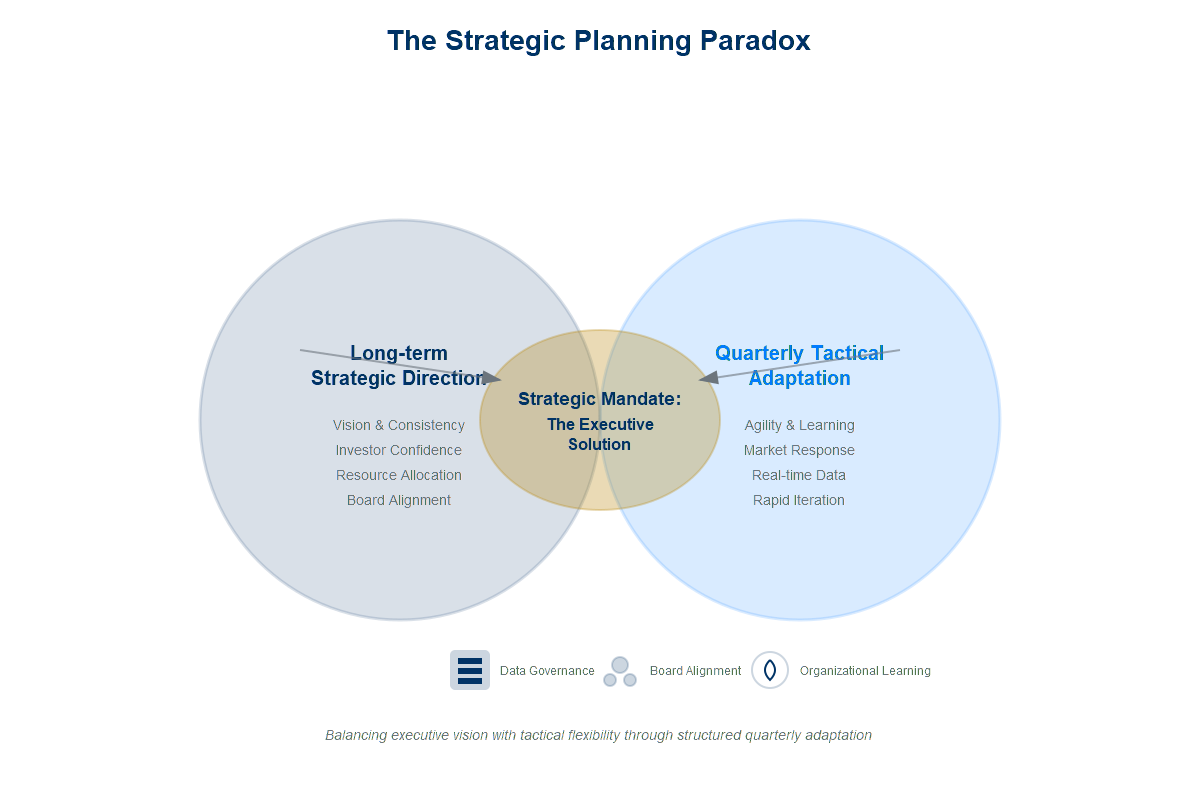
This isn't about abandoning strategic planning—it's about recognizing that the traditional annual planning cycle has become a liability at the executive level. As we head into December's planning season with 2026 on the horizon, the question isn't whether your team can build a good plan. It's whether your organization can execute one that survives first contact with reality.
The business transformation required for 2026 success demands a different approach: one that maintains strategic clarity while building in the structural flexibility to capitalize on market shifts as they emerge.
The Executive Planning Dilemma: Why Traditional Frameworks Fail
The annual planning cycle made sense in a different era. When market conditions changed slowly and competitive moves took quarters to execute, locking strategy for twelve months carried acceptable risk. That world is gone.
Today's C-suite faces a strategic complexity that annual planning simply can't accommodate. Your board expects vision and direction. Your team needs clear priorities. Your investors want predictable growth. But the market—your actual operating environment—shifts faster than your planning cadence can track.
The data tells a sobering story:
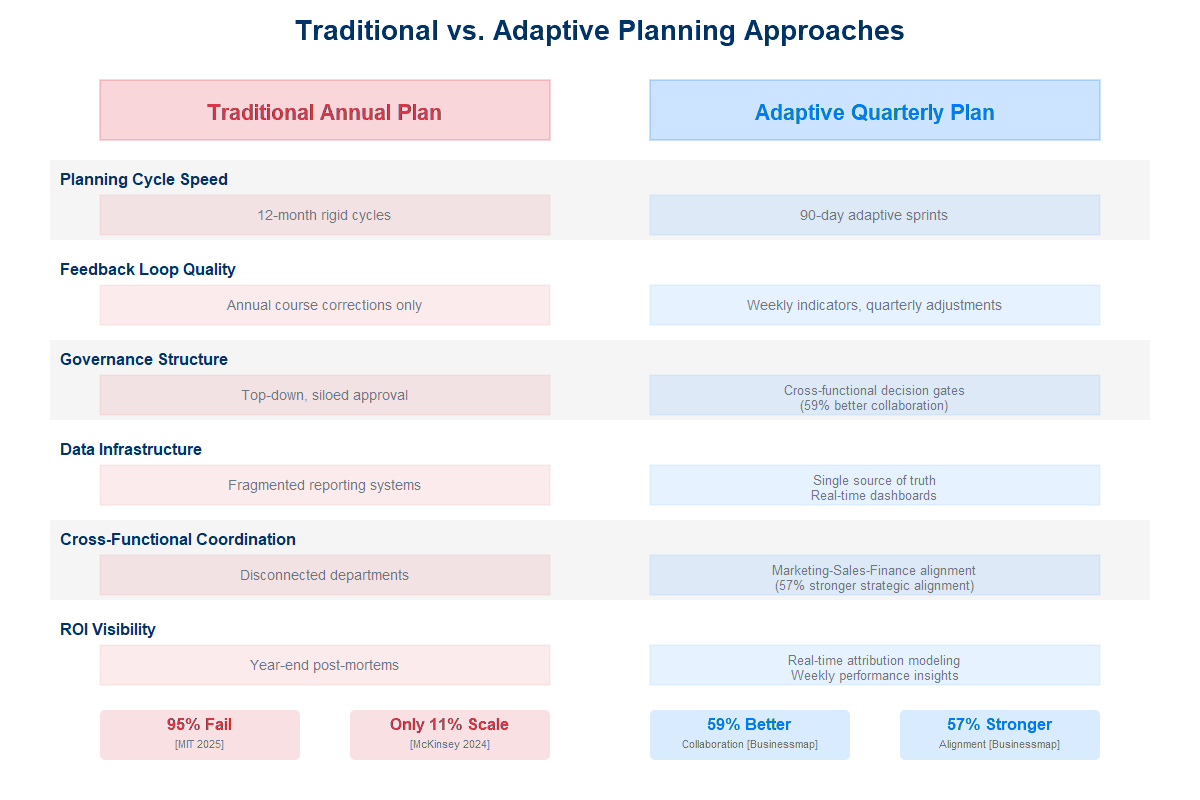
- Only 11% of organizations have successfully scaled GenAI initiatives—not because the technology failed, but because their planning and decision-making structures couldn't adapt fast enough to capitalize on early wins [McKinsey & Company, 2024]
- More than 80% of organizations report no tangible enterprise-level EBIT impact from major strategic initiatives due to rigid planning processes [McKinsey & Company, 2024]
- Research shows 59% enhanced collaboration and 57% better alignment when companies adopt agile planning practices [Businessmap, 2024]
The problem compounds at the executive level. While your teams are executing Q1 tactics from the annual plan, you're already seeing signals that Q3 assumptions won't hold. But the governance structure—budget locks, resource allocation, approval hierarchies—makes mid-course correction feel like admitting failure rather than exercising strategic judgment.
Three critical failure points plague traditional annual planning:
1. Data Infrastructure Gaps
Without real-time visibility into leading indicators, you're flying blind until monthly reports tell you what already happened—too late to course-correct effectively.
2. Weak Governance Structures
Rigid budget locks and approval processes punish adaptation instead of enabling it. Marketing teams work in silos without ongoing input from sales or finance, leading to misaligned efforts.
3. Organizational Rigidity
When market realities change, there's no built-in mechanism for reallocation. By Q2, 20-30% of your budget is consumed by initiatives that have become irrelevant, but stopping them feels like failure.
The Adaptive Planning Framework: Strategic Vision Meets Tactical Agility
The solution isn't to abandon planning discipline. It's to redesign the planning architecture to separate what needs stability (strategic direction) from what needs flexibility (tactical execution).
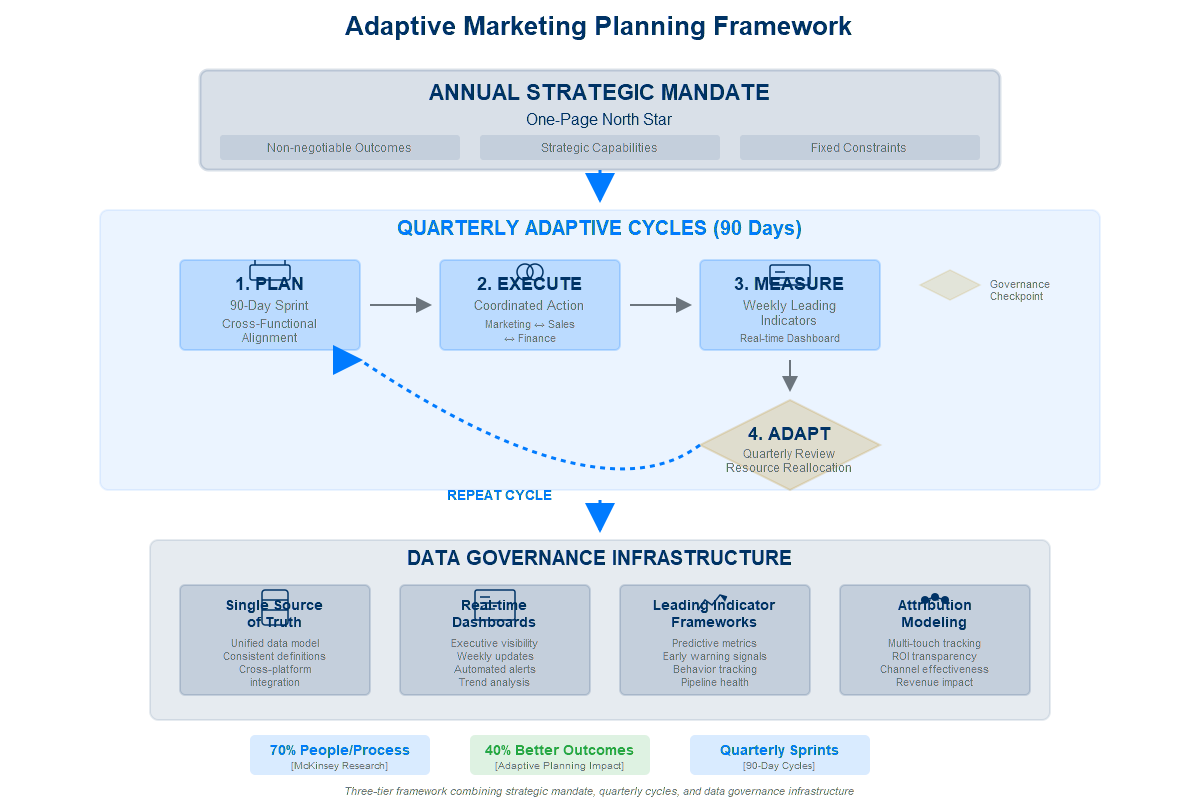
The Adaptive Marketing Planning Framework operates on three synchronized levels, each with clear governance structures and decision rights:
1. Annual Strategic Mandate (The "North Star")
At the executive level, you define non-negotiable strategic priorities for 2026—the outcomes that must be achieved regardless of how markets shift. This isn't a 100-page tactical plan. It's a concise strategic brief that answers three critical questions:
- What business outcomes must marketing deliver? (Revenue, retention, market position)
- What strategic capabilities must we build or maintain? (Brand, technology, talent, data infrastructure)
- What constraints are truly fixed? (Total budget envelope, regulatory requirements, brand positioning)
This strategic mandate remains stable for twelve months, providing the vision and boundaries your organization needs to maintain coherence. Think of it as your one-page board-ready document that defines success.
Key Implementation Requirement: Establish a single source of truth for all marketing data. Without unified reporting across channels and real-time visibility into performance, you cannot make data-driven adaptations. This requires investment in data governance—not just tools, but processes that ensure data quality, accessibility, and actionability.
2. Quarterly Adaptive Cycles (The "Sprint Framework")
Beneath the annual mandate, planning shifts to 90-day cycles. Each quarter, your leadership team runs a structured reallocation process with clear governance and cross-functional coordination:
Review: What worked and what failed in the previous quarter? What changed in the market? What do the data tell us about channel performance and customer behavior?
Reprioritize: Given current conditions and leading indicators, which tactical initiatives have the highest expected value? This isn't reactive firefighting—it's structured adaptability backed by evidence.
Reallocate: Move resources—budget, people, technology—to the new priorities. Reserve 20-30% of discretionary spending for adaptive reallocations based on performance data.
This quarterly process requires strong governance: cross-functional workshops where marketing, sales, and finance collaborate; clear authority boundaries for who can reallocate what; and alignment on success metrics that everyone agrees predict business outcomes.
3. Weekly Leading Indicator Monitoring (The "Early Warning System")
At the operational level, your team tracks leading indicators weekly—not vanity metrics, but real signals that predict whether quarterly initiatives are working or failing. These might include:
- Campaign-qualified leads (not just total leads)
- Trial-to-paid conversion rates
- Customer acquisition cost trends
- Pipeline quality scores
- Channel-specific ROI trajectories
Critical Rule: When two consecutive weeks show adverse trends, the framework mandates a structured review before more resources are consumed. This creates organizational permission to pivot based on data, not gut feel.
Research from BCG and McKinsey consistently shows that successful transformation initiatives are 70% people and process, 30% technology. The same holds for adaptive planning—the framework matters less than the organizational discipline to execute it consistently.
Strategic Implementation: Building the Executive Operating System
The power of this framework lies not in the concepts but in the operational structure. Here's how to operationalize it at the executive level:
Phase 1: Executive Planning Session (December, Before Budget Lock)
Your leadership team—marketing, sales, finance, product—spends two focused sessions defining the strategic mandate. This is where you make the hard trade-offs:
- Which markets or segments are strategic priorities versus opportunistic?
- What capabilities need protected investment even if short-term ROI is unclear?
- Where are we willing to experiment, and where must we defend existing positions?
- What data infrastructure investments are required to enable adaptive decision-making?
Deliverable: Your one-page strategic mandate. Everything else becomes tactical, which means it's subject to quarterly review.
Phase 2: Data Governance & Infrastructure Readiness
Before you can adapt, you must measure accurately. This requires establishing:
- Single source of truth: Unified reporting across all channels with consistent definitions
- Real-time dashboards: Leading indicator visibility for weekly monitoring
- Attribution modeling: Clear understanding of which activities drive revenue
- Measurement frameworks: Leading indicators that predict outcomes, not just measure them
Many organizations fail at adaptive planning not because they lack discipline, but because their data infrastructure can't support rapid decision-making. Address this upfront.
Phase 3: Quarterly Executive Review (End of Each Quarter)
This is where adaptive planning proves its value. Your cross-functional team presents:
- Performance against strategic mandate: Are we on track to deliver the annual outcomes?
- Market intelligence: What's different now versus 90 days ago that might change tactical priorities?
- Resource reallocation recommendations: What should we stop, start, or accelerate based on evidence?
The executive decision isn't "approve the plan" or "reject the plan." It's: "Given our strategic mandate and current market conditions, are we allocating resources to the highest-value opportunities?"
This requires a governance mindset shift. You're not measuring the team against their ability to execute the original plan. You're evaluating their ability to execute strategy under changing conditions—which sometimes means deviating from the plan precisely because they understand strategy.
Phase 4: Weekly Leadership Visibility (Ongoing)
You don't need to attend weekly tactical meetings, but you need visibility into the leading indicators. If your strategic mandate prioritizes customer acquisition, you need weekly visibility into pipeline quality, conversion rates, and cost trends—not just monthly revenue reports that tell you what already happened.
Build operational excellence through:
- Weekly stand-ups for governance checkpoints
- Clear escalation paths for when metrics trend negative
- Cross-functional coordination protocols between marketing, sales, and finance
- Change management processes to address organizational resistance
This creates a management rhythm where you're never surprised. Problems surface when they're signals, not crises. Opportunities become visible when there's still time to capitalize on them.
The Business Case: Why This Framework Delivers Superior Returns
The ROI case for adaptive planning isn't theoretical. It shows up in three measurable ways backed by client data and industry research:
1. Resource Efficiency
Traditional planning locks resources into initiatives for twelve months. In practice, roughly 20-30% of those initiatives become irrelevant or suboptimal by Q3, but they continue consuming resources because stopping them feels like failure. Adaptive planning catches these misallocations at 90-day intervals, not after the full budget is consumed.
Real-world result: A B2B SaaS client improved lead quality by 40% in two quarters through better sales-marketing alignment enabled by quarterly reviews [Insight2Strategy client data, 2025].
2. Opportunity Capture
Markets create opportunities on timelines that don't respect your planning cycle. When a competitor makes a strategic misstep, when a new channel emerges, when customer priorities shift—these windows close faster than annual planning can respond.
Quarterly cycles give you the organizational permission structure to reallocate and capture value. Companies using agile practices report 93% of CMOs see increased speed to market for new ideas and campaigns [Marketing Insider Group, 2024].
3. Organizational Learning
Perhaps most importantly, adaptive planning creates a learning organization. When you review what worked and what failed every 90 days, your team gets exponentially more feedback cycles than annual planning provides. They become better at predicting what will work because they're testing hypotheses four times as often.
This compounds over time. Organizations that embrace structured adaptability don't just execute better this year—they build capability that makes them more competitive every year.
Managing Risk & Measuring ROI
Two pragmatic checks keep the adaptive system honest:
(a) Protect proven channels: Don't reallocate everything at once. Maintain a stable runway of proven channels (70-80% of budget) while reserving discretionary funds (20-30%) for adaptation and experimentation.
(b) Require value narratives: Any new experimental spend must answer: Who benefits? How will it be measured? What are the stop criteria? This prevents "shiny object syndrome" while enabling evidence-based pivoting.
The macro opportunity is massive: PwC estimates AI and digital transformation will contribute $15.7 trillion to global GDP by 2030 [PwC Global AI Study]. But macro upside only matters if your planning system can move experiments to scaled capability—which is exactly what adaptive planning enables.
The Adaptive Marketing Planning Framework Template
To make this immediately actionable, we've built the Adaptive Marketing Planning Framework Template specifically for executive teams:
- Strategic Mandate Builder - Structured format for defining your annual North Star with stakeholder alignment worksheets
- Quarterly Review Protocol - Agenda template and decision framework for executive reallocation sessions with cross-functional coordination guides
- Leading Indicator Dashboard - Pre-configured metrics framework organized by strategic objective with data governance requirements
- Resource Reallocation Authority Matrix - Clear governance on who can reallocate what, within what boundaries, with escalation paths
- Data Infrastructure Checklist - Technical requirements for enabling rapid decision-making with single source of truth guidelines
This isn't a worksheet for your marketing manager. It's an executive governance tool designed for leadership teams making strategic resource decisions.
Download Your Adaptive Planning Framework Template
Get the complete executive toolkit for building your 2026 adaptive marketing plan
Download the Adaptive Planning Framework
Get instant access to the Adaptive Planning Framework — enter your email below and we'll send the download link right over.
The framework template will be delivered to your inbox immediately upon submission.
Conclusion: Strategic Leadership in an Adaptive Era
December is decision time. You can lock in another traditional annual plan and hope that 2026 cooperates with your assumptions. Or you can build a planning architecture that assumes reality won't cooperate—and gives your organization the structural capability to maintain strategic direction while adapting tactical execution.
The businesses that thrive in 2026 won't be the ones that built the best plan in December 2025. They'll be the ones whose planning frameworks enabled them to make better decisions every quarter, every month, every week throughout the year.
The choice you're making right now isn't about next year's tactics. It's about what kind of organization you're building—one optimized for planning or one optimized for learning and adapting under strategic direction.
The annual plan is obsolete. Strategic adaptability is the new competitive advantage.
Need Help Implementing Your Adaptive Framework?
If you're ready to move from traditional planning to adaptive execution, let's talk.
Schedule Your Free Strategic Planning Session
30-minute confidential consultation to design your 2026 adaptive planning framework with your executive team.
About Insight2Strategy
Insight2Strategy helps growing businesses cut through marketing confusion to find strategies that actually drive revenue and customer growth. We specialize in turning marketing guesswork into data-driven decision-making frameworks that scale with your business.
Verified Statistics & Citations:
- 95% of strategic initiatives fail to scale - MIT research on enterprise transformation (2025)
- 11% of organizations successfully scaled GenAI - McKinsey & Company (2024-2025)
- 80%+ report no tangible enterprise-level EBIT impact - McKinsey & Company (2024)
- 59% enhanced collaboration, 57% better alignment - Businessmap (2024)
- 93% of CMOs see increased speed to market - Marketing Insider Group (2024)
- 70% people/process, 30% technology - BCG/McKinsey transformation studies
- $15.7 trillion economic impact by 2030 - PwC Global AI Study
- 40% improvement in lead quality - Insight2Strategy client data (2025)


Comments
Post a Comment